In the thrilling, high-stakes world of Formula 1, where milliseconds define victory and defeat, every single component of a race car is meticulously designed and constantly refined. While the roaring engines and sleek chassis often grab the headlines, the true genius of F1 engineering frequently lies in the subtle intricacies – elements that appear minor but yield significant aerodynamic advantages. Among these seemingly humble components, the wing mirror has emerged as an unexpected battleground for innovation, a testament to the relentless pursuit of performance in modern motorsport.
The Unsung Heroes of Aero: F1 Wing Mirrors and Aerodynamic Innovation
For decades, Formula 1 wing mirrors served a singular, mandatory purpose: to provide drivers with crucial rearward visibility. Yet, in an environment where even the smallest surface can drastically influence airflow, these essential safety devices present a formidable challenge to aerodynamicists. A bluff, non-aerodynamic shape, by its very nature, creates disruptive turbulence, sabotaging the carefully orchestrated airflow over the car’s bodywork. However, recent regulatory shifts and the sheer ingenuity of F1 teams have transformed these once-problematic necessities into sophisticated aerodynamic tools, expertly integrated into the car’s overall performance package.
Advert | Become a Supporter & go ad-free
The Aerodynamic Paradox: Mirrors as Obstacles and Opportunities
At first glance, a wing mirror appears straightforward. Its primary function is to offer the driver an unobstructed view of what’s happening behind them, a critical safety requirement. From an aerodynamicist’s perspective, however, the mirror housing is inherently an anomaly. Its typical rounded or squared-off shape acts as a bluff body, creating significant drag and, more detrimentally, generating a turbulent wake. This chaotic airflow can disrupt the smooth, laminar flow over critical downstream components, such as the sidepods and rear wing, severely hindering their efficiency in generating downforce and managing drag.
The positioning of the mirror housing thus becomes paramount. Historically, teams experimented with mounting mirrors higher and wider to mitigate this unwanted turbulence, pushing them into less sensitive airflow regions. While this offered some aerodynamic benefits, it often came at the cost of compromising the driver’s rear vision – an unacceptable trade-off that led to subsequent rule clarifications. The challenge for designers has always been to strike a delicate balance: ensuring optimal driver visibility while minimizing the aerodynamic penalty and, ideally, turning a disadvantage into an advantage. This ongoing tension between functional necessity and aerodynamic optimization perfectly encapsulates the relentless innovation that defines Formula 1 design.
Evolving Regulations: A Catalyst for Creative Aerodynamics
The constant interplay between regulatory bodies and engineering innovation is a defining characteristic of Formula 1. Each season brings new rule interpretations or explicit changes, prompting teams to rethink their designs from the ground up. The 2019 season witnessed significant updates specifically targeting wing mirrors. To prevent excessive aerodynamic exploitation and improve driver visibility, new rules restricted teams to just two mirror mountings and stipulated a further outboard mounting position for the mirror pod itself. These regulations, while seemingly restrictive, inadvertently opened up a fresh frontier for aerodynamic gain.
Instead of merely complaining about the limitations, F1 engineers, renowned for their ingenuity, saw an opportunity. If the mirror pod and its mountings had to exist in a specific space, why couldn’t they be designed to actively contribute to the car’s overall aerodynamic performance? This shift in mindset marked a turning point, transforming the mandatory mirror into a sophisticated airflow management device. The FIA’s detailed definitions of the mirror pod and its permissible connections to the car provided a clear framework, within which teams could push the boundaries of design, legally exploiting every millimeter for performance.
Beyond Simple Support: Mountings as Aerodynamic Flow Conditioners
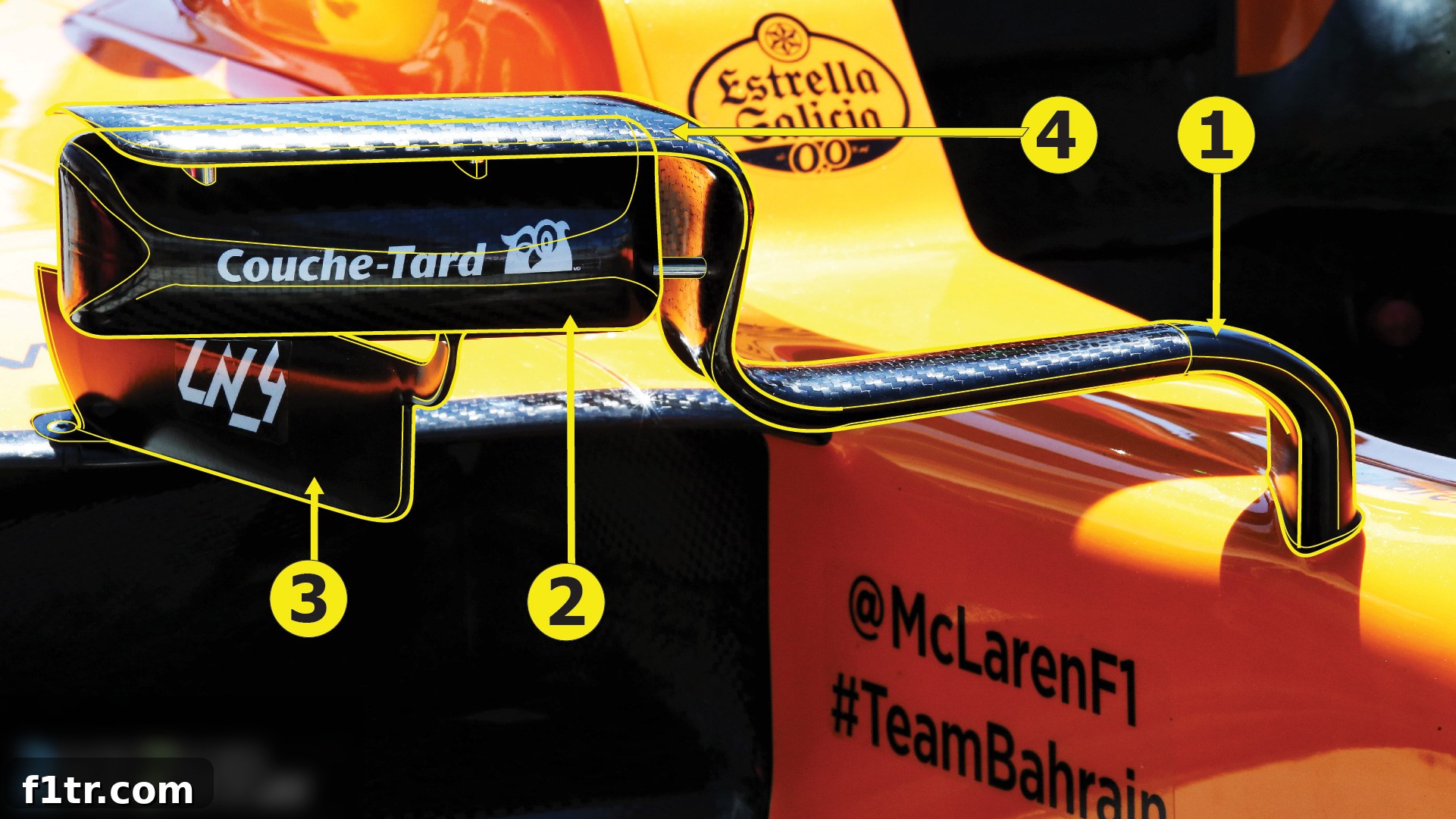
One of the most profound evolutions in recent F1 mirror design has been the transformation of the mounting stalks. No longer content with just structurally supporting the mirror, aerodynamicists began shaping these mounts into intricate, multi-functional components. These stalks evolved into highly effective “turning vanes” or “flow conditioners,” meticulously sculpted to direct airflow precisely where it’s needed most. This development was particularly crucial given the tight restrictions on other bodywork elements around the cockpit area, making the mirror mounts one of the few remaining zones for creative aerodynamic manipulation.
These oversized mounts, far larger than strictly necessary for structural integrity, became legally justified solely for their aerodynamic benefits. Teams rapidly converged on a configuration featuring two primary mounts: one extending vertically back towards the sidepods, and another stretching inboard towards the cockpit opening. Each of these mounts is carefully contoured to manage the complex airflow dynamics around the cockpit. By strategically guiding the air down and around the sidepod’s top surface, these components play a vital role in optimizing the efficiency of downstream aerodynamic elements, paving the way for improved downforce and reduced drag.
Advert | Become a RaceFans supporter andgo ad-free
The Revolutionary Mirror Vane: Shaping Airflow for Performance
Perhaps the most visible and impactful innovation in recent mirror design is the integration of an aerodynamic vane over the top of the mirror housing. This concept, pioneered notably by Red Bull Racing, quickly gained traction across the grid. The vane, often appearing as a sleek extension or fin above the mirror glass, serves a very specific and highly beneficial aerodynamic purpose. As airflow tends to rise upwards off the front wing and towards the sidepods, this vane acts as a “down-washing device.” Its cleverly designed profile helps to push this upward-moving air downwards, effectively keeping it attached to the sidepod surfaces.
The importance of this down-washing effect cannot be overstated. By maintaining attached airflow over the sidepod tops, the vane works in conjunction with the sidepod’s overall shaping to efficiently guide a greater volume of air towards the crucial diffuser area at the rear of the car. The diffuser is a primary downforce-generating component, and ensuring a robust, well-managed airflow into it significantly enhances its effectiveness. This leads directly to increased rear downforce, allowing cars to carry more speed through corners and improving overall stability – a classic example of marginal gains adding up to a substantial performance advantage.
Navigating the Legality: A Fine Line of Interpretation
The introduction of the mirror vane, like many F1 innovations, immediately raised questions of legality. The precise wording of the regulations can be ambiguous, leading to debates over whether such a vane constitutes part of the mirror housing or an additional mounting component. If deemed a separate mounting, it could potentially violate the two-mounting limit. However, the FIA, after careful review, has generally been content with the interpretation that these vanes are an integral part of the mirror housing itself. This interpretation has allowed teams to freely develop and implement these designs, leading to their widespread adoption across the grid.
This acceptance stands in contrast to previous instances where teams pushed the envelope a little too far. For example, Ferrari’s elaborate halo-mounted mirror fin in 2018, which was clearly designed as a standalone aerodynamic device rather than a mirror support, was quickly deemed illegal by a technical directive. Similarly, Williams’s pre-season mirror design, which merged the mirror glass, pod, and lower mounting into a single curved part, also raised concerns among rival teams regarding its true purpose and compliance. These examples highlight the constant dance between technical regulations and innovative engineering, where the line between what is permissible and what is not is constantly being drawn and redrawn.
The Impact on Overall Car Performance and the Future Outlook
The sophisticated integration of mirror design into the broader aerodynamic concept of an F1 car underscores the pursuit of ultimate performance. By effectively managing turbulent flow, acting as flow conditioners, and utilizing down-washing vanes, mirrors now play a direct role in optimizing sidepod and diffuser efficiency. These seemingly minor adjustments contribute to a holistic aerodynamic package that helps maximize downforce and minimize drag, directly translating into faster lap times and a competitive edge on the track.
The widespread adoption of these advanced mirror designs by teams like Red Bull, McLaren, Toro Rosso, Mercedes, and variations seen from Renault and Williams (based on Ferrari’s earlier vented pod concept), illustrates their proven efficacy. While future regulations, such as those introduced for 2020, continue to restrict what teams can do with their mirrors, they have not specifically banned the fundamental interpretation that allows for these aerodynamically optimized designs. This suggests that the mirror will continue to be a site of ongoing development and clever interpretation, even as the rules evolve.
In conclusion, the journey of the Formula 1 wing mirror from a simple safety requirement to a highly sophisticated aerodynamic component encapsulates the very essence of F1 engineering. It’s a compelling narrative of how even the most unassuming parts of a race car are scrutinized, reinvented, and integrated into a relentless quest for speed. The ingenuity displayed in turning an aerodynamic challenge into an opportunity for performance gain is a powerful reminder that in the world of F1, no detail is too small to escape the relentless pursuit of supremacy.
Advert | Become a RaceFans supporter andgo ad-free
F1 technology
- McLaren, Red Bull and Ferrari bring rear corner updates to Imola
- Ferrari, McLaren and Red Bull bring upgrades again for Saudi Arabian Grand Prix
- McLaren introduce major floor upgrade for Norris’ car at Mexican Grand Prix
- McLaren, Mercedes and Red Bull detail upgrade packages for United States GP
- Red Bull remove engine cover ‘cannons’ in major RB20 update – but they may return
Browse all F1 technology articles