Chaos Erupts in Q1: Stroll and Latifi Clash at the Australian Grand Prix
The opening qualifying session for the Australian Grand Prix was thrown into disarray during its crucial final minutes when Aston Martin’s Lance Stroll and Williams driver Nicholas Latifi collided, prompting an immediate investigation by the race stewards. The incident not only brought out the red flag but also effectively ended both drivers’ hopes of progressing further in the qualifying shootout, casting a shadow over their respective teams’ weekend prospects.
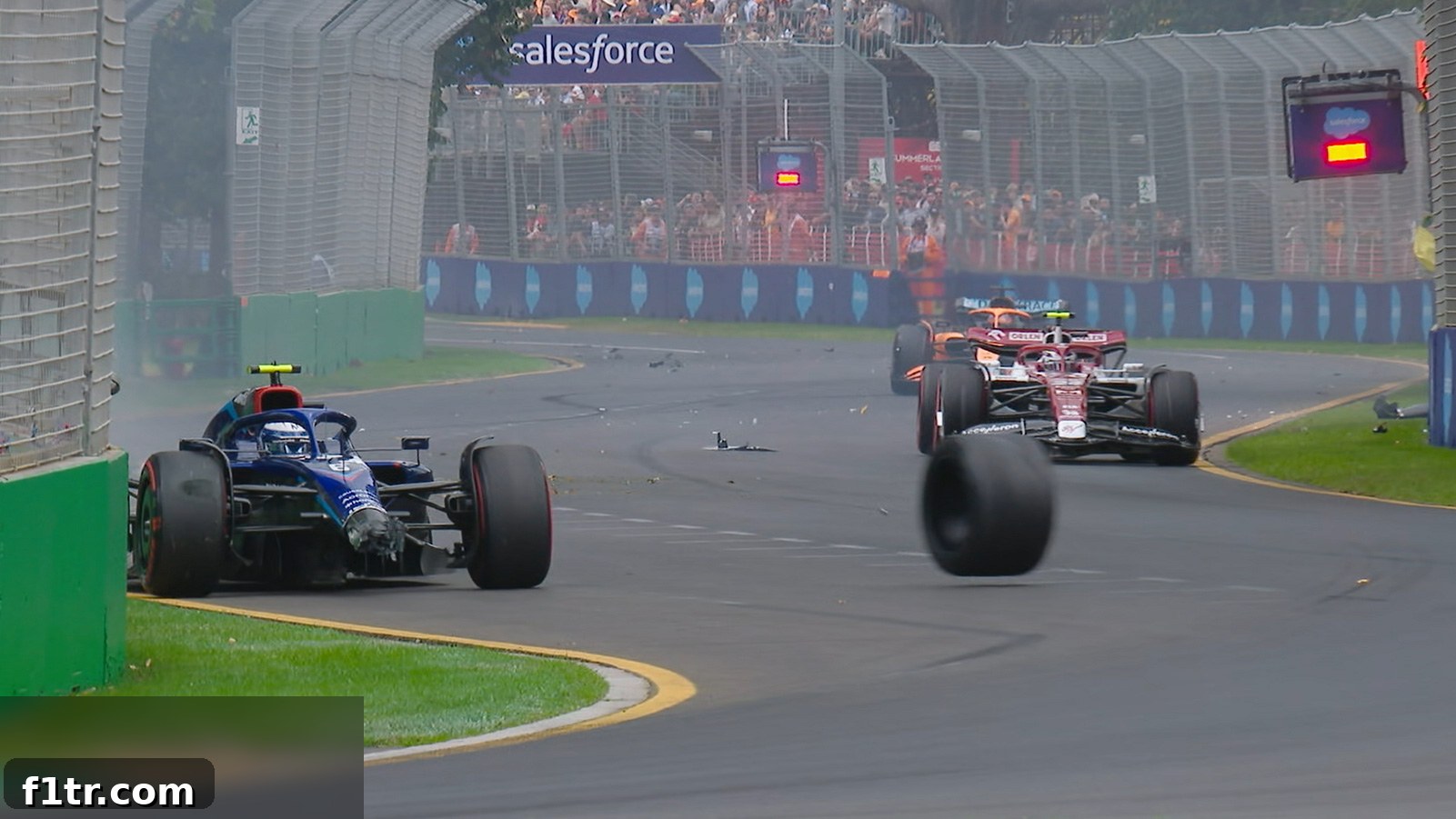
The collision, a significant moment of on-track drama, occurred with just over two minutes remaining in Q1. At this critical juncture, drivers were scrambling to set their final flying laps, aiming to secure a coveted spot in Q2. Stroll had just executed an overtake on Latifi as they approached turn five. However, as the cars navigated the corner, the Williams driver attempted to repass Stroll. This maneuver led to an unavoidable contact between the two vehicles, triggering a chain of events that left both cars damaged and both drivers fuming.
The Dramatic Unfolding of the Incident
The impact of the collision was severe, ripping the left-rear wheel clean off Latifi’s Williams FW44. The loss of control sent Latifi’s car spiraling violently into the trackside barriers, where it sustained extensive damage. Fortunately, Latifi was able to confirm he was uninjured, but his car was clearly beyond immediate repair. Stroll, meanwhile, was advised by his team to stop his Aston Martin AMR22 as he attempted to make his way back to the pits, indicating potential damage that would make continuing unsafe. The immediate consequence was a red flag, halting the session and forcing all remaining cars to return to the pit lane, further amplifying the tension in the paddock.
Understanding the context surrounding the incident requires delving into the radio communications between the drivers and their respective race engineers, which paint a picture of differing intentions and missed understandings on the track. Nicholas Latifi, it transpired, was not on a flying lap at the time of the collision. He had previously aborted his last attempt just moments before, a strategic decision communicated to his team. “I’m just backing off,” Latifi explained over the radio. “I was going to kill the tyres, I wasn’t going to improve.” This suggests Latifi was managing his tires and preparing for another, later attempt, or simply cooling down after a difficult run.
As Latifi proceeded through the challenging turns three and four complex, his race engineer, Gaetan Jego, provided a critical warning: “Watch out for Stroll within one [second].” Latifi acknowledged the proximity of the Aston Martin, reporting, “He backed off,” as Stroll passed him at the exit of turn four. Jego then gave Latifi the green light to pick up his pace if he wished: “Okay you can pick up then if you want.” It was at this precise moment, as Latifi attempted to regain his track position by passing Stroll on the right, that the Aston Martin driver seemingly moved towards him, initiating the contact and leading to the catastrophic collision.
Latifi’s immediate reaction on the radio was one of disbelief and frustration. “I don’t understand what he was doing, he wasn’t looking in his mirrors,” he exclaimed, clearly believing Stroll was at fault for not being aware of his presence. He quickly added a somber assessment of his car’s state: “I’m fine, the fucking car’s destroyed.” The expletive-laden outburst underscored the severity of the damage and the blow to his qualifying efforts.
Stroll’s Perspective and Race Engineer’s Warnings
Lance Stroll’s qualifying session had already begun under challenging circumstances. Having made a late start to Q1, his mechanics were still completing repairs to his car following a crash during the earlier practice session. This late start meant Stroll was on only his second lap of the session when the incident occurred, highlighting the immense pressure on him to deliver a competitive time quickly.
Before Stroll embarked on his first flying lap, his race engineer, Ben Michell, had prudently advised him on his options, particularly regarding track management. “You have time for an abort-push, you can abort-push, but we’re happy to push on first lap,” Michell communicated, giving Stroll the flexibility to manage his lap if traffic became an issue. This initial advice proved prescient.
As Stroll commenced his lap, Michell quickly realized that his driver was approaching a congested part of the track, with Latifi and other cars creating significant traffic. He immediately relayed this crucial information: “Okay Lance we’ve got big traffic if you want to abort and go again, we can do that. Too much traffic, abort, cool and we’ll go again.” This instruction indicates that Stroll was also on a slow-down or preparation lap, looking for clear air. The goal was to find an optimal window for a flying lap, a common strategy in the frenetic environment of F1 qualifying.
After Stroll passed Latifi, Michell sought to reassure his driver about his track position relative to other competitors. “You’re in phase with everybody,” he explained. “So get ahead of Latifi, you’ve got Russell ahead of you now, eight seconds, so you’re in a good gap, hold this position on track.” This instruction was intended to help Stroll manage his space, but tragically, it was precisely as Michell was delivering these instructions that Stroll and Latifi made contact. Stroll’s immediate reaction mirrored Latifi’s frustration: “Unbelievable, man, I don’t fucking understand what he was doing,” he vented, clearly bewildered by Latifi’s maneuver.
Post-Session Explanations and Differing Narratives
In the aftermath of the incident, both drivers offered their perspectives, each firmly believing the other was primarily responsible. Nicholas Latifi was unequivocal in his assessment, stating, “For me, it’s quite clear, I’ve just seen the video.” His interpretation was that he was merely attempting to regain his position in the queue to prepare for his next out-lap, and that Stroll inexplicably turned into him. “I was just trying to go back by to prepare my out-lap and it seems like he just turned into me once I was alongside him,” Latifi explained. He further clarified that he had initially yielded to Stroll because he was told Stroll was pushing to open a lap. “I let him through because he was pushing to open the lap, so I was told.” However, once he saw Stroll abort his lap, Latifi felt justified in attempting to repass. “Then I saw he aborted the lap, so I wanted to get carried on with my own preparation lap. So I went back by him, obviously there was a big gap. And once I kind of got past them for whatever reason, he decided to turn. So it’s clear for me on the video, there’s not much more to say.”
Lance Stroll, conversely, expressed surprise at Latifi’s sudden move to pass him on his right as they approached turn six. “He went all of a sudden, very suddenly,” Stroll recounted. He attributed the collision to a combination of Latifi’s sudden acceleration and the unique topography of the circuit at that point. “It falls to the right so the car kind of dips to the inside as the track falls away there. I think the timing was just terrible, as he was accelerating the track was falling to the right for me and that’s where we made contact.” Stroll’s explanation suggests that Latifi’s unexpected move, coupled with the natural line of the track that pulls cars to the right, created an impossible situation for him to avoid contact.
Implications and the Stewards’ Verdict
The collision between Lance Stroll and Nicholas Latifi was more than just a momentary lapse in judgment; it had significant implications for both drivers and their respective teams. For both Stroll and Latifi, their Q1 dreams were shattered, leaving them at the back of the grid for the main race, a substantial blow to their weekend performance. For Williams, the damage to Latifi’s car represented a considerable financial strain, especially for a team operating with a tighter budget. Repairing such extensive damage in a limited timeframe can be challenging, potentially impacting subsequent sessions or even future parts development.
Beyond the immediate sporting and financial consequences, the incident brought into sharp focus the intricate dynamics of qualifying sessions. The pressure to find clear track, manage tire temperatures, and prepare for flying laps often leads to a delicate dance between drivers, where misunderstandings can escalate quickly. The unwritten rules of F1 track etiquette, particularly during slow-down or warm-up laps, rely heavily on mutual awareness and clear communication, which evidently broke down in this instance.
The FIA stewards launched an immediate investigation into the incident, a standard procedure for such significant on-track clashes. Their task was to meticulously review all available data, including telemetry, onboard camera footage from both cars, and radio communications, to determine if any driver was predominantly at fault and whether any sporting penalties were warranted. Potential penalties could range from grid drops for the upcoming race to penalty points on their super licenses, or even fines, depending on the severity of the infraction as perceived by the stewards. The decision would not only assign blame but also send a message to the entire grid about acceptable conduct during critical phases of a Grand Prix weekend.
Ultimately, the Stroll-Latifi collision served as a stark reminder of the fine margins and intense competition inherent in Formula 1. Even seemingly minor misjudgments or miscommunications can have dramatic and costly consequences, altering the course of a race weekend for multiple teams and drivers. The incident underscored the ever-present challenge of balancing aggressive driving with safety and respect on the world’s most demanding racetracks.
Image: F1 via Twitter
2022 Australian Grand Prix
- Aston Martin’s porpoising “does not allow us to exploit the progress the guys have made”
- Wolff puts Mercedes’ odds of championship victory at “two to eight”
- FIA responds to Verstappen’s criticism of Safety Car performance
- “So this is the end of our race, I guess?” How Alonso’s luckless Australian GP unfolded
- Two-degree temperature rise led to Hamilton’s “difficult position” radio message
Browse all 2022 Australian Grand Prix articles