Safety Concerns Mount: F3 Grid Sizes and Wet Racing Under Scrutiny at Spa-Francorchamps
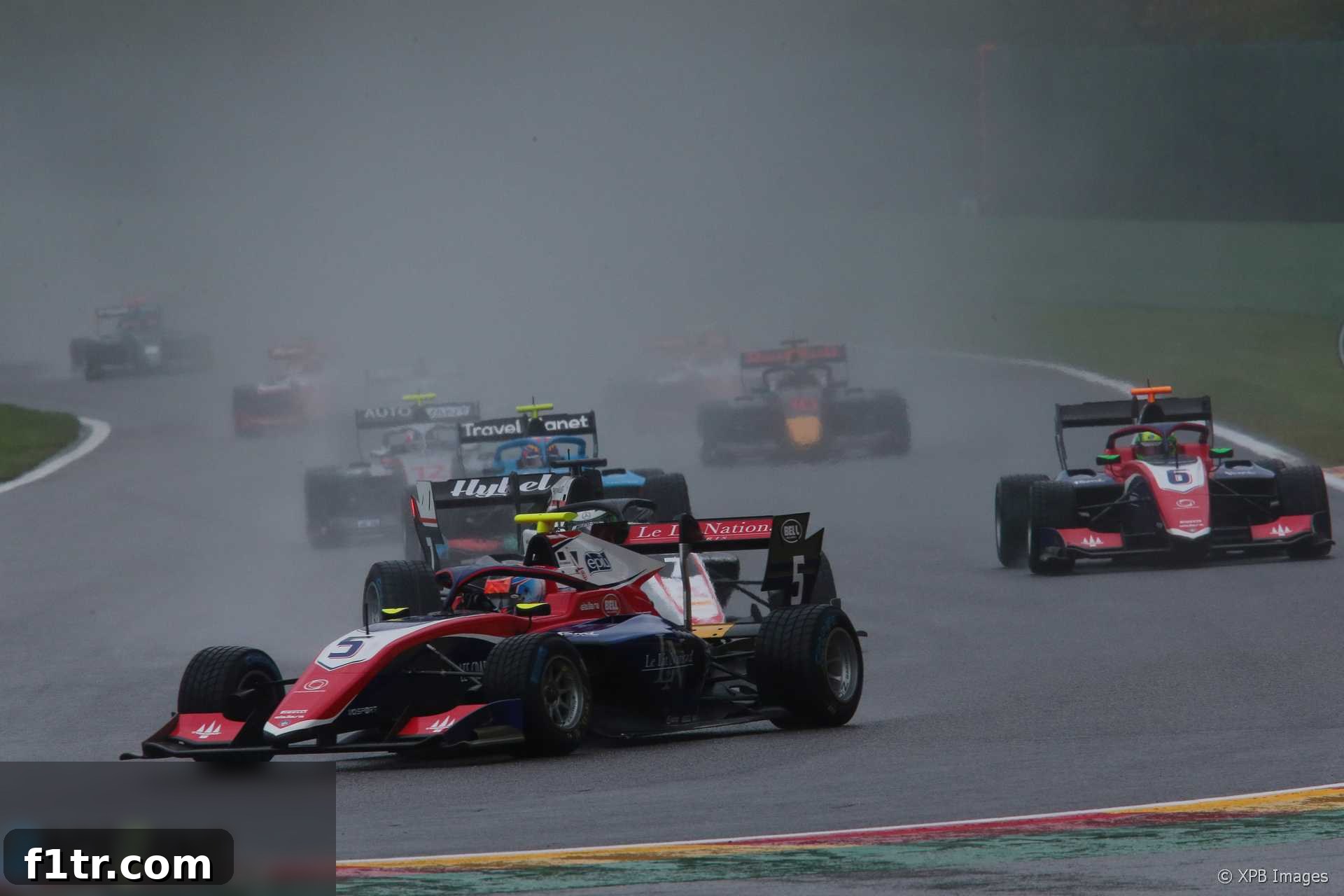
The iconic Spa-Francorchamps circuit, a formidable test of skill and bravery, has once again become the focal point of a crucial safety debate within motorsport. As the Belgian Grand Prix weekend approached, accompanied by forecasts of torrential rain, leading figures like Mercedes driver and Grand Prix Drivers’ Association director George Russell raised significant alarms regarding the safety of large Formula 3 grids competing in extreme wet conditions. These concerns are amplified following a recent tragic accident at the track, highlighting the inherent dangers when visibility is compromised on such a high-speed, undulating circuit.
Advert | Become a Supporter & go ad-free
A Tragic Precedent: The Shadow Over Spa
The current scrutiny over racing conditions at Spa-Francorchamps is particularly intense, stemming from a heartbreaking incident earlier this month. An 18-year-old driver, Dilano van ‘t Hoff, tragically lost his life in a Formula Regional European Championship (FREC) race at the circuit. This fatal accident occurred following a safety car restart in a race contested by 34 cars under severely wet conditions, where visibility was reported to be near zero. The sheer volume of cars on track, combined with dense spray, created an incredibly hazardous environment that many feared was a disaster waiting to happen.
Formula 1 itself has faced significant challenges with adverse weather at Spa in recent memory. The 2021 Belgian Grand Prix serves as a stark reminder, effectively abandoned after just three laps behind the Safety Car due to overwhelming safety concerns caused by persistent, heavy rain. This history underscores the circuit’s notorious reputation for unpredictable weather and its unforgiving nature when grip and visibility are at their worst.
George Russell’s Dire Warning: “A Matter of Time”
Ahead of the Belgian Grand Prix practice sessions, which themselves were held in wet conditions for F1’s junior categories F2 and F3, George Russell vocally emphasized the profound dangers of racing on a heavily saturated surface at a circuit like Spa. His experience and position within the GPDA lend considerable weight to his concerns, which he articulated clearly to media, including RaceFans.
“I think two years ago that was the correct decision to call the race off,” Russell stated, referring to the 2021 F1 race. He elaborated on the critical difference between a single car and a full grid: “I think for one single Formula 1 car to drive around, the conditions are safe enough and suitable enough to drive. But it’s when you’ve got 20 cars on track at once, anybody from third position backwards literally cannot see from here to the end of this wall away – so you’re talking 20, 30, 40 metres.”
Russell expressed a chilling premonition regarding the FREC incident. “I felt like the incident that happened in [FREC], it was only really a matter of time that something like that happened. Drivers aren’t going flat-out in the straight because they can’t see, somebody gets rear-ended and then there’s a car in the middle of a track. Obviously to have a race cancelled is not perfect for anybody, but we don’t want to see another huge incident as we’ve just seen.” His words painted a vivid picture of the chaotic and perilous conditions drivers face when visibility vanishes, turning high-speed racing into a terrifying lottery.
Advert | Become a RaceFans supporter andgo ad-free
Concerns for Junior Categories: F3’s Large Grids at Spa
The Belgian Grand Prix weekend was set to feature 30 drivers competing in the penultimate round of the F3 championship. Russell admitted he harbored particular concerns for these young drivers, potentially racing in conditions mirroring the FRECA race where the fatal accident occurred just weeks prior. “I fear a little bit for the junior categories with F3 out on track,” Russell confessed. His apprehension wasn’t limited to wet weather alone.
“I truly think F3 should not be allowed out with 30 cars on track at one time at any point – even in dry conditions. Again, I feel like it’s a matter of time before a big incident happens too.” This statement broadens the scope of the debate, suggesting that the sheer density of cars in junior categories, irrespective of weather, presents an elevated risk. Younger drivers, still honing their skills and racecraft, might be more susceptible to incidents in such crowded environments, especially on a circuit as demanding as Spa.
Logan Sargeant’s Terrifying Experience
Williams driver Logan Sargeant offers a firsthand account of the treacherous conditions at Spa, having competed in the last F3 race held there in the wet in 2021 – the same day F1’s Grand Prix was curtailed. When pressed by RaceFans about his thoughts on the safety risks, Sargeant vividly recounted his own unsettling experiences.
“I remember that was the year F1 got cancelled and we were driving in some pretty, honestly, questionable conditions,” he recalled. “In a situation like that, it definitely wasn’t nice. You can’t see the edge of the track, you can’t see your front wing, you can’t see the brake markers, you can’t see the car in front of you. You’re just driving flat-out into a wall of white mist. So honestly, in that situation, I think it’s getting to the point where it’s a bit too much. I think this track in particular, I guess the history makes it a bit more scary.”
Sargeant unequivocally stated that the lack of visibility at Spa in the wet ranks among the most frightening experiences of his racing career. “You’re driving flat up through Eau Rouge, but you don’t feel like you should be going flat-out – that’s for sure,” he explained, referencing one of motorsport’s most legendary and fearsome corners. “You don’t know what’s on the other side, and that’s never nice. It’s the one condition in racing that I can actually feel the scare of it, to be honest.” His description paints a harrowing picture of driving at immense speed purely on faith, unable to see anything beyond a few meters, a scenario that pushes the boundaries of acceptable risk.
Advert | Become a RaceFans supporter andgo ad-free
FIA Race Control: Trust and Challenges Ahead
Ultimately, the critical decisions regarding whether conditions are safe enough to race in rest with the FIA’s race control team. The FIA has undertaken significant overhauls in this area since the controversial 2021 season, implementing structural changes to enhance safety management. Niels Wittich was appointed as race director, Nikolas Tombazis transitioned into the crucial role of single-seater director, and Steve Nielsen, a highly respected figure from Formula 1, joined as sporting director earlier this year. These appointments signify a concerted effort to strengthen leadership and expertise in race management.
George Russell expressed his confidence in the abilities of this new leadership to make sound decisions for driver safety. “I think the way the FIA goes about things now is probably better than it has been in the recent past,” he observed. “It all seems a bit more organised with Nikolas at the helm there. Then with Steve Nielsen, who I think has been a really great addition to the FIA, Neils was thrown into the role. I think it’s just having that open dialogue. There is good communication between us now – better than it’s ever been.”
However, Russell also acknowledged the immense difficulty of finding immediate, definitive solutions to some of these systemic issues. “We all want decisions and answers ‘yesterday’ – the fact is we’re not going to find a solution for poor visibility for probably years to come. It’s challenging. It’s really not easy.” This candid admission highlights the complexity of mitigating risks associated with factors like spray and visibility, which are inherent challenges of wet weather racing, especially at high speeds. While dialogue and improved processes are vital, revolutionary technological solutions for visibility remain elusive.
Driver Mentality: The Unwavering Commitment
Despite the inherent risks and personal fears, the competitive spirit of a racing driver remains undeterred. With Formula 1 featuring two races in the Belgian Grand Prix weekend, including Saturday’s sprint race, Logan Sargeant confirmed his readiness to compete under any conditions deemed safe by race control. “At the end of the day, if we go to race, we go to race,” he stressed. “I’m never going to not be flat-out. It just is what it is. You have to live with it and go for it.”
Sargeant concluded by reiterating a fundamental trust in the system. “To be honest, I trust that they’ll make the right decision and I think a lot of it will come down to what we’re saying on the radio back to the teams.” This interplay between driver feedback and race control’s judgment is critical in dynamically assessing safety during a race, particularly when conditions are marginal. The ongoing dialogue and trust between drivers, teams, and the FIA are paramount in navigating these challenging safety dilemmas at circuits like Spa-Francorchamps.
Support Independent Motorsport Journalism
RaceFans is dedicated to bringing its readers direct news and insights from the heart of Formula 1. Our ability to deliver original journalism, including unique driver interviews and in-depth analysis, is made possible through the generous support of our RaceFans Supporters.
By contributing a small amount monthly or annually, you directly help cover the essential costs of producing high-quality, independent motorsport content – from travel and writing to hosting and development. We have proudly been supported by our readers for over a decade. If you value our commitment to objective coverage, please consider joining our community of RaceFans Supporters today. As an added benefit, all Supporters enjoy an ad-free browsing experience on our site.
- Become a RaceFans Supporter
- RaceFans Supporter FAQ
Advert | Become a RaceFans supporter andgo ad-free
2023 Belgian Grand Prix: Further Reading
- Haas drivers fear losing battle for seventh after “grim weekend” in Spa
- Mercedes optimistic they’re “in the right place for winter” with development plan
- Ferrari not convinced by call to equalise engines: ‘Renault is not so far away’
- Ferrari staying “calm” amid swings in performance from race to race
- Pirelli proposes new “super-intermediate” to address wet weather tyre problems
Browse all 2023 Belgian Grand Prix articles