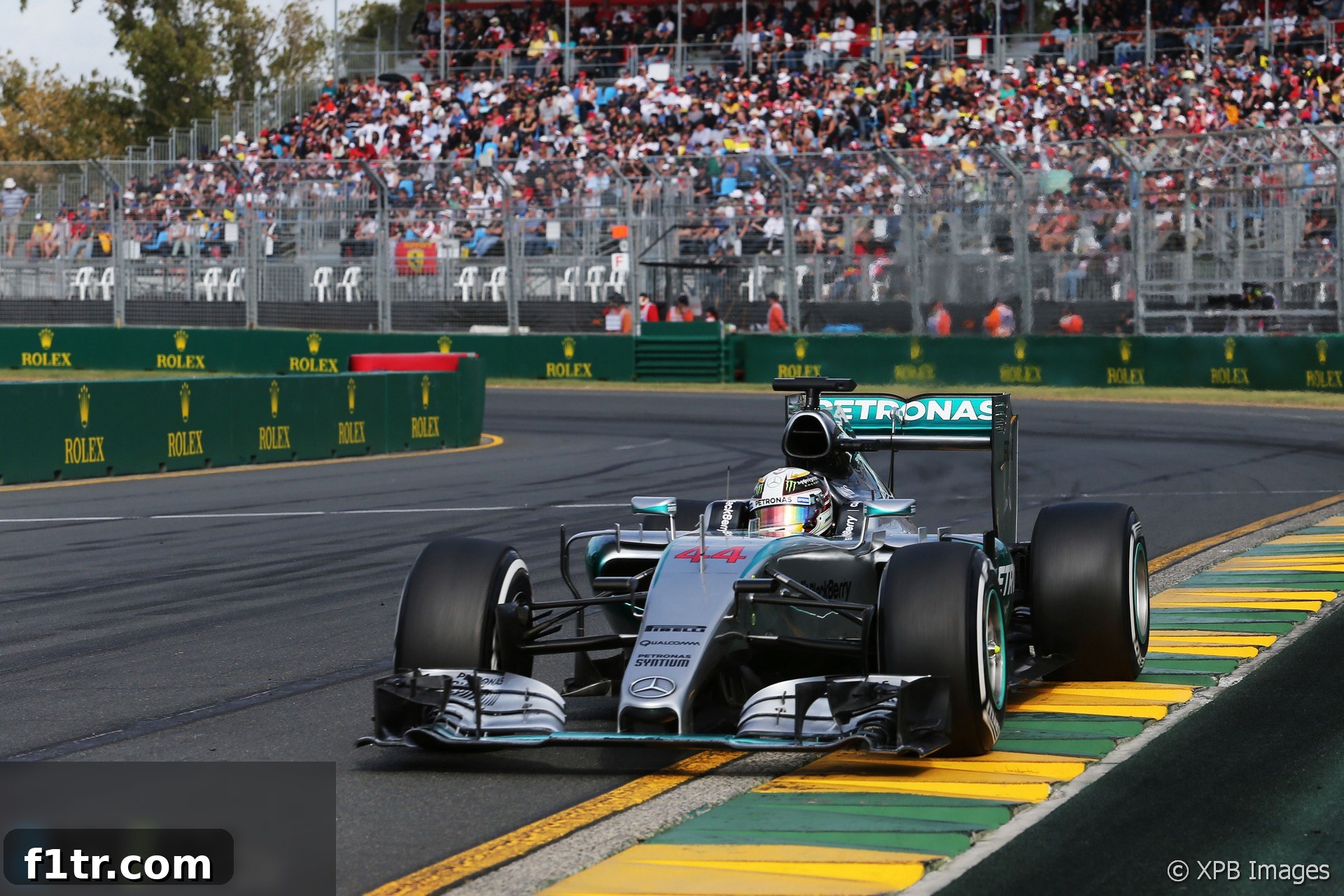
The 2015 Formula 1 season roared to life at the iconic Albert Park Circuit, hosting the Australian Grand Prix – an event anticipated to set the tone for the championship battle ahead. True to expectations, the Mercedes-AMG Petronas F1 Team, the dominant force of the previous year, immediately asserted their authority. Reigning world champion Lewis Hamilton and his fierce teammate Nico Rosberg delivered a commanding one-two victory, mirroring the seemingly effortless superiority they displayed throughout their eleven such finishes in 2014. This performance was not merely a win; it was a resounding statement, signaling that the Silver Arrows were once again the team to beat.
Advert | Become a Supporter & go ad-free
The sheer dominance was stark. Only three of their closest rivals managed to reach the chequered flag without being lapped, crossing the finish line more than half a minute after Hamilton’s Mercedes W06 had already completed its triumphant run. The gap to the rest of the field was not just significant; it was a chasm, leaving the competition scrambling to understand how to bridge such an immense performance deficit. Adding to the challenge for the opposition, what they lacked in raw pace and quality on track, they certainly didn’t make up for in sheer quantity of cars competing, as a series of unfortunate events significantly trimmed the grid even before the lights went out.
A Diminished Grid: Early Season Attrition at the 2015 Australian Grand Prix
The drama surrounding the 2015 F1 season opener in Australia began long before the engines were fired up for the race. Almost two weeks prior, the McLaren-Honda camp suffered a major setback with Fernando Alonso withdrawing from the event following a pre-season testing accident. His absence cast a shadow over McLaren’s much-heralded new partnership with Honda, hinting at the reliability woes that would plague them throughout the season. Alonso’s withdrawal, however, was just the beginning of a concerning trend that saw a quarter of the initially entered field fall by the wayside before the Grand Prix even started.
The most poignant absence was that of the Manor Marussia team. Despite a last-minute rescue deal that saved them from collapse, the team simply could not finish building their cars in time for qualifying, let alone the race. Both Manor drivers were unable to leave the garage all weekend, a heartbreaking start for a team that had fought so hard for survival. While the stewards acknowledged their serious efforts and cleared them of any wrongdoing, it was a stark reminder of the immense financial and logistical challenges smaller teams faced in Formula 1. They vowed to try again in Malaysia, hoping for a better outcome.
As the final minutes of the off-season ticked down and race day approached, three more drivers were struck from the grid, further depleting the already small field. Williams driver Valtteri Bottas, a strong contender for points, injured his back during qualifying. Following an inspection by the FIA, he was ruled out of the race, a significant blow for both the driver and the Williams team, who had high hopes for a strong start to their campaign. Adding to the pre-race chaos, two more cars failed to even make it to the grid after setting out from the garage. Kevin Magnussen’s Honda power unit, a harbinger of the struggles to come for McLaren-Honda, failed before he could take his place. Simultaneously, Daniil Kvyat’s Red Bull suffered a gearbox failure, forcing him to retire before the official start. This cascade of technical issues and injuries left an already diminished grid even smaller, setting a somber tone for the 2015 Australian Grand Prix.
Opening Lap Carnage: Mayhem at Melbourne’s Tricky Turn One
The crowd, which had earlier witnessed 25 of Australia’s spectacular V8 Supercars thunder towards the first corner, now observed a somewhat disheartening sight: a grid of just 15 F1 cars lining up for the start of the Australian Grand Prix. Yet, even this significantly reduced field proved incapable of navigating Melbourne’s challenging turn one without incident, providing a chaotic spectacle that further reduced the car count.
The trouble erupted swiftly, involving the newly paired Ferrari teammates, Sebastian Vettel and Kimi Raikkonen. Raikkonen initially got away more cleanly, but Ferrari’s recent high-profile signing, Vettel, held the inside line with characteristic assertiveness. As they converged, Vettel edged his teammate wide in the opening meters. “I think he had a better start for sure,” Vettel later commented, explaining the close quarters. “I got a little bit back under braking and then I think I was side-by-side with him. I couldn’t make corner one as tight as I wanted to, which made him lose a couple of positions.”
Advert | Become a RaceFans supporter andgo ad-free
This initial skirmish between the Scuderia pair created a domino effect. Raikkonen’s car subsequently went into anti-stall mode as he was clipped by Toro Rosso’s debutant, Carlos Sainz Jnr, who lost the left-hand end plate from his front wing in the contact. Amidst the chaos, Felipe Nasr’s Sauber, also making his debut, attempted to capitalize on the momentary delay of those ahead. However, as Nasr navigated the tight turn, Pastor Maldonado in his Lotus arrived on the scene. The two cars connected, sending Maldonado’s Lotus snapping violently around and into the barrier, ending his race prematurely. The wreckage of Maldonado’s car necessitated the immediate deployment of the Safety Car, further disrupting the flow of the race.
As the Safety Car circulated, another car peeled off into the pits – the second Lotus, driven by Romain Grosjean. His Mercedes engine was reportedly lacking power, a critical issue that Lotus decided was terminal. With Grosjean’s retirement, the field was now alarmingly down to just 13 runners, a grim testament to the unforgiving nature of the Australian Grand Prix and the myriad challenges faced by teams and drivers at the start of a new Formula 1 season. The race had barely begun, and already a significant portion of the grid had been eliminated, intensifying the focus on those still battling.
Strategic Battles and Unfolding Drama in the Mid-Race
When the Safety Car eventually pulled in, the race resumed, and a new phase of strategic battles and mechanical reliability tests began. Despite reporting that his final practice start felt “under-engaged,” Lewis Hamilton’s actual start was flawlessly smooth, allowing him to maintain his lead over Nico Rosberg. Meanwhile, Daniel Ricciardo, starting seventh on the grid in front of his home crowd, expressed frustration as his clean getaway was quickly undermined by his Renault engine. “Just drive-ability,” he reported over the radio. “Seemed like I got a decent launch then I had massive kicks. Otherwise it was looking alright.” At the restart, he found himself seventh behind Felipe Nasr, but both drivers quickly passed Carlos Sainz, whose car was inexplicably slow when the race resumed due to a software problem, costing him crucial track position.
Three laps later, Sainz lost another place to Kimi Raikkonen. However, the Ferrari driver’s race was about to be marred by a persistent issue with his left-rear wheel nut. During his first pit stop on lap 16, the nut became cross-threaded, costing him at least five seconds and dropping him down the order. The problem resurfaced with brutal clarity when he pitted again on lap 40; this time, the nut failed to reattach securely. Despite being sent out of the pits initially, Ferrari quickly realized the perilous situation and instructed him to park the car, ending his race prematurely. The stewards later ruled that Ferrari had complied with the strict safety rules regarding unsafe releases from the pit box, a significant relief for the team given the heavy sanctions such infringements usually carry.
Advert | Become a RaceFans supporter andgo ad-free
In contrast to his teammate’s woes, Sebastian Vettel enjoyed a much more successful first and only pit stop. Having patiently sat on the tail of Felipe Massa since the restart, Vettel executed a masterclass in pit stop strategy. By extending his stint three laps longer than the Williams driver, he was able to build up enough of a cushion during his faster out-lap to emerge ahead of Massa, even as Williams urgently implored their driver to push harder. This strategic triumph was a clear demonstration that, on this circuit at least, Ferrari had undeniably seized the mantle of ‘best of the rest’ behind the dominant Mercedes machines, signaling a promising resurgence for the Italian team.
Meanwhile, Daniel Ricciardo, staring at Nasr’s rear wing, was hoping for similar strategic intervention from his Red Bull team. “Let me know when we get a pit window,” he radioed, expressing his frustration. “Can’t do anything about the Sauber.” Despite pitting two laps earlier than Nasr in a concerted bid to undercut him, Ricciardo was unfortunately unable to leapfrog the Ferrari-engined Sauber. The pit stop strategy, a critical element in Formula 1, proved to be a mixed bag of success and failure for the midfield teams, highlighting the fine margins that define competitive advantage in the sport.
Hamilton’s Measured Control and Rosberg’s Frustration
As the 2015 Australian Grand Prix progressed, the familiar routine from the previous year’s dominant Mercedes campaign re-established itself at the front. Lewis Hamilton, in a display of measured control, maintained a comfortable distance from his teammate Nico Rosberg, pitting first as is often the case for the lead car. Rosberg, ever the tenacious challenger, pushed hard in pursuit, even brushing the turn 11 wall at one point in his fervent effort to close the gap. However, every time he threatened to get within DRS range of Hamilton, the world champion would respond by effortlessly extending his lead once more, showcasing his superior pace and tire management.
Interestingly, Hamilton seemed more preoccupied with the state of his fuel consumption than with any direct threat from Rosberg. His dashboard display was reportedly giving him worrying signals about his fuel levels, a critical concern under the stringent fuel regulations of modern Formula 1. His anxiety was eventually alleviated when word came from the pit wall confirming that his dashboard display was indeed faulty, providing immense relief and allowing him to push with renewed confidence.
Advert | Become a RaceFans supporter andgo ad-free
Rosberg, meanwhile, attempted to conserve fuel in the hope of launching a late-race attack on Hamilton. However, he was quickly reminded of the FIA’s radio restrictions, introduced in 2014, which severely limited the information teams could relay to drivers regarding their rivals’ fuel status. This regulatory constraint meant his race engineer, Tony Ross, was unable to provide the crucial details Rosberg sought about Hamilton’s remaining fuel. “I put the question because I wanted to know exactly where Lewis was,” Rosberg explained after the race, visibly frustrated. “But [Tony Ross] is not allowed to tell me, so I never got the answer. I hadn’t thought of that at the time – but obviously that was not good. Because I thought if I would know if he was down or something, that would be really motivating and it would be great.”
Resigned to the situation, Rosberg added, “All I could do is push flat-out and hope he had less. Which wasn’t the case.” It was a dispiriting race for Rosberg, who had demonstrated blistering pace during testing and carried that strong form into Friday practice in Australia. But when the serious business of competitive racing began, the world champion, Hamilton, once again raised his game, securing his seventh victory in eight races and reaffirming his status as the sport’s leading driver. The 2015 Australian Grand Prix thus concluded with a clear demonstration of Mercedes’ dominance and Hamilton’s mastery.
Rookies Shine, McLaren Struggles, and the Road Ahead for F1
Behind the dominant Mercedes duo, a revitalized Sebastian Vettel, in his first race for Ferrari, took the chequered flag, securing a valuable third place. He thanked his new team with a smattering of Italian, a gesture that resonated deeply with the Tifosi. “Of course it’s not a victory but for us today it feels like a victory,” he declared afterwards, his joy palpable. Both Vettel and Ferrari had endured poor 2014 campaigns individually; together, they had kick-started 2015 with a far stronger showing than anyone outside of the Mercedes garage could have anticipated. “Obviously it’s a great relief after a horrible season last year to know that the car in general is working,” Vettel reflected, openly admitting, “I’ve secretly been a fan, now officially I can be a fan of Ferrari.”
The rookie contingent also acquitted themselves remarkably well in the challenging opening race. Especially notable was Felipe Nasr, who, in his debut, brought his Sauber home in an excellent fifth place, scoring significant points and immediately making a name for himself. His teammate, Carlos Sainz Jr., although demoted by Nasr four laps from the end, still managed to secure points for ninth place on his own impressive debut. Max Verstappen, the youngest ever F1 competitor, showcased immense potential despite a premature end to his race. Following a long and impressive opening stint on the medium tyres, Verstappen looked set for a strong finish, only to suffer another Renault power unit failure, highlighting the persistent reliability issues plaguing the Renault-powered teams.
These numerous retirements left just 11 cars running at the end of the race, a stark contrast to the full grids typically expected in Formula 1. The last of these finishers was Jenson Button’s McLaren. While the car finishing last was perhaps unsurprising given McLaren-Honda’s evident struggles in qualifying, the fact that it kept running until the very end – or at least two laps shy of the full distance – was itself a small victory. “This is a very good step forward,” enthused Button on the radio, having managed to lop almost a full second off his best lap time on the final tour. “Very, very happy with what we’ve achieved here today.”
Even with these glimmers of hope and impressive debut performances, the overarching message from the 2015 Australian Grand Prix was clear: Mercedes’ dominance was absolute. Every team on the grid would need to make not just one, but several, significant “good steps forward” to even begin to bring the formidable Silver Arrows within competitive range. The season had begun with a bang, but also with a stark reminder of the immense challenge facing anyone hoping to contend for the championship against the might of Mercedes-AMG Petronas F1 Team.
Advert | Become a RaceFans supporter andgo ad-free
2015 Australian Grand Prix
- Sponsor Watch: 2015 Australian and Malaysian GP
- Nasr wins Driver of the Weekend poll on debut
- F1 can only get better after lifeless Melbourne opener
- 2015 Australian Grand Prix team radio highlights
- 2015 Australian Grand Prix fans’ video gallery
Browse all 2015 Australian Grand Prix articles
2014 F1 race reviews
- Antonelli lucks in for second win and becomes youngest F1 championship leader
- Emotional Antonelli grabs first Formula 1 victory in Chinese Grand Prix
- Russell sees off Ferrari threat to lead Mercedes one-two in Melbourne
- Norris clinches F1 title by two points as Verstappen wins finale at Yas Marina
- McLaren strategy blunder in Losail hands Verstappen crucial win and shot at title
Read all F1 race reviews