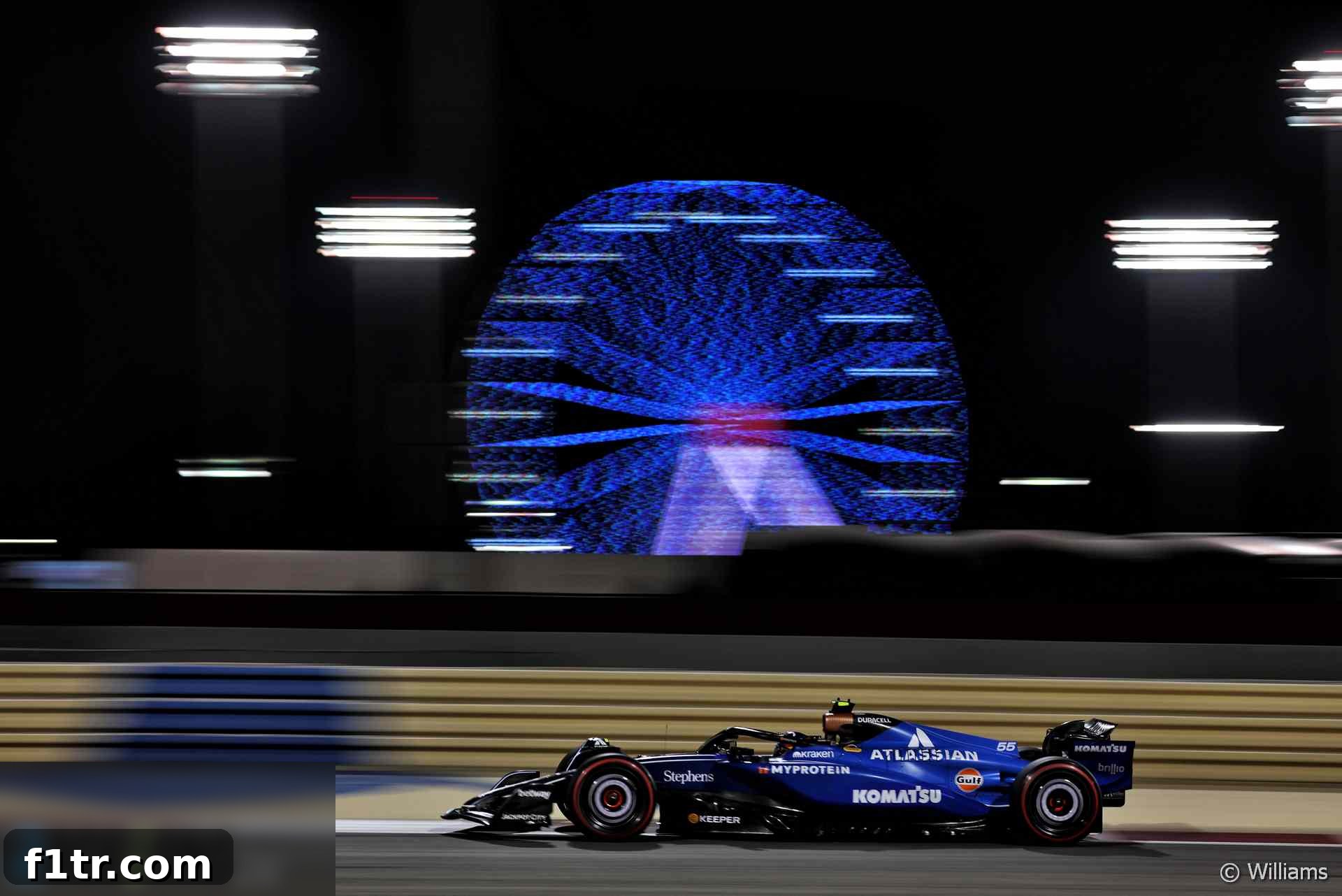
Carlos Sainz Jnr’s Bahrain Grand Prix Penalty: A Case Study in FIA Clarity
The aftermath of the Bahrain Grand Prix brought with it a peculiar moment of regulatory confusion that briefly overshadowed the on-track action. At the center of this administrative mix-up was Carlos Sainz Jnr, whose penalty for an incident involving Andrea Kimi Antonelli led to an initial, erroneous grid drop announcement before a swift and necessary correction by the FIA. This incident, though quickly resolved, served as a potent reminder of the intricate nature of Formula 1 regulations and the paramount importance of precise official communication in elite motorsport.
Advert | Become a Supporter & go ad-free
Your Premium Ad Placement Here
The On-Track Incident: A Close Call at Turn 10
During the intensity of the Bahrain Grand Prix, Carlos Sainz Jnr, driving for Scuderia Ferrari, found himself embroiled in a contentious on-track skirmish with Andrea Kimi Antonelli. The incident, which occurred at the challenging Turn 10, quickly caught the attention of the race stewards. Their subsequent review and official report painted a clear picture of what transpired. As Sainz approached the entry to Turn 10, a critical point on the circuit, he experienced a lock-up of his front wheels. This momentary loss of grip led to significant understeer, causing his car to deviate from the racing line. In doing so, Sainz missed the apex of the corner and, consequently, drifted wide directly into the path of Antonelli.
The consequence for Antonelli was immediate and detrimental. Forced off the track to avoid a more significant collision, he inevitably lost two crucial track positions. The stewards meticulously analyzed the telemetry and video evidence, concluding that Sainz’s maneuver was predominantly at fault for impacting Antonelli’s race. Such incidents are common in the high-stakes environment of Formula 1, where drivers push the limits of both their machinery and their own capabilities. However, the rules are clear: drivers must maintain control of their vehicles and avoid endangering or unfairly impeding competitors.
As a result of their findings, the stewards swiftly issued a 10-second time penalty to Carlos Sainz Jnr. This is a standard disciplinary measure in Formula 1 for such racing infringements, designed to penalize the driver without necessarily altering the immediate outcome of an incident in a way that could be further destabilizing. In addition to the time penalty, Sainz also received two penalty points on his Super Licence. These points contribute to a cumulative total; accumulating 12 points within a 12-month period leads to an automatic race ban. Sainz’s current tally now stands at three, serving as a cautionary note for future races.
The Initial Confusion: A Grid Drop for the Next Round?
The sequence of events following the penalty announcement injected an unexpected element of confusion into the post-race proceedings. The FIA initially declared that Sainz’s 10-second time penalty had not been served during the race. This announcement was made under the assumption that his subsequent retirement from the Grand Prix due to damage meant the penalty could not be fulfilled as prescribed. According to Article 54.3 of the Formula 1 Sporting Regulations, if a penalty is issued but cannot be served during the race – for example, if a driver retires before having the opportunity to come into the pit lane to serve a stop-and-go or a time penalty – it is then converted into a grid position penalty for the driver’s next competitive event.
The stewards’ original decision clearly articulated this interpretation: “As the penalty was unable to be served due to the driver being unclassified in the race, in accordance with Article 54.3 of the Formula One Sporting Regulations, the penalty is converted to a three grid position penalty for the next Race in which the driver participates.” This ruling generated significant discussion among motorsport pundits and fans, as it implied Sainz would carry a disadvantage into the subsequent race weekend, regardless of the incident itself having concluded. The prospect of an F1 driver facing a retrospective grid penalty for an incident in a prior, unclassified race is a rare and often controversial outcome, placing a heavy emphasis on the precise timing of events.
The Swift Correction: Clarity Prevails and Confusion Clears
However, the initial confusion was short-lived. The FIA, demonstrating its commitment to accuracy and transparency, quickly issued a revised document that overturned the previous decision. The updated communication made it unequivocally clear: Carlos Sainz Jnr’s 10-second time penalty had, in fact, been served during the race. The critical detail, which had evidently been overlooked in the initial assessment, revolved around the exact timing of the penalty service relative to Sainz’s retirement.
It was confirmed that Sainz served his 10-second time penalty on lap 44 of the Bahrain Grand Prix. Crucially, his retirement from the race due to car damage occurred just one lap later, on lap 45. This single lap proved to be the pivotal factor in the entire regulatory saga. Because the penalty was successfully executed before his official retirement and subsequent unclassification from the race, the conditions for applying Article 54.3 – which specifically deals with unserved penalties – were no longer met. Consequently, the FIA promptly cancelled the decision to convert the time penalty into a grid position penalty, stating directly: “Penalty was served and should not be converted to a grid position penalty.” This rapid rectification ensured that the regulations were applied correctly based on the precise chronological sequence of events, sparing Sainz an unjust grid drop in the upcoming race.
The Intricacies of F1 Stewarding and Regulatory Precision
The episode surrounding Carlos Sainz Jnr’s penalty at the Bahrain Grand Prix provides a fascinating glimpse into the intricate and often high-pressure world of Formula 1 stewarding and penalty enforcement. In a sport where every fraction of a second and every rule interpretation can have monumental implications for championships, team strategies, and driver careers, the clarity and accuracy of regulatory decisions are absolutely paramount. Race stewards operate under immense scrutiny, tasked with making critical, often real-time judgments during incredibly dynamic and fast-paced races, all while under the watchful eyes of a global audience.
Time penalties, like the 10-second sanction applied to Sainz, are a fundamental tool for addressing racing incidents where a driver is deemed predominantly responsible for unfairly impacting another competitor’s race. These penalties are typically served during a mandated pit stop or, less commonly, added to a driver’s total race time post-event. The system of penalty points, meanwhile, serves as a crucial long-term deterrent. Drivers accumulate points for various infractions ranging from dangerous driving to technical infringements. Reaching the threshold of 12 penalty points within a 12-month rolling period triggers an automatic race ban, emphasizing the serious nature of consistent rule breaches.
While the initial miscommunication by the FIA was a momentary lapse, its rapid identification and rectification underscore the governing body’s commitment to the integrity of the sport. Such administrative errors, though regrettable, can occasionally occur in an environment as complex and fast-moving as a Formula 1 Grand Prix weekend, with multiple cars, numerous on-track incidents, and various retirements occurring concurrently. However, the swiftness with which the correction was made, demonstrating a willingness to admit and rectify an oversight, is vital for maintaining trust and confidence in the regulatory processes of Formula 1.
Fan Reactions: Public Opinion on the Penalty
Even with the swift clarification from the FIA regarding the serving of the penalty, the broader debate among fans about the fairness and proportionality of the original 10-second penalty itself continued. Motorsport enthusiasts often hold passionate and diverse opinions on racing incidents, and the encounter between Carlos Sainz Jnr and Andrea Kimi Antonelli proved to be no exception. To capture the prevailing public sentiment, a poll was conducted, revealing a spectrum of perspectives on the stewards’ initial decision:
Sainz’s penalty for his incident with Antonelli is…
- No opinion (3%)
- Far too lenient (0%)
- Slightly too lenient (1%)
- Correct (43%)
- Slightly too harsh (29%)
- Far too harsh (23%)
Total Voters: 69
As the poll results illustrate, public opinion was quite divided. While a significant plurality of voters (43%) concurred with the stewards, deeming the penalty “Correct,” a substantial combined majority of 52% felt the penalty was either “Slightly too harsh” (29%) or “Far too harsh” (23%). A negligible percentage believed it was “Too lenient” or had “No opinion.” This noticeable split underscores the subjective nature inherent in adjudicating racing incidents and reflects the diverse expectations fans have for disciplinary actions in Formula 1. Such vigorous debates are an integral and healthy part of the F1 community, fostering a deeper engagement with the sport’s rules, their application, and the broader principles of fair competition.
Conclusion: The Enduring Pursuit of Clarity and Fairness
The brief saga surrounding Carlos Sainz Jnr’s penalty after the Bahrain Grand Prix ultimately serves as a powerful testament to the critical importance of absolute precision in the application of Formula 1 regulations. The difference between a penalty being served and remaining unserved, even by the narrowest margin of a single lap, holds immense implications for a driver’s standing and future races. For all stakeholders – the teams, the drivers, and the millions of dedicated fans worldwide – the consistent, clear, and accurate application of the rules is foundational to the integrity, credibility, and exhilarating nature of the sport.
The FIA’s prompt correction, despite initially causing a moment of confusion, ultimately reinforced its commitment to procedural accuracy and fairness. It highlighted that even in the high-octane, high-stakes theatre of Formula 1, administrative diligence and meticulous record-keeping are just as crucial as on-track performance. As the season progresses and competitive tensions inevitably rise, incidents requiring steward intervention will undoubtedly reoccur. However, the Bahrain Grand Prix penalty episode for Carlos Sainz Jnr offers a valuable and enduring lesson in the continuous, unwavering pursuit of clarity and equitable governance within motorsport.
Advert | Become a RaceFans supporter andgo ad-free
Large Banner Ad Placeholder
Go ad-free for just £1 per month>> Find out more and sign up
Miss nothing from RaceFans
Get a daily email with all our latest stories – and nothing else. No marketing, no ads. Sign up here:
2025 Bahrain Grand Prix
- Hamilton making “drastic shift” in driving style to master Ferrari’s car
- Leclerc revealed Ferrari strategy details to Gasly before Bahrain Grand Prix
- Lawson made “very significant step forward” in Bahrain – Mekies
- Russell’s transponder was ‘frazzled and charred’ after Bahrain Grand Prix DRS drama
- “Don’t give me too much now”: Hamilton’s search for speed at Ferrari continues
Browse all 2025 Bahrain Grand Prix articles