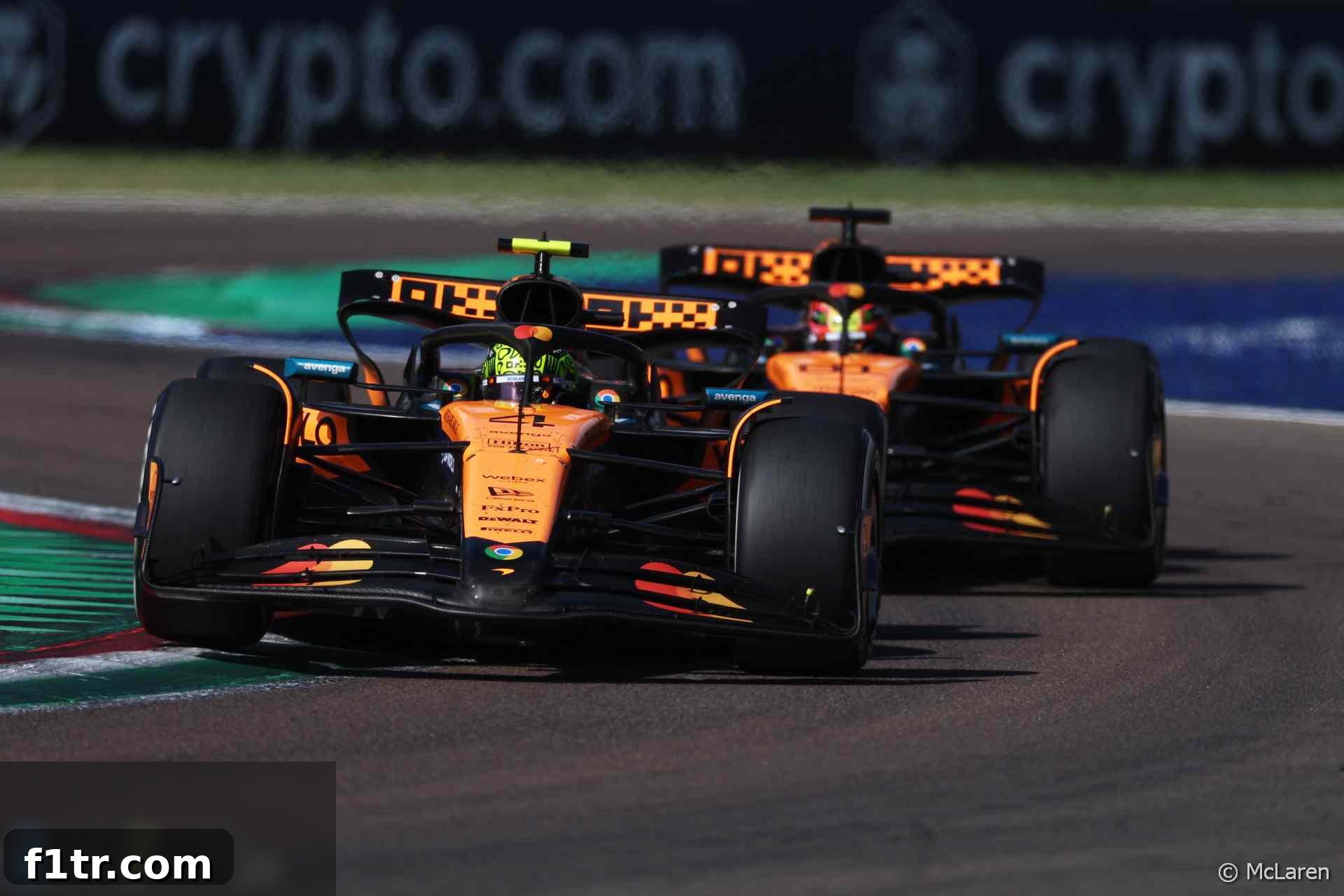
Lando Norris, the charismatic McLaren driver, offered a candid assessment of his team’s performance at the recent Emilia Romagna Grand Prix, admitting a significant underestimation of Red Bull Racing’s raw pace. Following their triumphant victory in Miami, McLaren had arrived at Imola with high hopes, but the iconic Italian circuit presented a starkly different challenge, one that ultimately saw them playing catch-up to the dominant RB20 of Max Verstappen.
Advert | Become a Supporter & go ad-free
Verstappen’s impeccable performance saw him clinch victory by a margin of six seconds over Norris, a lead he meticulously built over the challenging final ten laps of the race. Norris, who masterfully navigated his McLaren from a fourth-place grid start to eventually pass teammate Oscar Piastri for second, ultimately conceded that beating the pace-setting Red Bull was likely beyond reach on Sunday.
Norris Reflects on Imola: A Reality Check After Miami Triumph
“It’s probably the best result I thought we could really achieve today,” Norris articulated post-race, a sentiment that underscored both his satisfaction with a strong P2 finish and his realistic appraisal of the competitive landscape. “I probably just didn’t expect Red Bull to be quite as quick as they were. I’m happy with second. From fourth, it was a good race. But Max was too fast today.”
The Imola weekend marked a pivotal moment for McLaren, arriving fresh off Norris’s maiden Grand Prix victory in Miami. That win had ignited hopes of a genuine championship challenge, positioning McLaren as a credible threat to Red Bull’s long-standing dominance. However, the unique demands of the Autodromo Internazionale Enzo e Dino Ferrari quickly exposed differences in car performance, particularly when compared to the high-speed, flowing nature of the Miami International Autodrome. The contrast highlighted how sensitive modern Formula 1 cars are to track characteristics and how quickly fortunes can swing.
McLaren’s Struggle with Track Characteristics and Car Setup
Norris delved into the specifics of McLaren’s struggles at Imola, highlighting the track’s inherent characteristics as a significant factor. “It didn’t really feel great anywhere, to be honest,” he confessed, elaborating on the car’s handling. “It didn’t feel wonderful to drive. But sometimes it doesn’t and you’re just quick. So it’s a little bit difficult to say.” This nuance reflects the often counter-intuitive world of Formula 1, where a car might feel suboptimal yet still deliver results, or vice-versa.
Advert | Become a RaceFans supporter andgo ad-free
He specifically pinpointed the high-speed corners and the circuit’s notorious bumpiness as areas where the MCL38 struggled relative to its rivals, particularly the Red Bull RB20. “It’s just a very bumpy track. A lot of these high-speed corners, where we seem to maybe struggle a bit comparing to the Red Bulls, that’s where we’ve suffered the whole season so far, the high-speed corners. So we have to work in that area, and maybe that’s proved to hurt us a little bit more this weekend.” This detailed analysis underscores a persistent challenge for McLaren throughout the current Formula 1 season, where their car’s aerodynamic efficiency and suspension setup in fast, undulating sections of circuits have not consistently matched the benchmark set by Red Bull. Optimizing the car for these conditions without compromising performance elsewhere remains a delicate balancing act for technical teams.
Red Bull’s Unseen Pace Advantage Emerges at Imola
While McLaren had managed to capitalize on a safety car period and Verstappen’s prior qualifying struggles in Miami to secure their win, Norris observed a marked improvement in Red Bull’s race pace at Imola. This shift was critical, as it meant that even with Norris’s strong drive and strategic execution, the pure speed of Verstappen’s car on Sunday was insurmountable. Red Bull’s ability to extract peak performance in race conditions, particularly when the car is well-suited to the track, proved decisive.
“We said from the beginning that we have to keep working hard. Max has out-qualified us several times, and their pace just converted today onto Sunday,” Norris explained. This observation sheds light on a recurring pattern: Red Bull often demonstrates blistering one-lap pace, but their Sunday performance has sometimes been more vulnerable. At Imola, however, they seemingly found a way to translate their qualifying advantage directly into race-winning speed. “Sometimes they’ve been ahead, but their pace on Sunday has not been too strong. They’ve maybe worked on some things, and their pace was better today. That’s the price we pay for not being quick enough.” This statement underlines the relentless development race in Formula 1 and how quickly teams can adapt and improve.
The Technical Battle: Mastering High-Speed Corners and Bumps
The battle for supremacy in Formula 1 is often decided by fine margins, and car characteristics play a pivotal role. McLaren’s ongoing challenge with high-speed corners versus Red Bull’s apparent mastery in these sections points to fundamental differences in their respective aerodynamic philosophies and suspension setups. High-speed corners demand exceptional downforce stability and precise handling, allowing drivers to carry immense speed through the apex. If a car lacks this inherent stability, drivers must lift off the throttle or compromise their line, losing precious tenths of a second over an entire race distance.
Imola, with its classic layout featuring iconic corners like Acque Minerali, Piratella, and Rivazza, demands a finely balanced car. The circuit’s bumps further complicate matters, as suspension systems must be adept at absorbing these imperfections without unsettling the car or compromising aerodynamic performance. Red Bull, historically known for its strong front end and excellent traction, often excels in these challenging conditions, maximizing the efficiency of its ground-effect aerodynamics. The RB20 demonstrated exceptional stability and responsiveness, enabling Verstappen to push harder and maintain speed where others had to manage. McLaren, while making significant strides with its recent upgrade packages, still appears to have a performance deficit in these very specific, yet critical, areas. Addressing this will be crucial for their championship ambitions, requiring a deep dive into the car’s setup, aerodynamics, and mechanical grip characteristics.
Championship Implications and Future Outlook for McLaren
The Imola result serves as a sobering reminder that the current Formula 1 season remains a fiercely contested battle, with Red Bull and Max Verstappen still setting the benchmark. While McLaren’s performance surge, particularly in Miami, demonstrated their capability to challenge for wins, Imola highlighted the areas where further development is desperately needed. The gap to Red Bull, though seemingly closed on certain tracks, can reopen swiftly when circuit characteristics favor their rival, reminding everyone that consistency across all track types is key to a title challenge.
For Lando Norris and McLaren, the focus will now undoubtedly shift to meticulously analyzing the data from Imola to understand precisely why their package struggled in the high-speed sections and over the bumps. Future upgrade packages will likely target these specific performance windows, aiming to enhance the MCL38’s versatility across a broader range of circuits. The team’s technical leadership will be under pressure to deliver solutions that allow Norris and Piastri to consistently fight at the front, regardless of track layout. This continuous development race is what makes Formula 1 so compelling, with teams constantly striving to find that extra tenth of a second.
The season is long, and the development race in Formula 1 is relentless. McLaren has proven its ability to make significant gains, and their fighting spirit is undeniable. Their progression from the previous season to now has been remarkable. However, Norris’s admission at Imola is a clear signal: to truly challenge for the championship, they must not only match Red Bull on their strong circuits but also minimize the performance deficit on tracks where the RB20 currently holds an advantage. The next few races will be crucial in determining whether McLaren can sustain their championship aspirations or if Red Bull will reassert its dominance decisively in what promises to be an thrilling season.
Miss nothing from RaceFans
Get a daily email with all our latest stories – and nothing else. No marketing, no ads. Sign up here:
Advert | Become a RaceFans supporter andgo ad-free
2025 Emilia Romagna Grand Prix
- Antonelli was tiring from home race at Imola attention by Friday – Wolff
- Ferrari struggling to recreate set-up which “worked well” in Shanghai – Hamilton
- Verstappen told Red Bull to use Tsunoda before “hold him up” call
- ‘Saturdays have been mine for years but for some reason it’s drifted away’ – Norris
- “Plan C?”: Why McLaren only got their strategy right for one driver at Imola
Browse all 2025 Emilia Romagna Grand Prix articles