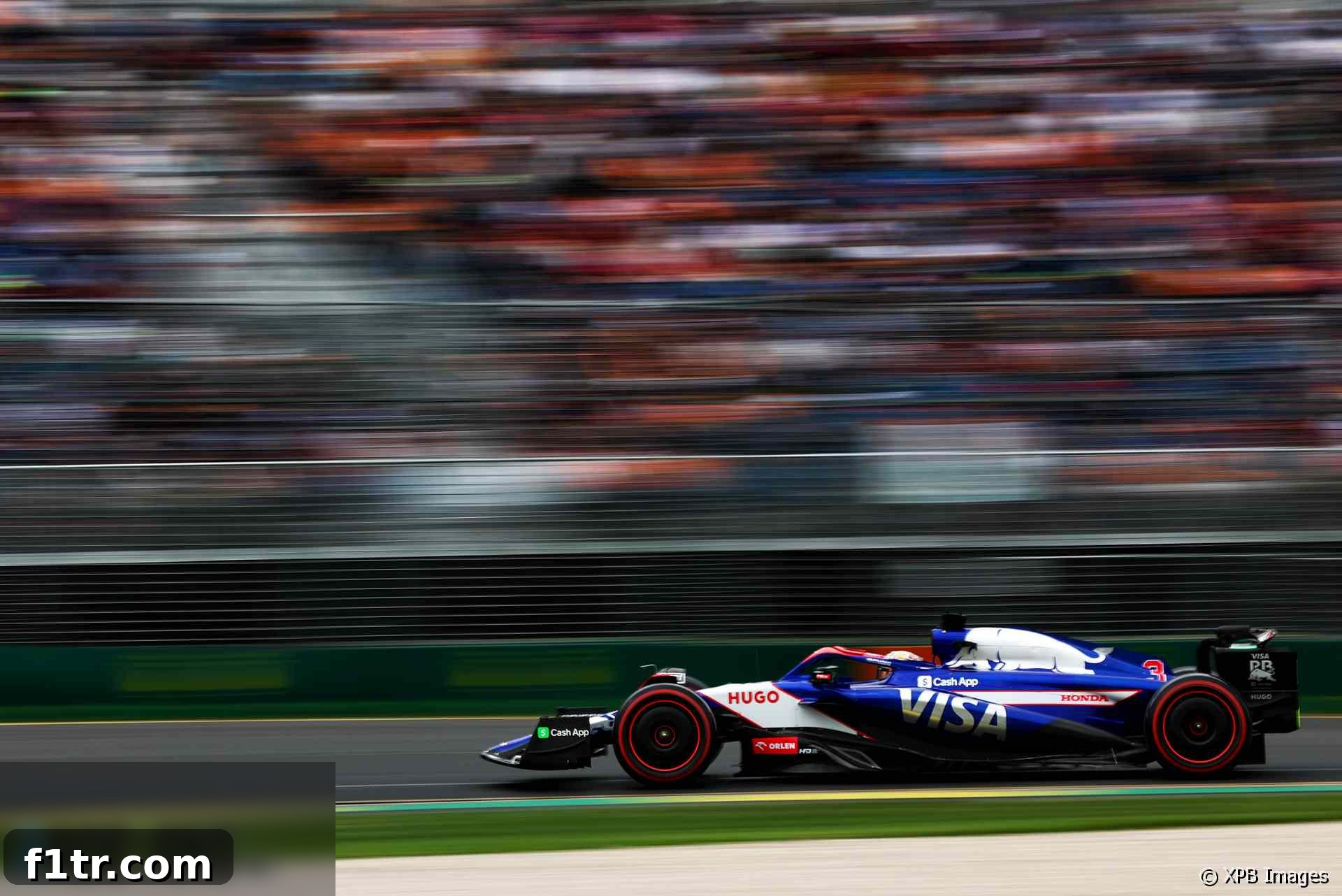
Daniel Ricciardo’s Disheartening Qualifying: Track Limits and Lingering Pace Concerns at His Home Grand Prix
The 2024 Formula 1 Australian Grand Prix qualifying session proved to be a profoundly disappointing affair for local hero Daniel Ricciardo. The RB F1 driver found himself eliminated in Q1, destined to start his home race from a lowly 18th position. Adding insult to injury, his best lap time, which would have been sufficient to progress to Q2, was controversially deleted due to a track limits infringement. Yet, in a revelation that underscored a deeper struggle, Ricciardo admitted he wouldn’t have been satisfied with that lap even if it had stood, highlighting persistent concerns over his car’s performance and his own pace.
Advert | Become a Supporter & go ad-free
Ricciardo’s fastest attempt, a 1’17.466, was just a tenth of a second shy of his teammate Yuki Tsunoda’s time, a margin that would typically see a driver through to the next session in the highly competitive midfield. However, the stewards deemed he had exceeded the track limits at Turn 4, a critical corner at the Albert Park circuit known for catching drivers out. The deletion pushed him down the order, cementing his Q1 exit and leaving him facing an uphill battle on Sunday. This incident served as a stark reminder of the stringent regulations governing track limits in modern Formula 1, where even the slightest deviation can have significant consequences for a driver’s grid position and overall weekend trajectory. For a home Grand Prix, such a setback is particularly crushing.
Reflecting on the incident, Ricciardo conveyed a sense of immediate detachment, suggesting the full weight of the penalty hadn’t immediately registered. “I wouldn’t even say it sunk in when it happened,” he recounted to the official F1 channel. “Pierre [Hamelin, his race engineer] told me and I kind of knew what it meant, but even now I don’t think it’s fully sunk in.” He detailed the moment of the infringement, explaining, “On the lap, I knew Turn 4 I was fighting and I knew I washed [out] a little bit wider. But it happens and then you think about the next corner. So I nearly forgot about it until he brought it up.” This candid admission paints a picture of a driver pushing the absolute limits, perhaps even subconsciously, in a desperate bid for pace. The fine margins in Formula 1 mean that such small errors are often unavoidable when a driver is extracting every ounce of performance, but the outcome here was devastating for his qualifying efforts.
While the track limits infringement undoubtedly contributed to his immediate despair, Ricciardo’s deeper frustration stemmed from a more fundamental issue: his perceived lack of raw speed. The McLaren alumnus, who has faced an arduous journey back to a full-time F1 seat, expressed genuine bewilderment that he had extracted what he felt was the absolute maximum from his RB car, only for it to still be insufficient. “I honestly felt like I’d gave it all I had. So I was happy with the lap, but I wasn’t happy with still where we are in terms of the stopwatch,” he articulated. “So for me that still is not quite adding up in my head where I think it should be.” This sentiment suggests a disconnect between his driving feel and the objective reality of the lap times, a critical challenge for any professional racing driver striving for peak performance and battling for a competitive edge in Formula 1.
The weekend at Albert Park had been a struggle from the outset for the Australian driver. Free practice sessions offered little solace, and qualifying, traditionally the moment where drivers and teams “put it all on the line,” only served to amplify the concerns. “It’s been a struggle, I would say, all weekend. But come qualifying, everyone puts it on and you can see where you’re at, and that lap was all I had and was still slower,” Ricciardo admitted. This persistent underperformance, particularly when compared to his teammate Yuki Tsunoda, who has shown flashes of stronger form, raises significant questions about the car’s inherent pace and its suitability for Ricciardo’s driving style. The competitive nature of the Formula 1 midfield means that even small deficits in performance can lead to a significant drop in grid position, placing immense pressure on drivers to perform consistently.
The RB team, formerly known as AlphaTauri and now officially Visa Cash App RB, had reportedly invested considerable effort in addressing performance issues since the previous round in Saudi Arabia. Ricciardo acknowledged these efforts: “I’ve done enough of these laps and qualis and all that to know where I am and there’s still some things I think where we’re missing. But I’m not sure because the team’s put a lot of effort in since Saudi to fix some things that we saw and adjusted the car and put on some new parts here and there, and it looked better. But I’m still a little bit sceptical.” His skepticism, despite the team’s apparent progress, underscores a lingering uncertainty about the fundamental competitiveness of the V-CARB 01 chassis. Drivers often develop a strong intuition for their machinery, and Ricciardo’s doubt hints that the car’s underlying characteristics might still be hindering his ability to unlock its full potential, or perhaps, that the implemented changes haven’t yielded the expected dividends in raw lap time on track.
The 2024 season marks a pivotal return for Daniel Ricciardo to full-time competition in Formula 1, following a tumultuous period that saw him dropped by McLaren two years prior. His struggles at McLaren were well-documented, as he grappled to adapt to a car that seemingly didn’t align with his driving strengths, ultimately leading to an early departure despite a contract. The current situation, where he confesses he “couldn’t understand why he is losing time in some corners,” echoes some of those past difficulties. He elaborated, “The car itself, I feel the balance and that is all within the window. I’m driving, I’m not really struggling with anything in particular. But then you’ll see just some corners I’m a chunk slower, but that’s kind of all I’ve got.” This paradox – a car that feels balanced and predictable but consistently loses crucial time in specific sectors – presents a perplexing riddle for both driver and engineers. It suggests a potential lack of outright grip, aerodynamic efficiency in certain phases of the corner, or perhaps an inability to extract peak performance from the tyres at critical moments. For a driver of Ricciardo’s calibre and extensive experience, this level of uncertainty about fundamental pace is deeply concerning and highlights the immense pressure he is currently under to deliver results and prove his enduring value in the sport.
Ricciardo’s career has been characterized by his infectious smile and audacious overtakes, earning him a reputation as one of the sport’s most charismatic figures. However, the demands of modern Formula 1 are unforgiving, and performance is paramount. His current predicament at RB, a team with aspirations of climbing the constructors’ standings and nurturing talent, places his future firmly under the spotlight. The F1 paddock is a notoriously competitive environment, and with many young talents eager for a seat, consistently outperforming his teammate and demonstrating clear progress is non-negotiable for Ricciardo to secure his place for 2025 and beyond. His honest appraisal – “So, I don’t know. I’ve got some thoughts but I just know a lap like that, it’s normally faster” – resonates with a driver grappling with a complex technical challenge that is directly impacting his core job: being fast. The psychological toll of such a struggle, particularly at his home Grand Prix, cannot be underestimated.
As the Australian Grand Prix race day approaches, starting from 18th position on a circuit that historically offers limited overtaking opportunities presents a daunting task for Daniel Ricciardo. While anything can happen in Formula 1, including timely safety cars, strategic gambles, or adverse weather conditions, his immediate focus will likely shift to understanding the car’s nuances better and finding a rhythm that allows him to make up ground. The qualifying session in Melbourne has not only exposed ongoing performance issues for Ricciardo and the RB team but has also reignited discussions about the veteran driver’s future in the sport. The road ahead for the ‘Honey Badger’ appears challenging, and the pressure to rediscover his signature pace and confidence is mounting with each passing race weekend, as the global F1 community watches closely for signs of a turnaround.
Advert | Become a RaceFans supporter andgo ad-free
2024 Australian Grand Prix
- Alonso calls Australian GP penalty a ‘one-off I’ve had too many of’
- Red Bull saw warning sign of Australian GP brake problem on Saturday – Verstappen
- Failing to punish Alonso would have “opened a can of worms” – Russell
- Leclerc sure “many team principals” are pursuing Sainz for 2025 seat
- “Don’t put me under pressure” – The best unheard team radio from Melbourne
Browse all 2024 Australian Grand Prix articles