Strategic Advantage: How Max Verstappen and Red Bull Capitalized on a Rival’s Oversight in Qatar
Modern Formula 1 is a crucible of speed, skill, and increasingly, sharp strategic play both on and off the track. A prominent feature of this intricate dance is the use of radio communications by teams and drivers, not just for race management, but also to influence race control and push for penalties against rivals. This tactic, while sometimes controversial, has become an integral part of high-stakes competition. Seldom, however, has it achieved such a spectacular and decisive outcome as it did for Max Verstappen and Red Bull Racing during the recent Qatar Grand Prix, significantly altering the race’s landscape for a key competitor.
The Precedent: Verstappen’s Qualifying Penalty Sets the Stage
The intensity of this strategic maneuvering was palpable even before the main race began. Just 24 hours prior, Verstappen himself found his pole position in qualifying revoked. He was handed a penalty for impeding George Russell by slowing down in front of him, an incident that served as a stark reminder of the strict enforcement of F1’s sporting regulations. This experience undoubtedly sharpened Red Bull’s and Verstappen’s senses, making them acutely aware of any potential infringements by their competitors, perhaps even fueling a desire for balanced justice in the heat of battle.
The Qatar Grand Prix: A High-Stakes Duel Unfolds
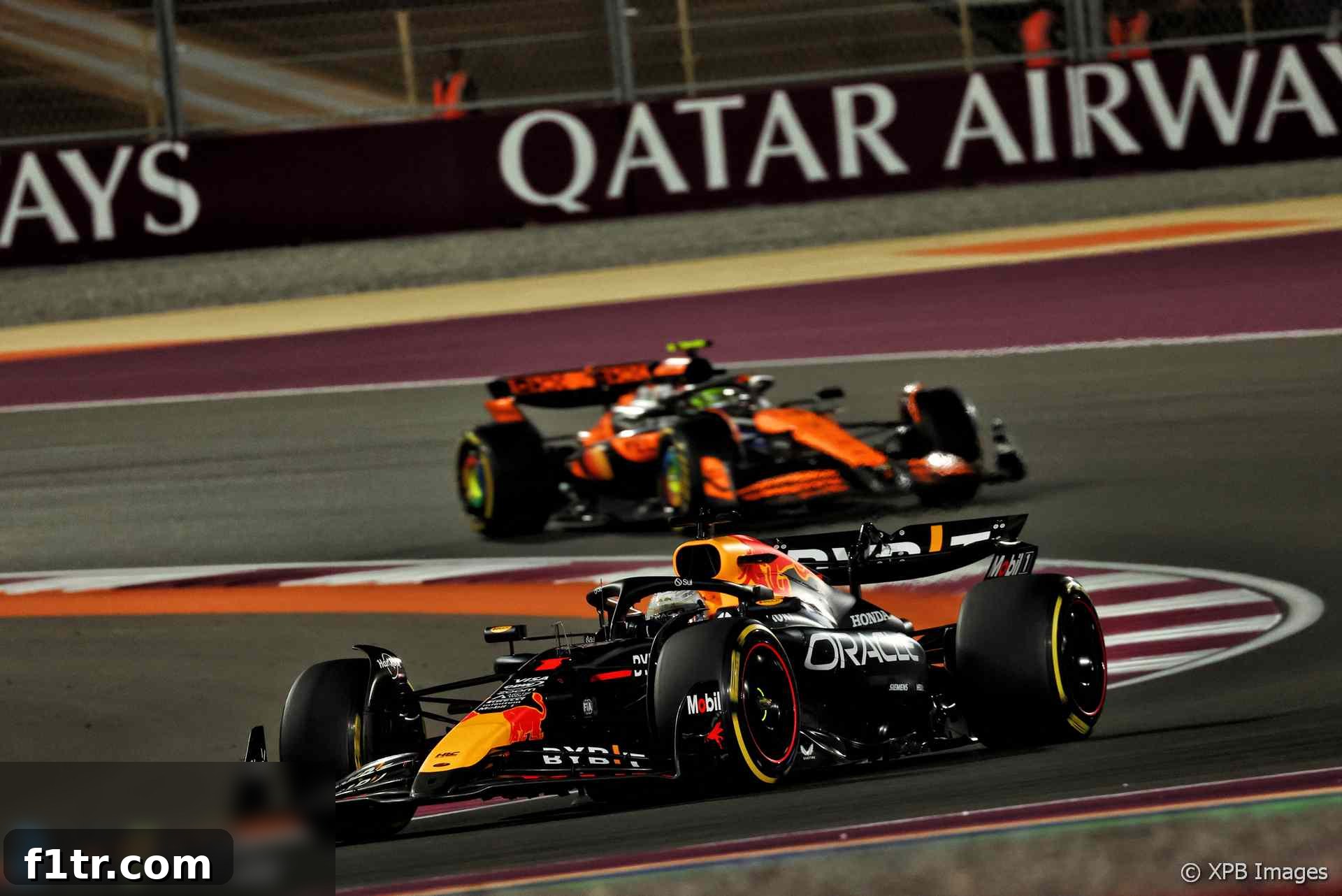
As the Qatar Grand Prix commenced, Verstappen quickly neutralized any lingering threat from the rival who had benefited from his qualifying penalty, securing his lead. However, his initial stint was far from comfortable, with Lando Norris of McLaren applying relentless pressure, constantly breathing down his neck. The battle between these two young titans is always fierce, marked by their exceptional talent and unwavering competitive spirit. This particular race at the Losail International Circuit was shaping up to be another chapter in their gripping rivalry, where every millisecond and every strategic decision could prove pivotal.
The Pivotal Moment: Double Yellow Flags and DRS
It was on the 30th lap, heading into Turn One, that Verstappen spotted a crucial opportunity to turn the tables. He observed marshals waving double yellow flags – a critical signal in motorsport indicating a significant hazard on or near the track, requiring drivers to slow down considerably and be prepared to stop. Reacting instantly, Verstappen lifted off the throttle, as mandated by the regulations. Simultaneously, he instructed his astute race engineer, Gianpiero Lambiase, to verify if Norris had similarly adhered to the safety protocol. This moment was made even more complex as Lambiase had just informed Verstappen that Norris was benefiting from DRS (Drag Reduction System) on that very lap, as he was lapping Valtteri Bottas’s Sauber. The combination of double yellows and DRS presented a clear conflict of racing directives: safety versus outright speed.
| Lambiase | Info, I believe Lando has a free shot at DRS. Yep, Lando on DRS this straight. |
| Verstappen | Check if he lifted for the yellow. |
| Verstappen | There was a yellow in the middle of the straight. |
| Lambiase | Yep, there was, we’ll have a look, make sure he lifted. |
| Lambiase | Max if you see Safety Car or VSC you can pit. Otherwise, stay out. |
| Verstappen | Is there still a yellow or not? |
| Verstappen | Yep it’s still yellow. Stay on the racing line. |
Verstappen’s Alertness and Red Bull’s Immediate Response
Verstappen’s immediate reaction demonstrated his deep understanding of Formula 1’s stringent rules and his natural competitive instinct. “I lifted because I saw the double yellow,” he explained after the race, highlighting his adherence to safety regulations. “And I know that, of course, if I wouldn’t have lifted, it would have been investigated straight away. So you’re just on it.” His quick thinking extended beyond his own compliance; he immediately questioned Norris’s actions. “I asked if he lifted because he had a DRS, I think, from a backmarker at the same time as well. And then, of course, when we came out of Turn One, I saw that he was a lot closer. So I just asked the team to check it. It was just a normal question and I know with double yellows, they’re quite strict.” This was not merely a casual inquiry; it was a deliberate move to ensure fair play and potentially gain a sporting advantage. Red Bull’s race engineers, known for their meticulous attention to detail and ability to process vast amounts of data in real-time, promptly began reviewing the footage of Norris’s lap to verify Verstappen’s observation.
Confirming the Infringement: The Evidence Mounts
The swift investigation by Red Bull’s technical team quickly yielded results. Their review of the telemetry and video evidence confirmed Verstappen’s suspicions: Lando Norris had indeed failed to lift under the double yellow flags. This was a clear breach of the sporting regulations, which explicitly require drivers to significantly reduce speed and be prepared to stop when double yellows are displayed. The consequences of such an infringement can be severe, not only compromising safety in a high-speed environment but also unfairly influencing lap times and race positions. Upon receiving confirmation, Verstappen, ever the strategist, promptly instructed his engineer to report the infraction to race control, escalating the matter officially. This was a crucial step in formalizing the complaint and initiating a potential investigation by the stewards.
| Lambiase | Lando did not lift, Max. |
| Verstappen | Report that, then. |
| Lambiase | Track is clear. And yes, we reported it, Max. Still no reply. |
Pressure Mounts: Red Bull’s Persistent Lobbying
Red Bull’s engineers were not content to merely report the incident; they continued to press the issue, providing further detailed information to race control to bolster their case. This persistence underscored their commitment to ensuring that sporting regulations were upheld, particularly given the perceived injustice they had experienced with Verstappen’s qualifying penalty. Their repeated radio messages to Verstappen, confirming the specific details of Norris’s infringement, served to solidify the evidence and maintain pressure on the race stewards. The precise technical details conveyed, such as Norris being “wide-open throttle” and using DRS right up to the braking zone, painted a clear picture of a driver who had not adhered to the critical safety signals. This detailed relay of information is a testament to the sophisticated communication and data analysis capabilities within modern F1 teams.
| Lambiase | Just to be clear that was wide-open throttle, on DRS, to the braking zone at turn one. |
| Verstappen | Yeah there was double waved yellows there on that lap. |
| Lambiase | Roger that. |
Even during a subsequent Safety Car period, after he had made his scheduled pit stop, Verstappen remained focused on the outcome of his report. His persistent questioning about the yellow flag incident revealed his strategic foresight and determination to ensure the matter was thoroughly investigated. This highlights how drivers, even amidst the chaos of a Grand Prix, maintain a keen awareness of the broader strategic implications beyond their immediate track position.
| Verstappen | Anything on that yellow flag? Or you can just go flat-out through a yellow? |
| Lambiase | Literally just speaking about it now, Max. Stand by. |
The Verdict: Norris Receives a Stop-Go Penalty
The persistence paid off. On lap 44, Lambiase delivered the decisive news: Lando Norris had been found guilty and penalized. The stewards issued a 10-second stop-go penalty, one of the most severe time penalties in Formula 1, requiring Norris to enter the pit lane, stop for ten seconds, and then rejoin the race. This penalty is rarely given and signifies a serious breach of regulations, often related to safety infringements or dangerous driving. Verstappen received the information without a verbal response, his silence perhaps a testament to his satisfaction or intense focus on the remaining laps of the race. The impact on Norris was immediate and dramatic, effectively dropping him out of the points-scoring positions.
| Lambiase | Just information at this stage, Max, but race control now investigating the incident with Lando. |
| Lambiase | Lando has been given a 10-second stop-go penalty, 10-second stop-go penalty, which he needs to serve within two laps. |
| Lambiase | Lando in pit lane, Max. So car behind Leclerc, gap 3.2. |
The Aftermath: Impact and Rivalry Deepens
The 10-second stop-go penalty significantly hampered Norris’s race. It plunged him down the order, initially moving him out of the points. While he displayed remarkable resilience and skill to recover to a respectable 10th place by the checkered flag, the penalty had undeniably cost him a much stronger result. This incident in Qatar served as a vivid demonstration of the high stakes involved in Formula 1 and how quickly fortunes can turn due to a momentary lapse or a rival’s vigilance.
A Modern F1 Battleground: Strategic Lobbying and Sporting Integrity
The Qatar Grand Prix incident perfectly encapsulates the evolving nature of competition in Formula 1. Beyond the raw speed and tactical brilliance, the ability of teams to leverage sophisticated communication systems and real-time data analysis to influence race control has become a critical strategic dimension. This isn’t just about protesting a rival’s actions; it’s about actively monitoring and reporting potential infringements, turning every rule violation into a potential strategic advantage. While some may argue it adds an element of unsportsmanlike conduct, others view it as a necessary part of ensuring sporting integrity in a highly regulated environment. The lines between competitive cunning and simple adherence to rules become incredibly blurred when championship points and reputations are on the line.
Verstappen vs. Norris: A Rivalry Forged in Fire
Although the championship fight between Max Verstappen and Lando Norris was largely decided before the Qatar Grand Prix, this incident underscored that their personal rivalry remains as intense as ever. It’s a rivalry forged in numerous on-track battles and competitive jabs, highlighting the relentless nature of their professional relationship. This wasn’t an isolated event; it echoed a previous instance in Baku where Norris himself had actively ensured that race control spotted a potential infringement by Verstappen during a Virtual Safety Car period. Such tit-for-tat actions exemplify the cutting-edge competition between these two formidable drivers and their respective teams, demonstrating that every opportunity to gain an edge, however small, will be seized upon. Their ongoing contest is not just about who is faster, but also about who is sharper, more disciplined, and better able to navigate the complex labyrinth of F1 regulations.
Conclusion: The Evolving Face of Formula 1 Competition
The Qatar Grand Prix provided a compelling snapshot of modern Formula 1: a sport where advanced technology, strategic communication, and an unwavering commitment to both performance and regulatory compliance converge. Max Verstappen and Red Bull Racing’s successful lobbying for a penalty against Lando Norris was a masterclass in capitalizing on a competitor’s oversight, fundamentally altering the race narrative. It highlights the critical role of vigilance, detailed observation, and robust communication within teams. This incident serves as a powerful reminder that in the high-octane world of F1, success is often a combination of raw talent, engineering prowess, and the strategic acumen to exploit every facet of the sporting regulations. The drama of such moments ensures that Formula 1 remains one of the most captivating and unpredictable spectacles in global motorsport.
Related Articles: 2024 Qatar Grand Prix
Explore more insights and analyses from the 2024 Qatar Grand Prix:
- Horner ‘believes 100%’ Verstappen did not threaten to crash into Russell
- Russell and Verstappen cast new light on clash which triggered explosive row
- Hamilton’s puncture not caused by mirror debris – Mercedes
- Another start-to-finish win shows Qatar GP could be F1’s most processional race
- “Am I dead last now?” Unheard radio from Hamilton’s disastrous Qatar GP
Browse all 2024 Qatar Grand Prix articles