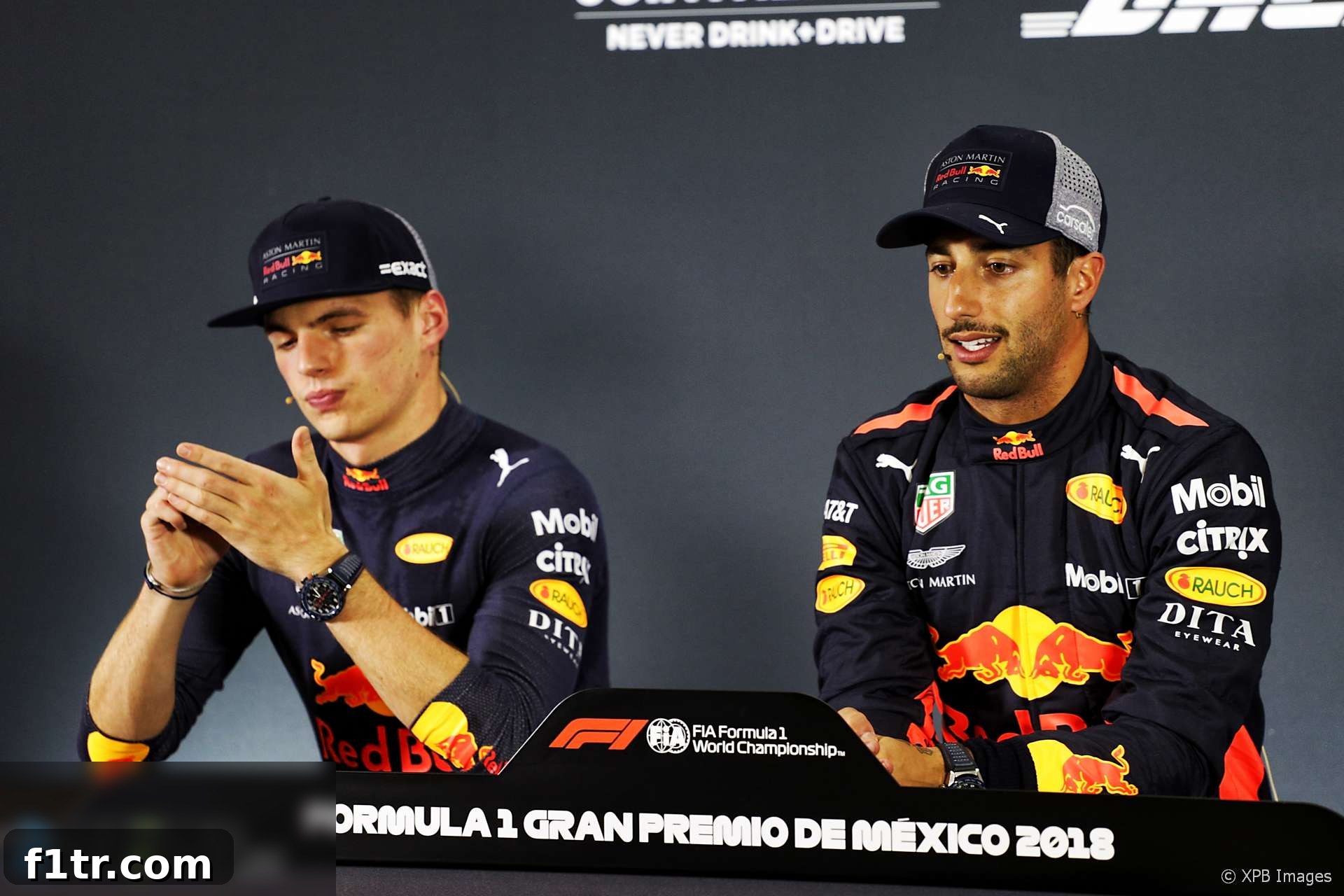
In the high-stakes world of Formula 1, the fine margins between triumph and frustration are often measured in milliseconds and the delicate balance of complex machinery. Such was the stark reality for Max Verstappen at the Mexican Grand Prix weekend, where an exhilarating Sunday victory stood in stark contrast to a perplexing Saturday qualifying session. Just 24 hours before celebrating his second win of the season, a deep-seated frustration enveloped the young Dutchman, stemming from a persistent technical issue that underscored Red Bull Racing’s ongoing challenges with its Renault power unit.
Verstappen had demonstrated formidable pace throughout all three practice sessions at the Autodromo Hermanos Rodriguez, consistently topping the time charts and signaling his intent for pole position. His dominance suggested a straightforward path to the front row. However, in a dramatic turn during the decisive Q3 session, his teammate, Daniel Ricciardo, unexpectedly snatched pole position by an agonizingly slender margin of less than three-hundredths of a second. For any driver, losing out to a teammate in such a critical moment is disappointing, but for Verstappen, the grievance ran deeper. His time loss was attributed to a recurring and deeply unsettling problem with how the Renault power unit affected the intricate balance of his Red Bull RB14.
Verstappen’s strong momentum from practice seamlessly carried into qualifying. He showcased his blistering speed in Q1, leading the pack among those who opted for a single run on the hyper-soft tyres. Subsequently, in Q2, he demonstrated strategic prowess by switching to the harder ultra-softs, securing the top spot and positioning himself advantageously for the race. To fine-tune his car’s handling ahead of the crucial top-10 shootout, he completed an out-lap and an in-lap on hyper-softs at the end of Q2. Despite appearing incredibly competitive and swift on track, Verstappen harbored significant concerns about the car’s potential performance when pushed to its absolute limit on a maximum-attack lap in Q3. These concerns were evident in his radio exchanges with the team.
Verstappen’s Qualifying Concerns: Radio Transcripts
Verstappen’s Radio After Q2 Ultra-Soft Run
| To Verstappen: | And that put you P1. Top six on ultras, 15.6, saw you lost quite a bit of time in sector three as well and it’s still looking a little bit neutral into some of the low-speed turns. |
| Verstappen: | Yeah, very neutral. |
| To Verstappen: | Is that just balance or engine issues? |
| Verstappen: | Well, a little of both. |
This initial exchange highlighted a critical dual problem: a neutral balance, particularly in low-speed corners, coupled with an underlying engine issue. A “neutral” car lacks a definitive bias towards understeer or oversteer, which can be difficult to predict and control, especially when pushing hard. Verstappen’s concise answer, “a little of both,” pointed to a systemic challenge that went beyond simple car setup.
Verstappen’s Radio After Aborted Q2 Hyper-Soft Run
| To Verstappen: | Abort, Max, abort. So just make sure your dash is negative on the way in and box. |
| Verstappen: | How did it look? |
| To Verstappen: | From outside it looked reasonable, certainly sector two through sector three. How did the car feel? |
| Verstappen: | Yeah, same issues still. |
| To Verstappen: | Understood. You were purple again in sector two. Looked like your sector three was again a step up. |
| Verstappen: | Yeah I have a lot of rear locking under braking as well which is not helping. |
| To Verstappen: | Which corners? |
| Verstappen: | One a little bit but especially four. |
| To Verstappen: | OK we’ll have a look, thank you. |
The subsequent radio conversation after an aborted hyper-soft run further clarified the problem. Despite strong sector times, Verstappen explicitly stated, “same issues still,” and crucially, “I have a lot of rear locking under braking as well which is not helping.” Rear locking, especially during downshifts or throttle lift-off, causes the rear wheels to lose traction, making the car unstable and unpredictable. This is particularly problematic for a driver who relies on precise rear-end stability for aggressive corner entry. The team acknowledged the issue, promising to investigate, but the seeds of frustration had already been sown.
True to his pre-Q3 concerns, after leading the initial runs on the hyper-softs, Verstappen found himself unable to improve on his second and final run. This allowed Daniel Ricciardo, who had evidently managed to extract the maximum from his car, to seize pole position in a dramatic upset. The immediate aftermath saw Verstappen articulating the persistent nature of his woes.
“I was struggling the whole qualifying with the same problems I had in FP2,” Verstappen explained to the media. “I had a lot of rear locking on the down-shifting and when I come off throttle. Somehow the behaviour was not correct.” This recurring instability, particularly during crucial phases of corner entry where drivers modulate the throttle and gears, significantly eroded his confidence. In Formula 1, confidence is paramount; without it, a driver cannot push the car to its absolute limits, leaving crucial performance on the table. The issue effectively forced Verstappen into a more conservative driving approach than his natural, aggressive style demands.
As a direct consequence of this persistent problem, Verstappen was unable to drive the Red Bull RB14 with the full confidence required to extract its maximum potential. “I just had to lock a lot of tools, go forward on the brake balance to try and stabilise the whole car. It’s not how you want to do qualifying, normally you go more aggressive and be more aggressive on all the tools.” This revelation highlights a significant compromise. “Locking a lot of tools” implies fixing certain car settings (like differential or engine braking maps) to a more benign state, rather than dynamically adjusting them for optimal performance through each corner. Moving the “brake balance” forward shifts more braking power to the front wheels, which can help stabilize the rear but often at the cost of overall braking efficiency and turn-in agility. These adjustments are a testament to the struggle Verstappen faced, having to compensate for an inherent flaw rather than exploit the car’s strengths.
Understanding the Technical Nuances: Verstappen’s Driving Style and Engine Braking
Red Bull team principal Christian Horner provided crucial insight into the root cause of the issue, acknowledging that the problem was present in both drivers’ cars. However, the critical difference lay in how each driver, particularly Max Verstappen, interacts with and commands his RB14. “Max is more sensitive to it from the entry speed he takes into a corner than Daniel,” said Horner. “That’s always been the case.” This explanation points to a fundamental disparity in driving styles, where Verstappen’s unique approach amplifies a pre-existing characteristic of the Renault power unit.
The core of the problem stems from Verstappen’s exceptionally high corner entry speed. He pushes the car into corners with immense momentum, relying heavily on the car’s rear-end stability to maintain control and trajectory. When power is fed into the transmission during downshifts – a process known as engine braking – any inconsistency or abruptness can profoundly unsettle the rear of the car. Horner elaborated on the technical specificity: “It’s the throttle control on the downshift: Getting the right throttle control on the blip on the downshift and the right torque engagement basically into the gearbox. It’s a mapping issue.” The “blip” refers to a momentary increase in engine RPM during a downshift to match engine and wheel speeds, ensuring a smooth gear change. If the engine mapping for this blip or the subsequent “torque engagement” is not perfectly calibrated, it can lead to erratic engine braking characteristics, causing the rear wheels to momentarily lock up or lose grip, especially under the extreme loads of high-speed corner entry that Verstappen favors.
Intriguingly, Horner revealed that this specific trait of the Renault power unit was also apparent during its first generation of V6 hybrid power units, notably when Sebastian Vettel drove for Red Bull. “[Verstappen] takes so much speed into the corner he relies – a little bit like Sebastian used to, Sebastian was always more sensitive to it than Daniel – particularly with Max’s driving style when he carries so much momentum into the corner, if he doesn’t get what he expects it unsettles the car, catches him out. And then you have to under-drive the car at that point in time.” This comparison is telling, drawing a historical parallel between two highly sensitive and aggressive drivers, both of whom struggled with Renault’s engine braking characteristics more than their teammates. It highlights a long-standing pattern where certain driving styles, particularly those that push the limits of corner entry speed and demand absolute rear-end stability, are more adversely affected by these power unit idiosyncrasies. When the car doesn’t respond predictably, the driver is forced to “under-drive,” meaning they cannot push the car to its maximum potential, sacrificing lap time and confidence.
Future Prospects and Strategic Choices
Sebastian Vettel ultimately resolved his frustration with the Renault power unit by making a high-profile move to Ferrari, where he found a different engine philosophy that better suited his driving demands. Max Verstappen, similarly, expressed strong hopes that his persistent issues would be resolved when Red Bull transitions to Honda power units in the subsequent season. This move represented a significant strategic shift for Red Bull, driven partly by the desire for a power unit that offered greater control and predictability, especially in critical areas like engine braking. For Verstappen, the promise of a Honda engine meant the potential for a power unit that harmonized more effectively with his aggressive, high-speed corner entry driving style, allowing him to exploit his full talent without battling inherent car instability.
Meanwhile, Daniel Ricciardo, whose driving style was less susceptible to these specific Renault power unit frustrations, made the decision to continue with Renault power units in his next chapter in Formula 1. His move to the Renault F1 team underlined the fact that for some drivers, the engine characteristics, while challenging for others, did not fundamentally impede their performance or confidence. This divergence in driver preferences and sensitivities highlights the complex interplay between a driver’s unique style, the car’s chassis dynamics, and the specific characteristics of the power unit – a triumvirate that must align perfectly for championship-winning success. The qualifying session in Mexico, despite leading to a Sunday victory, served as a stark reminder of the technical battles fought behind the scenes and the relentless pursuit of perfection in Formula 1.
2018 F1 season
- F1 feared “death knell” for Drive to Survive after Ferrari and Mercedes snub
- McLaren staff told us we were “totally crazy” to take Honda engines in 2018 – Tost
- ‘It doesn’t matter if we start last’: How Red Bull’s junior team aided Honda’s leap forward
- Honda’s jet division helped F1 engineers solve power unit problem
- McLaren Racing losses rise after Honda split
Browse all 2018 F1 season articles