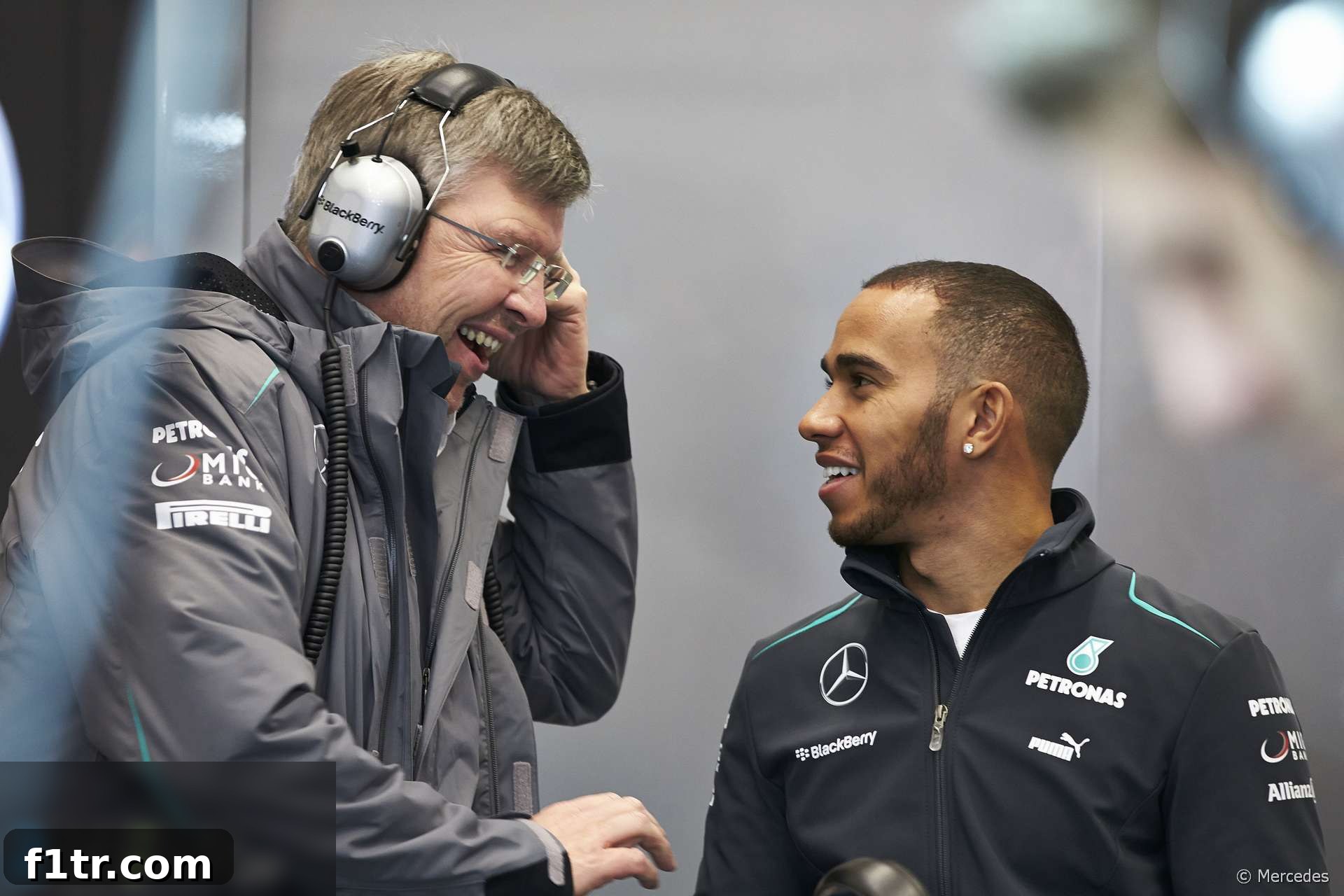
The Pivotal Decision: How Lewis Hamilton Almost Wasn’t a Mercedes Star
In a revelation that sends ripples through Formula 1 history, former Mercedes CEO Nick Fry has disclosed that the team’s top management initially favoured veteran driver Nick Heidfeld for the coveted seat that Lewis Hamilton now occupies. This surprising detail emerges from the high-stakes contract talks that ultimately saw Hamilton depart from McLaren to join Mercedes in 2013, a move that would redefine a decade of Formula 1.
The decision, made six years prior to this article’s original publication, would prove monumental. Mercedes had brought Lewis Hamilton on board as the highly anticipated replacement for the legendary Michael Schumacher, who had concluded his illustrious career. Since his arrival at the Brackley-based squad, Hamilton has not only met but vastly exceeded expectations, clinching multiple world championships and cementing his status as one of the sport’s all-time greats.
Mercedes’ Quest for Dominance: From Schumacher to a New Era
Before Hamilton’s seismic transfer, Mercedes Grand Prix was a team in transition. Having returned to Formula 1 as a full factory outfit in 2010, they had invested heavily, even bringing Michael Schumacher out of retirement. While Schumacher’s presence brought immense prestige and invaluable development experience, the outright race victories and championships Mercedes yearned for remained elusive. The team, still finding its footing, knew it needed a catalyst, a driver who could not only deliver on track but also inspire and lead the entire operation towards an era of sustained success.
The car in 2012 was competitive but not dominant, and the team faced the daunting task of developing the forthcoming V6 turbo-hybrid regulations, which would debut in 2014. Securing the right talent was paramount. They needed someone with raw speed, championship pedigree, and the mental fortitude to spearhead a new project. The search for Schumacher’s successor was arguably one of the most critical talent acquisition processes in modern F1 history, one that would dictate the trajectory of the sport for years to come.
Hamilton at McLaren: A Champion Seeking a New Challenge
At the time, Lewis Hamilton was a McLaren prodigy, a driver they had nurtured since his karting days. He had delivered a sensational World Championship title in 2008, his second season, and continued to be a front-runner. However, by 2012, cracks were beginning to show in his relationship with the Woking-based team. Despite winning races, McLaren hadn’t mounted a serious title challenge since 2008, and Hamilton was growing increasingly frustrated with what he perceived as a lack of competitive edge and certain contractual limitations.
The opportunity at Mercedes, though seemingly a step down to a less successful team at the time, offered a blank slate and the promise of a long-term vision, particularly with the impending hybrid era. Hamilton’s then-manager, Simon Fuller, initiated discussions with Nick Fry in mid-2011, with formal talks intensifying in the summer of 2012. It was a bold move for Hamilton, leaving the team where he had spent his entire F1 career, and one that required immense foresight and belief in the Mercedes project. The risk, as history would show, paid off spectacularly.
The Unsung Contender: Nick Heidfeld’s Near Miss at Mercedes
According to Nick Fry’s candid account in his forthcoming book, ‘Survive. Drive. Win.’, the path to signing Lewis Hamilton was far from straightforward. Mercedes’ senior staff, initially, were “lukewarm” about the prospect of Hamilton joining their ranks. This hesitation opened the door for other candidates, most notably Nick Heidfeld. Heidfeld, a veteran of 183 Grands Prix, had amassed an impressive record of consistent points finishes and podiums throughout his career, often in midfield machinery. He had raced for teams like Sauber, Williams, and BMW Sauber, earning a reputation for his technical feedback and smooth driving style.
Fry vividly recounts being repeatedly pushed by Mercedes management to “look at people like Nick Heidfeld again.” Heidfeld himself was described as “super-keen to get the seat,” going as far as to “repeatedly text me with photos of himself, his family and his dog in a futile bid to pique my interest.” This anecdote underscores the intense desire of drivers to secure a top seat and the often-unconventional lengths they would go to in order to make an impression. Heidfeld had parted ways with Renault midway through the 2011 season, making him an experienced and readily available option.
While Heidfeld possessed undeniable talent and experience, particularly in developing cars, he lacked the championship-winning aura and global superstar status that Hamilton already commanded. His best finish in the championship was fifth, and despite numerous podiums, he never secured a Grand Prix victory. The contrast between Heidfeld’s solid, reliable career and Hamilton’s explosive, history-making trajectory highlights the monumental nature of the decision Mercedes ultimately faced. Had they chosen Heidfeld, the entire landscape of Formula 1, and indeed the Mercedes legacy, would have been drastically different.
Other Drivers in Consideration: Di Resta and Villeneuve
The Mercedes team’s meticulous search extended beyond Heidfeld. Fry also noted that Paul di Resta, then driving for Force India and with strong ties to Mercedes through his DTM career, was considered for the role. Furthermore, even Jacques Villeneuve, a former world champion who had experienced a dramatic fallout with the team eight years prior when it was branded British American Racing, reportedly offered his services. These alternative considerations underscore the high stakes and the range of options Mercedes explored before making their definitive choice.
Niki Lauda: The Catalyst for a Legacy
The turning point in the Hamilton negotiations came with the arrival of Formula 1 legend Niki Lauda as Mercedes’ non-executive chairman in September 2012. Lauda, a three-time world champion himself, possessed an unparalleled understanding of racing and an astute eye for talent. He instantly recognized Hamilton’s immense potential and the transformative impact he could have on the nascent Mercedes team. Lauda’s influence proved to be the decisive catalyst needed to overcome the internal skepticism within Mercedes management.
According to Fry, Lauda’s directive on his very first day working for the team in September 2012 was clear and unequivocal: “go and do it and I will ask Mercedes for forgiveness later.” This bold, no-nonsense approach from a figure of Lauda’s stature cut through the bureaucracy and hesitation, greenlighting what would become one of the most successful partnerships in sports history. Lauda’s unwavering belief in Hamilton was instrumental, showcasing his visionary leadership and commitment to building a championship-winning team. His ability to convince the board to invest in Hamilton was a critical moment that forever altered Mercedes’ destiny.
The Hamilton-Mercedes Dynasty: A Partnership That Rewrote History
Hamilton’s groundbreaking move to Mercedes was officially announced on September 28th, 2012, sending shockwaves through the F1 paddock. Few could have predicted the sheer scale of success that this partnership would achieve. The timing, coinciding with the advent of the V6 turbo-hybrid regulations in 2014, was impeccable. Hamilton, alongside Mercedes’ engineering prowess, adapted seamlessly to the new era, ushering in a period of unprecedented dominance.
From 2014 onwards, Lewis Hamilton and Mercedes became virtually unstoppable. Hamilton secured his first championship with the team in 2014, followed by titles in 2015, 2017, 2018, 2019, 2020. This incredible run cemented his place as one of the most decorated drivers in F1 history, tying Michael Schumacher’s record of seven world championships. Beyond the statistics, Hamilton’s influence extended to the team’s culture, driving innovation and setting new benchmarks for performance. His strategic racing, consistent brilliance, and ability to perform under pressure became hallmarks of the Mercedes era. The decision to bring Hamilton in, initially met with internal resistance, blossomed into a dynasty that redefined modern Formula 1, proving Niki Lauda’s vision profoundly correct.
Nick Fry’s Revealing Memoir: Behind the F1 Curtains
Nick Fry’s book, “Survive. Drive. Win.,” co-authored with Ed Gorman, provides invaluable insights into the inner workings of Formula 1 during a pivotal period. Such memoirs are crucial for shedding light on the often-secretive world of top-tier motorsport, revealing the complex negotiations, political machinations, and personal dynamics that shape the sport’s landscape. Fry’s recollections offer a rare glimpse into the high-stakes decisions that underpin success, highlighting the immense pressure and foresight required to navigate the fiercely competitive environment of F1.
“Survive. Drive. Win.” by Nick Fry and Ed Gorman was published by Atlantic Books on October 3rd.
A Different Timeline: Reflecting on What Might Have Been
The revelation that Nick Heidfeld was a primary contender for Lewis Hamilton’s Mercedes seat serves as a powerful reminder of how finely balanced the scales of fate can be in elite sport. One decision, one influential voice, changed the course of Formula 1 history irrevocably. Had Mercedes opted for Heidfeld, the F1 landscape of the 2010s would have been drastically different. Mercedes might not have achieved their unparalleled run of championships, and Lewis Hamilton’s legacy, while still significant, would likely have taken a very different path.
This “what if” scenario underscores the profound impact of talent acquisition in Formula 1 and the visionary leadership required to make unconventional, yet ultimately transformative, choices. The story of Lewis Hamilton and Mercedes is not just about a driver and a team, but about a pivotal moment where destiny hung in the balance, shaped by astute judgement and a touch of daring.
Related Formula 1 Content
- Crying in the Melbourne car park at 2019 grand prix was my career low – Ocon
- McLaren Racing reports reduced £71 million loss in 2019
- Kvyat: Hockenheim podium last year was “my biggest achievement” so far
- How the FIA’s new encrypted fuel flow meter targets Ferrari’s suspected ‘aliasing’ trick
- “He smashed my office door”: 23 must-see moments from ‘Drive to Survive’ season two
Browse all 2019 F1 season articles