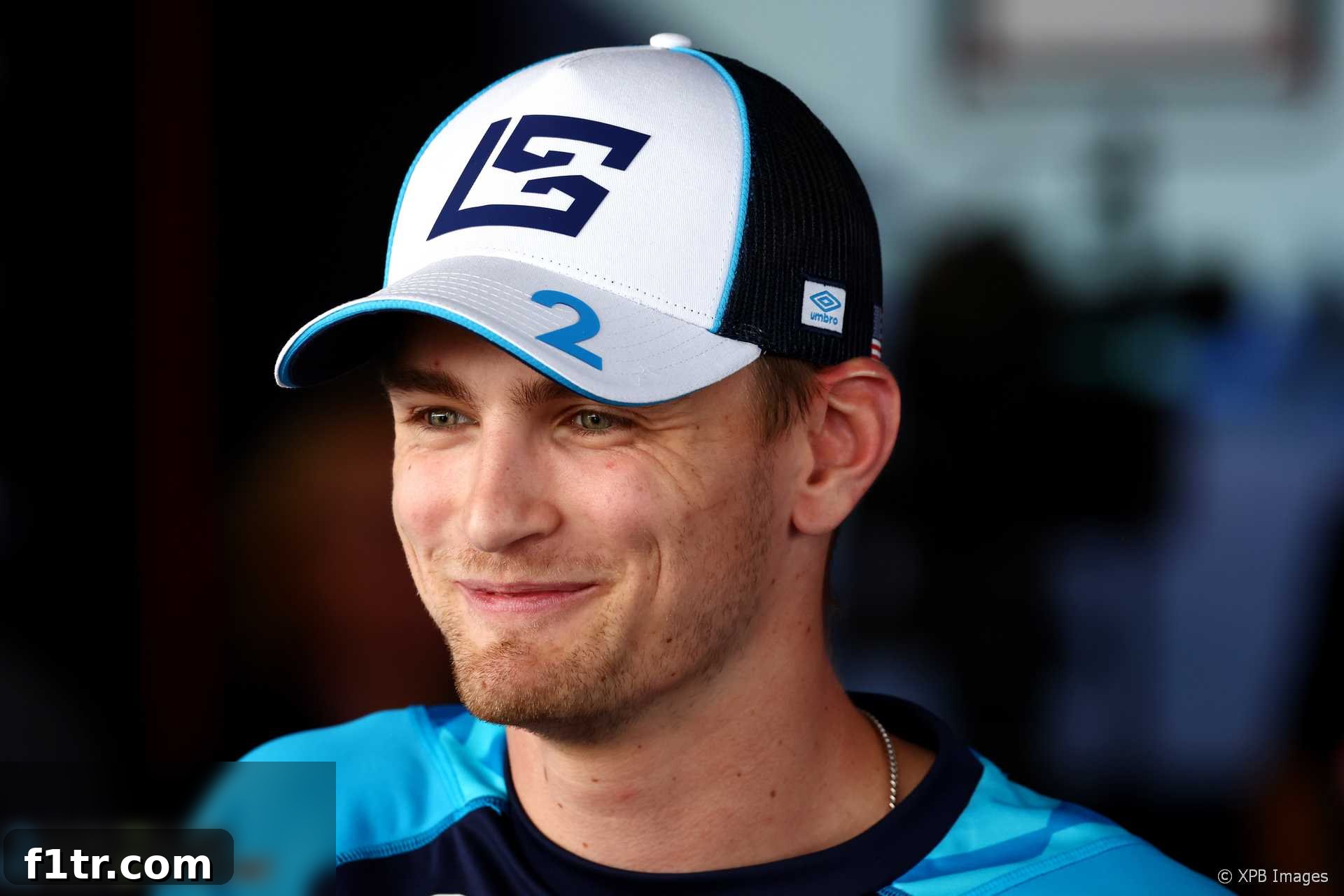
Logan Sargeant’s Breakthrough: A Deep Dive into His First Formula 1 Point and Rookie Season Challenges
The world of Formula 1 demands relentless perseverance, especially from rookies battling to establish their presence. For Logan Sargeant, the 2023 United States Grand Prix marked a pivotal moment in his debut season, as he clinched his maiden Formula 1 point. This achievement, a significant milestone for any driver, provided a much-needed boost for the young American and his Williams Racing team. Dave Robson, Williams’ head of vehicle performance, eloquently captured the driver’s mood following this breakthrough, stating that Sargeant was “desperate to get back in the car,” brimming with enthusiasm and an undeniable bounce in his step.
Sargeant’s tenth-place finish in Austin, Texas, was not just a personal victory but also a significant morale injection for Williams, marking their first points finish with two cars since the 2021 Belgian Grand Prix. It was his second of three home races in his rookie campaign, adding a special layer of meaning to the accomplishment. This positive result came after a challenging period, which included a concerning mid-race withdrawal from the Qatar Grand Prix due to ill health in the brutally hot and humid conditions. Such an experience underscored the immense physical and mental demands placed upon Formula 1 drivers, especially newcomers trying to adapt to the sport’s unforgiving nature.
A Point Hard-Earned: Beyond the Disqualifications
While Logan Sargeant was ultimately promoted to the final points-scoring position following the disqualifications of Lewis Hamilton and Charles Leclerc due to plank wear infringements, Dave Robson was quick to emphasize that the point was unequivocally earned. Robson lauded Sargeant’s performance, highlighting his “very strong race pace” throughout the Grand Prix. This assertion is crucial, as it validates the young driver’s inherent speed and racecraft, demonstrating that he wasn’t merely a beneficiary of others’ misfortunes but genuinely drove a competitive race.
The ability to maintain strong race pace, manage tires effectively, and execute a consistent strategy are hallmarks of an accomplished Formula 1 driver. For a rookie like Sargeant, showcasing these traits in a high-pressure environment like a home Grand Prix speaks volumes about his potential. The point, irrespective of how it was officially confirmed, served as tangible proof of his progress and capability, providing a solid foundation for renewed confidence and motivation as he looked to “go and do it again” in subsequent races.
Navigating the Rookie Labyrinth: Challenges and Growth
Sargeant’s journey in Formula 1 has been a testament to the steep learning curve faced by every debutant. His season began with promise, including an “outstanding” 12th-place finish on his debut in Bahrain, which hinted at his raw talent. However, as the season progressed, the challenges intensified. Robson noted that Sargeant faced a particularly “tougher job” on a group of tracks that were entirely new to him, requiring rapid adaptation and understanding of diverse circuit characteristics.
Adding to these difficulties was the unfortunate circumstance of having to use some older car parts compared to his more experienced teammate, Alexander Albon. In a sport where fractional differences in car performance can have significant impacts, running with a less-than-optimal specification can severely hinder a driver’s ability to extract maximum performance and build confidence. This disparity in equipment “probably hurt his confidence a bit,” according to Robson, as it would naturally lead to tougher comparisons and greater struggles, especially against a highly capable teammate like Albon.
The European leg of the season saw a resurgence in Sargeant’s form, with Robson observing that he “came back strong,” even if points were still elusive. This period demonstrated his resilience and ability to learn and adapt. However, a series of “rough races” involving car damage further complicated his progress. Incidents that led to damage not only impacted the “spec” of his car dueencing the parts available for repair and development but also undoubtedly “affected his confidence a little bit.” In Formula 1, confidence is a fragile yet vital asset, and even minor setbacks can have a cumulative effect on a driver’s mental state and performance. Robson expressed his optimism that Sargeant’s confidence is now “back on the way up again” after his positive result in Austin, anticipating a renewed charge in the remaining races.
The Albon Benchmark: Experience vs. Raw Talent
One of the most valuable aspects of Logan Sargeant’s rookie season has been the opportunity to benchmark himself against a proven performer like Alexander Albon. Dave Robson highlighted that the difference between Sargeant and Albon in terms of one-lap pace in qualifying is “really quite small.” This indicates that Sargeant possesses genuine raw speed, a fundamental requirement for success in Formula 1. However, the true differentiator, especially in the cut-and-thrust of race conditions, lies in Albon’s extensive experience.
Robson eloquently explained the profound complexity of Formula 1 racing, stating, “I think it’s genuinely quite difficult to explain to everyone how complicated it is, and how seemingly small and innocuous changes can have big impacts.” This complexity manifests in various aspects, from subtle adjustments to driving style to intricate car setup changes, tire management strategies, fuel saving, and understanding the nuances of race strategy. An experienced driver like Albon has a much deeper comprehension of how these myriad factors interact and can optimize his performance accordingly. “I think that’s still somewhere where he struggles to get his head around it a little bit,” Robson concluded, pointing to the ongoing learning process Sargeant must undertake to master the strategic and technical intricacies of a Grand Prix.
The ability to consistently extract performance over a full race distance, manage tire degradation, react to changing track conditions, and communicate effectively with engineers about car balance and setup is an art form honed over many years. Albon’s experience allows him to provide more precise feedback, anticipate race developments, and execute strategies with greater consistency, offering a clear target for Sargeant to aspire to and learn from.
The Added Hurdle of Sprint Events and Unlucky Breaks
As if the standard challenges of a rookie season weren’t enough, the introduction of sprint events further complicates matters for new drivers. Robson underscored this difficulty, particularly in weekends featuring the sprint race format, such as the Brazilian Grand Prix. “Obviously, with the sprint events, it’s particularly difficult, because you don’t get to see any of Alex’s proper race data,” he explained. The compressed schedule, with only one free practice session before qualifying, leaves minimal time for setup adjustments, track familiarization, and data analysis. This limited track time severely disadvantages rookies who desperately need every lap to refine their skills and understand the car’s behavior.
In a standard race weekend, multiple practice sessions allow rookies to experiment with setups, learn tire degradation patterns, and analyze their teammate’s long-run data to identify areas for improvement. Sprint weekends drastically reduce this crucial learning opportunity, forcing them to make high-stakes decisions with less preparation. This scenario further highlights the mental fortitude required, as rookies must quickly adapt and perform under immense pressure.
Adding to the list of rookie challenges, Sargeant also encountered his share of bad luck. The Mexican Grand Prix, held just before Brazil, was another instance where potential points slipped through his fingers. After running commendably in 12th position, he was classified 16th due to a fuel pump problem that forced his retirement on the very last lap. Such mechanical failures are particularly frustrating for drivers, especially when they are on the cusp of delivering a strong result. These incidents, while beyond his control, underscore the fine margins and unpredictable nature of Formula 1, requiring a resilience to bounce back from disappointment.
Looking Ahead: Sargeant’s Trajectory and Williams’ Future
The journey of Logan Sargeant in Formula 1 is far from over. His first point at the United States Grand Prix served as a vital validation of his talent and an indicator of his potential to grow within the sport. While the path has been arduous, marked by the typical rookie struggles of adapting to new tracks, managing car development disparities, and grappling with the mental toll of performance pressure, his resilience shines through.
For Williams Racing, Sargeant’s development is crucial. As the team aims for a stronger constructors’ championship standing and future competitiveness, having two capable drivers consistently pushing the limits is paramount. The insights gained from Albon’s experience, coupled with Sargeant’s improving understanding of F1’s complexities, paint a hopeful picture for the team’s trajectory. As Sargeant continues to learn and refine his racecraft, leverage the renewed confidence from his Austin achievement, and overcome the unique challenges of the sprint format, his trajectory in Formula 1 will be watched with keen interest. The first point is merely the beginning of what Williams hopes will be a long and successful career for the young American.
2023 United States Grand Prix Related Articles
- US GP was Mercedes’ best race of 2023 despite disqualification – Wolff
- Singapore and Austin retirements cost me top 10 championship place – Ocon
- United States Grand Prix result unchanged as FIA rejects Haas’ call for review
- Sargeant admits he’s ‘struggled to use all the downforce at times’ in F1
- Mercedes’ Brazilian GP set-up was “conservative” after US GP disqualification
Browse all 2023 United States Grand Prix articles