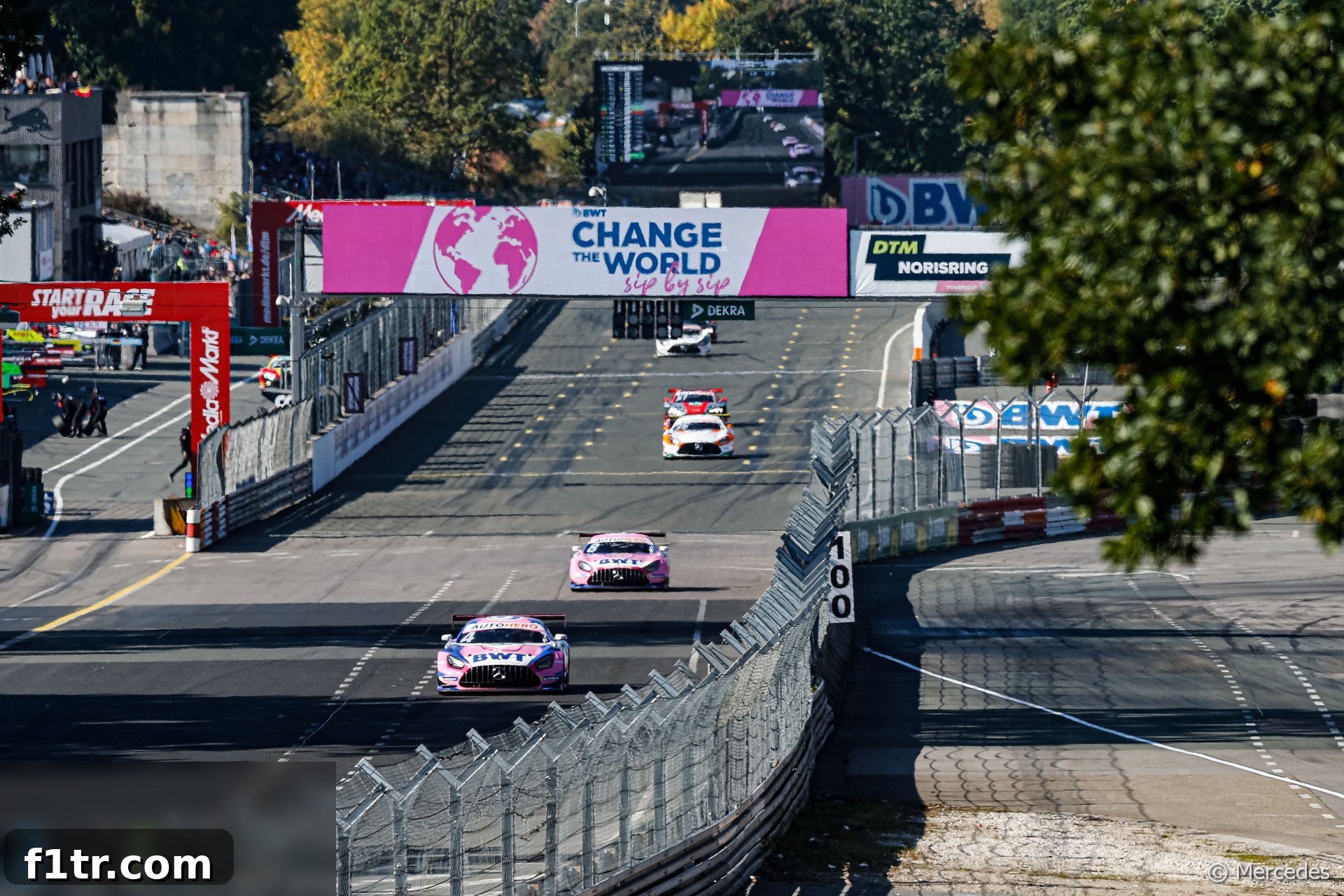
In a recent round-up of significant motorsport news, Mercedes team principal Toto Wolff weighed in on the contentious team orders observed in the DTM’s season finale, asserting that such practices would not be permissible or occur within the highly regulated and integrity-driven environment of Formula 1.
Formula 1: Upholding Integrity Amidst Motorsport’s Team Order Debates
Wolff: F1’s Stance on Team Orders Diverges from DTM’s “Modus Operandi”
The dramatic conclusion of Germany’s premier touring car series, DTM, ignited a firestorm of criticism following allegations of orchestrated team orders. Reports detailed how drivers from one Mercedes customer team appeared to deliberately slow down, creating an advantage for a rival Mercedes customer driver to secure the championship. This controversial event prompted widespread discussion across the motorsport world, raising questions about sporting fairness and competitive integrity.
Naturally, the spotlight immediately shifted to Formula 1, particularly given the intense championship battle unfolding between Mercedes’ Lewis Hamilton and Red Bull Racing’s Max Verstappen. Could a similar scenario, involving strategic manipulation between teams, ever materialize in F1? According to Mercedes team principal Toto Wolff, the answer is a resounding no.
Wolff firmly stated his belief that such inter-team manipulation is unprecedented in Formula 1. “In my opinion, that has never happened in Formula 1, that other teams have given up positions for anybody else, at least not in my recollection,” he asserted. He drew a clear distinction between the operational norms of DTM and F1, highlighting a historical precedent in the German touring car series. “In touring cars it’s a modus operandi in the DTM that we have known for a long time. In the DTM 30 years ago, they started to do that and we saw that also in the last race. But that’s not going to happen in Formula 1.”
This distinction underscores Formula 1’s commitment to maintaining competitive fairness and ensuring that championships are won purely on merit and performance within specific team structures. While F1 has had its own debates over team orders within a single constructor (e.g., instructing one driver to let another pass), the notion of an entirely separate team sacrificing its own race positions to aid a competitor in securing a championship is alien to its philosophy. The global appeal and stringent regulations of F1 mean that any perceived external manipulation would severely damage the sport’s credibility and the legitimacy of its champions, a risk F1’s governing bodies and teams are eager to avoid. The focus remains on pure, unadulterated racing, even if strategic decisions within a team are a part of that.
F1’s Expansion in the Americas: A Strategic Move for Global Viewership and Engagement
Formula 1’s drive for global expansion continues unabated, with a significant focus on strengthening its presence in the Americas. Alejandro Soberon, the influential president of the Mexico City Grand Prix promoter CIE, recently articulated the strategic advantages of hosting more F1 races across the American continent. His perspective highlights how an increased number of events in this region can substantially boost the sport’s global popularity and viewership figures.
Advert | Become a Supporter & go ad-free
Soberon emphasized the crucial role of favorable time zones for television audiences. “I think the more races that there is in our continent, the better for all the races because it draws more interest in general for people to be able to watch it on TV,” he explained. He elaborated on the convenience for fans: “Or at least more interest to be in this time zone, it’s more interesting to watch a race at 2pm or 1pm or seven at night than do it at seven in the morning or six in the morning or three in the morning.” This direct correlation between accessible broadcast times and heightened viewer engagement is a key factor in F1’s scheduling decisions, aiming to maximize live audience participation across major global markets. Balancing the calendar geographically ensures that no single region is disproportionately inconvenienced by inconvenient broadcast times, thereby broadening F1’s appeal.
The expansion in the Americas is evident with the 2022 F1 calendar featuring three rounds: the existing races in Austin (United States Grand Prix) and Mexico City (Mexican Grand Prix), now joined by the highly anticipated Miami Grand Prix. Despite the increased regional competition, Soberon expressed no concern about potential negative impacts on his event. He confidently stated, “I don’t see that the Miami race has to affect in any way the Mexico race, or the or Austin race, I think there’s enough space.” His optimism stems from the vast potential of the market and the unique character each race offers.
Latin America alone boasts a population of over 500 million people, representing an enormous untapped market for Formula 1. Soberon believes the success hinges on delivering compelling experiences: “What you need to have is a race people want to attend and to go and to have the competition where it has to be.” He also highlighted the current competitive state of F1, which further fuels interest. “I think, in that regard, Formula 1 is a better race and more competitive race than [previous] years.” The diversity of venues, from the established COTA in Austin to the vibrant streets of Miami and the passionate atmosphere of Mexico City, ensures that each event draws a distinct audience while contributing to the overall growth of the sport in a crucial geographical segment.
Fernando Alonso’s Enduring Legacy: Reflecting on His 2006 Championship Triumph
Two-time Formula 1 World Champion Fernando Alonso recently revisited the site of his glorious championship victories, the Interlagos circuit in Brazil. This return brought back a flood of memories, especially from his second title win in 2006, an achievement he finds hard to believe was 15 years ago. Alonso’s candid reflections offer a glimpse into the pressures and triumphs of a bygone era in Formula 1.
“Obviously, the place brings back very good memories and it doesn’t feel like it was 15 years ago that I won my second title there,” Alonso remarked. He fondly recalled the Renault team’s strong package during that season, which allowed him to contend for the championship from the outset. However, the latter stages of the season saw an intense resurgence from Ferrari, with the legendary Michael Schumacher pushing Alonso to the limit. The championship battle was a classic, marked by strategic brilliance and nail-biting finishes.
The turning point came at Suzuka, the race just before the Brazilian finale, where Michael Schumacher suffered a retirement. This pivotal event dramatically shifted the championship calculus in Alonso’s favor. “However, Michael [Schumacher] had a retirement in Suzuka, which was the round just before Brazil, and this meant we only needed one point to take the championship.” The pressure was still immense, but the requirement eased, allowing Alonso and Renault to focus on a controlled performance in Brazil.
In the end, Alonso delivered a masterful performance, securing a second-place finish in Brazil, which was more than enough to clinch his second consecutive world title. “In the end we delivered a good race to finish second and it was enough for the title. The feeling afterwards was amazing.” This reflection not only highlights Alonso’s personal triumph but also serves as a reminder of an era of fierce competition and unforgettable championship showdowns in Formula 1, further cementing his place as one of the sport’s all-time greats. His ongoing presence in F1 continues to inspire, showcasing his enduring passion and competitive spirit.
Calan Williams Set for Significant Formula 2 Post-Season Test with Williams
In a crucial step for his budding single-seater career, Formula 3 racer Calan Williams is poised to participate in the upcoming post-season test for Formula 2 teams. The test, scheduled from December 18th to 18th (likely a typo, suggesting a single day or range within a week, e.g., 16-18th Dec) at the renowned Yas Marina Circuit, offers Williams an invaluable opportunity to experience the demands of the higher-tier category and showcase his talent to potential F2 teams.
The transition from Formula 3 to Formula 2 represents a significant leap in performance, requiring substantial physical and mental preparation. Williams himself acknowledged the rigorous training he has undertaken to ready himself for this challenge. “I’ve been preparing physically for the testing for the past few months,” he stated, emphasizing his commitment to being in peak condition.
The F2 car is considerably more powerful, heavier, and boasts superior aerodynamic capabilities compared to its F3 counterpart. This requires a different driving style, greater physical strength to manage the higher G-forces, and a quicker adaptation to faster cornering speeds and acceleration. Williams recognized the intensity of this step up: “The step up to a car that is heavier and corners and accelerates faster than anything I’ve ever experienced before will push me even further, so I need to be ready.” This test is not just about raw pace; it’s also about demonstrating technical feedback, consistency, and the ability to work effectively with an F2 team, all crucial attributes for a successful career in the feeder series en route to Formula 1. It serves as a vital benchmark for drivers aiming to climb the motorsport ladder.
Advert | Become a RaceFans supporter andgo ad-free
Social Media Buzz: Key Developments from the Motorsport Community
A look at notable updates and discussions circulating on social media platforms:
Reports from Silverstone testing indicate that a GP3 car was unfortunately written off today. This incident reduces the pool of private testing tools available, particularly for those with substantial financial backing. (Via Ida, November 10, 2021) Original Tweet
Skepticism continues to surround the long-discussed prospect of a Formula 1 race in London. While many hope for it to materialize, previous proposals have faced significant hurdles. (Via Brad Philpot, November 10, 2021) Original Tweet
F1 CEO Stefano Domenicali recently visited the Hard Rock Stadium, the future home of the Miami Grand Prix, alongside Tom Garfinkel and his team. Domenicali expressed strong enthusiasm for the impressive progress being made, stating his anticipation for the upcoming F1 Miami event. (Via F1 Media, November 10, 2021) Original Tweet
- Find more official F1 accounts to follow in the F1 Twitter Directory
Motor Racing Roundup: Key Stories and Developments
A compilation of interesting links and news from across the motor racing world:
Pato O’Ward: Hungry for More (McLaren)
IndyCar sensation Pato O’Ward reflects on a tumultuous season, candidly discussing the emotional rollercoaster of competing at the highest level. “Honestly, for me, there were five or six levels of emotion. You’re happy (because you’re in contention), but then you’re sad, you’re irritated, you’re angry, you’re pissed off, and then you just have to laugh about it,” he shared. His drive and determination, coupled with his ties to McLaren, suggest a bright future, potentially even beyond IndyCar.
Andretti Autosport Welcomes Hunter McElrea to 2022 Indy Lights Program (Andretti)
Andretti Autosport, a powerhouse in American open-wheel racing, has officially announced the addition of New Zealander Hunter McElrea to their 2022 Indy Lights championship lineup. This marks a significant step up for McElrea, placing him in a prime position within one of motorsport’s most respected development programs, aiming for a future in IndyCar.
FIA and Formula E Deliver Sustainability Message at COP26 (FIA)
The FIA and Formula E collaborated to deliver a powerful message on sustainability at the COP26 climate summit. Driver Lucas di Grassi highlighted Formula E’s impact: “Creating a platform to push electric technologies forward is something that the FIA has done very well. Formula E has already inspired people to buy electric vehicles and encourage manufacturers to expand electric technology development.” This underscores motorsport’s role as a platform for technological advancement and environmental responsibility.
First FIA Formula 3 Test Achieved for Iron Dames’ Weug and Pin (Formula 3)
The groundbreaking Iron Dames project saw Maya Weug and Doriane Pin complete their first FIA Formula 3 test, marking a pivotal moment for female representation in top-tier single-seater racing. Team principal Nathalie Perrin praised their performance: “Maya and Doriane have done a good job today. They were very attentive to every detail, and they were able to get comfortable in the car quite quickly. It’s been a good and studious day on all fronts.” This initiative continues to nurture and promote female talent in motorsport.
Abbie Eaton: ‘If I can help people feel comfortable in their own skin, that’s definitely a positive’ (Females in Motorsport)
W Series driver Abbie Eaton shares her insights on a variety of topics, including the financial barriers in single-seater racing and her personal motivations. Eaton explained her career path, “I’ve never looked at doing single-seaters purely because of the cost – it’s very expensive. Another reason is probably my dad, I’ve watched him racing tin tops and touring cars, so it was never really on my radar as something, but then the opportunity of W Series came about and it’s something new and different.” She also emphasizes the importance of being a role model: “If I can help people feel comfortable in their own skin, that’s definitely a positive.”
We always endeavour to credit original sources. If you have a tip for a link relating to single-seater motorsport to feature in the next RaceFans round-up please send it in via the contact form.
Advert | Become a RaceFans supporter andgo ad-free
Fan Insight: Navigating the 2022 F1 Regulations – Red Bull vs. Mercedes Approaches
Following Dieter’s insightful analysis regarding how Formula 1 teams might adapt to and perform under the radical 2022 regulations, an engaging discussion has emerged among fans. A particularly noteworthy contribution came from Tifoso1989, who offered a compelling perspective on how team cultures and established methodologies might prove to be as critical as the regulations themselves in determining early success.
Tifoso1989 expressed a measured outlook, suggesting that initial predictions might be overly optimistic for some teams. “I don’t expect Red Bull to be the outright fastest from the first race. I think Mercedes will be the team to beat.” This statement immediately sets the stage for a debate on which team is better positioned to hit the ground running under a completely new set of aerodynamic rules. The core of their argument hinges on the differing philosophical approaches of Red Bull and Mercedes.
The comment elaborated on Red Bull’s anticipated strategy: “In any aero rule change Newey himself has admitted that his main concern is to get the car concept right from the beginning which will serve for him and his team as the baseline which they can build on top of it.” This suggests a foundational approach, prioritizing a sound conceptual design over immediate peak performance. “I suspect Red Bull (just like in 2017) will launch a basic car to validate the aero concepts and then they will gradually start upgrading it during the first races. Once they have a clear understanding of the development direction they will follow, they will start developing it intensely during the season.” This long-game strategy emphasizes continuous development throughout the year, building on validated data.
Conversely, Tifoso1989 posited a different strategy for Mercedes, rooted in their renowned engineering precision and simulation capabilities. “Mercedes on the other hand are famous for getting to validate their car concept during their first outing at Silverstone and make sure everything is running according to the plan. They do have a lot of trust in their simulations, wind tunnel, systems and tools. Then they arrive at Melbourne with a heavily upgraded B-version of their car.” This describes a highly optimized and thoroughly tested approach, aiming for a strong start right from the first race of the season.
The comment concluded with a nod to the unpredictable nature of Formula 1, echoing the legendary Murray Walker: “Though anything can happen in F1 and it usually does (Murray Walker). Theoretically speaking someone can still pull a Brawn and have a jump start over the competition.” This reference to Brawn GP’s Cinderella story in 2009 reminds everyone that revolutionary rule changes can always lead to unexpected breakthroughs, regardless of established team reputations. The 2022 season promises to be a fascinating battle of engineering philosophies and team adaptability.
@tifoso1989
Happy Birthday!
A big happy birthday to Brendan, Catalina, Drmouse, and Ramatlhodi! We wish you all a fantastic day.
On This Day in Motorsport History
- Born on this day in 1926 was Maria Theresa de Filippis, a pioneering figure in motorsport. She holds the distinction of being the first woman to start an F1 race, achieving this remarkable feat at the 1958 Belgian Grand Prix while driving a Maserati 250F. Her legacy continues to inspire generations of female racers.