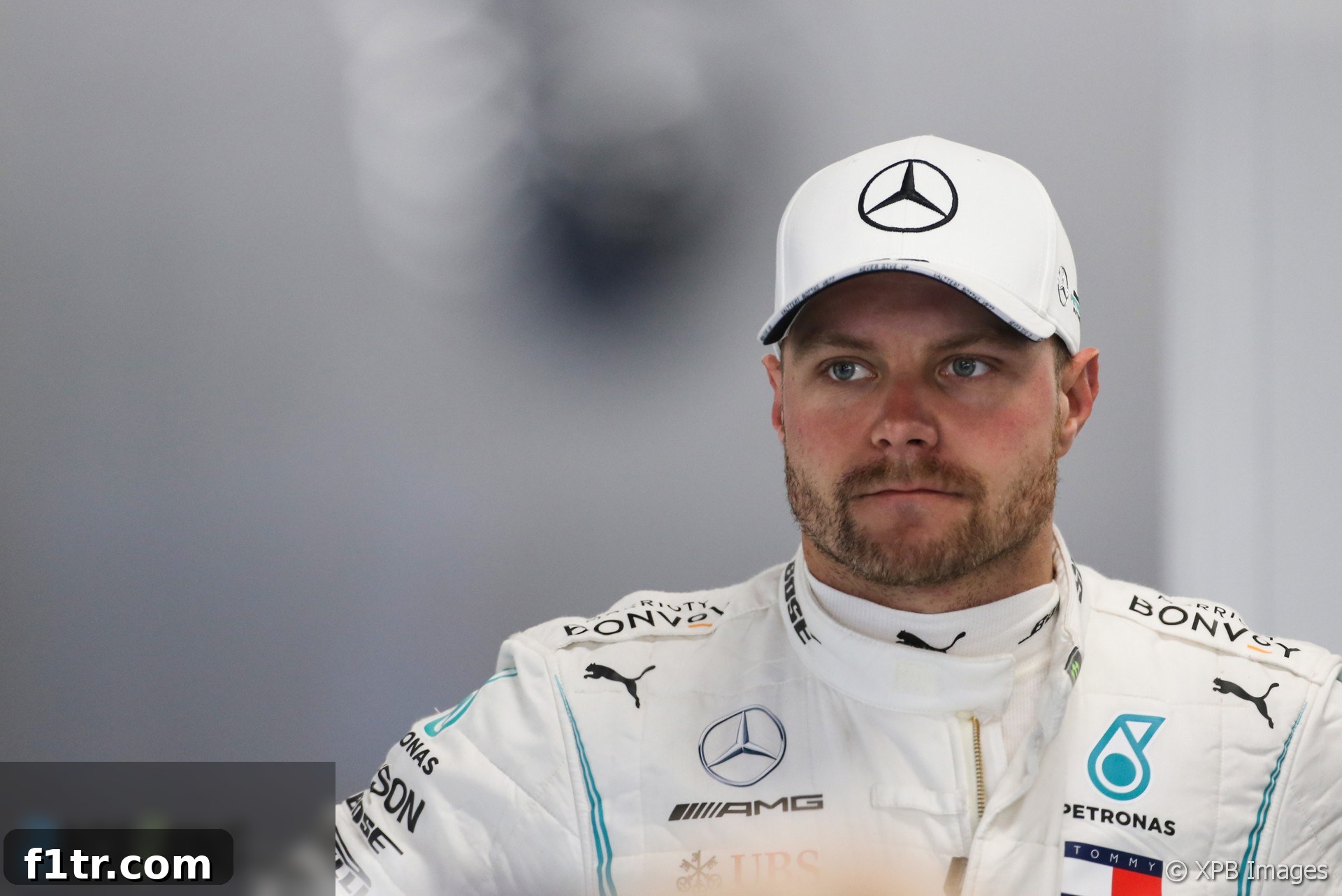
The 2020 Formula 1 season presented a unique paradox: absolute dominance from the Mercedes-AMG Petronas Formula One Team, yet a championship fight that felt surprisingly one-sided. While Lewis Hamilton soared to his seventh world title, the aspirations for a truly competitive intra-team battle for the drivers’ championship rested squarely on the shoulders of Valtteri Bottas. As the only other driver in the supremely potent W11 machinery, Bottas was, by default, the sole realistic challenger to his formidable teammate. His journey through 2020, however, became a compelling narrative of immense potential often overshadowed by inconsistent execution and the relentless brilliance of Hamilton.
Advert | Become a Supporter & go ad-free
The season began with a burst of promise that electrified the F1 paddock. At the truncated season opener in Austria, Bottas, piloting car number 77, seized pole position with a commanding performance and converted it into a decisive victory. This triumph was further amplified by Hamilton incurring a pair of penalties, temporarily tilting the points balance in Bottas’s favor. Optimism for a genuine championship fight swelled, suggesting that perhaps 2020 would be the year Bottas truly stepped out of Hamilton’s shadow. Yet, as the championship unfolded across diverse tracks and challenging conditions, it didn’t take long for Hamilton to reassert his familiar superiority, gradually eroding the early lead and the hopes it inspired.
The raw speed demonstrated by Bottas in qualifying sessions was undeniable and remained a significant strength throughout the year, largely mirroring his performance in 2019. He consistently pushed Hamilton, making the battle for pole position a thrilling spectacle on numerous Saturdays. Bottas managed to out-qualify Hamilton on five occasions, securing pole, and came agonizingly close at several other Grand Prix weekends. This consistent one-lap pace showcased his innate talent and the capability to extract the maximum from the Mercedes W11 when conditions were optimal. However, the true test in Formula 1 lies beyond a single flying lap; it’s about sustained performance and execution over a full race distance, an area where Bottas often struggled to maintain the same level of dominance as his teammate.
Following the season’s conclusion, Bottas himself reflected that his most significant gains against Hamilton were made in race pace rather than qualifying. While this self-assessment holds some truth, his overall race performances remained a perplexing mix of brilliance and disappointment. Considering his strong starting positions, a tally of just two victories from a championship-winning car suggests a critical underperformance. These missed opportunities were, in part, due to genuine misfortune, but a deeper analysis reveals a recurring pattern of circumstances that Bottas failed to fully capitalize on.
Indeed, a measure of bad luck did plague Bottas’s campaign. At the 70th Anniversary Grand Prix, for instance, converting pole position into a victory was always an uphill battle due to Mercedes’ unusual tyre degradation issues, a rare vulnerability for the dominant team. Later in the season, a race-ruining debris strike at Imola unequivocally compromised his afternoon. Furthermore, at the Nürburgring, after securing another pole, he struggled to keep Hamilton behind in the early stages before a catastrophic power unit problem forced his retirement – notably, Mercedes’ only race-ending technical failure of the entire year. These incidents, undeniably, robbed him of potential points and podium finishes, painting a picture of a driver whose efforts were sometimes thwarted by external factors beyond his control.
However, the narrative of misfortune only tells half the story. There were equally significant occasions where Bottas simply came up short, failing to seize the golden opportunities presented by circumstance or competitor errors. A concerning and all-too-common feature of his 2020 season was a propensity for sub-standard starts, particularly evident at the Hungarian and Spanish Grands Prix. These sluggish getaways, often from the front row, immediately put him on the back foot, forcing him into recovery drives rather than allowing him to dictate the race from the front. Such lapses in concentration or execution proved incredibly costly, especially in a car capable of winning every race, and allowed rivals to gain an immediate advantage.
These critical errors, particularly his inconsistent starts and racecraft, frequently opened the door for Max Verstappen to exploit. The fact that the Red Bull Racing driver, in a demonstrably slower car, was able to remain within striking distance of Bottas in the drivers’ championship standings until the final round of the season speaks volumes and does not reflect well on the Mercedes driver’s ability to maximize his machinery. Verstappen’s relentless consistency and ability to capitalize on every opportunity contrasted sharply with Bottas’s fluctuating form, highlighting the gap between Bottas’s potential and his actual performance as a consistent championship contender.
Advert | Become a RaceFans supporter andgo ad-free
Perhaps the most public and personally damaging illustration of Bottas’s struggles came at the Sakhir Grand Prix. With Lewis Hamilton sidelined due to COVID-19, Mercedes drafted in the highly-rated George Russell as a one-off substitute. This was a prime opportunity for Bottas to unequivocally demonstrate his leadership and secure a dominant victory. Instead, a sluggish getaway from pole position allowed Russell, a relative rookie in a Mercedes, to immediately snatch the lead. While Bottas had already mathematically lost the title to Hamilton by this stage, being so decisively shown up by a stand-in teammate, who then controlled much of the race with impressive maturity, was the last thing his season needed and compounded the questions about his championship credentials.
Valtteri Bottas |
|
|---|---|
| Beat team mate in qualifying | 6/17 |
| Beat team mate in race | 5/16 |
| Races finished | 16/17 |
| Laps spent ahead of team mate | 313/994 |
| Qualifying margin | +0.11s |
| Points | 223 |
The Sakhir incident continued a distressing run of three poor results for Bottas, which began at the Turkish Grand Prix. While he could reasonably point to genuine misfortune in both Turkey and the first Bahrain race, the overall picture was still concerning. In Istanbul, he spun repeatedly and suffered heavy damage at the start, making any recovery extraordinarily difficult. In Bahrain, he endured two separate punctures, further hindering his progress. While these races cannot be entirely counted against Bottas given the circumstances, they nonetheless contributed to a narrative of a season punctuated by missed chances and a lack of consistent control over his own destiny on track.
However, his dire showing at Monza stood out as an undeniable lapse. At the Italian Grand Prix, Hamilton incurred a penalty for entering a closed pit lane, creating an unprecedented opportunity for Bottas to seize victory and make a significant dent in the championship deficit. Yet, he utterly failed to capitalize on this stroke of luck. His early race struggles, inability to make decisive overtakes, and ultimate failure to convert a prime position into a win against rivals with slower machinery were a stark reminder of his struggles to fully exploit advantageous situations. This inability to capitalize on Hamilton’s rare missteps proved particularly frustrating for those hoping for a closer title fight, reinforcing the perception that Bottas struggled under the intense pressure of leading a race or championship assault.
It is certainly true that had the scales of misfortune been balanced more evenly across the two sides of the Mercedes garage, Bottas’s championship challenge might have appeared more convincing. However, a crucial test of a top-tier driver lies in their ability to overcome adversity and consistently perform at their peak. The final two races of the season – where he was first paired with a substitute (Russell) and then a still ailing and sub-par Hamilton (after his COVID-19 recovery) – presented Bottas with a unique opportunity to demonstrate his capabilities as a clear team leader. His failure to firmly grasp this mantle in either event only amplified the questions surrounding his suitability for the role. As the grid looks ahead, Bottas’s 2021 campaign will be unequivocally defined by whether he can convince Mercedes to keep their faith in him over the ever-present threat and burgeoning talent of George Russell, whose Sakhir performance cast a long shadow over the Finn’s aspirations.
Advert | Become a RaceFans supporter andgo ad-free
2020 F1 season review
- 2020 F1 season driver rankings #1: Lewis Hamilton
- 2020 F1 driver rankings #2: Max Verstappen
- 2020 F1 driver rankings #3: Charles Leclerc
- 2020 F1 driver rankings #4: Carlos Sainz Jnr
- 2020 F1 driver rankings #5: Daniel Ricciardo
Browse all 2020 F1 season review articles