Recap: The Strategic Battle and Unforeseen Drama of the 2022 Spanish Grand Prix
The 2022 Spanish Grand Prix at the Circuit de Barcelona-Catalunya delivered a high-stakes strategic battle, intense on-track action, and a significant shift in the championship narrative. Soaring track temperatures, coupled with high tyre degradation, quickly pushed most drivers toward a demanding three-stop strategy. The hard compound tyre, often a viable long-stint option, was largely avoided due to its perceived lack of performance in the sweltering conditions, forcing teams to rely heavily on the softer compounds for pace.
Advert | Become a Supporter & go ad-free
Even Sergio Perez, renowned for his exceptional tyre management skills and ability to extend tyre life beyond expectations, found a two-stop strategy untenable. As the race progressed, his pace on the second stint began to noticeably degrade, prompting Red Bull Racing to call him in for an additional set of fresh rubber, underlining the extreme demands of the Barcelona circuit on Pirelli’s tyres that weekend.
Recognizing early on the high probability of a multi-stop race, almost every car on the grid started the Grand Prix on the softest available tyre compound. The notable exception was Lewis Hamilton’s Mercedes, which began the race on the more durable medium compound. However, the potential impact of this alternative strategy remained largely unseen, as Hamilton was involved in an unfortunate collision with Kevin Magnussen on the very first lap. Both drivers sustained punctures and were forced to pit immediately, effectively resetting their races and compelling them into unexpected recovery drives.
Hamilton’s early setback left many wondering what his race might have been like without the lap-one incident, posing one of the more fascinating unanswered questions of the event. Similarly, the eagerly anticipated fight for victory between championship protagonists Max Verstappen and Charles Leclerc was also curtailed by unforeseen circumstances. Verstappen’s early off-track excursion and subsequent DRS issues, followed by a devastating power unit problem for Leclerc’s Ferrari, conspired to deny fans a direct, unadulterated head-to-head battle for the win.
Key Incidents and Strategic Twists on Track
Verstappen’s uncharacteristic error at turn four on lap nine saw him run wide into the gravel trap. This costly mistake resulted in an eight-second loss, further exacerbated as he rejoined the track and found himself stuck behind the impressive George Russell, who fiercely defended his position. Interestingly, Carlos Sainz Jnr made an almost identical error just two laps later, also attributing it to the tricky wind conditions, and lost even more time, around seven seconds in total.
Before his incident, Verstappen was trailing leader Leclerc by a mere two seconds, though the Ferrari had just begun to show signs of pulling away. Post-race, Leclerc expressed encouragement regarding his Ferrari’s tyre degradation performance, which had been a notable weakness in previous races. The improvements observed at the Circuit de Catalunya suggested that Ferrari had made significant strides in managing their F1-75’s tyre wear, a critical factor for championship contention.
The Spanish Grand Prix ultimately signalled an encouraging sign for the 2022 championship, indicating that the competition was intensifying. With very little to separate the top two teams, Red Bull and Ferrari, on overall race pace, and Mercedes demonstrating a significant step forward in closing the gap to the front-runners, the stage was set for an even closer and more thrilling season.
Advert | Become a RaceFans supporter andgo ad-free
Race Overview: A Battle of Resilience and Strategy
The 2022 Spanish Grand Prix will be remembered for its brutal honesty regarding tyre management and the unpredictable nature of top-tier motorsport. The high ambient temperatures of Barcelona made the Circuit de Catalunya a crucible for both machinery and strategy. Teams had arrived with updated packages, notably Mercedes with significant revisions aimed at combating their porpoising issues, making the race a critical testbed for mid-season development. The prevailing conditions, characterized by scorching asphalt and a challenging wind, ensured that tyre degradation would be the defining factor. While Pirelli offered their C1 (Hard), C2 (Medium), and C3 (Soft) compounds, the C1 hard tyre proved deeply unpopular, with teams finding little performance or longevity benefit from it, thus limiting strategic options primarily to the C2 and C3 compounds.
Championship Dynamics: Red Bull Takes the Lead
Max Verstappen’s victory, despite his early off-track moment and a recurring DRS issue that complicated his overtaking efforts against George Russell, propelled him to the top of the Drivers’ Championship standings. This was largely due to Charles Leclerc’s unfortunate power unit retirement while leading comfortably. Leclerc’s Ferrari had shown dominant pace, particularly after demonstrating improved tyre degradation characteristics, which had been a concern for the Scuderia. His retirement not only cost him a likely victory but also surrendered his championship lead, adding another dramatic twist to an already captivating season.
Mercedes’ Promising Step Forward
Perhaps one of the most significant takeaways from Barcelona was the clear progress made by Mercedes. After a challenging start to the season plagued by porpoising and a lack of pace, the W13 updates brought to Spain appeared to have genuinely improved the car’s performance. George Russell’s stellar defense against Verstappen and Lewis Hamilton’s incredible recovery drive from 19th position (after his lap one incident) to a podium contender showcased a significant uplift in potential. While a double podium wasn’t achieved, largely due to Hamilton’s early race damage and a conservative late-race call, the team’s strong performance and enhanced understanding of their car offered a glimpse of a more competitive future, suggesting they might yet join the championship fight.
Go ad-free for just £1 per month
>> Find out more and sign up
Detailed Performance Analysis: Lap by Lap and Driver by Driver
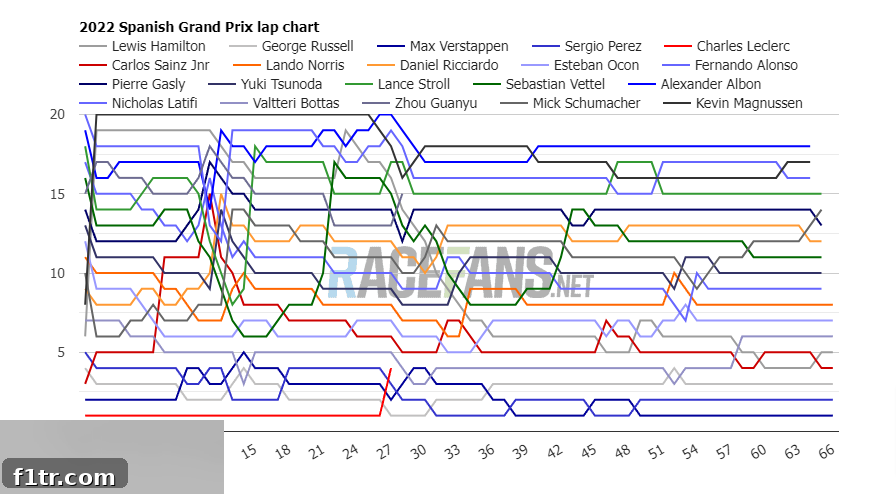
2022 Spanish Grand Prix lap chart
The positions of each driver on every lap. Click name to highlight, right-click to reset. Toggle drivers using controls below:
The lap chart, if visualized, would clearly illustrate the dynamic shifts throughout the race. Leclerc’s early dominance, Verstappen’s initial drop after his off and subsequent climb, and Hamilton’s dramatic ascent from the back of the grid would be prominent features. It would underscore the effectiveness of the three-stop strategy for many, as well as the impact of safety cars or virtual safety cars if they had occurred, though this race was largely run under green flag conditions, emphasizing pure pace and strategy execution.
2022 Spanish Grand Prix race chart
The gaps between each driver on every lap compared to the leader’s average lap time. Very large gaps omitted. Scroll to zoom, drag to pan and right-click to reset. Toggle drivers using controls below:
Analyzing the race chart, showing gaps to the leader, would reveal Leclerc’s early advantage steadily growing before his retirement. Verstappen’s chart would show a plateau or slight drop when stuck behind Russell, followed by aggressive lap times to close the gap once he had clear air. Hamilton’s trajectory would be particularly striking, illustrating his consistent speed and ability to shave seconds off his rivals as he navigated through the field, showcasing Mercedes’ improved performance.
Position change
Examining the position change table offers valuable insights into individual driver performances and the effectiveness of their strategies. Drivers like Lewis Hamilton (+1 position change from his starting position despite a massive drop after lap one) and Fernando Alonso (+8 positions from 17th to 9th), who started from the back due to penalties, showcased incredible recovery drives. Alonso’s climb through the field was particularly impressive, highlighting his enduring skill and Alpine’s solid race pace. Conversely, Kevin Magnussen’s significant drop (-9 positions) underscores the harsh consequences of his lap one incident with Hamilton. Sergio Perez’s gain of 3 positions reflected his strong, consistent drive to secure a 1-2 finish for Red Bull, capitalizing on Leclerc’s misfortune.
| Driver | Start position | Lap one position change | Race position change |
|---|---|---|---|
| Lewis Hamilton | 6 | -13 | 1 |
| George Russell | 4 | 1 | 1 |
| Max Verstappen | 2 | 0 | 1 |
| Sergio Perez | 5 | 1 | 3 |
| Charles Leclerc | 1 | 0 | |
| Carlos Sainz Jnr | 3 | -2 | -1 |
| Lando Norris | 11 | 1 | 3 |
| Daniel Ricciardo | 9 | 1 | -3 |
| Esteban Ocon | 12 | 3 | 5 |
| Fernando Alonso | 17 | 2 | 8 |
| Pierre Gasly | 14 | 2 | 1 |
| Yuki Tsunoda | 13 | 2 | 3 |
| Lance Stroll | 18 | 4 | 3 |
| Sebastian Vettel | 16 | 3 | 5 |
| Alexander Albon | 19 | 3 | 1 |
| Nicholas Latifi | 20 | 2 | 4 |
| Valtteri Bottas | 7 | 0 | 1 |
| Zhou Guanyu | 15 | -2 | |
| Mick Schumacher | 10 | 4 | -4 |
| Kevin Magnussen | 8 | -12 | -9 |
2022 Spanish Grand Prix lap times
All the lap times by the drivers (in seconds, very slow laps excluded). Scroll to zoom, drag to pan and toggle drivers using the control below:
A detailed breakdown of lap times would highlight the raw pace of the front-runners. Leclerc’s initial stint on the softs, before his retirement, would show an impressive string of quick laps, underlining his command of the race. Verstappen’s lap times, post-error, would likely show a mix of slower laps when stuck in traffic and then rapid times once in clear air, often matching or exceeding the pace of his rivals. Hamilton’s relentless pace in the latter half of the race would be a testament to Mercedes’ progress and his own driving ability, consistently setting times that put him in contention for the fastest lap.
2022 Spanish Grand Prix fastest laps
Each driver’s fastest lap:
The fastest laps table provides a snapshot of ultimate single-lap pace. Sergio Perez clinching the fastest lap on lap 55, towards the very end of the race on fresh soft tyres, demonstrates Red Bull’s strong pace and their commitment to maximizing every opportunity. Lewis Hamilton and George Russell securing the second and third fastest laps, respectively, further cements the notion of Mercedes’ significant performance upgrade, indicating their car was highly competitive, especially in race trim and with clearer air. Leclerc’s relatively earlier fastest lap on lap 25, before his retirement, showed his commanding pace at that point.
| Rank | Driver | Car | Fastest lap | Gap | On lap |
|---|---|---|---|---|---|
| 1 | Sergio Perez | Red Bull | 1’24.108 | 55 | |
| 2 | Lewis Hamilton | Mercedes | 1’24.253 | 0.145 | 51 |
| 3 | George Russell | Mercedes | 1’24.636 | 0.528 | 53 |
| 4 | Max Verstappen | Red Bull | 1’25.456 | 1.348 | 46 |
| 5 | Lando Norris | McLaren-Mercedes | 1’25.619 | 1.511 | 53 |
| 6 | Esteban Ocon | Alpine-Renault | 1’25.935 | 1.827 | 54 |
| 7 | Carlos Sainz Jnr | Ferrari | 1’25.985 | 1.877 | 49 |
| 8 | Valtteri Bottas | Alfa Romeo-Ferrari | 1’26.395 | 2.287 | 36 |
| 9 | Fernando Alonso | Alpine-Renault | 1’26.599 | 2.491 | 56 |
| 10 | Yuki Tsunoda | AlphaTauri-Red Bull | 1’26.828 | 2.720 | 59 |
| 11 | Lance Stroll | Aston Martin-Mercedes | 1’26.876 | 2.768 | 54 |
| 12 | Pierre Gasly | AlphaTauri-Red Bull | 1’26.987 | 2.879 | 51 |
| 13 | Charles Leclerc | Ferrari | 1’27.030 | 2.922 | 25 |
| 14 | Nicholas Latifi | Williams-Mercedes | 1’27.246 | 3.138 | 52 |
| 15 | Daniel Ricciardo | McLaren-Mercedes | 1’27.285 | 3.177 | 54 |
| 16 | Mick Schumacher | Haas-Ferrari | 1’27.447 | 3.339 | 32 |
| 17 | Kevin Magnussen | Haas-Ferrari | 1’27.537 | 3.429 | 3 |
| 18 | Sebastian Vettel | Aston Martin-Mercedes | 1’27.629 | 3.521 | 59 |
| 19 | Alexander Albon | Williams-Mercedes | 1’28.281 | 4.173 | 56 |
| 20 | Zhou Guanyu | Alfa Romeo-Ferrari | 1’28.415 | 4.307 | 12 |
Advert | Become a RaceFans supporter andgo ad-free
2022 Spanish Grand Prix tyre strategies
The tyre strategies for each driver:
The tyre strategy table clearly shows the overwhelming preference for a three-stop race, predominantly utilizing soft (C3) and medium (C2) compounds. Most front-running teams like Red Bull, Mercedes, and Ferrari opted for multiple stints on both C2s and C3s, trying to balance initial grip with longer-term degradation. The general pattern of starting on C3, moving to C2, then C3 again, and often a final C2 or C3, underscores the difficulty in making tyres last. Charles Leclerc’s truncated strategy, with only two stints before retirement, denies us the full picture of Ferrari’s intended plan, but his C3-C2 choice was standard. The varied stint lengths highlight how different drivers and teams managed degradation on track, with some drivers, like Alexander Albon, even attempting five stints, though likely due to early stops and adapting to unfolding race conditions.
| Stint 1 | Stint 2 | Stint 3 | Stint 4 | Stint 5 | |
|---|---|---|---|---|---|
| Max Verstappen | C3 (13) | C2 (15) | C3 (16) | C2 (22) | |
| Sergio Perez | C3 (17) | C2 (20) | C2 (16) | C3 (13) | |
| George Russell | C3 (13) | C2 (23) | C2 (15) | C3 (15) | |
| Carlos Sainz Jnr | C3 (10) | C2 (21) | C2 (14) | C3 (21) | |
| Lewis Hamilton | C2 (1) | C3 (21) | C2 (26) | C3 (18) | |
| Valtteri Bottas | C3 (14) | C2 (20) | C2 (32) | ||
| Esteban Ocon | C3 (13) | C2 (22) | C3 (17) | C3 (14) | |
| Lando Norris | C3 (12) | C2 (21) | C3 (18) | C3 (15) | |
| Fernando Alonso | C3 (10) | C2 (21) | C3 (22) | C3 (12) | |
| Yuki Tsunoda | C3 (11) | C2 (21) | C3 (20) | C3 (13) | |
| Sebastian Vettel | C3 (21) | C3 (21) | C2 (23) | ||
| Daniel Ricciardo | C3 (11) | C3 (20) | C2 (17) | C3 (17) | |
| Pierre Gasly | C3 (10) | C2 (19) | C3 (17) | C3 (19) | |
| Mick Schumacher | C3 (12) | C3 (18) | C2 (35) | ||
| Lance Stroll | C3 (14) | C3 (13) | C2 (19) | C3 (19) | |
| Nicholas Latifi | C3 (12) | C2 (14) | C3 (24) | C3 (14) | |
| Kevin Magnussen | C3 (1) | C2 (28) | C1 (35) | ||
| Alexander Albon | C3 (11) | C2 (14) | C3 (20) | C2 (9) | C3 (10) |
| Zhou Guanyu | C3 (10) | C2 (18) | |||
| Charles Leclerc | C3 (21) | C2 (6) |
Go ad-free for just £1 per month
>> Find out more and sign up
2022 Spanish Grand Prix pit stop times
How long each driver’s pit stops took:
The pit stop times table highlights the incredible efficiency and pressure under which F1 pit crews operate. Red Bull demonstrated exemplary consistency, with Sergio Perez’s fastest stop at 21.619 seconds, closely followed by his second stop. Ferrari also showed competitive pit stops, as evidenced by Charles Leclerc’s stop being among the quickest. The close margins between the top stops, often within tenths of a second, underscore the fine line between gaining and losing positions in the pits. Longer pit stops, like those for Lewis Hamilton and Kevin Magnussen on lap 1, reflect the emergency nature of their punctures, where damage assessment and tyre change took priority over speed, leading to significantly extended times.
| Driver | Team | Pit stop time | Gap | On lap | |
| 1 | Sergio Perez | Red Bull | 21.619 | 37 | |
| 2 | Sergio Perez | Red Bull | 21.694 | 0.075 | 53 |
| 3 | Charles Leclerc | Ferrari | 21.794 | 0.175 | 21 |
| 4 | Pierre Gasly | AlphaTauri | 21.838 | 0.219 | 46 |
| 5 | Carlos Sainz Jnr | Ferrari | 21.867 | 0.248 | 31 |
| 6 | Fernando Alonso | Alpine | 21.914 | 0.295 | 31 |
| 7 | Lando Norris | McLaren | 21.916 | 0.297 | 12 |
| 8 | Max Verstappen | Red Bull | 21.941 | 0.322 | 44 |
| 9 | Max Verstappen | Red Bull | 21.966 | 0.347 | 28 |
| 10 | Pierre Gasly | AlphaTauri | 22.008 | 0.389 | 10 |
| 11 | Sergio Perez | Red Bull | 22.032 | 0.413 | 17 |
| 12 | Esteban Ocon | Alpine | 22.033 | 0.414 | 52 |
| 13 | George Russell | Mercedes | 22.039 | 0.420 | 36 |
| 14 | Lewis Hamilton | Mercedes | 22.105 | 0.486 | 22 |
| 15 | Daniel Ricciardo | McLaren | 22.124 | 0.505 | 11 |
| 16 | Esteban Ocon | Alpine | 22.137 | 0.518 | 13 |
| 17 | George Russell | Mercedes | 22.154 | 0.535 | 13 |
| 18 | Daniel Ricciardo | McLaren | 22.154 | 0.535 | 48 |
| 19 | Lando Norris | McLaren | 22.165 | 0.546 | 51 |
| 20 | Max Verstappen | Red Bull | 22.173 | 0.554 | 13 |
| 21 | Lewis Hamilton | Mercedes | 22.241 | 0.622 | 48 |
| 22 | Carlos Sainz Jnr | Ferrari | 22.302 | 0.683 | 45 |
| 23 | Nicholas Latifi | Williams | 22.311 | 0.692 | 26 |
| 24 | Yuki Tsunoda | AlphaTauri | 22.316 | 0.697 | 52 |
| 25 | Carlos Sainz Jnr | Ferrari | 22.341 | 0.722 | 10 |
| 26 | Fernando Alonso | Alpine | 22.375 | 0.756 | 10 |
| 27 | Daniel Ricciardo | McLaren | 22.399 | 0.780 | 31 |
| 28 | Sebastian Vettel | Aston Martin | 22.456 | 0.837 | 42 |
| 29 | Sebastian Vettel | Aston Martin | 22.536 | 0.917 | 21 |
| 30 | Valtteri Bottas | Alfa Romeo | 22.541 | 0.922 | 34 |
| 31 | Alexander Albon | Williams | 22.657 | 1.038 | 25 |
| 32 | Nicholas Latifi | Williams | 22.761 | 1.142 | 50 |
| 33 | Yuki Tsunoda | AlphaTauri | 22.802 | 1.183 | 32 |
| 34 | George Russell | Mercedes | 22.815 | 1.196 | 51 |
| 35 | Lance Stroll | Aston Martin | 22.833 | 1.214 | 14 |
| 36 | Esteban Ocon | Alpine | 22.953 | 1.334 | 35 |
| 37 | Valtteri Bottas | Alfa Romeo | 22.987 | 1.368 | 14 |
| 38 | Yuki Tsunoda | AlphaTauri | 23.083 | 1.464 | 11 |
| 39 | Zhou Guanyu | Alfa Romeo | 23.109 | 1.490 | 10 |
| 40 | Mick Schumacher | Haas | 23.127 | 1.508 | 30 |
| 41 | Nicholas Latifi | Williams | 23.189 | 1.570 | 12 |
| 42 | Alexander Albon | Williams | 23.328 | 1.709 | 45 |
| 43 | Lando Norris | McLaren | 23.341 | 1.722 | 33 |
| 44 | Lance Stroll | Aston Martin | 23.394 | 1.775 | 27 |
| 45 | Alexander Albon | Williams | 23.404 | 1.785 | 54 |
| 46 | Alexander Albon | Williams | 23.419 | 1.800 | 11 |
| 47 | Mick Schumacher | Haas | 23.582 | 1.963 | 12 |
| 48 | Lance Stroll | Aston Martin | 23.812 | 2.193 | 46 |
| 49 | Kevin Magnussen | Haas | 23.878 | 2.259 | 29 |
| 50 | Fernando Alonso | Alpine | 25.407 | 3.788 | 53 |
| 51 | Pierre Gasly | AlphaTauri | 27.947 | 6.328 | 29 |
| 52 | Kevin Magnussen | Haas | 29.632 | 8.013 | 1 |
| 53 | Lewis Hamilton | Mercedes | 31.054 | 9.435 | 1 |
2022 Spanish Grand Prix Related Articles
- Q&A: Kubica ‘shocked’ by ‘completely different’ Alfa Romeo in Spain
- How heat and traffic trouble left F1 fans fuming after the Spanish Grand Prix
- Mercedes not yet certain their porpoising problem has “disappeared”
- Sticking to budget cap “pretty much impossible” due to rising costs – McLaren
- Ricciardo hoping to find an explanation for Spanish GP pace deficit to Norris
Browse all 2022 Spanish Grand Prix articles