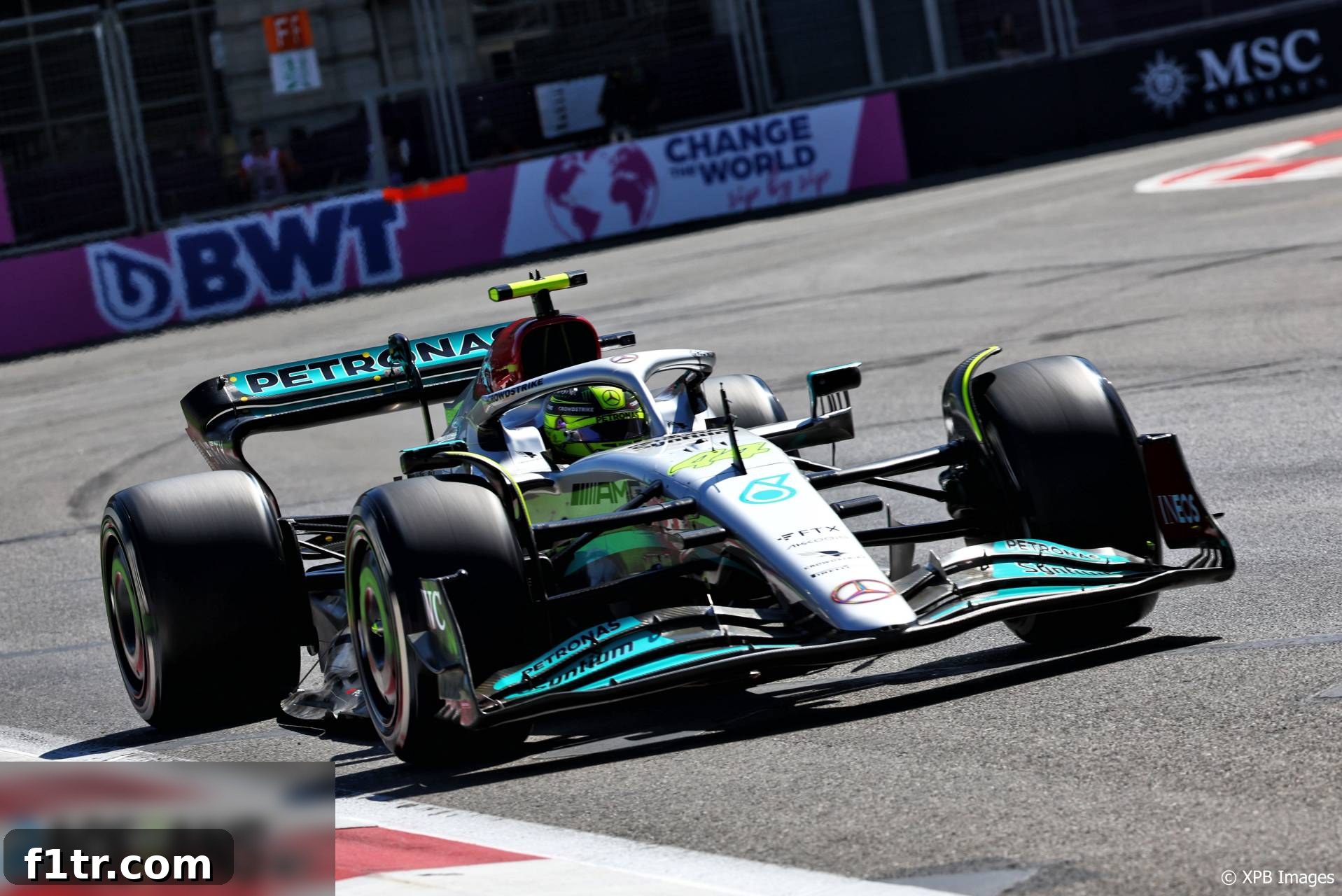
Seven-time Formula 1 World Champion Lewis Hamilton voiced significant concerns regarding the severe porpoising and bottoming out issues plaguing his Mercedes W13 at the Azerbaijan Grand Prix in Baku. Hamilton revealed that these aerodynamic struggles were costing him crucial time on track, particularly when compared to his teammate, George Russell.
The 2022 Formula 1 season has presented an unprecedented technical challenge for Mercedes, the dominant force of the turbo-hybrid era. The radical new aerodynamic regulations, centered around ground effect, have led to the phenomenon known as ‘porpoising’ – an uncontrolled high-speed oscillation of the car. While many teams have grappled with this issue, Mercedes’ W13 has been particularly susceptible, hampering their performance and leaving them a step behind rivals like Red Bull and Ferrari.
Mercedes’ W13 Woes: A Deeper Dive into Porpoising
Porpoising, in essence, is the rapid, rhythmic bouncing of a Formula 1 car at high speeds, caused by the interplay of aerodynamic forces. As the car gains speed, the ground effect increases, pulling the car closer to the track. At a certain point, the airflow under the car can become turbulent or stall, leading to a sudden loss of downforce. This causes the car to lift slightly, allowing the airflow to reattach, and the process repeats, creating a violent bouncing motion. This not only makes the car incredibly difficult to drive but also significantly compromises performance by disturbing the driver’s focus, reducing grip, and causing severe physical discomfort.
Mercedes team principal Toto Wolff confirmed that Hamilton’s W13 was indeed running a different configuration compared to Russell’s. This disparity in car setup stems from the team’s relentless experimental efforts to diagnose and ultimately resolve the fundamental problems inherent in their 2022 challenger. “Today I was losing over a tenth just on the straight line because of the bottoming compared to George,” Hamilton explained after qualifying, highlighting the tangible performance deficit directly attributable to the car’s behavior.
Baku’s Bumps Exacerbate the Challenge
The Baku City Circuit, renowned for its extremely long, high-speed straights and undulating surface, proved to be a particularly unforgiving venue for Mercedes’ W13. While the team believed they had made significant progress in mitigating their porpoising problem with upgrades introduced at the Spanish Grand Prix, the return to Baku saw the familiar issues resurface with intensified ferocity. Hamilton wistfully recalled the relative ease of driving in Barcelona, a track with a smoother surface and less extreme straight-line speeds.
“I miss already Barcelona, just driving down the straight no problem,” Hamilton admitted to reporters, underscoring the stark contrast between the two circuits. He further highlighted the severity of Mercedes’ plight by contrasting his experience with that of his former teammate, Valtteri Bottas, now driving for Alfa Romeo. “When I go and talk to some of the other drivers like Valtteri, I’m like, ‘have you got any bouncing?’ He’s like, ‘no’. Wow, can you imagine how nice that would be? We’ll get there eventually.” Bottas’s anecdote paints a clear picture of just how far Mercedes still needed to go to catch up with even midfield teams in terms of ride comfort and stability.
The Physical Toll: Hamilton’s Battle with Pain
The constant, violent impacts from bottoming out and porpoising were not just affecting Hamilton’s lap times; they were taking a significant physical toll on the veteran driver. The bouncing was particularly acute for Hamilton in Baku due to the specific floor configuration he was running on his W13. He openly shared the extent of his discomfort, crediting his long-time physiotherapist, Angela Cullen, for her invaluable support.
“We had so much bottoming at the end of the straight [on Friday] that I couldn’t finish my long run,” he revealed, describing the immediate impact on his practice session. “My back was a real mess. Thank God for Angela. I’ve got Angela giving me physio every night and acupuncture. I woke up with quite a bit of pain [on Saturday]. Now we don’t have it as bad at the end of the straight but it’s through those corners, you’re just trying to keep it out of the wall.” This candid admission underscores the extreme physical demands placed on drivers in the current generation of F1 cars, especially when grappling with aerodynamic instabilities. The high G-forces and repeated jarring impacts from porpoising can lead to chronic back pain, headaches, and general fatigue, raising serious questions about driver safety and long-term well-being in the sport.
Hamilton held out hope that the car would be less punishing to drive during the race, particularly with a full fuel load. “With the heavy fuel hopefully it will be less, I’m hoping. But we are very slow on the straight. I’m sure part of that is the bottoming that slows you down every time you touch the ground. The others also have like a Monza wing I think here, so we have a lot of work to do.” His observations point to a dual problem: not only is the car physically demanding, but the need to manage the porpoising also forces compromises in setup that impact straight-line speed, a critical factor on Baku’s long avenues.
Relentless Effort: Hamilton and Mercedes’ Search for Solutions
Despite the immense challenges, Hamilton’s dedication to helping Mercedes overcome their W13’s limitations remained unwavering. He described his intense efforts to contribute to the problem-solving process, extending his working hours late into the night after the initial practice sessions.
“I was here to 1:30 last night,” he stated. “I’m here studying, I’m doing everything I can. I’m working with the guys back at the factory. I was at the factory two days on the sim. I’m giving everything I can, there’s not much more I can do.” This level of commitment from a driver of Hamilton’s stature highlights the complexity of the engineering conundrum Mercedes faces. The simulator work and direct engagement with factory engineers are crucial for providing real-world data and nuanced feedback that telemetry alone cannot capture. The team’s collective brainpower, coupled with Hamilton’s unparalleled experience, forms the core of their strategy to unlock the W13’s potential.
Mercedes’ struggle with the W13 in 2022 represents a pivotal moment for the team. After years of unrivaled success, they found themselves in a challenging development race, forced to adapt to a completely new set of aerodynamic principles. Overcoming porpoising is not merely about comfort; it’s about unlocking the car’s inherent performance, which is currently being suppressed by these uncontrolled oscillations. The team’s ability to interpret data, iterate designs, and implement effective solutions will define their season and set the stage for their future competitiveness.
Looking Ahead: The Path to Recovery
The Azerbaijan Grand Prix served as another stark reminder of the hurdles Mercedes needed to clear. While immediate solutions might be elusive, the continuous efforts by Lewis Hamilton and the entire Mercedes-AMG Petronas F1 Team underscore their determination to return to the front. The detailed feedback from drivers, combined with extensive simulation and wind tunnel work, is crucial for identifying the precise aerodynamic adjustments required to tame the W13. The ultimate goal remains to find a setup that maximizes ground effect efficiency without triggering severe porpoising, thereby restoring the car’s competitive edge and ensuring driver well-being.
The journey to resolve the W13’s issues is a marathon, not a sprint. Each race weekend provides valuable data, and every adjustment, however minor, contributes to the larger understanding of the car’s complex behavior. For Lewis Hamilton, navigating these physically demanding races while simultaneously driving the team’s development forward is a testament to his resilience and commitment to Mercedes. The hope remains that their relentless pursuit of a solution will eventually yield the breakthrough needed to challenge for victories once again.