Red Bull’s Tactical Masterpiece: Unpacking Max Verstappen’s Dominant Victory at the 70th Anniversary Grand Prix
The 2020 70th Anniversary Grand Prix at Silverstone presented a fascinating strategic battle, culminating in a sensational victory for Red Bull Racing and Max Verstappen. The question on everyone’s mind was whether this triumph was a result of Red Bull outsmarting the dominant Mercedes tactically, or if their RB16 challenger simply possessed superior pace on that particular day. The answer, as often is the case in Formula 1, lies in a compelling combination of both, with external factors playing a crucial role in tilting the balance.
Advert | Become a Supporter & go ad-free
A Strategic Gambit That Paid Off: Red Bull’s Hard Tyre Advantage
Red Bull’s decision to start the race on the hard compound Pirelli tyre (C2) was, without a doubt, a stroke of strategic genius. This bold move contrasted sharply with Mercedes, who opted for the medium compound (C3) for both Lewis Hamilton and Valtteri Bottas. While the hard tyre start carried inherent risks – an early Safety Car intervention, for instance, could have severely compromised their strategy by forcing an early pit stop or disrupting their tyre cycle – the gamble ultimately paid dividends in spectacular fashion. The warmer track temperatures, a key differentiator from the previous week’s British Grand Prix, made tyre degradation a much more significant factor, and Red Bull had clearly anticipated this.
Christian Horner, Red Bull’s Team Principal, articulated the success of their approach: “We were actually able to create an over-cut on the Mercedes on an older tyre and bag track position. This enabled us then to switch our strategy to run the medium tyre and then cover them with a hard tyre which put us effectively on a straight race to the end of the race on the same compound.” This intricate dance of tyre compounds and pit stop timings highlighted Red Bull’s confidence in their car’s ability to manage degradation and Max Verstappen’s exceptional talent behind the wheel. The early pace of the RB16 on the more durable hard tyres meant Verstappen could maintain a competitive speed without overstressing his rubber, putting pressure on Mercedes who were struggling with their mediums.
Horner further emphasized the symbiotic relationship between strategy and driver performance: “All of that was possible because of the way that Max managed the tyre and the pace that we had in the car.” Verstappen’s renowned sensitivity and precision in managing tyre wear allowed Red Bull to extend their first stint significantly, setting the foundation for the overcut strategy that eventually propelled him into the lead.
Mercedes’ Unexpected Struggles: The W11’s Achilles’ Heel Revealed
While Red Bull’s performance was undeniably strong, the narrative of the 70th Anniversary Grand Prix cannot be fully understood without acknowledging the unprecedented struggles faced by the Mercedes-AMG Petronas Formula One Team. After dominating the earlier races and the British Grand Prix just a week prior, the Silver Arrows found themselves grappling with severe tyre blistering and degradation issues, particularly on the softer compounds in the warmer Silverstone conditions. This led to a significant drop in their race pace, reportedly as much as two seconds per lap compared to their performance in the preceding event.
The W11, which had appeared virtually invincible, showed a rare vulnerability. The softer sidewalls of the Pirelli tyres, coupled with the higher track temperatures, seemed to push the Mercedes into an operating window where its incredible downforce generated too much heat, leading to rapid degradation and blistering. This effectively neutralized a significant portion of their aerodynamic advantage, making their strategic options limited and forcing them into more pit stops than initially desired. Both Lewis Hamilton and Valtteri Bottas, usually masters of tyre management, found themselves on the back foot, unable to extract the consistent pace seen in previous races.
Christian Horner himself conceded that Red Bull’s success was also aided by Mercedes’ difficulties: “We just simply had the pace today which gave us that that length of stint and pace advantage over the Mercedes.” This candid admission underscores that while Red Bull executed a perfect strategy, the inherent weakness of Mercedes on this particular tyre allocation and track condition was a pivotal factor in the outcome. Hamilton’s later second stop allowed him to secure the bonus point for fastest lap, a small consolation, but the race highlighted that Red Bull, on this occasion, undeniably possessed the quicker race package.
Max Verstappen: A Masterclass in Tyre Management and Raw Pace
Max Verstappen’s performance at the 70th Anniversary Grand Prix was a true testament to his status as one of Formula 1’s elite drivers. His “superb talents,” as the initial analysis rightly noted, were on full display. From the moment the lights went out, Verstappen demonstrated an unparalleled ability to combine aggressive, yet controlled, driving with meticulous tyre conservation. He carved through the field with surgical precision, making his hard tyres last far longer than anyone anticipated while maintaining a pace that Mercedes could not match.
His ability to manage the delicate balance between pushing the car to its limits and preserving the integrity of the tyres was the cornerstone of Red Bull’s victory. He skillfully fended off the initial challenge from the Mercedes cars, built a comfortable gap, and then utilized the advantage of fresh mediums in his second stint to solidify his lead. This race was not just about raw speed; it was a profound demonstration of race craft, strategic awareness, and the mental fortitude required to execute a complex strategy flawlessly under pressure.
Beyond the Leaders: Notable Performances and Gutsy Calls
While the spotlight shone brightest on Verstappen and Mercedes’ woes, other drivers also delivered memorable performances. Charles Leclerc, for Ferrari, pulled off a gutsy and highly impressive one-stop strategy, finishing fourth. This was a remarkable feat given the tyre failures and degradation issues that plagued many competitors, including his own team’s struggles throughout the season. Leclerc’s ability to make the C3 medium and then the C2 hard tyres last for exceptionally long stints showcased both his supreme tyre management skills and Ferrari’s unexpected aptitude for conserving rubber on this specific occasion. In a race where multiple stops were the norm, his single stop was a bold deviation that paid off handsomely, leaving many to wonder how many more drivers might have attempted a similar strategy had the race been run again.
Advert | Become a RaceFans supporter andgo ad-free
Another standout performance came from Nico Hulkenberg, who, stepping in for the unwell Sergio Perez at Racing Point, qualified impressively and secured a strong seventh-place finish. His return to Formula 1 was marked by consistent pace and an ability to quickly adapt to the challenging conditions, demonstrating his enduring skill.
Decoding the Data: Lap Times, Strategies, and Pit Stop Analysis
Analyzing the underlying data from the 70th Anniversary Grand Prix offers further insights into the race dynamics and the key factors that influenced the outcome. The following sections provide a detailed look at the fastest laps, tyre strategies, and pit stop times for each driver, illustrating the varied approaches and performances throughout the event.
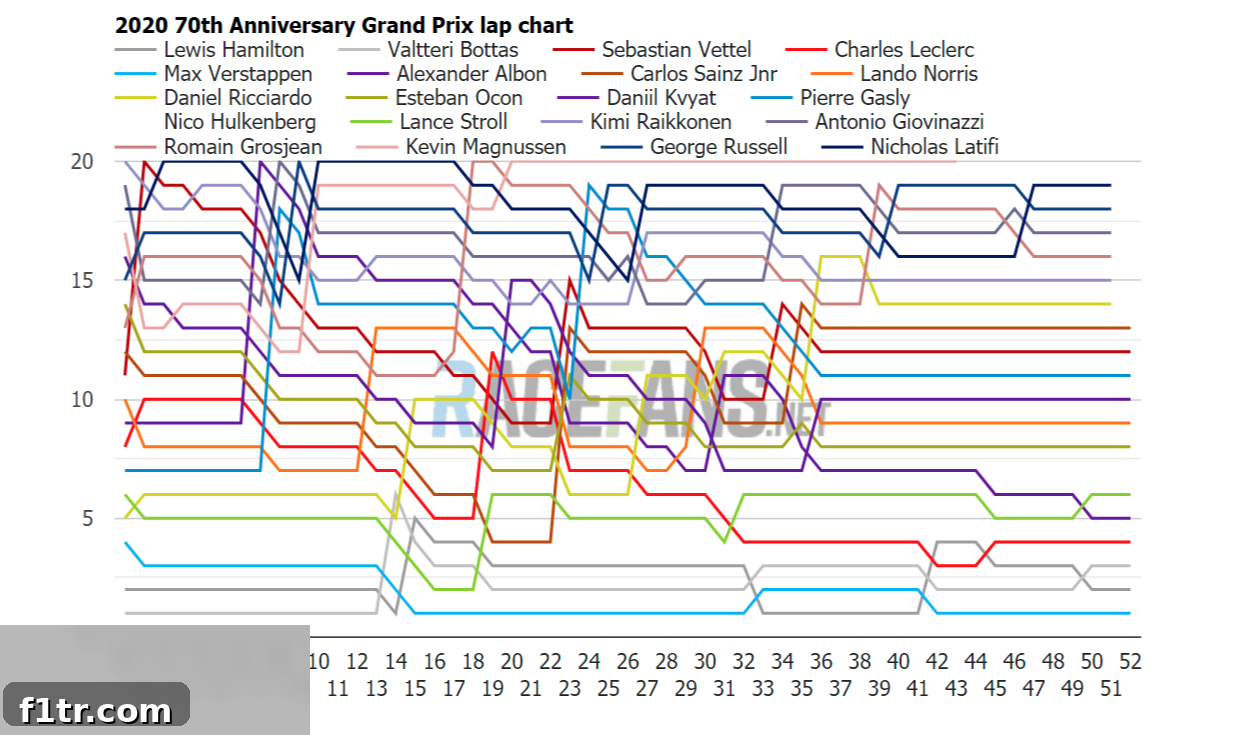
2020 70th Anniversary Grand Prix Lap Chart Overview
The lap chart, which typically visualizes the positions of each driver on every lap, would vividly illustrate Max Verstappen’s steady climb to the front and his ability to maintain a commanding lead. It would show the early battle with Mercedes, the strategic pit stops, and how track position shifted throughout the race. Such a chart would be crucial for understanding the ebb and flow of overtakes and strategic gains.
2020 70th Anniversary Grand Prix Race Chart Overview
A race chart, displaying the gaps between drivers relative to the leader’s average lap time, would underscore the performance advantage Verstappen built. It would reveal how quickly he was able to extend his lead over the struggling Mercedes and maintain a comfortable buffer, highlighting periods of intense pressure and strategic responses. Very large gaps would typically be omitted for clarity, focusing on the competitive clusters.
2020 70th Anniversary Grand Prix Lap Times Overview
The comprehensive lap times for all drivers, excluding exceptionally slow laps (e.g., due to pit entries or incidents), provide a granular view of individual and team performance. This data allows for detailed analysis of driver consistency, car pace on different tyre compounds, and how performance evolved as fuel loads decreased and tyres aged. Examining these times would confirm Verstappen’s superior consistency on his chosen strategy and Mercedes’ comparative lack of pace on hotter tracks.
2020 70th Anniversary Grand Prix Fastest Laps
Each driver’s fastest lap offers a snapshot of their ultimate raw speed potential during the race. Interestingly, despite losing the race, Lewis Hamilton recorded the fastest lap, showcasing Mercedes’ underlying pace when not hampered by severe tyre degradation on a specific fresh compound. Verstappen’s second fastest lap, followed closely by his teammate Alexander Albon, highlights Red Bull-Honda’s impressive outright pace.
| Rank | Driver | Car | Fastest lap | Gap | On lap |
|---|---|---|---|---|---|
| 1 | Lewis Hamilton | Mercedes | 1’28.451 | 43 | |
| 2 | Max Verstappen | Red Bull-Honda | 1’29.465 | 1.014 | 46 |
| 3 | Alexander Albon | Red Bull-Honda | 1’29.477 | 1.026 | 46 |
| 4 | Valtteri Bottas | Mercedes | 1’29.765 | 1.314 | 44 |
| 5 | Nicholas Latifi | Williams-Mercedes | 1’29.950 | 1.499 | 48 |
| 6 | Nico Hulkenberg | Racing Point-Mercedes | 1’30.087 | 1.636 | 52 |
| 7 | Pierre Gasly | AlphaTauri-Honda | 1’30.092 | 1.641 | 52 |
| 8 | Charles Leclerc | Ferrari | 1’30.552 | 2.101 | 39 |
| 9 | Carlos Sainz Jnr | McLaren-Renault | 1’30.556 | 2.105 | 49 |
| 10 | Esteban Ocon | Renault | 1’30.575 | 2.124 | 50 |
| 11 | Lando Norris | McLaren-Renault | 1’30.698 | 2.247 | 49 |
| 12 | Daniil Kvyat | AlphaTauri-Honda | 1’30.738 | 2.287 | 52 |
| 13 | Sebastian Vettel | Ferrari | 1’30.785 | 2.334 | 49 |
| 14 | Romain Grosjean | Haas-Ferrari | 1’30.793 | 2.342 | 51 |
| 15 | Lance Stroll | Racing Point-Mercedes | 1’30.877 | 2.426 | 45 |
| 16 | Daniel Ricciardo | Renault | 1’31.168 | 2.717 | 39 |
| 17 | George Russell | Williams-Mercedes | 1’31.408 | 2.957 | 50 |
| 18 | Kimi Raikkonen | Alfa Romeo-Ferrari | 1’31.756 | 3.305 | 30 |
| 19 | Antonio Giovinazzi | Alfa Romeo-Ferrari | 1’31.826 | 3.375 | 37 |
| 20 | Kevin Magnussen | Haas-Ferrari | 1’31.830 | 3.379 | 39 |
Advert | Become a RaceFans supporter andgo ad-free
2020 70th Anniversary Grand Prix Tyre Strategies
The tyre strategies employed by each team were a defining aspect of the race. Red Bull’s innovative choice to start on the hard (C2) tyres for Verstappen, allowing a longer first stint, stood in stark contrast to Mercedes’ initial medium (C3) tyre starts. The table below meticulously details each driver’s compound choices and the number of laps completed on each stint, highlighting the diverse approaches to tyre management on a day when degradation was paramount. Leclerc’s two-stint race with C3 and C2 is particularly noteworthy for its efficiency.
| Stint 1 | Stint 2 | Stint 3 | Stint 4 | |
|---|---|---|---|---|
| Max Verstappen | C2 (26) | C3 (6) | C2 (20) | |
| Lewis Hamilton | C3 (14) | C2 (27) | C2 (11) | |
| Valtteri Bottas | C3 (13) | C2 (19) | C2 (20) | |
| Charles Leclerc | C3 (18) | C2 (34) | ||
| Alexander Albon | C3 (6) | C2 (24) | C2 (22) | |
| Lance Stroll | C3 (18) | C2 (13) | C2 (21) | |
| Nico Hulkenberg | C3 (15) | C2 (15) | C2 (14) | C4 (8) |
| Esteban Ocon | C3 (22) | C2 (30) | ||
| Lando Norris | C3 (12) | C2 (17) | C2 (23) | |
| Daniil Kvyat | C2 (19) | C2 (16) | C3 (17) | |
| Pierre Gasly | C3 (7) | C2 (16) | C2 (29) | |
| Sebastian Vettel | C2 (22) | C2 (11) | C3 (19) | |
| Carlos Sainz Jnr | C2 (22) | C3 (12) | C2 (18) | |
| Daniel Ricciardo | C3 (14) | C3 (12) | C2 (9) | C3 (16) |
| Kimi Raikkonen | C2 (26) | C3 (25) | ||
| Romain Grosjean | C3 (17) | C2 (21) | C2 (13) | |
| Antonio Giovinazzi | C3 (7) | C2 (26) | C3 (18) | |
| George Russell | C3 (8) | C2 (16) | C2 (15) | C3 (12) |
| Nicholas Latifi | C3 (9) | C2 (17) | C2 (20) | C3 (5) |
| Kevin Magnussen | C3 (9) | C2 (11) | C2 (23) |
2020 70th Anniversary Grand Prix Pit Stop Times
Efficiency in the pit lane is crucial for success in Formula 1. This table compiles the duration of each driver’s pit stops, offering insights into team operational precision and potential strategic delays. Quick stops, such as those consistently delivered by Red Bull, can make a significant difference in track position, while slower stops can severely compromise a race. Antonio Giovinazzi recorded the fastest pit stop of the race, showcasing Alfa Romeo’s quick turnaround capabilities, while some extended stops for others reflected challenges or strategic intentions.
| Driver | Team | Pit stop time | Gap | On lap | |
| 1 | Antonio Giovinazzi | Alfa Romeo | 27.693 | 33 | |
| 2 | Alexander Albon | Red Bull | 27.858 | 0.165 | 30 |
| 3 | Antonio Giovinazzi | Alfa Romeo | 27.892 | 0.199 | 7 |
| 4 | Lando Norris | McLaren | 27.949 | 0.256 | 12 |
| 5 | Lance Stroll | Racing Point | 27.974 | 0.281 | 31 |
| 6 | Daniil Kvyat | Toro Rosso | 28.036 | 0.343 | 19 |
| 7 | Daniel Ricciardo | Renault | 28.057 | 0.364 | 35 |
| 8 | Nicholas Latifi | Williams | 28.086 | 0.393 | 26 |
| 9 | Esteban Ocon | Renault | 28.093 | 0.400 | 22 |
| 10 | Sebastian Vettel | Ferrari | 28.167 | 0.474 | 22 |
| 11 | Daniel Ricciardo | Renault | 28.167 | 0.474 | 26 |
| 12 | Valtteri Bottas | Mercedes | 28.188 | 0.495 | 32 |
| 13 | Lance Stroll | Racing Point | 28.235 | 0.542 | 18 |
| 14 | Pierre Gasly | Toro Rosso | 28.306 | 0.613 | 23 |
| 15 | George Russell | Williams | 28.331 | 0.638 | 24 |
| 16 | Sebastian Vettel | Ferrari | 28.352 | 0.659 | 33 |
| 17 | Pierre Gasly | Toro Rosso | 28.356 | 0.663 | 7 |
| 18 | Daniil Kvyat | Toro Rosso | 28.365 | 0.672 | 35 |
| 19 | Nico Hulkenberg | Racing Point | 28.386 | 0.693 | 30 |
| 20 | George Russell | Williams | 28.391 | 0.698 | 8 |
| 21 | Lewis Hamilton | Mercedes | 28.406 | 0.713 | 14 |
| 22 | Valtteri Bottas | Mercedes | 28.408 | 0.715 | 13 |
| 23 | Alexander Albon | Red Bull | 28.417 | 0.724 | 6 |
| 24 | Daniel Ricciardo | Renault | 28.587 | 0.894 | 14 |
| 25 | George Russell | Williams | 28.692 | 0.999 | 39 |
| 26 | Nicholas Latifi | Williams | 28.696 | 1.003 | 9 |
| 27 | Nico Hulkenberg | Racing Point | 28.736 | 1.043 | 44 |
| 28 | Carlos Sainz Jnr | McLaren | 28.772 | 1.079 | 34 |
| 29 | Lando Norris | McLaren | 28.874 | 1.181 | 29 |
| 30 | Kevin Magnussen | Haas | 28.934 | 1.241 | 9 |
| 31 | Nico Hulkenberg | Racing Point | 28.981 | 1.288 | 15 |
| 32 | Max Verstappen | Red Bull | 28.986 | 1.293 | 32 |
| 33 | Nicholas Latifi | Williams | 29.049 | 1.356 | 46 |
| 34 | Max Verstappen | Red Bull | 29.115 | 1.422 | 26 |
| 35 | Kimi Raikkonen | Alfa Romeo | 29.296 | 1.603 | 26 |
| 36 | Romain Grosjean | Haas | 29.377 | 1.684 | 17 |
| 37 | Kevin Magnussen | Haas | 29.389 | 1.696 | 20 |
| 38 | Lewis Hamilton | Mercedes | 29.402 | 1.709 | 41 |
| 39 | Charles Leclerc | Ferrari | 29.419 | 1.726 | 18 |
| 40 | Romain Grosjean | Haas | 29.803 | 2.110 | 38 |
| 41 | Carlos Sainz Jnr | McLaren | 35.864 | 8.171 | 22 |
The Verdict: A Confluence of Pace, Strategy, and Conditions
Ultimately, Red Bull’s victory at the 70th Anniversary Grand Prix was not attributable to a single factor but rather a perfect storm of elements aligning in their favor. While their strategic call to start on the hard tyre was undoubtedly a masterstroke, it was amplified by Mercedes’ unforeseen struggles with tyre degradation in the hotter track conditions. The RB16, for once, proved to be kinder to its tyres than the W11, especially on the softer compounds, granting Red Bull an inherent pace advantage over longer stints.
Max Verstappen’s exceptional talent in tyre management and his consistent, aggressive pace were the linchpin that brought the strategy to life. Without his ability to maximize the life of each compound while maintaining a competitive speed, even the best strategy would have faltered. This race served as a crucial reminder that in Formula 1, the interplay between car performance, driver skill, and strategic acumen under varying conditions is what truly determines success. The 70th Anniversary Grand Prix was a strategic chess match won by Red Bull, not just through cunning, but through a superior understanding of the day’s unique challenges and the flawless execution by their star driver.
Related 2020 70th Anniversary Grand Prix Articles
- 2020 70th Anniversary Grand Prix Star Performers
- Williams expect to compete for points “on merit” soon
- Wolff “happy to go to court” as Horner calls for FIA to examine Mercedes’ role in Racing Point case
- Albon eager to understand how his “amazing” Red Bull improved
- Verstappen at his irrepressible best as tyres trip Mercedes
Browse all 2020 70th Anniversary Grand Prix articles