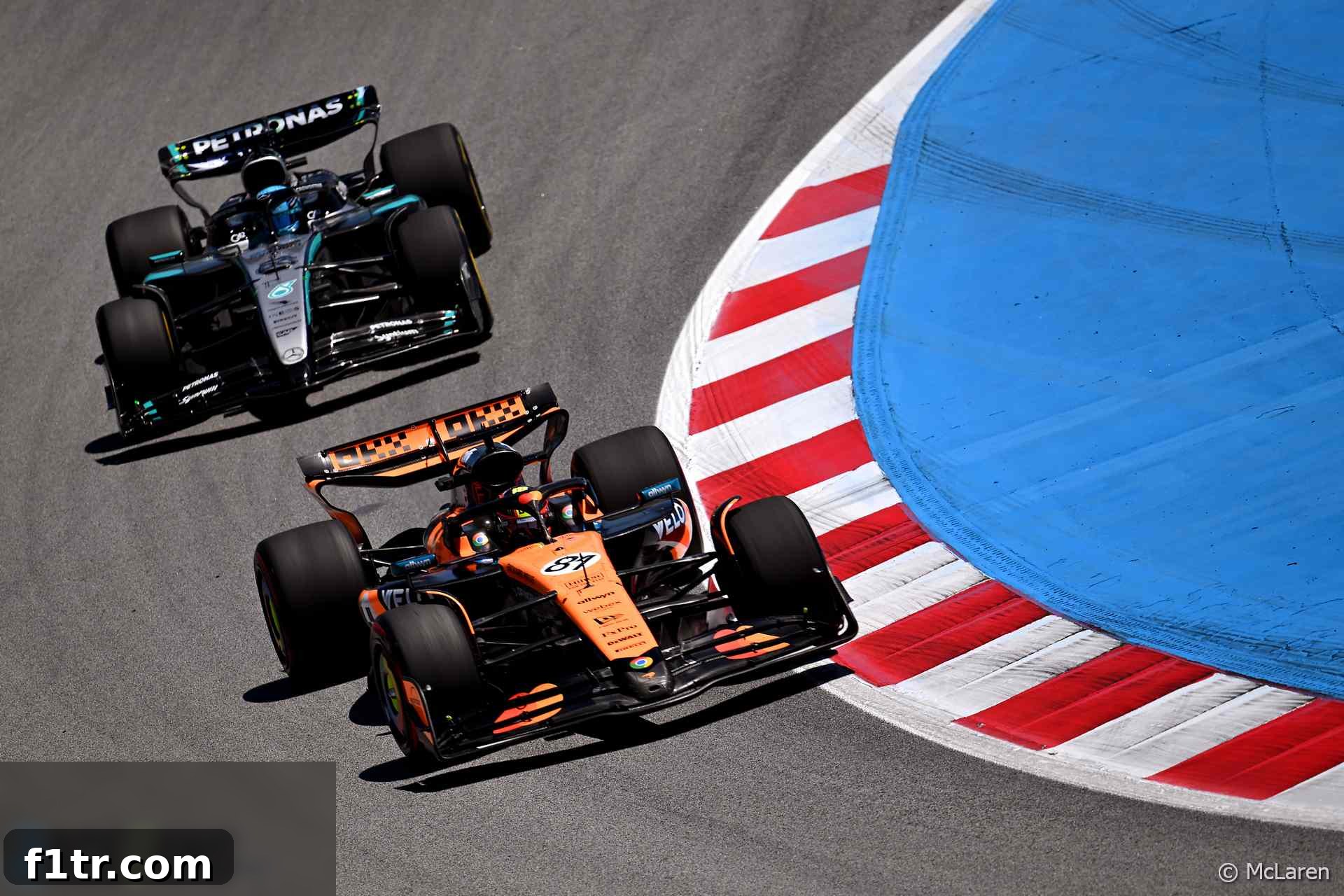
In a stunning display of engineering prowess and on-track execution, McLaren has emerged as the undisputed dominant force in the 2025 Formula 1 season. Their performance has not only captivated fans but has also left their closest rivals scratching their heads, wondering how the Woking-based team managed to gain such a significant and seemingly insurmountable advantage. With nine victories out of the first twelve rounds of the championship, McLaren has amassed more than double the points of their nearest competitor, Ferrari, firmly establishing their reign in the Constructors’ Championship.
The individual brilliance of McLaren’s drivers, Oscar Piastri and Lando Norris, further underscores the team’s commanding position. Both drivers are locked in a thrilling battle for the Drivers’ Championship, with Piastri currently holding a slender eight-point lead over his highly talented teammate. Their consistent podium finishes and race wins have made them the clear favourites for this year’s coveted title, highlighting a remarkable synergy between car and driver.
The 2025 season was widely anticipated to be a fiercely contested year, with many experts predicting a tight battle among several top teams. McLaren, along with Red Bull, Mercedes, and Ferrari, had all secured multiple race victories in the latter stages of the previous season. Furthermore, with the impending shift in technical regulations for the 2026 season, there was a general expectation that teams would not deviate too drastically from their existing car designs, focusing instead on fine-tuning and incremental improvements. However, McLaren has defied these predictions, unveiling a car that has unlocked a major performance gain for the third consecutive season, marking an extraordinary trajectory of success.
McLaren’s Unparalleled Dominance: A Deep Dive into the 2025 F1 Season
The scale of McLaren’s ascendancy is starkly illustrated by the current Drivers’ Championship standings. Reigning world champion Max Verstappen, a driver renowned for his unwavering consistency and exceptional skill, finds himself an astonishing 69 points adrift of championship leader Oscar Piastri. This substantial deficit underscores the sheer pace and reliability of the McLaren package, suggesting a level of advantage rarely seen in the highly competitive world of Formula 1.
Rival Reactions: Confusion and Admiration from the Paddock
The paddock is abuzz with theories, but concrete answers remain elusive for McLaren’s rivals. Mercedes driver George Russell openly admitted his team’s bewilderment regarding McLaren’s superiority. “We don’t really know exactly why McLaren enjoys such a large advantage over the rest of the field,” he confessed in response to a query from RaceFans, highlighting the depth of the mystery surrounding their performance leap.
Russell elaborated on specific areas where McLaren appears to excel. “They seem very good on the tyres,” he observed, pointing to a crucial performance differentiator in modern Formula 1. Tire management is often the linchpin of race strategy and longevity, and McLaren’s apparent mastery in this domain grants them a significant edge. He further noted their impressive performance in hot races, suggesting superior cooling solutions or aerodynamic efficiency that allows their car to maintain optimal performance in challenging conditions. “Clearly their updates are working as they expect,” Russell added, acknowledging the effectiveness of McLaren’s development program.
The Mercedes driver’s reflection on McLaren’s journey painted a vivid picture of sustained excellence. “I think when you find yourself on the right tracks of this development slope, the rewards are endless, and they’ve clearly found that perfect path,” Russell concluded. This sentiment implies that McLaren has not just stumbled upon a single brilliant innovation, but rather has embarked on a meticulously planned and flawlessly executed development trajectory. This “perfect path” likely encompasses a deep understanding of the current technical regulations, coupled with an iterative design process that consistently delivers performance gains correlating perfectly from simulation to track.
Russell also touched upon the inherent challenges of the current regulatory era. “These cars, these regulations, are not easy,” he stated, reflecting a common sentiment among teams grappling with complex aerodynamic and power unit requirements. While looking ahead, he added, “I think we’re all looking forward to a change of regs. It’s not going to be easy next year, but the cars do seem a little bit more conventional. But then obviously we’re going to have the challenges with the power unit and the batteries, so that’s a secondary factor.” This highlights the continuous evolutionary cycle of Formula 1, where today’s dominance can quickly be challenged by tomorrow’s rule changes, particularly with the significant power unit and energy recovery system changes anticipated for 2026.
Ferrari’s Frustration: A Glimpse into the Struggle
Ferrari, currently the closest challengers to McLaren in the Constructors’ Championship, finds themselves with only half of McLaren’s points tally, a stark illustration of the performance gap. Charles Leclerc, Ferrari’s lead driver, expressed his profound difficulty in understanding McLaren’s pace during the first half of the season. “I wish I knew what made McLaren so fast this year,” he candidly admitted, echoing the frustration felt throughout the Maranello team.
Leclerc acknowledged the significant leap forward McLaren has made, a move that surprised many in the paddock. “For sure, they’ve done a significant step forward, something that I don’t think many of us expected,” he explained. The surprise stems from the conventional wisdom that in the final year of a specific regulatory cycle, performance tends to converge as teams optimize their designs. McLaren, however, has defied this trend, making a substantial stride forward when others expected incremental gains at best.
The Ferrari ace further hypothesized on the source of McLaren’s advantage. “I doubt that it’s coming from one thing. It never comes from only one thing,” Leclerc mused, suggesting a multi-faceted approach to their success. “I think it’s just many different things that they are doing better than others, which makes a big difference at the end.” This holistic view indicates that McLaren’s current dominance is likely a product of excellence across various departments – from aerodynamics and chassis design to power unit integration and operational efficiency.
Leclerc specifically recalled a moment of awe during the final practice session for the Bahrain Grand Prix. As track temperatures soared above 40 degrees Celsius, a condition notorious for challenging car and tire performance, Leclerc was the quickest driver not in a McLaren. Yet, he was over eight-tenths of a second slower than Oscar Piastri, a margin that left him truly baffled. “It is true that one of the characteristics that significantly has improved since last year is hot weather,” he noted, corroborating Russell’s observation about McLaren’s strong performance in high temperatures.
Reflecting on that particular Bahrain session, Leclerc added, “I think I remember there was a practice session in Bahrain this year where I’m still wondering ‘how did Oscar do that lap time in that heat?’, which was very impressive.” Such moments of almost inexplicable speed leave rivals searching for answers. “There are these kinds of laps that you look and you’re just a bit lost for words and you don’t really understand where the performance comes from. So they found something, especially whenever it’s warm and on tyres, that we’re still trying to figure out,” Leclerc concluded, summarizing the ongoing quest for understanding within the rival teams.
The Pillars of McLaren’s 2025 Performance Advantage
McLaren’s remarkable performance in the 2025 Formula 1 season can be attributed to several key factors that, when combined, create a formidable competitive edge:
- Unrivalled Tire Management: Both Russell and Leclerc highlighted McLaren’s exceptional ability to manage their tires, particularly in challenging conditions. This indicates a car with a superb aerodynamic platform and balanced suspension setup that efficiently distributes load and minimizes degradation. Optimal tire usage translates directly into stronger race pace, fewer pit stops, or the ability to push harder for longer stints.
- Dominance in Hot Weather Conditions: The observations from Bahrain underscore McLaren’s particular strength in high-temperature environments. This could be a result of a highly efficient cooling package, which prevents power unit and brake temperatures from escalating, or an aerodynamic design that maintains downforce levels even as air density changes. This characteristic provides a significant advantage on circuits known for their scorching conditions.
- Effective and Consistent Development: Russell’s “perfect path” comment points to McLaren’s rigorous and successful development program. The team has consistently brought upgrades that deliver expected performance gains, suggesting a strong correlation between their simulator data, wind tunnel results, and on-track performance. This iterative improvement process allows them to stay ahead of the curve.
- Exceptional Driver Synergy: The healthy competition between Oscar Piastri and Lando Norris has undoubtedly pushed both drivers and the team to new heights. Having two drivers capable of extracting maximum performance from the car provides invaluable data and feedback for engineers, accelerating development and fine-tuning. Their close battle for the Drivers’ Championship serves as proof of their individual and collective strengths.
- Strategic Vision and Operational Excellence: Beyond the car itself, McLaren’s strategy team and pit crew have demonstrated exemplary operational efficiency. Flawless pit stops, astute race strategies, and effective communication contribute significantly to converting raw car pace into championship points.
Looking Ahead: Navigating the 2026 Regulations and Sustaining Success
McLaren’s commanding lead in 2025 presents both immediate triumph and a strategic conundrum for the future. With such a dominant car, the Woking outfit could theoretically shift some of its developmental focus earlier towards the radically new technical regulations slated for 2026. This would grant them a head start in designing a completely new chassis, aerodynamics, and integrating the revised power units and battery systems. However, the allure of securing both the Constructors’ and Drivers’ Championships in 2025 is immense, requiring continued focus on the current season’s car development.
The transition to 2026 is expected to be one of the most significant in recent F1 history, with a renewed emphasis on sustainable fuels, simplified aerodynamics, and vastly different power unit specifications. George Russell’s mention of “challenges with the power unit and the batteries” for 2026 highlights the monumental task facing all teams. McLaren’s current form suggests they are operating at a very high level across all departments, which bodes well for their ability to adapt and innovate for the next generation of Formula 1.
As the 2025 Formula 1 season progresses, McLaren’s dominance remains the central storyline. Their rivals are left in pursuit, desperately seeking to unravel the secrets behind the papaya team’s exceptional speed and consistency. The ongoing quest for understanding McLaren’s advantage promises to drive further innovation across the grid, setting the stage for an intriguing battle for supremacy, both in the remainder of this season and in the exciting new era of Formula 1 that awaits in 2026.
Formula 1 Insights
- F1 returning to India soon after 2027 sounds like wishful thinking
- Verstappen loathes F1’s new generation of cars – but what do his rivals reckon?
- The ‘throwback weekend’ is back in fashion. But it’s a flawed concept – especially for F1
- Is Formula 1’s double race cancellation a blessing in disguise?
- Todt admits Schumacher crashed on purpose – but did it really cost him two titles?
Browse all Formula 1 articles