Ferrari F1 Teammate Tensions Flare: Sainz Responds to Leclerc’s Spanish GP Complaints
Tensions within the Ferrari Formula 1 team surfaced at the Spanish Grand Prix, following a contentious on-track incident between teammates Carlos Sainz Jnr and Charles Leclerc. Post-race, Sainz openly dismissed Leclerc’s complaints, suggesting his Monegasque teammate has a tendency to vocalize grievances “too many times” after racing incidents.
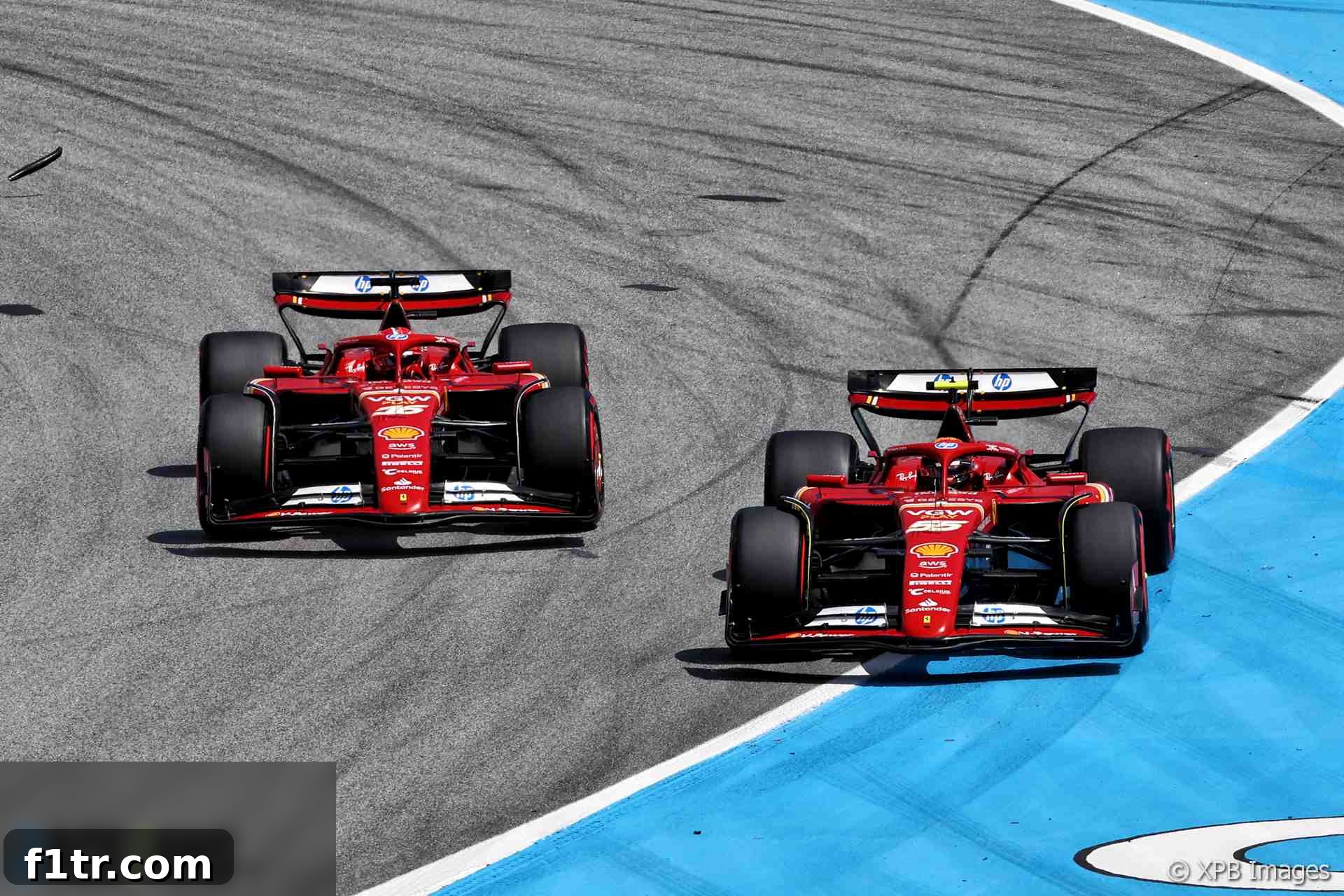
The duo concluded the Barcelona race in the same positions they started, with Leclerc finishing fifth and Sainz in sixth. However, these results came after a significant moment on the third lap when Sainz, on fresher tyres, attempted a bold overtake on Leclerc around the outside of the opening corner. The manoeuvre resulted in minor front wing damage for Leclerc, setting the stage for an immediate post-race debate about team strategy and driver conduct.
The On-Track Clash: Lap 3 Drama Unfolds at Circuit de Barcelona-Catalunya
The incident that ignited the Ferrari firestorm occurred early in the Grand Prix, a critical phase where tyre advantage is often exploited. As the pack settled, Carlos Sainz, armed with a fresh set of soft Pirelli tyres, identified an opportunity to gain track position. His target was not only to challenge rivals but also, initially, his own teammate, Charles Leclerc.
Sainz’s attempt to pass Leclerc on the outside of Turn 1 – a notoriously tricky corner for such a move – led to unavoidable contact. While the damage to Leclerc’s front wing was described as minor, its psychological impact and potential aerodynamic consequences for the remainder of the race were significant. This early-race aggression immediately raised questions about pre-race agreements and the fine line between competitive racing and team cohesion.
Leclerc, speaking after the race, expressed his belief that Sainz had not adhered to agreed-upon team tactics, which he implied dictated a more conservative approach in the early stages, especially against a teammate. He suggested that Sainz, performing in front of his home crowd, might have been overly eager to “do something spectacular,” potentially at the expense of team strategy. This sentiment highlighted a potential disconnect in understanding expectations for the opening laps of the race.
Carlos Sainz’s Robust Defense: Aggression as Essential Strategy
Carlos Sainz was quick to counter Leclerc’s accusations, making it clear he viewed his actions as strategic and necessary. Speaking to Sky Sports, Sainz articulated his frustration with the recurring nature of Leclerc’s complaints: “I think it’s too many times that he complains after a race about something.” This pointed statement suggests a deeper, ongoing dynamic between the two competitive drivers.
Sainz elaborated on his rationale for the Lap 3 manoeuvre. “I was on the attack,” he explained. “We were on new soft [tyres], Mercedes were on used soft and we had to go on the attack in the first laps when you have a new tyre and try to pass them.” This highlights a crucial strategic window in Formula 1: the initial laps on fresh, soft tyres offer peak performance, and failing to capitalise can mean losing valuable track positions that are difficult to recover later.
The Spanish driver asserted that his actions were not arbitrary but aligned with pre-race discussions. “Like we even said before the race, I passed Charles because I don’t know if he did a mistake or if he was just managing a bit too much.” This implies that Sainz perceived Leclerc as being too cautious, potentially costing the team valuable time and positions against rival constructors like Mercedes.
Sainz’s ambition extended beyond his teammate. After clearing Leclerc, he aggressively pursued Lewis Hamilton. “I nearly passed Lewis, I undercut Lewis, we nearly passed Russell at the pit stop,” he recounted. This sequence of events, according to Sainz, demonstrated his commitment to extracting maximum performance from his car and tyres, fulfilling his role as a proactive driver. “So I think I was trying out there what I have to try as a driver, what is required from me as a driver. And he elected to manage more.” This starkly contrasts their driving philosophies during that critical phase of the Grand Prix, with Sainz prioritising immediate attack and Leclerc seemingly opting for more measured tyre management.
Divergent Strategies and Team Orders: A Complex Mid-Race Dynamic
Following their early clash, the two Ferrari drivers pursued distinct tyre strategies, adding another layer of complexity to their race. Carlos Sainz opted for a more aggressive soft-medium-hard compound sequence, aiming for performance early and banking on the hard tyres to see him through the final stint. Charles Leclerc, meanwhile, chose a soft-medium-soft approach, preserving a fresh set of softs for a strong finish.
In the later stages of the race, the team intervened with a directive. Sainz was instructed to allow Leclerc to pass, enabling his teammate, on the softer and potentially faster tyres, to attack George Russell, who was ahead. Sainz complied with the team order, showcasing his adherence to the overall team objective despite his earlier frustrations.
Reflecting on the race’s outcome, Sainz acknowledged the contrasting fortunes of their strategies. “In the end, for him, [the contact] kind of paid off because he beat me at the end on a soft-medium-soft,” he admitted. For his part, Sainz’s aggressive soft-medium-hard strategy ultimately didn’t yield the desired result. “For me, I elected to be aggressive – soft-medium-hard – and it didn’t pay off. It is what it is. I think George and I on the hards at the end, we were just too slow, while the guys on softs were very quick.” This candid assessment highlights the inherent risks and rewards of diverging strategies in F1, where track conditions and tyre degradation can shift unexpectedly.
Frederic Vasseur’s Assessment: Damage Control and Looking Ahead
Ferrari team principal Frederic Vasseur was asked to weigh in on the controversial clash between his drivers. His assessment aimed to downplay the incident’s overall impact on the team’s final result, suggesting that other factors were equally, if not more, influential. “You have also other situations in the race where we lost one or two seconds, here and there,” Vasseur told Sky, implying that a single incident, while notable, wasn’t solely responsible for their finishing positions.
Vasseur also took the opportunity to commend Sainz for his compliance with team orders later in the race, which is crucial for maintaining team discipline and strategic execution. “Carlos swapped when we asked him to swap at one stage, it was a good move.” This endorsement from the team principal serves to reinforce Sainz’s professionalism despite the earlier on-track tension, demonstrating that, ultimately, team goals took precedence.
The Broader Context: Ferrari’s Internal Dynamics and Championship Aspirations
The Barcelona incident between Carlos Sainz and Charles Leclerc is more than just a fleeting moment of on-track drama; it speaks volumes about the internal dynamics at Ferrari and their ongoing quest for championship success. In a season where Ferrari aims to challenge Red Bull and fend off the resurgence of McLaren and Mercedes, managing two highly competitive drivers becomes paramount.
Ferrari’s history is replete with examples of intense intra-team rivalries, from the iconic Prost-Senna era (albeit at McLaren) to internal pressures with Schumacher and Barrichello. The challenge for Frederic Vasseur is to harness the raw speed and ambition of both Sainz and Leclerc without allowing their individual desires to undermine the team’s collective objective. Each point is critical in the Constructors’ Championship, and lost opportunities due to internal squabbles can be devastating.
Sainz, racing at his home Grand Prix, undoubtedly felt an added pressure to perform exceptionally. Such circumstances can heighten a driver’s aggression and determination, sometimes leading to decisions that are later scrutinised. Leclerc, on the other hand, a designated long-term pillar for Ferrari, seeks a clear and consistent strategic approach, which he felt was compromised by Sainz’s early move.
The incident also puts a spotlight on the evolving landscape of F1 strategy. With tyre degradation and track position being so crucial, the window for aggressive moves is often narrow. Sainz’s argument about capitalising on new soft tyres against older hard compounds from rivals like Mercedes is a valid strategic point. However, the execution of such a move, especially against a teammate, requires careful consideration and, ideally, pre-race alignment.
Navigating the Fine Line: Driver Freedom vs. Strategic Imperatives
For any Formula 1 team principal, balancing driver freedom with strategic imperatives is a perpetual tightrope walk. On one hand, allowing drivers to race hard and exploit opportunities often leads to spectacular racing and can yield unexpected results. This freedom fuels the competitive spirit that defines F1.
On the other hand, unchecked aggression can lead to incidents, lost points, and damaged morale, particularly when it involves teammates. Team orders, though sometimes unpopular with fans, are a necessary tool to prioritise the constructors’ championship and ensure the best possible outcome for the team as a whole. Vasseur’s pragmatic assessment and his recognition of Sainz’s compliance with later team orders illustrate this delicate balance.
The Barcelona incident will undoubtedly spark internal discussions at Maranello, focusing on clearer communication regarding race plans and expectations, especially in critical early race phases. Ferrari must ensure that both drivers understand the boundaries and priorities, particularly as the championship battle intensifies. The goal is to channel their immense talent and competitive drive into a cohesive force, rather than allowing it to become a source of internal friction.
Conclusion: A Recurring Challenge for Ferrari’s Championship Ambitions
The Spanish Grand Prix clash between Carlos Sainz and Charles Leclerc serves as a stark reminder of the inherent complexities in managing two top-tier Formula 1 drivers within a championship-contending team. Sainz’s defensive stance, emphasizing strategic aggression to combat rivals, stands in contrast to Leclerc’s call for adherence to pre-arranged team tactics and a more considered approach.
While team principal Frederic Vasseur downplayed the incident’s ultimate impact on the race result, the verbal exchange highlights a fundamental tension that Ferrari must continue to navigate. The incident underscores the ongoing challenge for the Scuderia: how to foster a fiercely competitive environment between its drivers while ensuring that individual ambition always serves the overarching goal of team success and championship glory. As the F1 season progresses, how Ferrari manages this dynamic will be crucial to their aspirations.
Related Articles: 2024 Spanish Grand Prix Insights
- Russell ensures Norris has still never kept his lead from pole position
- Williams repeatedly switch floors in search for Sargeant’s missing downforce
- “Why’s he not defending?”: How Russell sank to fourth after stunning start
- What radio calls reveal about Verstappen’s controlled pace and Perez’s struggles
- 2024 Spanish Grand Prix weekend F1 driver ratings
Browse all 2024 Spanish Grand Prix articles