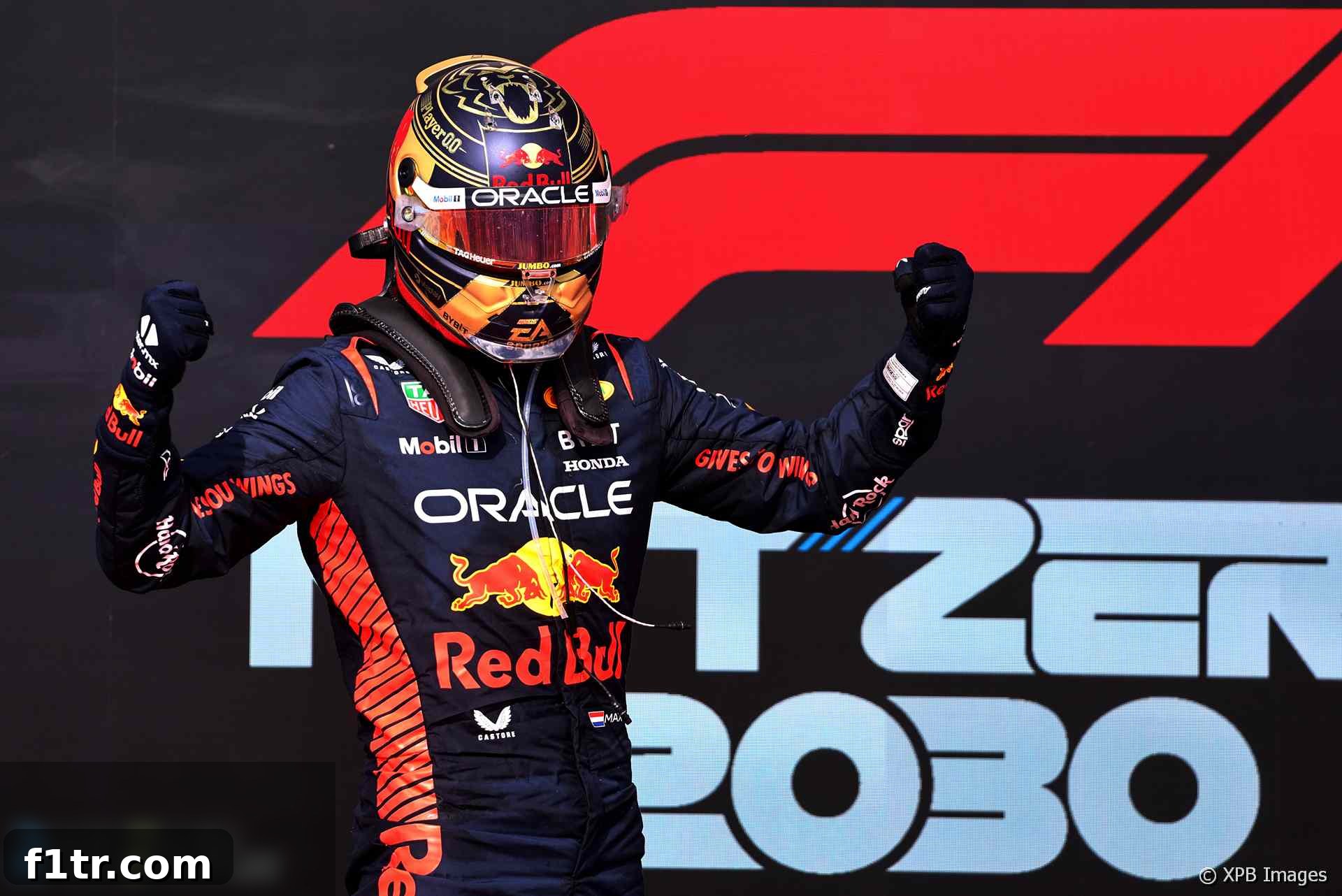
In a display of sheer determination and unparalleled skill, Max Verstappen clinched a monumental victory at the United States Grand Prix. The Dutch superstar navigated 56 grueling laps at the Circuit of the Americas (COTA) while grappling with a significant braking problem, an adversity that he believes cost Mercedes and Lewis Hamilton a golden opportunity for the win.
Max Verstappen’s Masterclass: Battling Braking Woes to Secure US Grand Prix Victory
The Red Bull Racing ace, starting from a challenging sixth position on the grid, executed a flawless drive to secure his record-equalling 15th victory of the season. His ascent through the field was marked by decisive overtakes on formidable rivals, including the Ferrari contingent and McLaren’s Lando Norris. Despite the apparent dominance, Verstappen’s in-car radio transmissions painted a vivid picture of his struggles, frequently complaining about the inconsistent and unreliable performance of his brakes.
A Race Against Himself: Overcoming Persistent Braking Issues
From the early stages of the race, Verstappen’s frustrations were palpable. He famously told his race engineer, Gianpiero Lambiase, that “these brakes are so shit,” a candid admission that underscored the severity of the problem. Throughout the Grand Prix, he repeatedly urged his team not to engage in radio communication while he was navigating a braking zone, indicating the intense focus required to manage the issue and avoid costly errors. This persistent mechanical challenge transformed what could have been a straightforward win into a testament to his adaptability and resilience.
Having convincingly won the sprint race from pole position the day before, Verstappen acknowledged that Sunday’s main event presented a far stiffer challenge. “It started already with starting in P6,” he explained after the race, highlighting the initial hurdle. However, the core difficulty stemmed from his equipment: “The whole race I was struggling a lot with the brakes. Around here there are quite a few braking points and I couldn’t really have the same feeling as yesterday. So that definitely made my race a bit tougher out there today.”
COTA is renowned for its technical layout and heavy braking zones, particularly Turn 1, Turn 11, and the final sequence of corners. These sections demand absolute precision and confidence in the braking system, making Verstappen’s performance even more extraordinary given his handicap. He had to constantly adjust his braking points and pressure, an intricate dance that risked overheating the tires or locking up, yet he managed to maintain a blistering pace.
Hamilton’s Relentless Pursuit: A Late-Race Thriller
Despite establishing a seemingly comfortable five-second lead at one point after dispatching Norris, the closing stages of the race witnessed a dramatic turn. Lewis Hamilton, driving for Mercedes, launched a formidable comeback, relentlessly closing the gap to the Red Bull. In the final laps, the seven-time world champion narrowed the margin to under two seconds, creating a nail-biting finish that had fans on the edge of their seats.
“You could see it was very close to the end,” Verstappen admitted, reflecting on Hamilton’s late charge. The challenge was compounded by navigating backmarkers as tire degradation became a significant factor. “Also with the backmarkers when the tyres are really going, it makes it a little bit more difficult,” he added, underscoring the delicate balance required to maintain pace and manage traffic under pressure.
Verstappen revealed that finding a workable solution to his braking woes was an ongoing process throughout the Grand Prix. “Of course you don’t want to destroy the tyres, but at the same time I was struggling a lot on the braking, so it took quite a while to at least find a bit of a middle way,” he explained. This continuous adaptation under race conditions highlights the mental fortitude and problem-solving capabilities that define a true champion, allowing him to push the car to its limits without compromising its integrity or his race position.
A Historic Milestone: 50 Wins and a Record-Equalling Season
Beyond the immediate triumph, the United States Grand Prix marked several significant milestones for Max Verstappen. Not only did he equal his own record for the most Grand Prix wins in a single season (15), but he also joined an elite club of Formula 1 legends by achieving his 50th career victory. This remarkable feat places him as only the fourth driver in the sport’s illustrious history to reach a half-century of wins, solidifying his place among the all-time greats.
“It’s of course incredible to win my 50th Grand Prix here, as well,” Verstappen beamed, acknowledging the historical significance of the moment. “So, very proud of course and we’ll just keep on trying to push for more.” This statement serves as a potent reminder of his relentless ambition and ongoing quest for dominance in the sport.
Mercedes’ Missed Opportunity: A Strategic Blunder?
Despite his own victory, Verstappen was candid in his assessment of Mercedes’ strategy, particularly concerning Lewis Hamilton’s race. He took the chequered flag with one of his smallest winning margins of the season, a fact he attributes directly to Hamilton’s pace and Mercedes’ strategic choices. Verstappen firmly believes that a different approach from the Silver Arrows could have altered the outcome of the race.
“For sure they could have won today if they did a better strategy,” Verstappen told Sky Sports, offering a rare glimpse into a rival team’s potential miscalculation. He elaborated on Mercedes’ overall performance throughout the weekend: “The whole weekend they were very good, quick, I think.” This acknowledgement underscores the competitive threat posed by Mercedes and Hamilton, making their strategic decision even more perplexing in hindsight.
Hamilton’s strategy involved a particularly long first stint, which, while aiming to create an offset, ultimately cost him crucial track position and time. This extended run on the initial set of tires meant he had to push harder later in the race, burning through his tire life faster in his pursuit of Verstappen. The Red Bull driver recognized this dynamic: “Today, probably from our side also with the brake issues that was hampering my pace, but in general I think they were very strong this weekend.” This perspective suggests that even with his own car’s limitations, Verstappen felt Mercedes had the raw pace to win if their pit stop timing and tire management had been optimized.
The COTA circuit, with its high-speed sections and technical turns, places immense strain on both car and driver. Tire management and strategic timing are paramount. Mercedes’ decision to extend Hamilton’s first stint may have been a calculated gamble that simply didn’t pay off, leaving them to rue what could have been a significant victory in their pursuit of Red Bull’s dominance.
Looking Ahead: Verstappen’s Unyielding Dominance
Max Verstappen’s victory at the United States Grand Prix was more than just another win; it was a testament to his ability to overcome adversity, manage extreme pressure, and deliver historic results. Despite the internal struggles with his car, he outmaneuvered his rivals and capitalized on strategic opportunities, further cementing his status as one of Formula 1’s most formidable drivers. As the season progresses, his relentless pursuit of records and championships continues, promising more thrilling battles and unforgettable moments on the track.
2023 United States Grand Prix Related Articles
- US GP was Mercedes’ best race of 2023 despite disqualification – Wolff
- Singapore and Austin retirements cost me top 10 championship place – Ocon
- United States Grand Prix result unchanged as FIA rejects Haas’ call for review
- Sargeant admits he’s ‘struggled to use all the downforce at times’ in F1
- Mercedes’ Brazilian GP set-up was “conservative” after US GP disqualification
Browse all 2023 United States Grand Prix articles