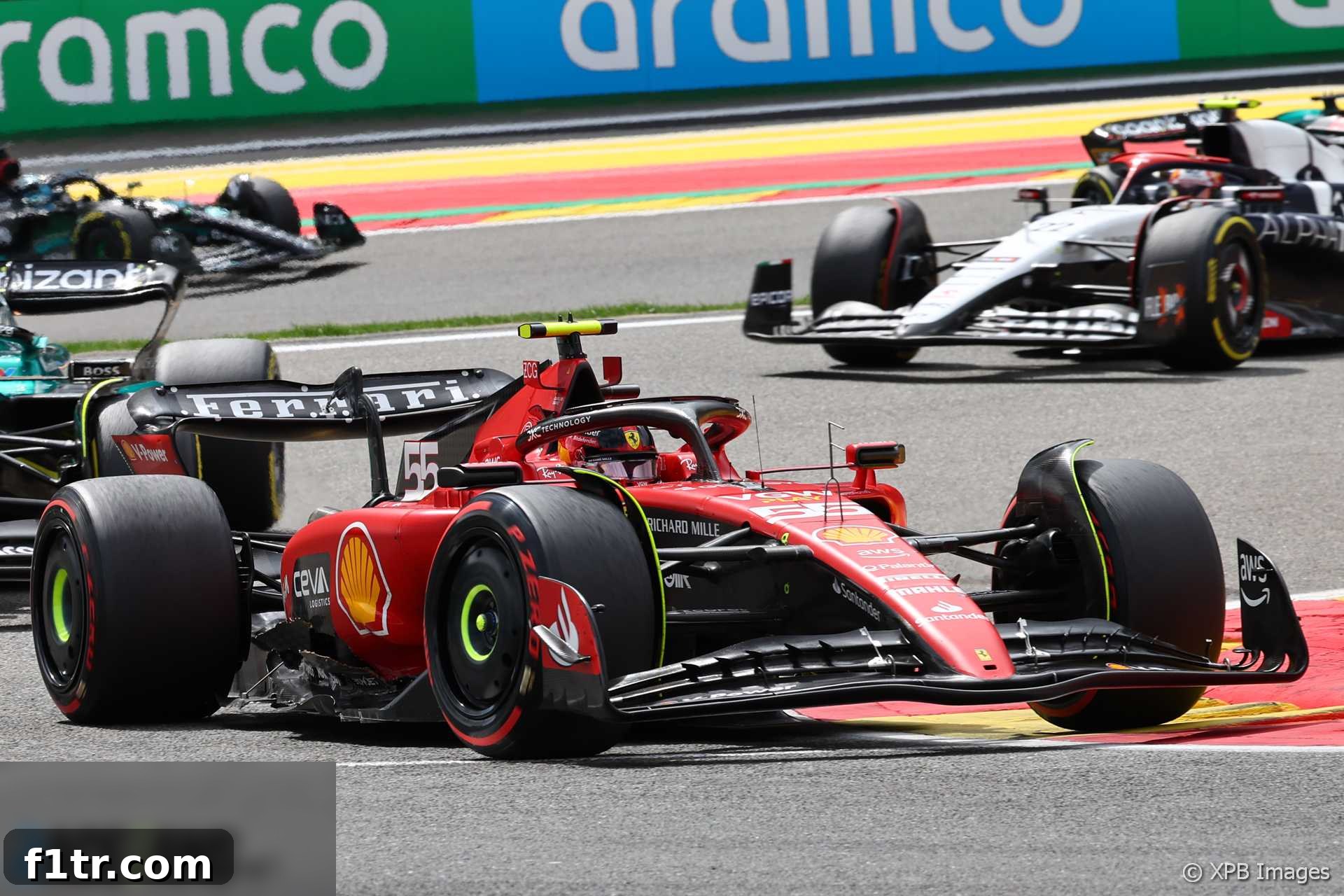
Ferrari’s Risky Gamble: Why Carlos Sainz Stayed Out with Damaged Car at the Belgian Grand Prix
The 2023 Formula 1 Belgian Grand Prix at the iconic Spa-Francorchamps circuit delivered its usual dose of drama, but one incident stood out for its strategic implications: Ferrari’s decision to keep Carlos Sainz Jnr on track despite significant damage to his car during the opening lap. The team’s calculated risk hinged on the expectation of a red flag, which they hoped would provide a crucial window to repair the Spanish driver’s stricken SF-23.
From the outset, the Belgian Grand Prix weekend was fraught with the unpredictability of Spa’s microclimate. The two days preceding Sunday’s main event had already seen substantial disruption due to persistent rain, setting a precedent for a potentially chaotic race day. This history of inclement weather and resultant race stoppages likely played a significant role in Ferrari’s bold strategic call.
The Opening Lap Collision and Immediate Consequences
The pivotal moment for Sainz occurred at the notorious La Source hairpin, the very first corner of the race. A collision involving Sainz and McLaren’s Oscar Piastri irrevocably altered both drivers’ races. While Piastri’s McLaren was critically damaged, forcing him to retire on the first lap, Sainz’s Ferrari, though severely compromised, managed to continue. The right-hand side of his floor sustained extensive damage, a critical area for the sophisticated aerodynamics of modern Formula 1 cars.
The floor of an F1 car is arguably its most vital aerodynamic component, responsible for generating a substantial portion of the car’s total downforce. Damage to this area can dramatically alter the car’s performance, stability, and balance, making it incredibly challenging for a driver to maintain pace and control. Despite this, Ferrari chose to keep Sainz out, a decision rooted deeply in their analysis of the prevailing conditions and forecasts.
Ferrari’s Strategic Wager: Hoping for a Red Flag
Ferrari’s team principal, Frederic Vasseur, later confirmed the rationale behind their strategy. “We were just expecting a red flag at one stage, to be able to fix it, with the first shower,” Vasseur explained. The team had been closely monitoring weather forecasts, which indicated a 40% chance of rain during the grand prix. Given Spa’s reputation for sudden downpours and the safety implications this often carries, a red flag—a full race stoppage—was a distinct possibility. Such a stoppage would have allowed teams to perform repairs on damaged cars, effectively giving Sainz a second chance in the race.
The decision to continue with a damaged car is always a difficult one in Formula 1. It balances the slim chance of salvaging points against the risks of further damage, potential safety issues, and the wear and tear on engine components. For Ferrari, the potential reward of securing points, especially from a competitive driver like Sainz, outweighed the immediate drawbacks, provided their red flag prediction materialized.
The Elusive Rain and Lingering Hope
As the race progressed, the heavens did open, bringing a shower around the halfway point. This momentary downpour reignited Ferrari’s hopes. However, the rain, while present, never intensified to the point required to warrant a red flag. The track conditions remained manageable for the drivers, and the race control deemed it unnecessary to stop the proceedings fully. This was a critical blow to Ferrari’s strategy.
The intermittent nature of the rain at Spa-Francorchamps is a characteristic challenge for teams. Drivers and strategists constantly analyze radar, track temperature, and grip levels to make split-second decisions on tyre compounds and pit stop timings. In this instance, the rain was just enough to create uncertainty but not enough to trigger the desired race stoppage, leaving Ferrari in a difficult predicament.
The Undeniable Impact of Extensive Damage
The consequences of the floor damage were immediate and severe for Sainz’s performance. Vasseur articulated the complexity of the issue: “It’s quite difficult because you are losing downforce, but it’s not just the downforce it’s the balance of the car. We never did the calculation of a potential lap time with its points of downforce, its points of balance, but it was a lot.” This highlights a fundamental aspect of F1 aerodynamics; it’s not merely about the quantity of downforce, but its distribution and how it affects the car’s handling characteristics through corners and under braking.
A damaged floor can lead to unpredictable handling, increased tyre degradation, and a significant loss of overall grip. For a driver of Sainz’s caliber, competing on a challenging track like Spa-Francorchamps, such a compromised car quickly becomes a major impediment. Sainz himself confirmed the severity, stating his car was “undriveable, pretty much,” after the collision. Despite the immense difficulty, he heroically kept pushing, driven by the team’s shared hope for a red flag that would reset their race.
The Inevitable Retirement and Strategic Afterthought
As the rain shower passed and the prospect of a red flag faded, Ferrari was faced with a stark reality. Continuing to circulate with a severely damaged and underperforming car served no strategic purpose. Not only was Sainz unable to compete for points, but keeping the car on track risked further damage to vital components, potentially incurring penalties or requiring expensive repairs later in the season.
Shortly after the rain subsided and the lack of a red flag became apparent, Ferrari made the pragmatic decision to retire Sainz’s car. “But when the shower came without the red flag, we decided to stop it,” Vasseur concluded. Sainz echoed this sentiment: “But we kept it going and never gave up in case there’s a red flag. Then when the rain passed and there was no red flag we retired.” It was a disheartening end to a race that promised much, a testament to the fine margins and strategic gambles inherent in Formula 1.
Reflecting on Spa’s Whims and F1 Strategy
The incident involving Carlos Sainz and Ferrari at the Belgian Grand Prix serves as a compelling illustration of the high-stakes chess match that is Formula 1 strategy. It underscores the profound influence of weather, the critical importance of aerodynamics, and the calculated risks teams are willing to take in pursuit of championship points. Spa-Francorchamps, with its legendary corners and ever-present threat of rain, continues to be a crucible where such strategic decisions are tested to their limits.
While Ferrari’s gamble ultimately didn’t pay off on this occasion, it was a perfectly understandable strategy given the circuit’s history and the prevailing conditions. Such moments define the drama of F1, showcasing not just the raw speed of the cars and talent of the drivers, but also the relentless intellectual battle waged by strategists on the pit wall. The 2023 Belgian Grand Prix will undoubtedly be remembered for this bold strategic play that, despite its unfortunate outcome, highlighted the captivating unpredictability that keeps fans enthralled.
Delving Deeper into Motorsport Analysis
In the fast-paced world of Formula 1, understanding the intricate strategies, technical details, and behind-the-scenes decisions is paramount for true enthusiasts. Comprehensive and independent analysis helps shed light on these complex aspects, enriching the fan experience.
Quality motorsport journalism relies on dedicated reporting, detailed technical breakdowns, and direct insights from the paddock. Supporting platforms that provide in-depth coverage allows for the continuation of this vital work, bringing you closer to the heart of the sport. Your engagement fuels the ability to travel, investigate, write, and publish original content that brings the stories of F1 to life.
- Explore In-Depth F1 Analysis
- Frequently Asked Questions about F1 Coverage
More from the 2023 Belgian Grand Prix
- Haas drivers fear losing battle for seventh after “grim weekend” in Spa
- Mercedes optimistic they’re “in the right place for winter” with development plan
- Ferrari not convinced by call to equalise engines: ‘Renault is not so far away’
- Ferrari staying “calm” amid swings in performance from race to race
- Pirelli proposes new “super-intermediate” to address wet weather tyre problems
Browse all 2023 Belgian Grand Prix articles