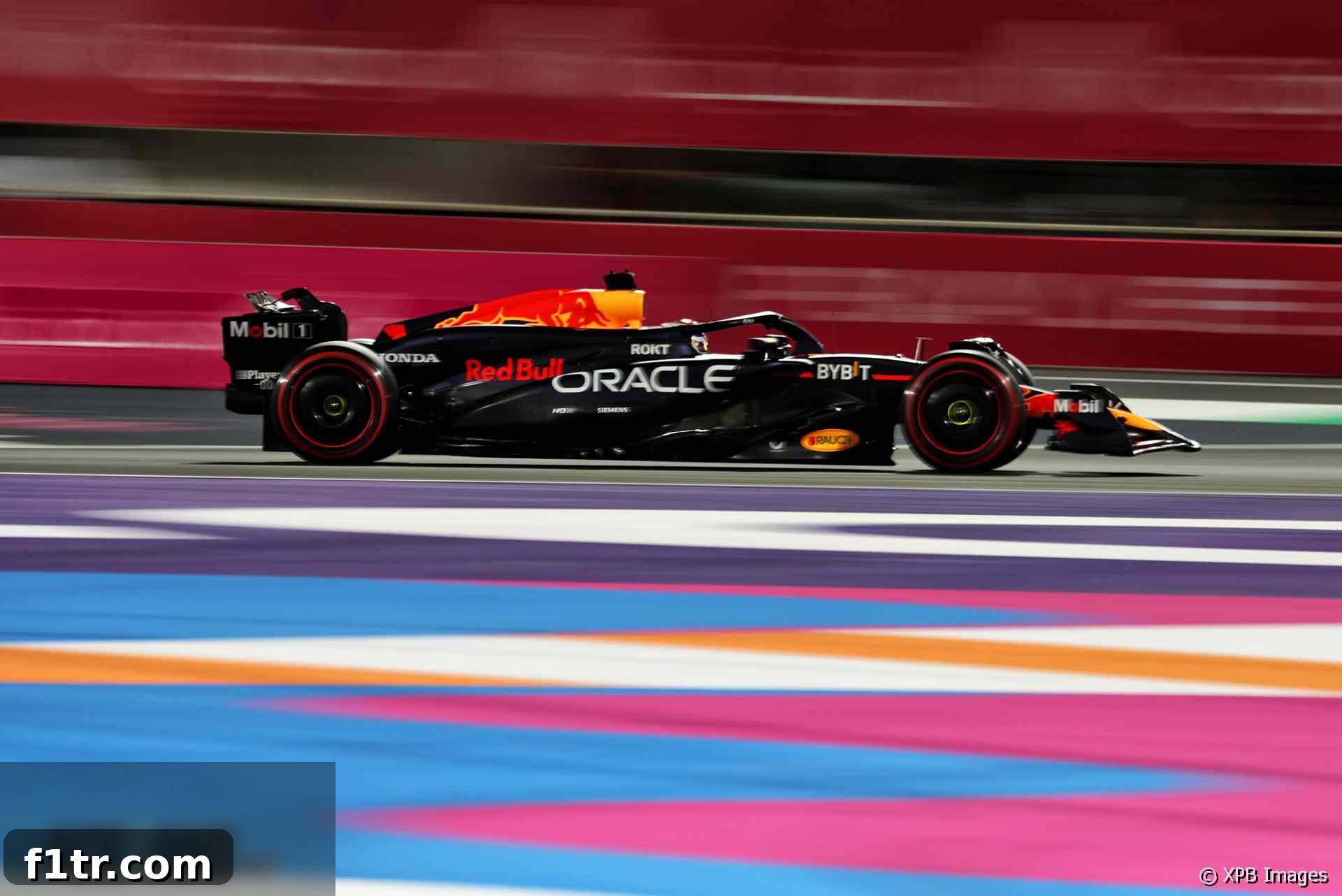
In his illustrious career spanning three championship-winning seasons, Max Verstappen had never before claimed pole position at the Saudi Arabian Grand Prix. The Jeddah Corniche Circuit, with its unique blend of blistering speeds and unforgiving walls, had proven to be a perplexing challenge for the Dutch maestro. However, in his fourth attempt, Verstappen emphatically broke this streak, securing the coveted pole position for the 2024 edition. This achievement sets the stage for what many anticipate will be another dominant performance, yet Jeddah has historically presented anything but a straightforward race for the reigning world champion.
Advert | Become a Supporter & go ad-free
Verstappen’s Past Triumphs and Tribulations in Jeddah
Verstappen’s history at the Saudi Arabian Grand Prix is a tapestry woven with intense battles, strategic gambles, and unexpected setbacks. In 2021, he found himself embroiled in a fierce and often controversial wheel-to-wheel contest with Lewis Hamilton, a memorable chapter in their epic championship rivalry. Though he ultimately fell short of victory that year, the intensity of their duel highlighted the unforgiving nature of the circuit and Verstappen’s relentless pursuit of victory.
The 2022 race saw him clinch victory, but not without a touch of fortune. His then pole-winning teammate, Sergio Perez, lost the lead due to a critically ill-timed Safety Car deployment, an incident that underscored how quickly fortunes can turn at Jeddah. Last year, Verstappen was poised for another strong challenge, likely to convert a pole position into a win. However, a debilitating driveshaft failure during qualifying relegated him to a distant 15th on the grid. Despite this significant handicap, his exceptional racecraft and the raw pace of his Red Bull machine saw him scythe through the field to finish a remarkable second, a testament to his sheer talent and the car’s superiority.
Unpacking Red Bull’s Unyielding Pace
Following his commanding lights-to-flag victory in Bahrain just a week prior, Verstappen himself had suggested that Jeddah’s faster, more flowing layout and smoother asphalt would “probably help other teams compared to us.” This prediction, however, was swiftly disproven by his qualifying performance. His advantage over the competition in Jeddah was noticeably larger than it had been in Bahrain, a stark reminder of Red Bull’s formidable package. This bodes ill for their rivals, especially considering the RB20’s known strength over a full race stint, which often surpasses its single-lap qualifying pace.
The data from Thursday’s second practice session further solidified this narrative of dominance. Verstappen consistently demonstrated superior long-run pace, maintaining lap times in the high 1’33s and low 1’34s on the medium compound tyre. This was not merely half a second faster than his own teammate; it also eclipsed the efforts of key rivals, including Carlos Sainz Jnr in the Ferrari, both Mercedes cars, and both McLarens, all of whom ran on the same tyre compound. Charles Leclerc, starting alongside Verstappen on the front row, opted for a long run on the soft tyre, perhaps exploring its durability on a track that is significantly kinder to rubber than Bahrain. Yet, even on a theoretically faster compound, Leclerc was unable to match Verstappen’s sustained pace, underscoring the Red Bull’s exceptional performance envelope.
Advert | Become a RaceFans supporter andgo ad-free
Strategy Simplicity Amidst Track Complexity
While Formula 1 is rarely straightforward, the strategic landscape in Jeddah appears almost deceptively simple. The 6.1-kilometer circuit is renowned for its low tyre degradation and incredibly high average lap speeds. These factors collectively make a multi-stop strategy largely impractical and strategically unwise. Pirelli, the sport’s sole tyre supplier, has explicitly described a one-stop strategy as “almost obligatory.” Their recommendation for the race is a start on the medium compound tyres, followed by a single pit stop to switch to hard tyres, ideally executed between laps 18 and 25. The limited time gained by fresh tyres against the significant time loss in the pit lane unequivocally favors a single pit visit, simplifying the strategic decisions for teams but intensifying the focus on tyre management within that single stint.
However, despite the clear-cut tyre strategy, very little else is simple around the Jeddah Corniche Circuit. The Grand Prix start itself offers a prime example of potential unpredictability. Charles Leclerc, lining up in second position on the grid, possesses a genuine and strong chance of challenging Verstappen into the first corner. A historical analysis of the five standing starts held across the three previous Saudi Arabian Grands Prix (the 2021 race experienced two stoppages and restarts) reveals a telling statistic: the car on pole position has retained the lead only twice. This data suggests that the run down to Turn 1 in Jeddah is far from a formality for the pole-sitter, offering Leclerc a golden opportunity to upset Verstappen’s rhythm from the outset.
The Dirty Air Dilemma and Jeddah’s Wildcard Nature
Saturday’s race will also serve as a crucial early test for the 2024 season regarding the impact of “dirty air” on overtaking and competitive racing. Dirty air refers to the turbulent aerodynamic wake created by a leading car, which significantly reduces the downforce and aerodynamic efficiency of a following car, making it harder to stay close and attempt overtakes. If Leclerc, despite his strong starting position, begins to fall away from Verstappen, and Perez finds himself unable to challenge the Ferrari for second place, it would be a concerning indicator for the overall competitiveness and overtaking prospects throughout the rest of the season. The Jeddah circuit, with its high-speed sections and relatively short braking zones, can exacerbate the effects of dirty air, potentially creating a procession if cars cannot follow closely enough.
Fortunately for fans seeking excitement, Jeddah has a well-earned reputation for being one of Formula 1’s most unpredictable circuits, frequently producing Safety Car periods, Virtual Safety Cars (VSCs), and even red flag stoppages at a higher rate than almost any other venue. While circuit modifications implemented over the past two years have aimed to improve safety and reduce the likelihood of such disruptions, Jeddah remains a track where a single mistake, a misjudged overtaking maneuver, or an ill-timed mechanical failure can instantly turn a race on its head. These unforeseen incidents have a profound ability to scramble established strategies, creating chaos and opening up opportunities for drivers lower down the order, ensuring that the race is far from a foregone conclusion even if Verstappen maintains a lead.
Oliver Bearman’s Baptism of Fire
Adding another compelling layer of intrigue to the Saudi Arabian Grand Prix is the unexpected debut of 18-year-old Briton, Oliver Bearman. Stepping into the cockpit of the Ferrari SF-24 after Carlos Sainz Jnr was sidelined by appendicitis, Bearman faces the unenviable task of making his Formula 1 debut on one of the sport’s most relentlessly challenging tracks, starting from a competitive but crowded 11th position on the grid. This is a monumental moment for the young driver, thrust into the spotlight with minimal preparation in a high-pressure environment.
As his teammate Charles Leclerc’s front-row start emphatically demonstrates, Bearman has an undeniably fast car underneath him – a machine with superior pace to many of those around him in the midfield. The question is whether he can harness that raw potential over what promises to be the toughest, yet potentially most rewarding, 50 laps of his burgeoning racing career. His ability to navigate the cut and thrust of the midfield, manage his tyres, and extract performance from the Ferrari while avoiding mistakes will be scrutinized intensely. A strong performance, even a points finish, would be a sensational start to his F1 journey and a significant boost to his aspirations for a full-time seat in the future.
Advert | Become a RaceFans supporter andgo ad-free
Ferrari’s Determined Fight Against Red Bull Dominance
While Oliver Bearman navigates the complexities of his F1 debut from the midfield, his seasoned teammate, Charles Leclerc, will be spearheading Ferrari’s charge at the very front, aiming to take the fight directly to Red Bull. Leclerc remains characteristically optimistic despite the apparent pace advantage held by their rivals. “I’m always optimistic, so we’ll try our best,” Leclerc stated after a strong qualifying performance.
He realistically acknowledges the uphill battle: “However, we know that normally they have the upper hand and they have a bit more pace in the race than in qualifying. And looking at the gaps today it’s going to be a difficult one to get the top spot tomorrow. But I’ll do everything as always.” Ferrari has shown improved race pace this season, closing the gap to Red Bull compared to previous years. The challenge for Leclerc will be to manage his tyres effectively, execute a flawless pit stop, and exploit any potential Safety Car periods or Red Bull missteps to challenge for victory. Even if a win proves elusive, securing a strong second place and preventing a Red Bull one-two would be a significant moral victory for the Scuderia.
Speed Trap: Unveiling Straight-Line Performance
The speed trap data from qualifying provides an interesting snapshot of each car’s top-end performance, highlighting aerodynamic efficiency and engine power. While ultimate race pace depends on a multitude of factors, these figures offer insight into which teams might have an advantage in overtakes on Jeddah’s long straights.
| P. | # | Driver | Car | Engine | Model | Max kph (mph) |
|---|---|---|---|---|---|---|
| 1 | 27 | Nico Hulkenberg | Haas | Ferrari | VF-24 | 338.3 (210.2) |
| 2 | 20 | Kevin Magnussen | Haas | Ferrari | VF-24 | 334.7 (208.0) |
| 3 | 1 | Max Verstappen | Red Bull | Honda RBPT | RB20 | 333.1 (207.0) |
| 4 | 3 | Daniel Ricciardo | RB | Honda RBPT | 01 | 333.1 (207.0) |
| 5 | 44 | Lewis Hamilton | Mercedes | Mercedes | W15 | 332.9 (206.9) |
| 6 | 22 | Yuki Tsunoda | RB | Honda RBPT | 01 | 332.4 (206.5) |
| 7 | 31 | Esteban Ocon | Alpine | Renault | A524 | 332.1 (206.4) |
| 8 | 11 | Sergio Perez | Red Bull | Honda RBPT | RB20 | 332.1 (206.4) |
| 9 | 2 | Logan Sargeant | Williams | Mercedes | FW46 | 332.0 (206.3) |
| 10 | 23 | Alexander Albon | Williams | Mercedes | FW46 | 331.8 (206.2) |
| 11 | 63 | George Russell | Mercedes | Mercedes | W15 | 331.5 (206.0) |
| 12 | 14 | Fernando Alonso | Aston Martin | Mercedes | AMR24 | 331.0 (205.7) |
| 13 | 38 | Oliver Bearman | Ferrari | Ferrari | SF-24 | 331.0 (205.7) |
| 14 | 16 | Charles Leclerc | Ferrari | Ferrari | SF-24 | 330.9 (205.6) |
| 15 | 77 | Valtteri Bottas | Sauber | Ferrari | C44 | 329.3 (204.6) |
| 16 | 18 | Lance Stroll | Aston Martin | Mercedes | AMR24 | 328.8 (204.3) |
| 17 | 10 | Pierre Gasly | Alpine | Renault | A524 | 327.7 (203.6) |
| 18 | 4 | Lando Norris | McLaren | Mercedes | MCL38 | 327.2 (203.3) |
| 19 | 81 | Oscar Piastri | McLaren | Mercedes | MCL38 | 326.0 (202.6) |
| 20 | 24 | Zhou Guanyu | Sauber | Ferrari | C44 | 288.5 (179.3) |
Over to You: Your Predictions for the Saudi Arabian Grand Prix
As the engines prepare to roar, the questions loom large: Can Charles Leclerc mount a significant challenge and prevent another dominant Max Verstappen victory, or even a Red Bull one-two? What will Oliver Bearman, under immense pressure and expectation, be able to achieve in his thrilling Ferrari debut from the midfield?
Share your predictions and insights on what promises to be an action-packed Saudi Arabian Grand Prix in the comments below.
Become a RaceFans Supporter
RaceFans is run thanks in part to the generous support of its readers. By contributing £1 per month or £12 per year (or the same in whichever currency you use) you can help cover the costs of creating, hosting and developing RaceFans today and in the future.
Become a RaceFans Supporter today and browse the site ad-free. Sign up or find out more via the links below:
- Become a RaceFans Supporter
- RaceFans Supporter FAQ
2024 Saudi Arabian Grand Prix News and Analysis
- Bearman’s 2024 Jeddah debut performance makes him ‘feel like an absolute idiot’
- Vowles being patient with Sargeant but expects to see “progress”
- “So I’ve got nothing to worry about?” – The best unheard team radio from Jeddah
- “Shock” of poor start to season showed need for change at Alpine – Famin
- “My tyres are dying”: Stroll’s short-lived struggle until he hit the wall
Browse all 2024 Saudi Arabian Grand Prix articles
In his illustrious career spanning three championship-winning seasons, Max Verstappen had never before claimed pole position at the Saudi Arabian Grand Prix. The Jeddah Corniche Circuit, with its unique blend of blistering speeds and unforgiving walls, had proven to be a perplexing challenge for the Dutch maestro. However, in his fourth attempt, Verstappen emphatically broke this streak, securing the coveted pole position for the 2024 edition. This achievement sets the stage for what many anticipate will be another dominant performance, yet Jeddah has historically presented anything but a straightforward race for the reigning world champion.
Advert | Become a Supporter & go ad-free
Verstappen’s Past Triumphs and Tribulations in Jeddah
Verstappen’s history at the Saudi Arabian Grand Prix is a tapestry woven with intense battles, strategic gambles, and unexpected setbacks. In 2021, he found himself embroiled in a fierce and often controversial wheel-to-wheel contest with Lewis Hamilton, a memorable chapter in their epic championship rivalry. Though he ultimately fell short of victory that year, the intensity of their duel highlighted the unforgiving nature of the circuit and Verstappen’s relentless pursuit of victory.
The 2022 race saw him clinch victory, but not without a touch of fortune. His then pole-winning teammate, Sergio Perez, lost the lead due to a critically ill-timed Safety Car deployment, an incident that underscored how quickly fortunes can turn at Jeddah. Last year, Verstappen was poised for another strong challenge, likely to convert a pole position into a win. However, a debilitating driveshaft failure during qualifying relegated him to a distant 15th on the grid. Despite this significant handicap, his exceptional racecraft and the raw pace of his Red Bull machine saw him scythe through the field to finish a remarkable second, a testament to his sheer talent and the car’s superiority.
Unpacking Red Bull’s Unyielding Pace
Following his commanding lights-to-flag victory in Bahrain just a week prior, Verstappen himself had suggested that Jeddah’s faster, more flowing layout and smoother asphalt would “probably help other teams compared to us.” This prediction, however, was swiftly disproven by his qualifying performance. His advantage over the competition in Jeddah was noticeably larger than it had been in Bahrain, a stark reminder of Red Bull’s formidable package. This bodes ill for their rivals, especially considering the RB20’s known strength over a full race stint, which often surpasses its single-lap qualifying pace.
The data from Thursday’s second practice session further solidified this narrative of dominance. Verstappen consistently demonstrated superior long-run pace, maintaining lap times in the high 1’33s and low 1’34s on the medium compound tyre. This was not merely half a second faster than his own teammate; it also eclipsed the efforts of key rivals, including Carlos Sainz Jnr in the Ferrari, both Mercedes cars, and both McLarens, all of whom ran on the same tyre compound. Charles Leclerc, starting alongside Verstappen on the front row, opted for a long run on the soft tyre, perhaps exploring its durability on a track that is significantly kinder to rubber than Bahrain. Yet, even on a theoretically faster compound, Leclerc was unable to match Verstappen’s sustained pace, underscoring the Red Bull’s exceptional performance envelope.
Advert | Become a RaceFans supporter andgo ad-free
Strategy Simplicity Amidst Track Complexity
While Formula 1 is rarely straightforward, the strategic landscape in Jeddah appears almost deceptively simple. The 6.1-kilometer circuit is renowned for its low tyre degradation and incredibly high average lap speeds. These factors collectively make a multi-stop strategy largely impractical and strategically unwise. Pirelli, the sport’s sole tyre supplier, has explicitly described a one-stop strategy as “almost obligatory.” Their recommendation for the race is a start on the medium compound tyres, followed by a single pit stop to switch to hard tyres, ideally executed between laps 18 and 25. The limited time gained by fresh tyres against the significant time loss in the pit lane unequivocally favors a single pit visit, simplifying the strategic decisions for teams but intensifying the focus on tyre management within that single stint.
However, despite the clear-cut tyre strategy, very little else is simple around the Jeddah Corniche Circuit. The Grand Prix start itself offers a prime example of potential unpredictability. Charles Leclerc, lining up in second position on the grid, possesses a genuine and strong chance of challenging Verstappen into the first corner. A historical analysis of the five standing starts held across the three previous Saudi Arabian Grands Prix (the 2021 race experienced two stoppages and restarts) reveals a telling statistic: the car on pole position has retained the lead only twice. This data suggests that the run down to Turn 1 in Jeddah is far from a formality for the pole-sitter, offering Leclerc a golden opportunity to upset Verstappen’s rhythm from the outset.
The Dirty Air Dilemma and Jeddah’s Wildcard Nature
Saturday’s race will also serve as a crucial early test for the 2024 season regarding the impact of “dirty air” on overtaking and competitive racing. Dirty air refers to the turbulent aerodynamic wake created by a leading car, which significantly reduces the downforce and aerodynamic efficiency of a following car, making it harder to stay close and attempt overtakes. If Leclerc, despite his strong starting position, begins to fall away from Verstappen, and Perez finds himself unable to challenge the Ferrari for second place, it would be a concerning indicator for the overall competitiveness and overtaking prospects throughout the rest of the season. The Jeddah circuit, with its high-speed sections and relatively short braking zones, can exacerbate the effects of dirty air, potentially creating a procession if cars cannot follow closely enough.
Fortunately for fans seeking excitement, Jeddah has a well-earned reputation for being one of Formula 1’s most unpredictable circuits, frequently producing Safety Car periods, Virtual Safety Cars (VSCs), and even red flag stoppages at a higher rate than almost any other venue. While circuit modifications implemented over the past two years have aimed to improve safety and reduce the likelihood of such disruptions, Jeddah remains a track where a single mistake, a misjudged overtaking maneuver, or an ill-timed mechanical failure can instantly turn a race on its head. These unforeseen incidents have a profound ability to scramble established strategies, creating chaos and opening up opportunities for drivers lower down the order, ensuring that the race is far from a foregone conclusion even if Verstappen maintains a lead.
Oliver Bearman’s Baptism of Fire
Adding another compelling layer of intrigue to the Saudi Arabian Grand Prix is the unexpected debut of 18-year-old Briton, Oliver Bearman. Stepping into the cockpit of the Ferrari SF-24 after Carlos Sainz Jnr was sidelined by appendicitis, Bearman faces the unenviable task of making his Formula 1 debut on one of the sport’s most relentlessly challenging tracks, starting from a competitive but crowded 11th position on the grid. This is a monumental moment for the young driver, thrust into the spotlight with minimal preparation in a high-pressure environment.
As his teammate Charles Leclerc’s front-row start emphatically demonstrates, Bearman has an undeniably fast car underneath him – a machine with superior pace to many of those around him in the midfield. The question is whether he can harness that raw potential over what promises to be the toughest, yet potentially most rewarding, 50 laps of his burgeoning racing career. His ability to navigate the cut and thrust of the midfield, manage his tyres, and extract performance from the Ferrari while avoiding mistakes will be scrutinized intensely. A strong performance, even a points finish, would be a sensational start to his F1 journey and a significant boost to his aspirations for a full-time seat in the future.
Advert | Become a RaceFans supporter andgo ad-free
Ferrari’s Determined Fight Against Red Bull Dominance
While Oliver Bearman navigates the complexities of his F1 debut from the midfield, his seasoned teammate, Charles Leclerc, will be spearheading Ferrari’s charge at the very front, aiming to take the fight directly to Red Bull. Leclerc remains characteristically optimistic despite the apparent pace advantage held by their rivals. “I’m always optimistic, so we’ll try our best,” Leclerc stated after a strong qualifying performance.
He realistically acknowledges the uphill battle: “However, we know that normally they have the upper hand and they have a bit more pace in the race than in qualifying. And looking at the gaps today it’s going to be a difficult one to get the top spot tomorrow. But I’ll do everything as always.” Ferrari has shown improved race pace this season, closing the gap to Red Bull compared to previous years. The challenge for Leclerc will be to manage his tyres effectively, execute a flawless pit stop, and exploit any potential Safety Car periods or Red Bull missteps to challenge for victory. Even if a win proves elusive, securing a strong second place and preventing a Red Bull one-two would be a significant moral victory for the Scuderia.
Speed Trap: Unveiling Straight-Line Performance
The speed trap data from qualifying provides an interesting snapshot of each car’s top-end performance, highlighting aerodynamic efficiency and engine power. While ultimate race pace depends on a multitude of factors, these figures offer insight into which teams might have an advantage in overtakes on Jeddah’s long straights.
| P. | # | Driver | Car | Engine | Model | Max kph (mph) |
|---|---|---|---|---|---|---|
| 1 | 27 | Nico Hulkenberg | Haas | Ferrari | VF-24 | 338.3 (210.2) |
| 2 | 20 | Kevin Magnussen | Haas | Ferrari | VF-24 | 334.7 (208.0) |
| 3 | 1 | Max Verstappen | Red Bull | Honda RBPT | RB20 | 333.1 (207.0) |
| 4 | 3 | Daniel Ricciardo | RB | Honda RBPT | 01 | 333.1 (207.0) |
| 5 | 44 | Lewis Hamilton | Mercedes | Mercedes | W15 | 332.9 (206.9) |
| 6 | 22 | Yuki Tsunoda | RB | Honda RBPT | 01 | 332.4 (206.5) |
| 7 | 31 | Esteban Ocon | Alpine | Renault | A524 | 332.1 (206.4) |
| 8 | 11 | Sergio Perez | Red Bull | Honda RBPT | RB20 | 332.1 (206.4) |
| 9 | 2 | Logan Sargeant | Williams | Mercedes | FW46 | 332.0 (206.3) |
| 10 | 23 | Alexander Albon | Williams | Mercedes | FW46 | 331.8 (206.2) |
| 11 | 63 | George Russell | Mercedes | Mercedes | W15 | 331.5 (206.0) |
| 12 | 14 | Fernando Alonso | Aston Martin | Mercedes | AMR24 | 331.0 (205.7) |
| 13 | 38 | Oliver Bearman | Ferrari | Ferrari | SF-24 | 331.0 (205.7) |
| 14 | 16 | Charles Leclerc | Ferrari | Ferrari | SF-24 | 330.9 (205.6) |
| 15 | 77 | Valtteri Bottas | Sauber | Ferrari | C44 | 329.3 (204.6) |
| 16 | 18 | Lance Stroll | Aston Martin | Mercedes | AMR24 | 328.8 (204.3) |
| 17 | 10 | Pierre Gasly | Alpine | Renault | A524 | 327.7 (203.6) |
| 18 | 4 | Lando Norris | McLaren | Mercedes | MCL38 | 327.2 (203.3) |
| 19 | 81 | Oscar Piastri | McLaren | Mercedes | MCL38 | 326.0 (202.6) |
| 20 | 24 | Zhou Guanyu | Sauber | Ferrari | C44 | 288.5 (179.3) |
Over to You: Your Predictions for the Saudi Arabian Grand Prix
As the engines prepare to roar, the questions loom large: Can Charles Leclerc mount a significant challenge and prevent another dominant Max Verstappen victory, or even a Red Bull one-two? What will Oliver Bearman, under immense pressure and expectation, be able to achieve in his thrilling Ferrari debut from the midfield?
Share your predictions and insights on what promises to be an action-packed Saudi Arabian Grand Prix in the comments below.
Become a RaceFans Supporter
RaceFans is run thanks in part to the generous support of its readers. By contributing £1 per month or £12 per year (or the same in whichever currency you use) you can help cover the costs of creating, hosting and developing RaceFans today and in the future.
Become a RaceFans Supporter today and browse the site ad-free. Sign up or find out more via the links below:
- Become a RaceFans Supporter
- RaceFans Supporter FAQ
2024 Saudi Arabian Grand Prix News and Analysis
- Bearman’s 2024 Jeddah debut performance makes him ‘feel like an absolute idiot’
- Vowles being patient with Sargeant but expects to see “progress”
- “So I’ve got nothing to worry about?” – The best unheard team radio from Jeddah
- “Shock” of poor start to season showed need for change at Alpine – Famin
- “My tyres are dying”: Stroll’s short-lived struggle until he hit the wall
Browse all 2024 Saudi Arabian Grand Prix articles