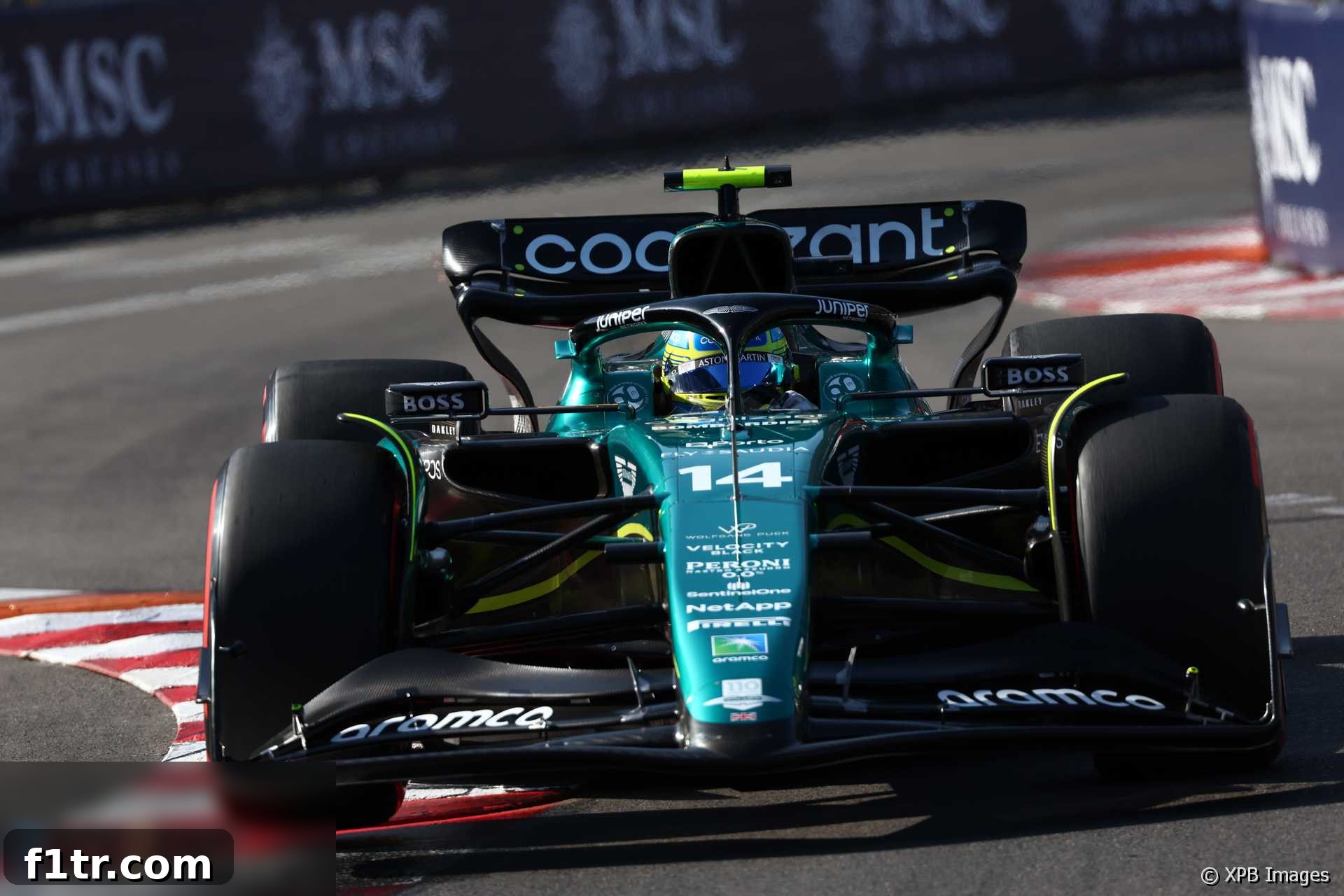
The highly anticipated Monaco Grand Prix qualifying session delivered its usual blend of drama and precision, culminating in a razor-thin margin separating the front runners. Aston Martin’s Fernando Alonso, demonstrating exceptional form, came tantalizingly close to securing his first pole position since 2012. However, the team has since provided a comprehensive explanation for why they ultimately lost crucial time to their rivals, most notably Red Bull’s Max Verstappen, in the challenging final sector of the circuit.
Advert | Become a Supporter & go ad-free
Alonso’s Pole Pursuit: A Battle Against Tyre Degradation and Traction
Fernando Alonso’s performance throughout the Monaco qualifying sessions was nothing short of brilliant. In Q3, the veteran driver displayed incredible pace, registering a time that was a remarkable 0.204 seconds quicker than Max Verstappen across the first two sectors of the lap. This commanding lead signaled a strong challenge for pole position, sending waves of excitement through the Aston Martin garage and among fans.
However, the notoriously tight and technical final sector of the Monaco circuit, which encompasses seven critical corners, proved to be Aston Martin’s Achilles’ heel. Verstappen managed to bridge the gap and then some, finding an impressive 0.288 seconds over Alonso in this single sector. This surge from the Red Bull driver ultimately denied Alonso what would have been a historic pole position by a mere 0.084 seconds, underscoring the relentless competition at the pinnacle of motorsport.
Aston Martin’s Performance Director, Tom McCullough, offered a clear explanation for the team’s struggles. Speaking to the media, including RaceFans, McCullough highlighted the difficulty in maintaining optimal tyre performance through the entire lap, especially as the tyres were pushed hard in the earlier sectors. “Around here it’s quite hard to get the tyres working for the first timed lap,” he stated, referring to the delicate balance required to heat the tyres effectively without overworking them.
The Nuances of Tyre Management on the Streets of Monaco
Monaco’s unique street circuit layout places extreme demands on tyres, requiring an intricate dance of heating and preserving their performance. The track is characterized by low speeds, numerous slow corners, and limited opportunities for the tyres to cool down. McCullough elaborated on the varied strategies employed by teams during qualifying: “As you saw a lot of people do different run plans throughout qualifying. We were able to get the tyres on our car working well often during the weekend, fastest in sector one and sector two.”
While this aggressive approach allowed Aston Martin to shine in the initial parts of the lap, it came with an inherent trade-off. By pushing the tyres to their limit in the first two sectors to maximize grip and speed, the team inadvertently compromised their longevity for the crucial final segment. “Obviously you take more out of the tyres by doing that. You get to sector three, it’s a bit harder. So we were trying to play that balance here,” McCullough admitted. This highlights the ever-present dilemma for engineers and drivers: optimize for an early advantage, or conserve for a stronger finish?
The final sector, with its sequence of challenging slow-speed turns and chicanes, demands consistent mechanical grip and immediate traction out of the corners. If the tyres have degraded even slightly, the car becomes less responsive, traction suffers, and the driver struggles to put power down cleanly. This loss of performance can compound rapidly across multiple corners, leading to a significant time deficit compared to rivals who might have managed their tyres more conservatively or whose car characteristics are better suited to sustained tyre performance.
Addressing Traction and Grip Deficiencies
Beyond the broader issue of tyre degradation, McCullough specifically pointed to challenges with traction and grip, particularly evident in the final two corners of the lap. “Also some of the traction and grip out of the last two corners wasn’t particularly strong and consistent for us. That’s something we tried to work on during the weekend,” he explained. These corners are pivotal for a strong exit onto the main straight, and any instability or lack of grip can critically impact acceleration and subsequent lap time.
The intricacies of optimizing traction and grip in Formula 1 are vast, involving a complex interplay of suspension setup, differential settings, and engine power delivery mapping. Even minor inconsistencies can make a significant difference on a circuit where precision is paramount. While Aston Martin actively sought to refine these areas during the practice sessions, the data revealed a persistent, albeit subtle, disadvantage against Red Bull.
McCullough noted that the time loss wasn’t due to a single catastrophic error but rather a cumulative effect. “But ultimately if you look at the GPS overlay to Max at the end it’s a little bit in all the last three or four corners. So it’s not stand-out,” he clarified. This means that instead of one major flaw, there were marginal losses in each of the critical slow-speed sections, which collectively amounted to the decisive difference in Verstappen’s favor. This level of microscopic analysis underscores the incredible competitiveness of modern Formula 1, where hundredths of a second are meticulously scrutinized.
Advert | Become a RaceFans supporter andgo ad-free
Monaco’s Suitability and Aston Martin’s Aerodynamic Prowess
Aston Martin entered the Monaco Grand Prix weekend with a strong sense of optimism, believing that the circuit’s unique characteristics would align perfectly with the inherent strengths of their AMR23 chassis. Unlike many other tracks on the calendar, Monaco offers very few opportunities for long, high-speed acceleration zones where Red Bull’s superior aerodynamic efficiency typically provides a significant advantage. Instead, the principality’s winding streets are a pure test of a car’s cornering performance, demanding maximum downforce and exceptional mechanical grip.
“The efficiency on this track means it’s just all about your cornering performance,” McCullough confirmed, emphasizing the fundamental design philosophy that Aston Martin adopted for their car. The team had specifically developed a bespoke high-downforce package for Monaco, which included a substantially larger rear wing, an optimized diffuser, and specialized brake ducts. The deployment of such a specific aerodynamic setup is a testament to the meticulous preparation required for this unique event. “It’s really hard until you come here as no one’s actually run max downforce before until you put the big rear wing on the car. And everyone’s got updates, so you don’t really know,” McCullough added, highlighting the unpredictable nature of bringing such a specialized package to a track where real-world performance validation is limited until the very first practice session.
Despite these uncertainties, the AMR23 performed remarkably well, meeting and even exceeding the team’s high expectations. “But thankfully our car performed well, to expectation. We put all the high downforce rear wing on, the diffuser, the brake ducts, everything worked well. So then you’re happy, the car was strong. The margins are small,” McCullough concluded with satisfaction. The successful implementation of these aerodynamic upgrades, combined with the underlying strength of the chassis, solidified Aston Martin’s position as a genuine front-runner. The qualifying session itself was a fierce demonstration of this competitiveness, with numerous drivers logging times within tenths of each other, confirming that Aston Martin had indeed arrived in Monaco with a legitimate chance at the top spot.
Lance Stroll’s Challenging Monaco Qualifying Session
While Fernando Alonso was battling at the sharp end of the grid, his teammate Lance Stroll experienced a far more challenging and frustrating qualifying session. Stroll ultimately secured only 14th position, a result that belied his underlying pace and was influenced by a series of unfortunate incidents. Tom McCullough provided a detailed account of the setbacks that plagued Stroll’s run.
A Cascade of Unfortunate Events
Stroll’s weekend had initially shown promise, with solid performances in Free Practice 3 and a strong showing in Q1, comfortably advancing him to the next stage. However, Q2 proved to be a turning point for the Canadian driver. “Quali two, into turn one on the first lap with a bit of a compromised out-lap, he had a snap on the exit of turn one and that sort of put him a bit on the back foot,” McCullough recounted. This initial incident involved Stroll making light contact with the barrier at Sainte Devote. Such a touch, even minor, can be incredibly unsettling for a driver’s confidence and can subtly affect the car’s handling, forcing them to drive more cautiously.
Advert | Become a RaceFans supporter andgo ad-free
Adding to his woes, Stroll then made a critical procedural error by missing the weigh bridge at the end of that compromised run. Missing the weigh bridge is a rule infraction that requires the car to be physically retrieved and brought back for weighing, an act that consumes valuable time and can lead to penalties. This misstep severely limited Stroll’s opportunities, reducing him to just a single attempt at a flying lap for the remainder of Q2. “He ended up at the end of that run missing the weigh bridge, having to get dragged back and then only having one lap,” McCullough confirmed, highlighting how easily a qualifying session can unravel due to seemingly minor issues.
Debris Damage Seals Stroll’s Fate
The most significant setback for Stroll, however, came unexpectedly during his final, make-or-break lap. As he pushed hard for a time that was “on for easily going through” to Q3, his car sustained critical damage. “Going into the penultimate corner, turn 18, he was on for easily going through and he just went in a bit deep to that corner,” McCullough explained.
Subsequent analysis revealed the true extent of the misfortune. Debris from Lando Norris’s earlier incident, specifically a substantial piece of Norris’s front wing, had broken off and caused damage to the forward strakes and the chin of Stroll’s car floor around Turn 12. “When we actually analysed it, you see the Norris incident, out of turn 12 a huge part of Norris’s front wing broke the forward strakes of the floor, broke the chin. So from an aero side, that last sector he had a lot of damage on this car,” McCullough detailed.
Losing crucial aerodynamic components on the floor, especially on a high-downforce circuit like Monaco, severely compromises the car’s stability, balance, and overall grip. Even a small reduction in downforce can lead to a significant loss of performance, making it incredibly difficult to extract the maximum from the car. This unforeseen damage effectively crippled Stroll’s Q2 attempt, transforming what was a promising lap into a disappointing one, all due to circumstances largely beyond his control.
In preparation for the race, Aston Martin’s dedicated mechanics worked tirelessly overnight to repair the damage. “We’ve actually had to change the floor overnight,” McCullough confirmed, underscoring the severity of the incident and the team’s commitment to ensuring both cars are in optimal condition. This episode serves as a powerful reminder of the fine margins in Formula 1; a few tenths, or an unlucky encounter with debris, can be the difference between a strong grid position and an unrepresentative result. “So it’s one of those ones, very small margins, before you know it one or two tenths has knocked you out and then the result looks bad. But he was actually quite comfortable with the car up until then,” McCullough concluded, emphasizing Stroll’s underlying pace prior to the series of unfortunate events.
Bringing the F1 news from the source
RaceFans strives to bring its readers news directly from the key players in Formula 1. We are able to do this thanks in part to the generous backing of our RaceFans Supporters.
By contributing £1 per month or £12 per year (or the equivalent in other currencies) you can help cover the costs involved in producing original journalism: Travelling, writing, creating, hosting, contacting and developing.
We have been proudly supported by our readers for over 10 years. If you enjoy our independent coverage, please consider becoming a RaceFans Supporter today. As a bonus, all our Supporters can also browse the site ad-free. Sign up or find out more via the links below:
- Become a RaceFans Supporter
- RaceFans Supporter FAQ
Advert | Become a RaceFans supporter andgo ad-free
2023 Monaco Grand Prix Related Articles
For more in-depth coverage and analysis from the 2023 Monaco Grand Prix weekend, explore these related articles:
- Mercedes ready to “grind” their way to competitiveness after major W14 update
- Verstappen surpasses Vettel as winner of most races for Red Bull
- How the first team to fit intermediate tyres in Monaco got the call right
- Verstappen’s Monaco pole run was the completion of his 2021 Jeddah lap – Horner
- Haas thrilled as upgrade performance exceeds wind tunnel predictions
Browse all 2023 Monaco Grand Prix articles