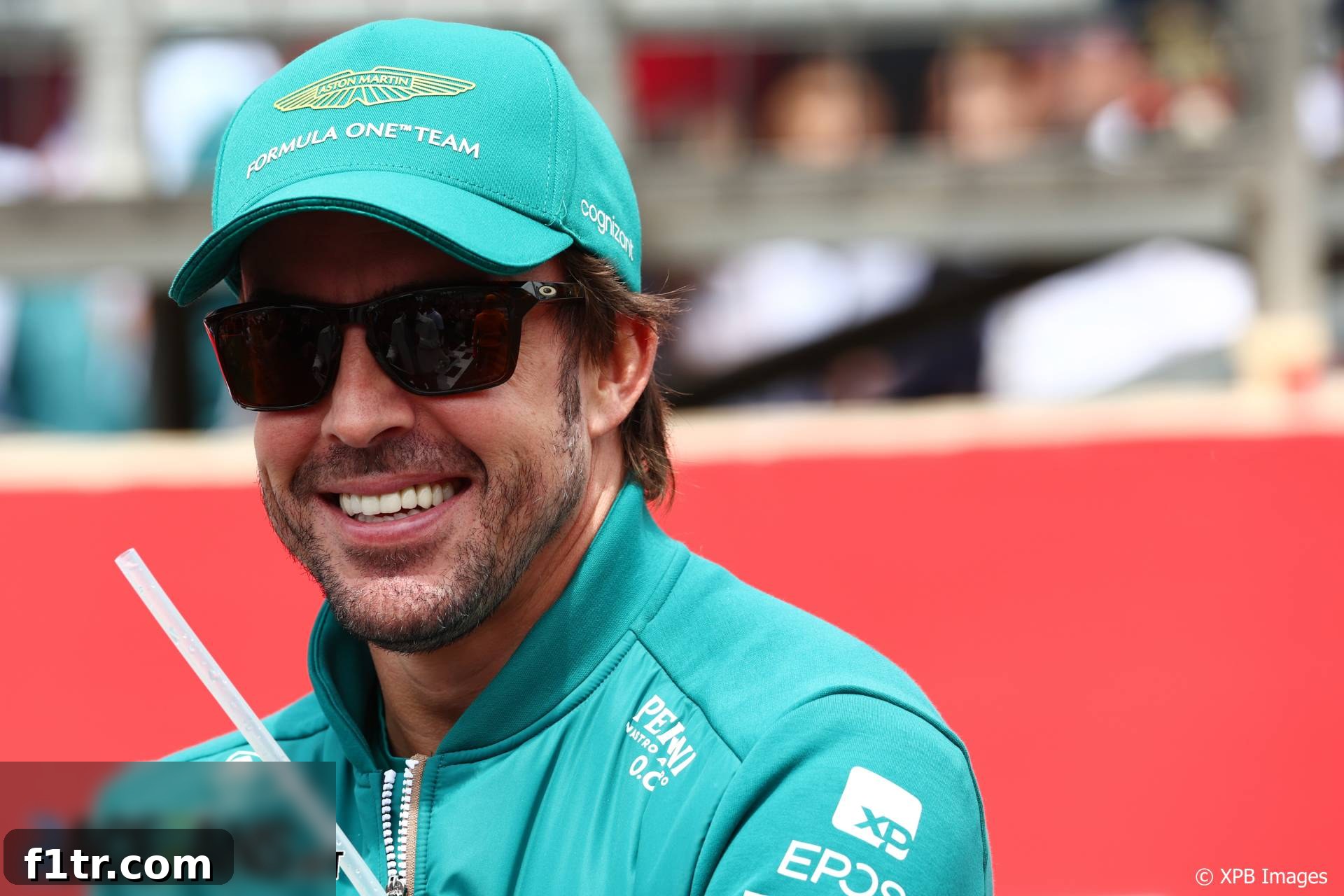
Fernando Alonso Backs FIA’s DRS Zone Reductions at Miami and Baku
In the dynamic and often contentious world of Formula 1, decisions made by the sport’s governing body, the FIA, frequently spark debate among drivers, teams, and fans alike. One such recent decision, the reduction of DRS (Drag Reduction System) zone lengths at circuits like Miami International Circuit and Baku City Circuit, has drawn varied reactions. However, two-time world champion Fernando Alonso has firmly come out in support of the FIA’s move, arguing that it aligns with the unique characteristics of these tracks and the evolving performance landscape of modern F1 cars.
The Purpose of DRS and Recent Adjustments
The Drag Reduction System was introduced to Formula 1 in 2011 with the primary aim of enhancing overtaking opportunities and improving the spectacle of racing. By allowing drivers to temporarily open a flap on their rear wing, reducing aerodynamic drag, DRS provides a speed advantage on designated straights, theoretically enabling closer racing and more passes. The length and placement of these DRS zones are meticulously calibrated by the FIA, taking into account track layout, historical overtaking data, and projected car performance.
For the 2023 season, the FIA opted to shorten the DRS zones at several circuits, most notably at the Baku City Circuit and the Miami International Circuit. This decision followed an analysis of the previous year’s races, where these tracks stood out for unusually high and often straightforward overtaking rates. While some drivers expressed concerns that shorter DRS zones might hinder their ability to pass, making racing more difficult, Alonso presented a nuanced perspective.
Alonso’s Endorsement: Learning from Past Races
Speaking to media, including RaceFans, in Miami, Fernando Alonso articulated his reasoning, stating, “It was the easiest [overtaking] here, last year, apparently. So that’s why I think FIA shortened the DRS.” He reiterated this sentiment for Baku, noting, “In Baku it also was one of the easiest last year, so they shortened the DRS.” Alonso’s stance suggests a belief that the FIA’s adjustments are data-driven and aim to strike a better balance, preventing overtaking from becoming excessively simple or guaranteed.
The Spaniard’s perspective highlights a crucial aspect of F1 race strategy: overtaking should be challenging but achievable, demanding skill and precise execution rather than being a mere formality. If DRS zones are excessively long, the effectiveness of defensive driving is diminished, and the thrill of a hard-fought pass can be lost. Alonso, a veteran known for his strategic prowess and race craft, seems to appreciate the FIA’s efforts to fine-tune the system based on empirical evidence.
The Varied Impact: A Car-Dependent Equation
Alonso further elaborated on the complexity of DRS effectiveness, pointing out that its impact is not uniform across the grid. “I heard Lewis [Hamilton] was saying that this year it was too short. Which I think for them, with the high downforce it was too short,” Alonso acknowledged. This refers to teams like Mercedes, which might rely more heavily on DRS to compensate for specific car characteristics or to overcome the aerodynamic wake of a leading car.
Conversely, Alonso observed the opposite effect for the dominant Red Bull Racing team. “For Red Bull it was too long because at the start/finish line they overtook Leclerc and he was opening to braking on the outside for turn one. So if you take one car it was too long, if you take another car it was too short.” This illustrates a fundamental challenge in regulating F1: performance disparities between cars mean that a single rule change can have drastically different implications for different teams. Red Bull’s exceptional straight-line speed, particularly with DRS activated, means even a shortened zone might still provide them with an overwhelming advantage, while other teams might struggle with the same reduced length.
Alonso concluded that the FIA’s decision was likely “about the calculation that the FIA do after have seeing last year’s races. Baku and Miami they were on the high side in terms of overtaking and how easy it was so that’s why they shortened it. Let’s see this year.” This pragmatic view underscores the ongoing iterative process of rule-making in Formula 1, where regulations are continually refined in response to real-world race data and evolving car designs.
The 2022 Regulations: A Second Season Assessment
The 2022 technical regulations were introduced with much fanfare, promising to make cars easier to follow and thereby improve the quality of racing. As F1 entered its second season under these new rules, some drivers and observers began to question their long-term effectiveness, suggesting that their initial promise might be waning. Alonso, however, remains cautious about drawing definitive conclusions.
“I think there were high expectations on following cars and maybe having the grid a little bit closer together,” he admitted. “But I don’t know. I think we need to give a little bit more time.” He posited that the extraordinary dominance of Red Bull might be skewing the perception of the regulations’ success. “If we didn’t have Red Bull that much ahead I think it was a very interesting fight with three or four teams within one or two tenths and maybe we were saying that the rules were a success.”
Alonso’s argument is compelling: without Red Bull’s significant performance advantage, the midfield battle, which often sees multiple teams separated by mere tenths of a second, would likely be hailed as a triumph for the new rules. This highlights how a single outlier can overshadow the intended positive effects of comprehensive regulatory changes. He suggested that once a period of stability in the rules allows for convergence, or with the introduction of new regulations in 2026, the true impact might become clearer.
Challenges of Modern F1 Cars and Overtaking
Beyond DRS zones and technical regulations, Alonso also pointed to inherent characteristics of current Formula 1 cars that contribute to the difficulty of overtaking, especially within a tightly matched grid. The performance gaps between teams, excluding Red Bull, are often minuscule.
“If you remove the Red Bull, sometimes within six-tenths you are from P3 to P16 in Q1 to go out of the next session,” Alonso explained. This extreme competitiveness means that once cars are qualified in their natural order, passing a competitor who is only half a tenth quicker becomes an immense challenge. “How will you overtake a car that in front of you is just half a tenth quicker than you? So it’s more or less your natural order.”
Furthermore, tire management remains a critical factor. Modern F1 tires are highly sensitive to temperature and often “overheat quite heavily if you follow cars.” This thermal degradation forces drivers to carefully choose their moments to attack, as sustained close following can quickly compromise tire performance, making an overtake attempt counterproductive. “So you need to decide wisely when you want to be too close to a car in front of you,” Alonso advised.
The sheer weight of the current generation of F1 cars also plays a role. Alonso acknowledged, “They are too heavy, for sure,” a sentiment echoed by many drivers and engineers. He quickly added a positive note, “but I think the cars are nice to drive,” suggesting that despite their mass, the driving experience remains exhilarating.
Conclusion: A Continuous Evolution
Fernando Alonso’s comprehensive analysis underscores the intricate balance the FIA constantly seeks to achieve in Formula 1. His support for shortened DRS zones at circuits like Baku City Circuit and the Miami International Circuit is rooted in a data-driven approach, aiming to maintain the integrity of overtaking while preventing it from becoming overly simplistic. The evolving nature of technical regulations, the varying impact of rules on different car philosophies, and the inherent challenges posed by car weight and tire behavior all contribute to a complex landscape for racing.
Ultimately, Formula 1 remains a sport of continuous evolution, with rules and systems constantly refined to optimize the spectacle without sacrificing the competitive essence. Alonso’s insights provide valuable context, reminding us that successful racing is not just about maximizing speed, but about mastering the subtle interplay of regulations, car design, and driver skill on every unique circuit.
2023 Miami Grand Prix
- Verstappen picks Miami Grand Prix as his best drive of 2023 so far
- Albon “maximised most races this year” despite single point scored to date
- A sign the upgrades worked? Ferrari see an upside to Leclerc’s Miami crashes
- Red Bull ‘surprised other teams under-delivered’ with their 2023 cars
- F1’s driver intros are right for US market but wouldn’t work at Silverstone – Horner
Browse all 2023 Miami Grand Prix articles