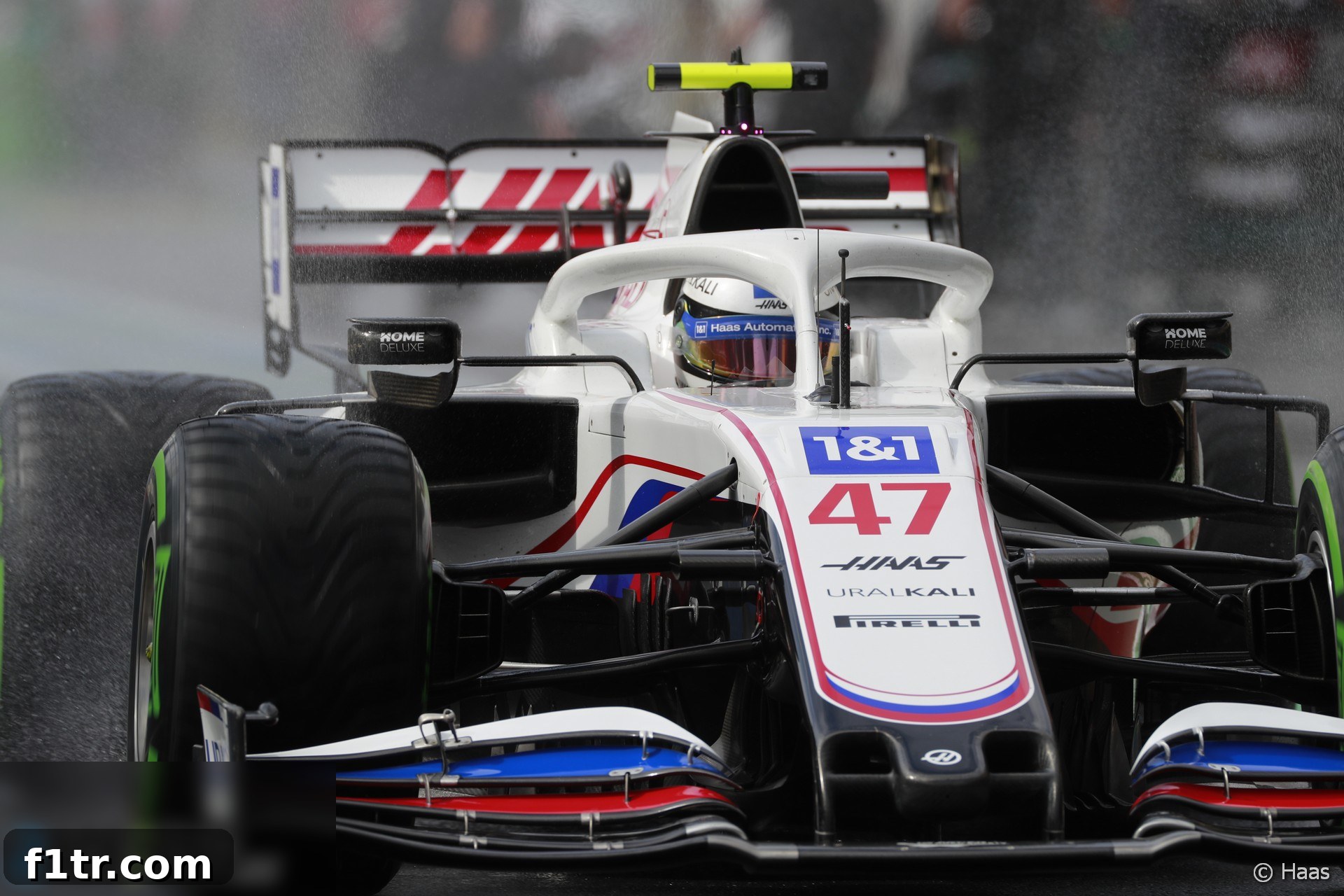
Mick Schumacher’s Turkish Grand Prix Q2 Heroics: A Testament to Raw Talent and Relentless Development
The 2021 Turkish Grand Prix presented a significant milestone for Mick Schumacher, marking a truly impressive entry into Q2 for the Haas Formula 1 team. While it wasn’t his inaugural appearance in the second qualifying session during his challenging rookie season, the circumstances surrounding his exceptional performance at the demanding Istanbul Park circuit were distinctly different and far more indicative of his burgeoning talent and methodical approach.
His sole previous Q2 entry at Paul Ricard had, by his own admission and team observation, been somewhat fortuitous. On that occasion, after posting a lap quick enough to narrowly escape the Q1 elimination zone, the young German unfortunately crashed, bringing his session to an abrupt end. While this incident secured his progression to Q2 by default, it naturally prevented him from participating further in the session. It was a bittersweet moment that, despite the statistical achievement, offered little genuine insight into his raw pace or ability under direct pressure.
Mastering the Treacherous Conditions at Istanbul Park
In stark contrast, Schumacher’s qualifying performance on the treacherously wet Istanbul Park circuit was a pure demonstration of skill, precision, and courage. The conditions were notoriously difficult, with a slick, low-grip track surface that caught out numerous seasoned drivers and made extracting performance an immense challenge. Yet, Schumacher navigated these complexities with remarkable composure and strategic intelligence.
Not only did he skillfully outmaneuver five competitors in Q1 to comfortably earn his place in the subsequent stage, but he also went a step further, claiming an additional scalp for good measure. His domination over his teammate, Nikita Mazepin, was particularly striking and spoke volumes about his adaptability. Much like his commanding drive at Sochi Autodrom just two weeks prior, Schumacher left Mazepin trailing by a colossal 2.894 seconds – an almost unprecedented gap between teammates in modern Formula 1 qualifying, especially when both cars are identical and typically found at the back of the grid.
The young German’s exceptional pace wasn’t limited to his teammate. Fellow Ferrari power unit users, Antonio Giovinazzi and the highly experienced 2007 world champion Kimi Raikkonen, also found themselves struggling to match Schumacher’s rhythm on the slick surface. Raikkonen, in particular, was nearly two seconds adrift, hampered somewhat by traffic but nonetheless unable to find the confidence and consistency that Schumacher evidently commanded.
Furthermore, Schumacher managed to best Nicholas Latifi in the Williams, a respectable achievement given the competitive nature of the field. While he was a mere tenth of a second shy of George Russell’s pace in the other FW43B – a car often lauded for its performance potential under Russell’s stewardship – Schumacher’s overall showing, especially against more experienced drivers in potentially quicker machinery, was undeniably impressive.
Crucially, he cemented his Q2 spot by decisively beating two other formidable and highly respected drivers: Daniel Ricciardo’s McLaren, whom he outpaced by a solid three-tenths of a second, and his mentor and enthusiastic supporter, Sebastian Vettel. The four-time world champion, driving his Aston Martin, was two-tenths of a second behind Schumacher, a testament to Mick’s raw pace and remarkable ability to extract maximum performance from his package in the most challenging and unpredictable of conditions.
Komatsu’s Unwavering Confidence: A Glimpse of True Potential
Despite Haas’s 2021 season being marred by a staggering 30 Q1 eliminations out of a possible 32 prior to Turkey, chief engineer Ayao Komatsu revealed he was “not really” surprised by Schumacher’s exceptional performance in the tricky conditions. This statement speaks volumes about the team’s deep-seated belief in their young driver’s inherent capabilities and potential.
“He did a very good job in changeable conditions,” Komatsu affirmed, highlighting the specific circumstances that allowed Schumacher to shine. “We know the pace of our car this year, so these are the conditions where we can out-perform some other drivers. He’s done a really good job, but it’s not like I was really surprised. He has the potential, and it’s all about maximising it, putting the lap together at the right moment. So it’s a great result.”
Komatsu’s words underscore a crucial aspect of Formula 1: while car performance is undeniably paramount, a driver’s sheer skill and adaptability in adverse weather can often bridge significant performance gaps. For a team like Haas, operating with a car that was demonstrably at the back of the grid, qualifying heroics in mixed conditions presented their best, and often only, opportunities to truly stand out. Schumacher seized this rare opportunity with both hands, delivering a performance that defied the limitations of his machinery.
The challenging nature of the track meant that many drivers were caught out, including Schumacher’s teammate. “It was very difficult because you saw so many people going off,” Komatsu explained, underscoring the sheer difficulty and unpredictable grip levels. “It was very tricky. Nikita went off three times, other drivers went off a few times as well. Mick was really struggling as well.” This context further amplifies Schumacher’s achievement, demonstrating his ability to manage extreme risk while extracting pace.
The notorious Turn 1 at Istanbul Park proved particularly treacherous, becoming the scene of multiple spins and near misses throughout the session. Schumacher, keenly aware of the risks, approached it with a calculated respect. Komatsu elaborated, “He made it into Q2, but with not his fastest lap. If you compare it against Russell, he still lost four tenths in Turn 1 on its own. So he was being careful to try to make sure he put the lap together.”
This strategic caution at Turn 1, combined with aggressive and confident driving elsewhere on the circuit, epitomized Schumacher’s mature approach. “The rest of the lap on the drier part of the circuit, he was very, very good,” Komatsu continued. “So he’s done a good job judging how much margin to take to make sure he can finish the lap, but then pushing elsewhere. That was a really good balance.” This ability to find the delicate balance between calculated risk and outright aggression is a hallmark of truly great drivers and a vital skill for a rookie learning the intricate ropes of Formula 1.
A Steady Ascent: More Than Just One Lap of Brilliance
While Schumacher’s performance was undeniably impressive, Komatsu was hesitant to label it his absolute “best lap of the season.” “I wouldn’t say so, simply because he could have pushed more in Turn 1. There was a couple of tenths left there. But it was pretty good,” he noted, suggesting a rigorous self-assessment and a constant drive for perfection that permeates both Schumacher’s mindset and the team’s philosophy.
What made Schumacher’s performance even more commendable was that he delivered it at a circuit he hadn’t previously raced at in a Formula 1 car. His meticulous preparation, however, proved key. “He felt he was actually very prepared having done the simulator session,” Komatsu explained. “Sometimes – before Zandvoort, I think – he couldn’t get the simulator session in before that, so [in first practice] he was slightly on the back foot. Where he felt here he had a good preparation straightaway.” This anecdote highlights the critical role of simulator work for rookies tackling new and unfamiliar tracks, demonstrating how effective virtual preparation can translate directly into tangible on-track success and confidence.
The Engine of Progress: Unwavering Work Ethic and Constructive Self-Criticism
Beyond his raw talent and impressive on-track skills, it is Schumacher’s exceptional work ethic and his unique, mature approach to self-improvement that truly impress the Haas team. In a season where competitive results were rare and often out of reach, his dedication and analytical prowess shone through consistently.
“Mick works really hard, whether he has a good weekend or a bad weekend,” Komatsu stated. “He’s really self-critical in a good way. He’s always looking for areas to improve. When he’s talking about ‘okay, I’ve done this wrong, I need to improve this’, it doesn’t actually depress him; it just gives him more motivation. So he’s always looking at himself.” This mature perspective, treating mistakes not as failures but as invaluable opportunities for growth and learning, is a powerful driver for continuous improvement and essential for long-term success at the pinnacle of motorsport.
His collaborative spirit with his engineers is another cornerstone of his rapid development. “Also, he works really hard with his engineers,” Komatsu added. “Mick’s engineers are really motivated by Mick’s attitude as well. So it works both ways.” A strong, trusting driver-engineer relationship is fundamental in Formula 1, fostering open communication and enabling precise setup adjustments, thorough performance analysis, and effective problem-solving. Schumacher’s positive, proactive attitude clearly creates an environment where everyone thrives and pushes collectively for better results.
A testament to his growing confidence and profound understanding of the car came in his 16th race weekend as a Formula 1 driver. Despite final practice being rain-affected, preventing him from testing overnight setup changes in dry conditions, Schumacher felt assured enough to carry them into qualifying. Komatsu noted, “In car set-up as well we made some changes overnight. Of course, he didn’t have a chance to test it in dry conditions in [final practice], but that’s something that worked before when Mick was more competitive. So they tried that set-up and they managed to pile on lots of a lot of car balance during qualifying session. So again, that gave him confidence in terms of front-end as well.” This willingness to commit to significant changes based on simulator data and prior experience, even without immediate on-track validation, signifies a driver who is truly finding his feet and developing a deep feel for his machinery.
The Philosophy of Continuous Improvement: A Rookie’s Journey
Komatsu emphasized that Schumacher’s gains were not the result of a sudden, dramatic breakthrough, but rather a steady, consistent accumulation of progress throughout his arduous debut season. This philosophy of continuous learning and incremental improvement is deeply embedded in their collaborative approach.
“He’s constantly learning and improving and absorbing every single time,” Komatsu explained. “For instance, there’s been some weekends where he crashed in some free practice session that had an impact on his qualifying performance, et cetera. Sometimes we sit down straight away, sometimes we talk about it a week later or at the next event, but we never leave things unanswered or not looked at.” This methodical approach to debriefing and learning from every experience, positive or negative, is absolutely crucial for long-term development in a high-stakes, fast-evolving sport like F1.
“He works very closely with his engineers as well. I work closely with him as well in terms of the philosophy of how you approach the weekend, what we’ve done wrong, what was the mindset for making certain things happen either positive or negative, then trying to put more and more positives together for the future weekends,” Komatsu concluded. “So I can’t really pinpoint one weekend where he made a step – I think he’s just constantly looking for improvements.” This holistic view of driver development, focusing on mindset, strategy, and continuous refinement across all aspects of a race weekend, paints a clear picture of why the Haas team holds such high regard for Mick Schumacher’s immense potential.
Looking Ahead: A Promising Future for the Young German
Mick Schumacher’s Q2 heroics at the 2021 Turkish Grand Prix were far more than just a fleeting moment of glory; they were a significant marker in his rookie season, demonstrating a compelling blend of raw speed, intelligent racecraft, and an unwavering commitment to self-improvement. While the Haas car rarely afforded him the chance to consistently fight at the front of the grid, performances like these in challenging conditions vividly showcased why he was a reigning Formula 2 champion and why he holds such promise for a long and successful career in Formula 1. His remarkable ability to extract maximum performance, even with a limited package, combined with his continuous growth trajectory, as consistently highlighted by his chief engineer, point towards a very bright and exciting future for the young German driver in the world of motorsport.
Related 2021 F1 Season Articles
- Masi ‘basically gifted the championship’ to Verstappen says 2021 FIA steward Sullivan
- Las Vegas race backers looking to extend F1 deal beyond 2025
- Why Mercedes put ‘a reminder of joy and pain’ on display in their factory lobby
- Verdict on error in GT race suggests Mercedes would have lost 2021 Abu Dhabi GP appeal
- Title ‘stolen’ from Mercedes made us ‘underdogs people cheer for’ – Wolff
Browse all 2021 F1 season articles