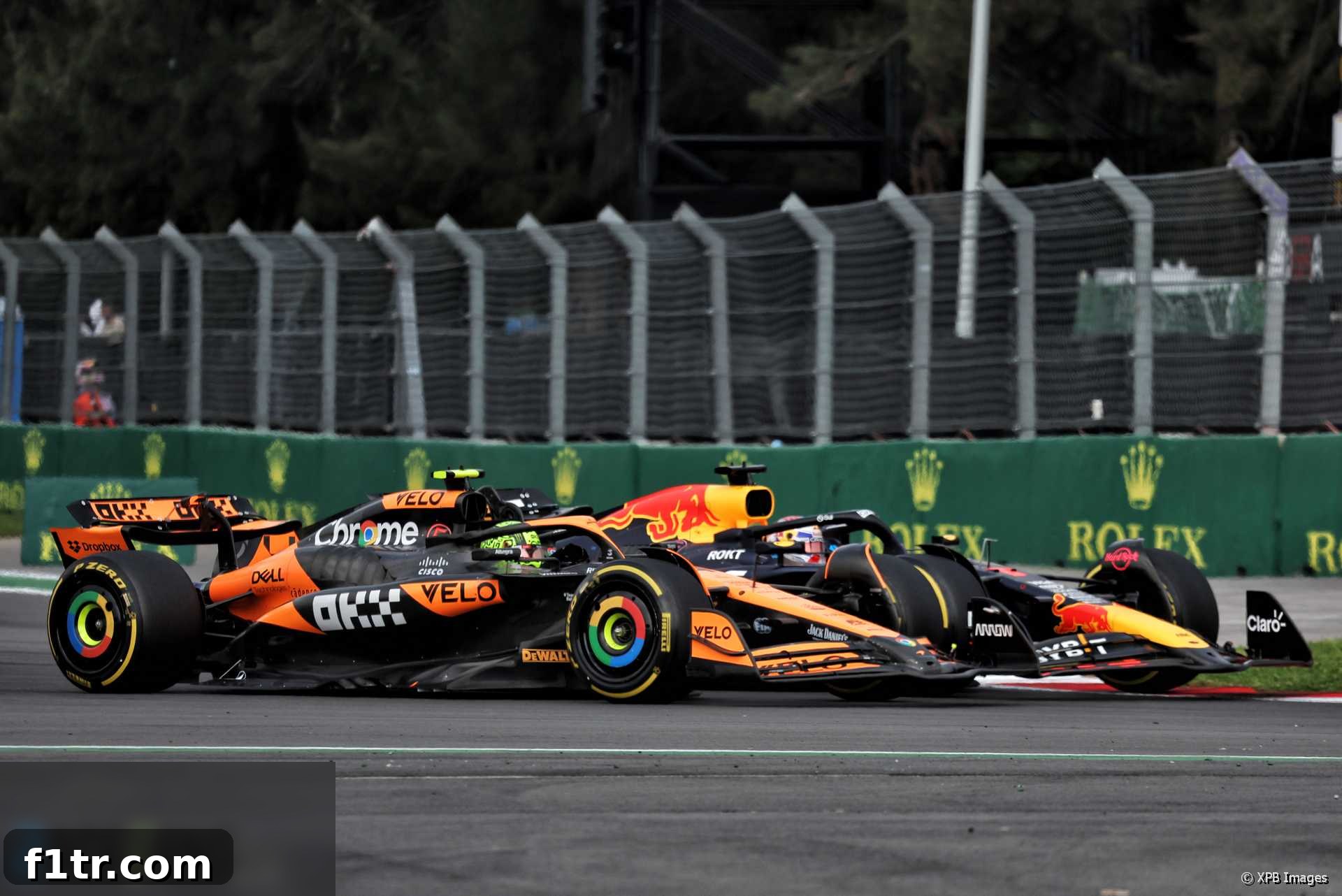
Max Verstappen is currently demonstrating an unyielding surge of momentum, relentlessly closing the gap on the McLaren drivers in what promises to be an enthralling championship finale. His recent performances have been nothing short of dominant, sending a clear message to his rivals that the fight for the title is far from over. This relentless pursuit has redefined the championship narrative, shifting the pressure squarely onto the shoulders of those currently leading the standings.
Advert | Become a Supporter & go ad-free
Over the past five races, Verstappen has consistently outperformed both McLaren cars, amassing a significant points advantage. This formidable streak began with commanding back-to-back victories at Monza and Baku, showcasing his exceptional pace and strategic prowess. Following these triumphs, he secured a strong second-place finish in Singapore, shadowing George Russell while keeping the McLarens firmly in his rearview mirror. The United States Grand Prix further cemented his ascendancy, where he not only won the sprint race – a race from which the McLarens exited prematurely on lap two – but also clinched another crucial victory in the main grand prix event. This consistent string of high-scoring results underscores his formidable challenge and the unwavering determination to claim the championship title.
McLaren’s Shifting Fortunes: From Dominance to Defensive
McLaren’s season has been a story of dramatic highs and recent challenges, experiencing a reversal of fortunes with remarkable speed. In the initial 15 Grands Prix of the season, the team enjoyed immense success, securing an impressive 12 victories. Their performance seemed to be on an upward trajectory, with their margin over competitors appearing to expand rather than contract. Indeed, had Lando Norris’s car not suffered a mechanical failure just eight laps from the finish at Zandvoort, McLaren would have achieved a perfect one-two finish in the final five of those dominant races, highlighting their overwhelming superiority at that point.
However, the landscape has drastically changed since then. McLaren has not managed a single Grand Prix win in the four races that followed their period of dominance. While they successfully secured the constructors’ championship in Singapore – a testament to their overall season performance – their drivers have found themselves increasingly unable to halt Verstappen’s relentless erosion of their championship lead. Since the Dutch Grand Prix, championship leader Oscar Piastri has seen his advantage diminish by a staggering 64 points against the Red Bull driver, while Norris has lost 44 points. This shift signifies a crucial turning point in the championship battle, transforming McLaren’s position from an offensive powerhouse to a team fighting to defend its hard-earned lead.
The Echoes of Past Battles: Lessons from Last Season
The current predicament facing Piastri and Norris bears a striking resemblance to the situation Verstappen himself navigated during the latter half of last season. In that championship campaign, Verstappen had built up a substantial lead over Norris in the initial races. However, McLaren’s significant speed advantage in the subsequent rounds transformed Norris into a formidable and clear threat, forcing Verstappen to adopt a more defensive, yet strategically aggressive, approach to maintain his championship aspirations. Understanding this historical parallel is crucial for McLaren, as it offers insights into the psychological and tactical demands of such a high-stakes championship fight.
A critical aspect of Formula 1 championship dynamics lies in the point allocation system. The seven-point difference between first and second place in an F1 race is considerably larger than the mere three-point gap separating any other consecutive positions on the grid. This seven-point differential is even greater than the six-point spread between second and fourth place. This unique scoring structure carries profound implications for any driver holding a championship lead while being pursued by a faster rival. If a leading driver is destined to finish behind their challenger, it is significantly more detrimental to finish second to them than it is to finish one or two places further back, especially if the rival does not secure the victory. In essence, for the championship leader, the paramount objective shifts from simply winning to, more crucially, preventing their direct rival from winning.
Advert | Become a RaceFans supporter andgo ad-free
Beyond the points system, another crucial dimension to any championship fight involves the willingness to take calculated risks, particularly regarding on-track contact. The driver who holds the points lead often finds themselves in a position where they have more to gain by initiating or risking contact. The rationale is straightforward: if both cars involved in an incident are forced to retire, the championship leader retains their existing points advantage. Furthermore, the chasing driver then has one fewer race opportunity to bridge the points gap, effectively reducing their chances of overturning the deficit. This strategic consideration can significantly influence driver behavior in tight championship scenarios, encouraging a more assertive, even confrontational, approach from the leading contender.
Verstappen’s tactical mastery, particularly evident in the second half of last season, demonstrates his profound understanding of these championship dynamics. His calculated aggression and willingness to push the boundaries of on-track etiquette were instrumental in securing his title. The pertinent question now arises: were the McLaren drivers, Piastri and Norris, astute observers of Verstappen’s championship-winning playbook? Did they absorb the lessons from his ruthless yet effective strategies?
Verstappen’s Ruthless Tactics: A Playbook for McLaren?
Lando Norris, having been directly on the receiving end of Verstappen’s aggressive tactics last season, should certainly have paid close attention. A clear illustration of Verstappen’s approach occurred at the start of the United States Grand Prix. As the lights went out, Verstappen launched an ambitious move down the inside of Norris at Turn 1. What unfolded next was highly revealing: Verstappen could have simply taken the lead, allowing Norris to slot in behind him. Instead, his deliberate action was designed to unequivocally prevent Norris from winning the race, even if it meant momentarily compromising his own position. He ran wide, forcing Norris off track with him, an opportunistic maneuver that allowed the Ferrari drivers to slip past both of them. This early race incident, though seemingly minor, showcased a clear intent to disrupt his rival’s race and prevent a victory, rather than merely securing his own lead.
Verstappen employed a strikingly similar tactical approach during the Mexican Grand Prix when Norris attempted to overtake him for second place, then held by Carlos Sainz Jnr. As Norris pulled fully alongside the Red Bull driver on the approach to Turn 4, Verstappen responded by diving deep into the corner, leaving Norris with an unenviable choice: either collide with the Red Bull or take evasive action by running off the track. Norris opted for the latter, rejoining the track ahead of Verstappen. Critically, with 68 laps still remaining in the race, even if the stewards had subsequently imposed a 10-second time penalty on Norris for gaining an advantage, he would likely still have been able to beat Verstappen and potentially even challenge for the race win given the remaining distance.
Recognizing this significant risk, Verstappen seized his final opportunity to force Norris off the track once more, this time as they approached Turn 7. This was an exceptionally risky, high-speed maneuver, and had Norris not anticipated it and taken swift evasive action onto the run-off area, the resulting collision could have been catastrophic. It was a moment of extreme brinkmanship, highlighting Verstappen’s unwavering commitment to his objective.
Advert | Become a RaceFans supporter andgo ad-free
However, despite the inherent risks, Verstappen’s aggressive tactics ultimately paid off. He successfully regained his position ahead of Norris, while Charles Leclerc’s Ferrari also managed to slip past both drivers. Although Verstappen later incurred penalties for both incidents – a testament to the contentious nature of his moves – Norris was so severely delayed by these maneuvers that he was rendered unable to catch Sainz and ultimately lost his opportunity to win the race. This demonstrated that even with penalties, the immediate disruption and strategic advantage gained by preventing a rival’s victory could be more valuable in a championship context.
The Penalty Point Equation: A New Dynamic for Risk
The McLaren drivers, Piastri and Norris, now find themselves in a unique position where they can afford to take significantly more risks in their on-track duels with Verstappen. This advantageous situation stems not only from their current standing in the championship, holding a lead that grants them a slight buffer, but critically, also from their lower accumulation of penalty points on their superlicences. Verstappen is currently precariously close to the limit, just three penalty points shy of the critical 12-point threshold that automatically triggers a race ban, forcing him to exercise greater caution. In stark contrast, Norris is in a much safer position with only three penalty points, while Piastri sits at six. This disparity in penalty points creates a crucial strategic imbalance, potentially allowing the McLaren drivers to push harder in close quarters, knowing that the immediate consequences for them might be less severe than for their Red Bull rival.
While uncompromising tactics were undoubtedly a significant factor in Verstappen’s championship triumph, it is important to acknowledge that they were not the sole determinant. His exceptional driving ability, exemplified by his brilliant performance at the subsequent round in Brazil, was equally crucial. However, if the McLaren drivers are presented with opportunities to strategically minimize Verstappen’s points-scoring potential, concurrently maximizing their own, it would be a profound strategic misstep to not seize such chances. This could involve leveraging Verstappen’s penalty point vulnerability or adopting a more assertive approach in direct combat.
Exploiting Vulnerabilities: The Russell Precedent and McLaren’s Choice
We have frequently witnessed Verstappen’s inherent belligerence and competitive fire in battle. However, other drivers are already demonstrating a shrewd understanding of his current predicament and are actively exploiting his imperative to score every available point. A prime example of this occurred last weekend during the sprint race, where George Russell launched an incredibly ambitious dive down the inside of Verstappen at Turn 12. Russell understood that Verstappen, acutely aware of his penalty point situation, would be compelled to avoid contact at all costs. Indeed, Verstappen reacted by running off the track to avert a collision. Had Russell managed to maintain his car on the track throughout the maneuver, he would have had a legitimate and compelling argument that he deserved the position, highlighting how other drivers are using this dynamic to their advantage.
Ultimately, whether the McLaren drivers will find themselves in a position to demonstrate the kind of ruthless effectiveness that proved so decisive for Verstappen last year will depend heavily on the specific circumstances of the remaining races. The high-pressure environment of a championship fight often presents unexpected openings and strategic dilemmas. The critical question, then, is not just whether such opportunities will arise, but whether Piastri and Norris will choose to grasp them with the same unwavering conviction that has defined their rival’s success. The final races of the season could very well become a stage for tactical masterclasses and intense on-track battles, making it a potentially very busy period for the FIA stewards.
Advert | Become a RaceFans supporter andgo ad-free
2025 Drivers’ Championship Standings
Up to 141 points available per driver in the remaining races.
Miss nothing from RaceFans
Get a daily email with all our latest stories – and nothing else. No marketing, no ads. Sign up here:
Explore More Formula 1 Content
- One of F1’s greatest races happened 15 years ago today. Or did it?
- “Overtaking is overtaking”: Domenicali denies F1’s yo-yo racing is “artificial”
- The crashes F1 is trying to prevent may be rare – but the danger is obvious
- F1 returning to India soon after 2027 sounds like wishful thinking
- Verstappen loathes F1’s new generation of cars – but what do his rivals reckon?
Browse all Formula 1 articles