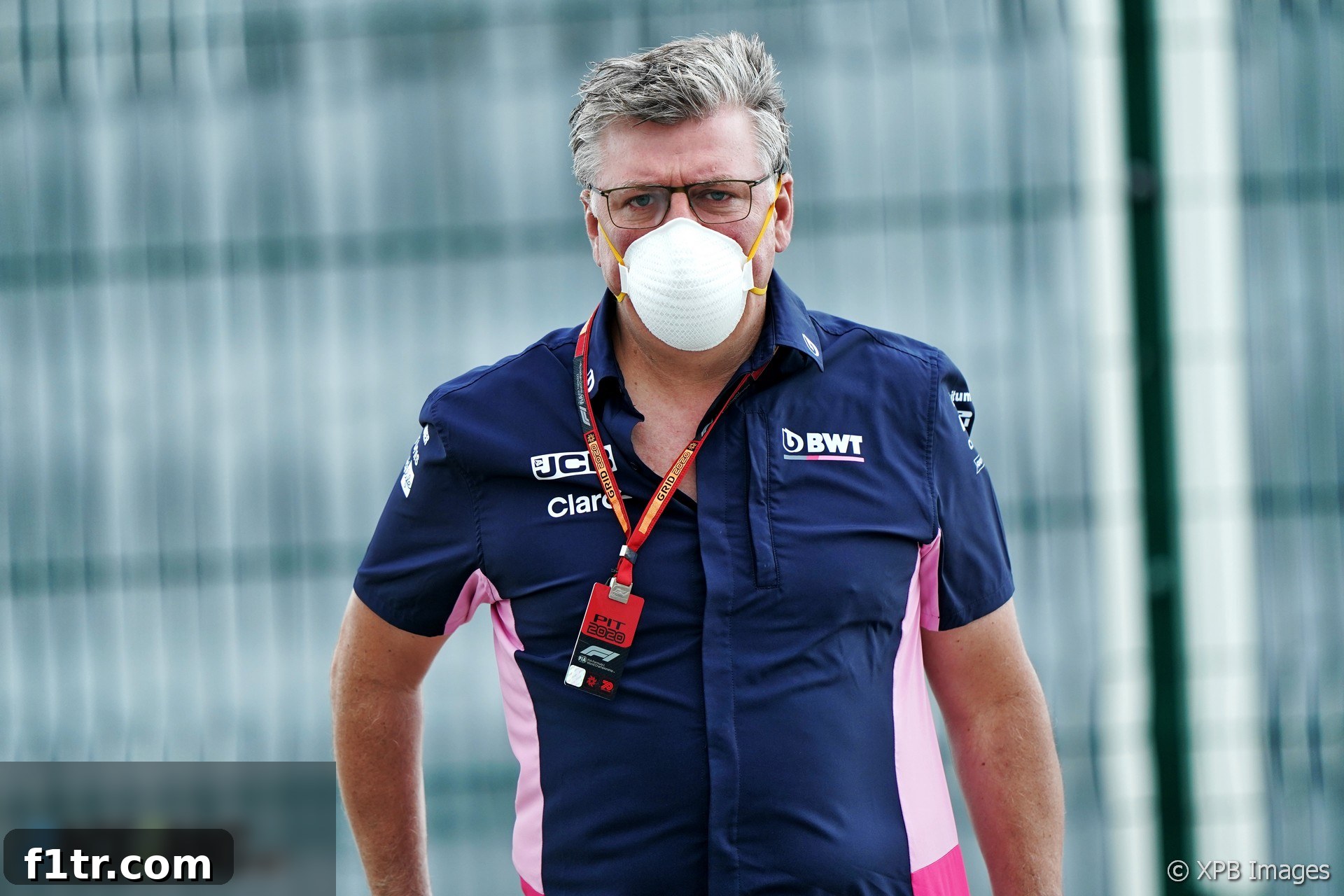
The highly competitive world of Formula 1 often sees fierce battles not only on the track but also off it, especially concerning technical regulations and team ethics. A significant controversy erupted during the 2020 season involving Racing Point, McLaren, and the FIA, leading to a sharp exchange of words between team principals Otmar Szafnauer and Zak Brown. This article delves into the details of the dispute, the FIA’s ruling, and the heated reactions that followed, providing a comprehensive look at one of F1’s most contentious regulatory sagas.
Racing Point, often dubbed the ‘Pink Mercedes’ due to the striking resemblance of its RP20 car to the championship-winning Mercedes W10 from the previous season, faced scrutiny and a subsequent penalty from the FIA stewards. The core of the issue revolved around the design and use of their rear brake ducts. Following the FIA’s verdict, which found Racing Point in breach of sporting regulations, McLaren Racing CEO Zak Brown launched a scathing critique of the penalized team, suggesting their claims of merely using photographic evidence for design replication were unfounded.
Brown’s statement was unequivocal. He declared that the FIA’s decision against Racing Point validated his team’s suspicions, indicating that Racing Point’s assertion of only utilizing photographs to copy elements of Mercedes’ design was “BS.” This strong language immediately ignited a response from Otmar Szafnauer, the CEO and Team Principal of Racing Point, who vehemently dismissed Brown’s comments, characterizing them as misinformed and lacking professional insight.
Szafnauer did not mince words in his counter-argument. “To Zak Brown it is BS because he’s not an engineer,” Szafnauer retorted, directly challenging Brown’s technical understanding. “He’s got no idea what he’s talking about. Zero.” This dismissal underscored Szafnauer’s frustration with what he perceived as an unqualified judgment from a rival team principal. Furthermore, Szafnauer went on to criticize Brown’s grasp of Formula 1’s intricate rulebook, quipping, “I’m surprised at how little he knows about the rules of Formula 1. It seems to me he knows more about historic racing than he does about Formula 1.” This was a pointed jab, implying Brown’s expertise might lie elsewhere, away from the cutting-edge technicalities and complex regulations of modern F1.
The controversy stems from a specific change in Formula 1’s sporting regulations. For the 2019 season, brake ducts were classified as ‘non-listed parts,’ meaning teams were permitted to purchase them or obtain their designs directly from other constructors. However, for the 2020 season, these components were reclassified as ‘listed parts.’ This crucial change meant that from 2020 onwards, every team was required to design and manufacture its own brake ducts independently. The FIA stewards found Racing Point to have violated this regulation by using a rear brake duct design obtained from Mercedes in 2019 as the basis for their 2020 brake duct, thus failing to design their own as mandated by the updated rules.
Otmar Szafnauer openly expressed his profound frustration with the FIA’s interpretation of the rules and the resulting penalty. He highlighted the apparent paradox and perceived unfairness in the decision. “The brake duct moved from a ‘non-listed part’ to a ‘listed part’,” Szafnauer explained, laying out the timeline of events. He then elaborated on Racing Point’s position, stating, “We didn’t have a relationship with another team, as Haas [with Ferrari] and Toro Rosso [now AlphaTauri, with Red Bull] do. They were running others’ brake duct designs forever.”
This comparison to Haas and AlphaTauri (formerly Toro Rosso) formed a significant part of Szafnauer’s defense. Both Haas and AlphaTauri have well-established technical partnerships with Ferrari and Red Bull Racing, respectively, allowing them to legally source numerous components and designs from their senior teams. Szafnauer emphasized that these teams routinely utilize parts designed by their partners, even those that have always been listed. “Haas, I don’t think has ever run a brake duct design that wasn’t Ferrari’s. They never designed their own. We’ve always designed our own,” he asserted, drawing a clear distinction between Racing Point’s operational model and that of the other ‘B-teams’.
Szafnauer further detailed Racing Point’s approach to obtaining data, emphasizing its legality at the time. “We started the process of getting some data legally from Mercedes on brake ducts in 2018 before they were even contemplating moving them from non-listed to listed,” he stated. The crux of his argument was that Racing Point initiated its data acquisition process when it was entirely permissible under the regulations. The subsequent reclassification of the brake ducts then retroactively rendered their earlier, legitimate actions problematic under the new interpretation. “And now we’re in breach of a sporting regulation process that says because we started with some data that we legally obtained from Mercedes, we’re in breach? It’s just ridiculous. That is the frustration,” Szafnauer lamented, expressing a sentiment of being unfairly targeted by a rule change that caught them in a grey area.
The Racing Point team principal continued to question the consistency of the FIA’s enforcement. “You look at people like Haas and Toro Rosso who forever have been getting not just data but brake ducts and designs and everything, and they’re all OK, but we’re not? That’s a frustration,” he concluded. This argument highlights a broader debate within Formula 1: the degree to which smaller teams should be allowed to rely on parts and designs from larger, more established constructors. While technical partnerships are explicitly permitted for many components, the line between legal collaboration and unauthorized copying of listed parts remains a contentious issue.
The ‘Pink Mercedes’ saga wasn’t just about brake ducts; it touched upon the very ethos of Formula 1. Critics argued that Racing Point’s approach undermined the spirit of independent design and innovation, potentially turning F1 into a championship of ‘customer cars’ where smaller teams could simply replicate successful designs from larger outfits, thus blurring the lines of true competition and engineering prowess. Proponents, however, argued that such collaborations could help smaller teams survive and compete, especially given the immense financial and technical challenges of F1. Racing Point maintained that their design process, while inspired by Mercedes, involved significant reverse engineering and their own independent work, not a direct transfer of intellectual property.
The FIA’s penalty against Racing Point included a fine and a deduction of constructors’ championship points, which had significant implications for the team’s standing in the fiercely contested midfield battle. Despite the penalty, Racing Point was allowed to continue using the controversial brake ducts for the remainder of the season, as a redesign would have been impractical. However, they faced the ongoing challenge of addressing the ethical and regulatory questions raised by their rivals. The incident prompted deeper discussions among team principals and the FIA about intellectual property, the definition of “copying,” and the regulations governing the sharing of components between teams, signaling a potential need for clearer guidelines in future seasons.
In essence, the heated exchange between Otmar Szafnauer and Zak Brown encapsulated a pivotal moment in the 2020 Formula 1 season. It brought to light the complexities of sporting regulations, the intense rivalries between teams, and the constant push and pull between innovation, fairness, and survival in the pinnacle of motorsport. While the immediate controversy eventually subsided, its ramifications continued to echo in the paddock, influencing discussions about the future direction of technical rules and the pursuit of a level playing field in Formula 1.
2020 F1 season
- Grosjean to make F1 test return tomorrow for first time since Bahrain horror crash
- Pictures: Wrecked chassis from Grosjean’s Bahrain fireball crash to go on display
- Bottas vs Rosberg: Hamilton’s Mercedes team mates compared after 78 races each
- F1 revenues fell by $877 million in Covid-struck 2020 season
- Hamilton and Mercedes finally announce new deal for 2021 season
Browse all 2020 F1 season articles