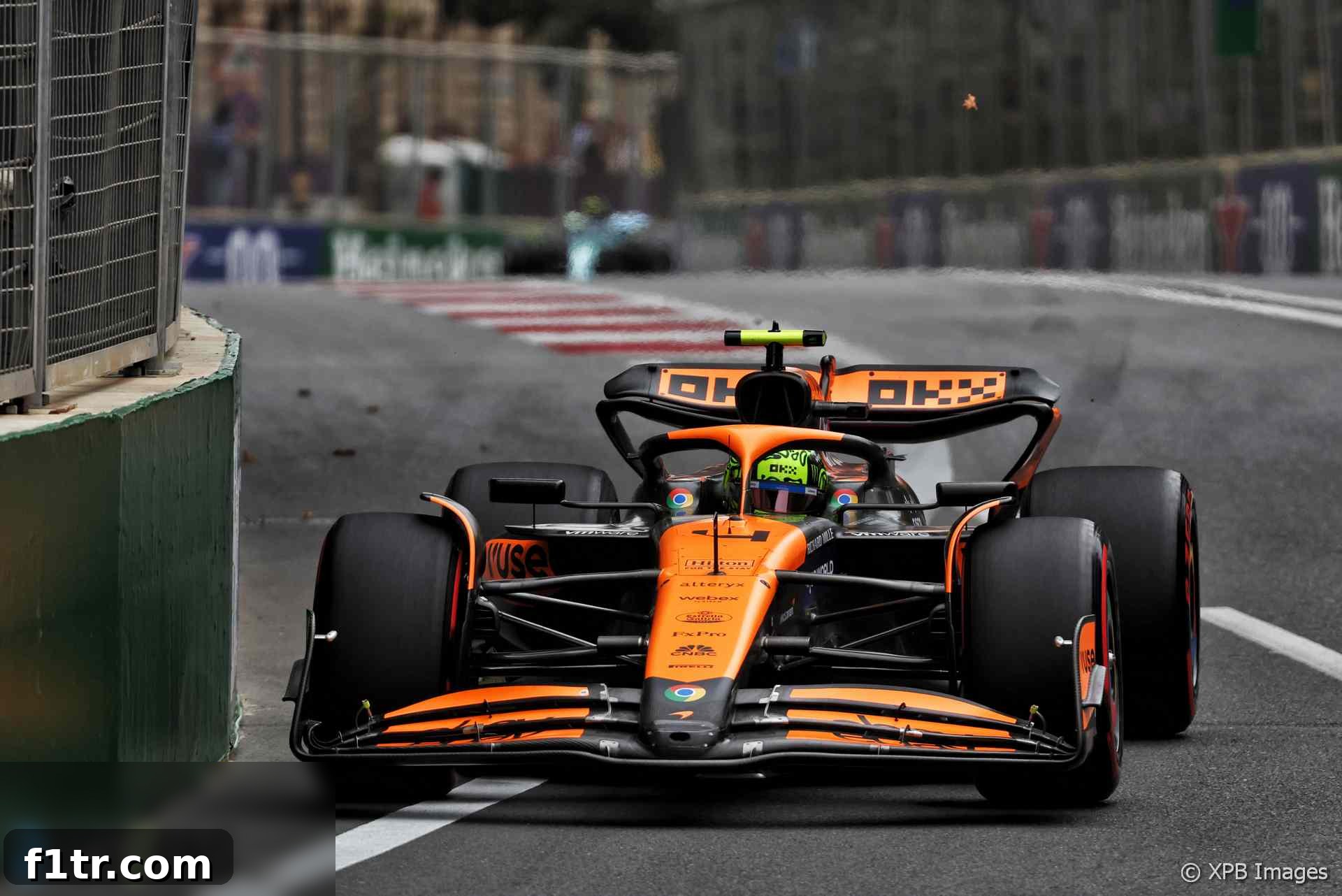
Controversial Yellow Flag Incident Mars Lando Norris’s Azerbaijan GP Qualifying
McLaren team principal Andrea Stella has confirmed that the team has formally approached the FIA, seeking a comprehensive explanation regarding the contentious yellow flag incident that unfortunately derailed Lando Norris’s qualifying session at the challenging Baku City Circuit. The incident, which saw Norris prematurely eliminated from Q1, has sparked debate and left McLaren demanding clarity from motorsport’s governing body.
Advert | Become a Supporter & go ad-free
Norris, a driver known for his consistent pace and sharp qualifying performances, found himself eliminated in a disappointing 17th place during the crucial first segment of qualifying in Baku. His final, potentially session-saving lap was tragically cut short when he encountered the slow-moving Alpine of Esteban Ocon at the exit of Turn 16, just as a single yellow flag was displayed, forcing him to abandon his flying effort.
The Dramatic Unfolding of Q1 in Baku
The Azerbaijan Grand Prix circuit, with its unique blend of long straights and tight, technical sections, is notoriously demanding, offering high rewards for precision but severe penalties for errors. Qualifying here is always a high-stakes affair, and Q1 often sees a flurry of activity as drivers push the limits to secure a spot in the next session.
With just four minutes remaining in Q1, Norris appeared to be in a relatively safe position, sitting comfortably in eighth place with a lap time of 1’43.609. He was marginally ahead of his McLaren teammate, Oscar Piastri, in the tightly contested timesheets. As the clock wound down, Norris exited the pit lane, directly behind Piastri, fully aware that this final attempt would be critical.
Meanwhile, the incident that would ultimately impact Norris was already unfolding. As Norris was meticulously preparing for his push lap through the middle sector, Esteban Ocon, among several drivers intensely pushing for a faster time in the first sector, experienced a significant mishap. At the notoriously unforgiving exit of Turn 4, Ocon made contact with the outside wall with his left-rear wheel, resulting in a puncture. Moments later, he narrowly avoided a more severe collision with the wall at Turn 6. Despite the damage and the precarious situation, Ocon’s race engineer, Josh Peckett, instructed him to “try and keep going if we can, Esteban,” hoping to nurse the car back to the pits without stopping on track.
The Ill-Timed Yellow Flag and Norris’s Predicament
As Ocon’s damaged Alpine slowly made its way around the circuit, Norris commenced his final, make-or-break push lap. His race engineer, Will Joseph, alerted him to potential hazards: “Mindful of debris between Turn 6 and Turn 7 – not sure where.” The yellow flag was initially shown as Ocon significantly slowed down just before Turn 7. However, for the majority of his subsequent lap, as the Alpine gingerly recovered towards the pit lane, Ocon’s car was covered by a white flag, signaling a slow-moving vehicle but generally allowing drivers to continue at speed with caution, provided no immediate danger.
By this point, Norris was halfway through his vital lap, demonstrating exceptional pace. He had completed the opening two sectors a remarkable eight-tenths of a second faster than his previous best time. Crucially, he was also over a second quicker than what would ultimately prove to be the cut-off time for Q2, which was eventually set by Fernando Alonso in 15th place. This indicated that Norris was comfortably on course to advance, perhaps even securing a significantly higher position.
However, as Norris navigated Turn 16, he ran slightly wide onto the outside kerb. Initially, there was some uncertainty about whether he had exceeded track limits, a violation that would typically lead to a lap time deletion. Yet, the subsequent official reports did not list Norris’s final lap among the seven deleted for track limits infringements during the session, strongly suggesting that had he completed it, his time would have stood.
Advert | Become a RaceFans supporter andgo ad-free
It was at this critical juncture, as Norris powered through Turn 16, that the FIA timing system simultaneously indicated a single yellow flag. The reason cited was Ocon’s slow-moving car in track sector 18 – precisely the section of the circuit Norris was entering. Although Ocon had moved off the primary racing line on his approach to Turn 18, he seemed to almost come to a complete halt, seemingly attempting to provide Norris with ample space to pass through the fast kinks of Turns 18 and 19 without further incident.
As Norris rounded Turn 17, his attention was drawn to a set of LED marshals boards at Turn 18. While one board appeared to be flashing green, indicating a clear track ahead, the lighting conditions in the evening twilight might have made it appear yellow from Norris’s perspective and distance. Regardless of the precise colour perception, Norris, adhering to the stringent safety protocols of Formula 1, would have reasonably assumed that a yellow flag zone was indeed active as he approached and passed the almost stationary Alpine. Prioritizing safety and regulatory compliance, he instinctively lifted off the throttle, backed off considerably before the fast kinks, and regrettably abandoned his lap.
His immediate radio communication encapsulated his frustration and confusion: “I had a yellow flag,” he informed Joseph. “Can I go again or not?” Joseph’s reply delivered the crushing news: “No. We have to box. We have to box.” Upon Norris’s return to the garage, a clearly remorseful Joseph added, “Mate, I’m sorry. They shouldn’t have done that.” This candid exchange underscored the team’s immediate belief that the yellow flag intervention was unjustified and detrimental.
FIA Regulations and McLaren’s Inquiry
Under Formula 1 regulations, when a single yellow flag is displayed, drivers are required to “discernibly reduce speed” through the affected sector. Crucially, their lap time is only deleted if they fail to show sufficient speed reduction or if they pass through a double yellow flag zone at undiminished speed. Given that Norris only encountered a single yellow flag and visibly backed off, his potential lap would likely have been allowed to stand, even with the required speed reduction. This further highlighted the missed opportunity and the direct impact of the flag on his qualifying outcome.
McLaren team principal Andrea Stella articulated the team’s mixed emotions following qualifying. He described the situation as a “bittersweet, difficult situation” for the Woking-based squad, particularly given the contrasting fortunes of his two drivers. Oscar Piastri delivered a commendable performance, securing second place on the grid, only behind the polesitting Charles Leclerc. Conversely, Norris was relegated to 17th.
Advert | Become a RaceFans supporter andgo ad-free
“The ‘sweet’ element is that the performance of the car was good again,” Stella told the official F1 channel, acknowledging the team’s ongoing progress. “We knew that this track would have been a bit difficult for us and the weekend wasn’t unfolding very easily. But I have to say that, especially in Q3, Oscar was able to put all the pieces together. A strong performance, only beaten by a specialist at this track like Leclerc. So it’s good from that side for Oscar, it’s good for us. We can definitely fight for a podium tomorrow.”
However, Stella was unequivocal about the team’s discontent regarding Norris’s situation. He confirmed that McLaren had formally enquired with the FIA for a precise explanation as to why Ocon’s car was covered by a yellow flag at the exact moment Norris was attempting to pass him on track. “On Lando’s side, we were on a good lap to get through in Q1. There was a little mistake out of the last corner, but I think there should have been no problem to go through,” Stella explained.
He continued, highlighting the core of their concern: “Then we found the yellow flag. We were discussing at the end of the session with the FIA as to why the yellow flag was displayed, because that was only a slow car going with no safety implications. So we are puzzled as to why the yellow flag was displayed.” McLaren’s stance is that a slow-moving car off the racing line, posing no immediate danger, typically warrants a white flag or simply a marshals’ warning, not a yellow flag which mandates a speed reduction and can critically impact a competitive lap.
Looking Ahead: Race Day Prospects from a Disadvantageous Position
Despite Norris being forced to start from his worst grid position of the season, Andrea Stella remains cautiously optimistic about the team’s ability to secure points on Sunday. The unpredictable nature of the Baku circuit, known for its frequent Safety Car periods and high attrition rates, often presents opportunities for drivers starting further down the grid to make significant progress.
“Points should be possible,” Stella stated, though he tempered expectations. “Obviously I hope there will be important points. It will require some attrition ahead of us, I think.” He acknowledged the formidable competition. “We have to say that during this weekend, Red Bull as well, they’ve been competitive, Mercedes – all these top four teams have a car there at the front. Williams, they seem to be competitive, so it’s pretty crowded. We’ll have to do a good job.”
For Lando Norris, starting 17th means an uphill battle, but his skill and the potential for chaos in Baku offer a glimmer of hope. The focus for McLaren will now shift to strategic race management, maximizing any opportunities that arise, and demonstrating the true pace of the car, which has clearly shown signs of strength despite the qualifying setback. The FIA’s response to McLaren’s inquiry will be keenly awaited, not just by the team, but by the wider F1 community, to ensure consistency and fairness in future race control decisions.
Advert | Become a RaceFans supporter andgo ad-free
Miss nothing from RaceFans
Get a daily email with all our latest stories – and nothing else. No marketing, no ads. Sign up here:
2024 Azerbaijan Grand Prix Coverage
- Verstappen: “Important” for FIA to clarify legality of McLaren’s ‘mini DRS’ wing
- Hamilton explains suspension set-up change behind “miserable” Baku weekend
- Piastri needs “crazy” results to become title contender despite Baku win
- FIA taking new look at flexing bodywork amid intrigue over McLaren’s rear wing
- Norris knew Verstappen broke VSC rules in Baku because he did the same in Melbourne
Browse all 2024 Azerbaijan Grand Prix articles