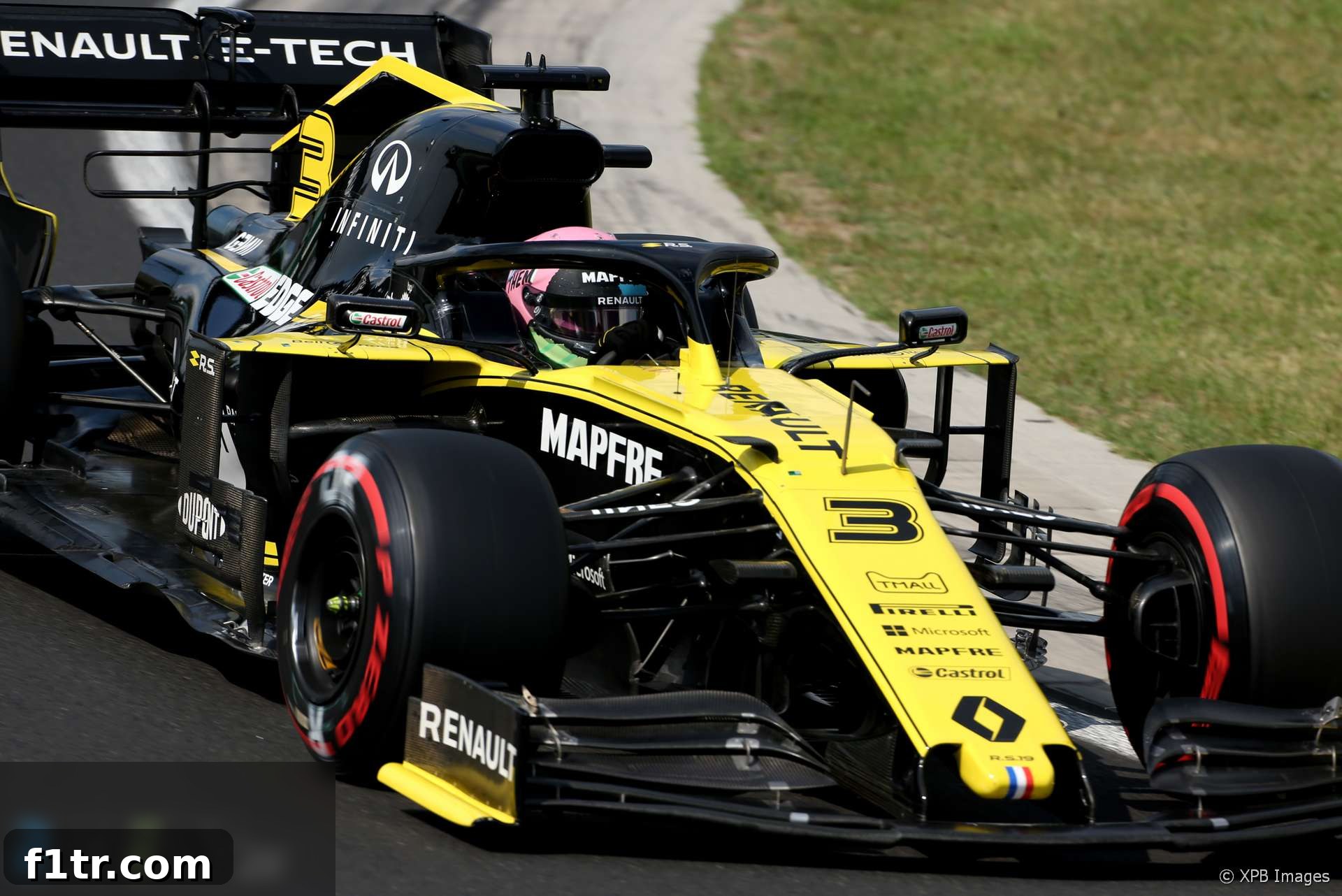
Daniel Ricciardo Faces Back-of-Grid Penalty at Hungarian Grand Prix
The anticipation for the Hungarian Grand Prix took a dramatic turn for Daniel Ricciardo and the Renault F1 team. In a significant pre-race development, Ricciardo will be forced to start the race from the very back of the grid after his team made the strategic decision to install a complete new power unit in his R.S.19 car. This move, while necessary for reliability and performance in the long run, presents a substantial challenge for the Australian driver at the notoriously tight Hungaroring circuit.
This penalty compounds an already difficult qualifying session for Ricciardo. He had initially secured the 18th starting position on the grid, a result of an incident during Q1 with Sergio Perez. The two drivers were involved in a misunderstanding at the exit of the final corner, each impeding the other, which ultimately compromised Ricciardo’s qualifying lap. With an official ruling from the stewards requiring him to start from the rear of the grid due to the power unit change, his original qualifying position became largely moot, making the strategic power unit swap a more palatable option for the team.
Strategic Power Unit Change: Renault’s Calculated Risk
Renault’s decision to fit a new power unit for Daniel Ricciardo was a calculated move designed to mitigate the impact of the impending grid penalty. Given that Ricciardo was already set to start from 18th place due to the qualifying incident, dropping an additional two places to 20th – the absolute back of the grid – was deemed less detrimental than incurring a similar penalty at a race where he might have qualified significantly higher. This tactical timing allows the team to refresh crucial engine components, ensuring better reliability and potentially unlocking more performance for the remainder of the season, without sacrificing a prime starting spot.
The new power unit for Ricciardo’s car includes a comprehensive overhaul of several key components. Specifically, he has taken his fourth Internal Combustion Engine (ICE), fourth Turbocharger (TC), and fourth Motor Generator Unit-Heat (MGU-H). In addition, he has received his third Motor Generator Unit-Kinetic (MGU-K), third Energy Store (ES), and third Control Electronics (CE). Each of these components has strict usage limits per season under Formula 1 regulations, and exceeding these limits automatically triggers grid penalties.
The stewards formally confirmed the penalty, stating that Daniel Ricciardo is “required to start the race from the rear of the grid” following these significant changes. This ruling highlights the strict enforcement of power unit regulations in Formula 1, where strategic component management is as crucial as on-track performance.
Understanding F1’s Power Unit Regulations and Penalties
Modern Formula 1 regulations impose stringent limits on the number of power unit components a driver can use during a single season. This system is designed to control costs, promote reliability, and prevent teams from constantly upgrading engines for performance gains. For the 2019 season, drivers were generally permitted to use three Internal Combustion Engines (ICE), Turbochargers (TC), and Motor Generator Unit-Heat (MGU-H) units without penalty. For the Motor Generator Unit-Kinetic (MGU-K), Energy Store (ES), and Control Electronics (CE), the limit was typically two units.
Exceeding these allocations triggers automatic grid penalties. The first time a driver uses an additional component beyond the limit (e.g., a fourth ICE), they incur a 10-place grid penalty. For each subsequent additional component used (e.g., a fourth TC or a third MGU-K), a 5-place grid penalty is applied. If the cumulative penalties from all component changes exceed 15 grid places, the driver is then mandated to start the race from the very back of the grid, regardless of their qualifying performance. This ‘back-of-grid’ rule is precisely what Ricciardo faced after fitting multiple new components.
Teams often strategically decide when to take these penalties. Taking a penalty at a circuit where overtaking is notoriously difficult, like Monaco or the Hungaroring, or when a driver has already qualified poorly due to other issues, can be a pragmatic choice. This allows them to introduce fresh components and reset their allocation for the remainder of the season, potentially avoiding further penalties at more critical races or circuits where a strong qualifying position is paramount. Renault’s move for Ricciardo at Hungary perfectly exemplifies this strategic approach, minimizing the overall impact of the penalty on their championship aspirations.
Daniel Ricciardo’s 2019 Season: A Renault Journey
The 2019 Formula 1 season marked Daniel Ricciardo’s highly anticipated debut with the Renault F1 team, following his high-profile move from Red Bull Racing. His arrival was met with significant expectations, both for Ricciardo himself and for the French manufacturer, who aimed to solidify their position as a top-tier contender. However, the season proved to be a mixed bag, characterized by moments of strong performance interspersed with frustrating reliability issues and strategic missteps.
Throughout the season, Renault’s power unit, while showing flashes of competitive pace, often struggled with consistency and reliability. This meant that Ricciardo and his teammate, Nico Hulkenberg, were frequently battling not just their rivals but also the technical challenges of their machinery. Such power unit concerns often force teams into difficult decisions regarding component usage, leading to the kind of grid penalty Ricciardo faced at Hungary. The constant juggling act between performance demands and the need to manage engine mileage and component lifespans became a recurring theme for Renault in 2019.
For Ricciardo, adapting to a new team and a different car philosophy was an ongoing process. While his signature aggressive driving style and exceptional overtaking abilities remained, converting these into consistent points finishes proved challenging. The Hungarian Grand Prix penalty, therefore, represented another hurdle in what was already a demanding transitional season, forcing him to demonstrate his renowned racecraft in the most challenging of circumstances.
The Hungaroring Challenge: Overtaking from the Back
The Hungaroring circuit, located just outside Budapest, is often described as “Monaco without the walls” due to its tight, twisty, and technical nature. With very few long straights and a succession of medium and slow-speed corners, it presents one of the most significant overtaking challenges on the Formula 1 calendar. Drivers often struggle to find clear opportunities to pass, making grid position exceptionally critical for a strong race result.
Starting from the very back of the grid, as Daniel Ricciardo was required to do, transforms the Hungarian Grand Prix into an immense uphill battle. His race strategy would need to be fundamentally different from those starting further up the order. This could involve trying an alternative tire strategy, hoping for safety car periods to bunch up the field, or relying purely on exceptional race pace and opportunistic overtakes. The narrow track width further exacerbates the difficulty, leaving little room for error when attempting to move through the pack.
Despite these daunting prospects, Ricciardo is widely regarded as one of Formula 1’s most skilled overtakers. His aggressive yet precise maneuvers have earned him a reputation for making spectacular passes, even in seemingly impossible situations. The Hungarian Grand Prix, therefore, became a true test of his abilities, asking him to perform a masterclass of defensive and offensive driving to salvage any points from a compromised starting position. For fans, it promised a thrilling display of racing prowess, watching one of the grid’s most exciting drivers attempt to defy the odds at a circuit not designed for comeback drives.
A Look at the 2019 F1 Power Unit Landscape
The table below provides a snapshot of the power unit component usage across the grid for the 2019 season leading up to the Hungarian Grand Prix. It highlights how various teams and drivers were managing their allocations, offering insight into the reliability and performance demands placed on each engine manufacturer.
| No. | Car | Engine | Driver | ICE | TC | MGU-H | MGU-K | ES | CE |
|---|---|---|---|---|---|---|---|---|---|
| 23 | Toro Rosso | Honda | Alexander Albon | 5 | 4 | 4 | 4 | 2 | 2 |
| 27 | Renault | Renault | Nico Hulkenberg | 5 | 4 | 4 | 3 | 2 | 3 |
| 26 | Toro Rosso | Honda | Daniil Kvyat | 4 | 4 | 4 | 3 | 3 | 3 |
| 55 | McLaren | Renault | Carlos Sainz Jnr | 4 | 4 | 4 | 3 | 3 | 3 |
| 3 | Renault | Renault | Daniel Ricciardo | 4 | 4 | 4 | 3 | 3 | 3 |
| 4 | McLaren | Renault | Lando Norris | 3 | 3 | 3 | 3 | 3 | 3 |
| 33 | Red Bull | Honda | Max Verstappen | 3 | 3 | 3 | 2 | 2 | 2 |
| 10 | Red Bull | Honda | Pierre Gasly | 3 | 3 | 3 | 2 | 2 | 2 |
| 7 | Alfa Romeo | Ferrari | Kimi Raikkonen | 3 | 3 | 3 | 2 | 2 | 2 |
| 18 | Racing Point | Mercedes | Lance Stroll | 3 | 3 | 3 | 2 | 1 | 1 |
| 63 | Williams | Mercedes | George Russell | 2 | 2 | 2 | 2 | 3 | 3 |
| 99 | Alfa Romeo | Ferrari | Antonio Giovinazzi | 2 | 2 | 2 | 2 | 2 | 3 |
| 20 | Haas | Ferrari | Kevin Magnussen | 2 | 2 | 2 | 2 | 2 | 3 |
| 5 | Ferrari | Ferrari | Sebastian Vettel | 2 | 2 | 2 | 2 | 2 | 3 |
| 8 | Haas | Ferrari | Romain Grosjean | 2 | 2 | 2 | 2 | 2 | 2 |
| 16 | Ferrari | Ferrari | Charles Leclerc | 2 | 2 | 2 | 2 | 2 | 2 |
| 77 | Mercedes | Mercedes | Valtteri Bottas | 2 | 2 | 2 | 2 | 2 | 2 |
| 11 | Racing Point | Mercedes | Sergio Perez | 2 | 2 | 2 | 2 | 1 | 1 |
| 31 | Williams | Mercedes | Robert Kubica | 2 | 2 | 2 | 2 | 1 | 1 |
| 44 | Mercedes | Mercedes | Lewis Hamilton | 2 | 2 | 2 | 2 | 1 | 1 |
As the table illustrates, Daniel Ricciardo and his Renault teammate Nico Hulkenberg, alongside the Honda-powered Toro Rosso drivers (Alexander Albon and Daniil Kvyat), were among those who had consumed the most power unit components by this stage of the season. Albon and Hulkenberg, notably, had already taken their fifth ICE unit, underscoring the ongoing reliability challenges faced by both Renault and Honda at this point in 2019. In contrast, drivers from Mercedes-powered and Ferrari-powered teams generally showed lower component usage, suggesting stronger reliability from those manufacturers.
This variance in component consumption highlights the delicate balance F1 teams must strike between pushing for performance and ensuring engine reliability over a long and demanding season. Frequent component changes, while providing fresh parts, can severely impact a team’s championship aspirations through accumulated grid penalties. For Renault, this situation underscored the critical need to improve their power unit’s durability to consistently compete at the front of the midfield.
Impact and Outlook for Daniel Ricciardo and Renault
The back-of-grid start at the Hungarian Grand Prix presented a significant hurdle for Daniel Ricciardo and Renault. While the strategic timing of the power unit change aimed to minimize immediate damage, it still meant a formidable challenge for Ricciardo to score points at a circuit where such a feat from the back is rare. The team’s immediate focus would shift from optimizing qualifying performance to devising an aggressive, yet flexible, race strategy, potentially involving alternative tire choices or banking on unexpected race incidents.
Looking beyond Hungary, the new power unit components offered a glimmer of hope for improved reliability and sustained performance in the latter half of the 2019 season. However, the fact that Ricciardo was already on his fourth major components (ICE, TC, MGU-H) and third minor components (MGU-K, ES, CE) so early in the season indicated persistent underlying issues that needed addressing. This scenario put ongoing pressure on Renault’s engine department to deliver more robust and competitive power units, not just for their own team but also for customer teams like McLaren.
For Daniel Ricciardo, the season continued to be a test of patience, resilience, and his undeniable talent. His ability to navigate challenges and deliver strong performances under pressure would be crucial for Renault’s ambitions to climb the Constructors’ Championship standings. The strategic penalty at Hungary was a stark reminder of the intense technical battle that underpins Formula 1, where every decision, from engine management to on-track strategy, can profoundly impact a team’s fortunes.
More from the 2019 F1 Season
- Crying in the Melbourne car park at 2019 grand prix was my career low – Ocon
- McLaren Racing reports reduced £71 million loss in 2019
- Kvyat: Hockenheim podium last year was “my biggest achievement” so far
- How the FIA’s new encrypted fuel flow meter targets Ferrari’s suspected ‘aliasing’ trick
- “He smashed my office door”: 23 must-see moments from ‘Drive to Survive’ season two
Browse all 2019 F1 season articles