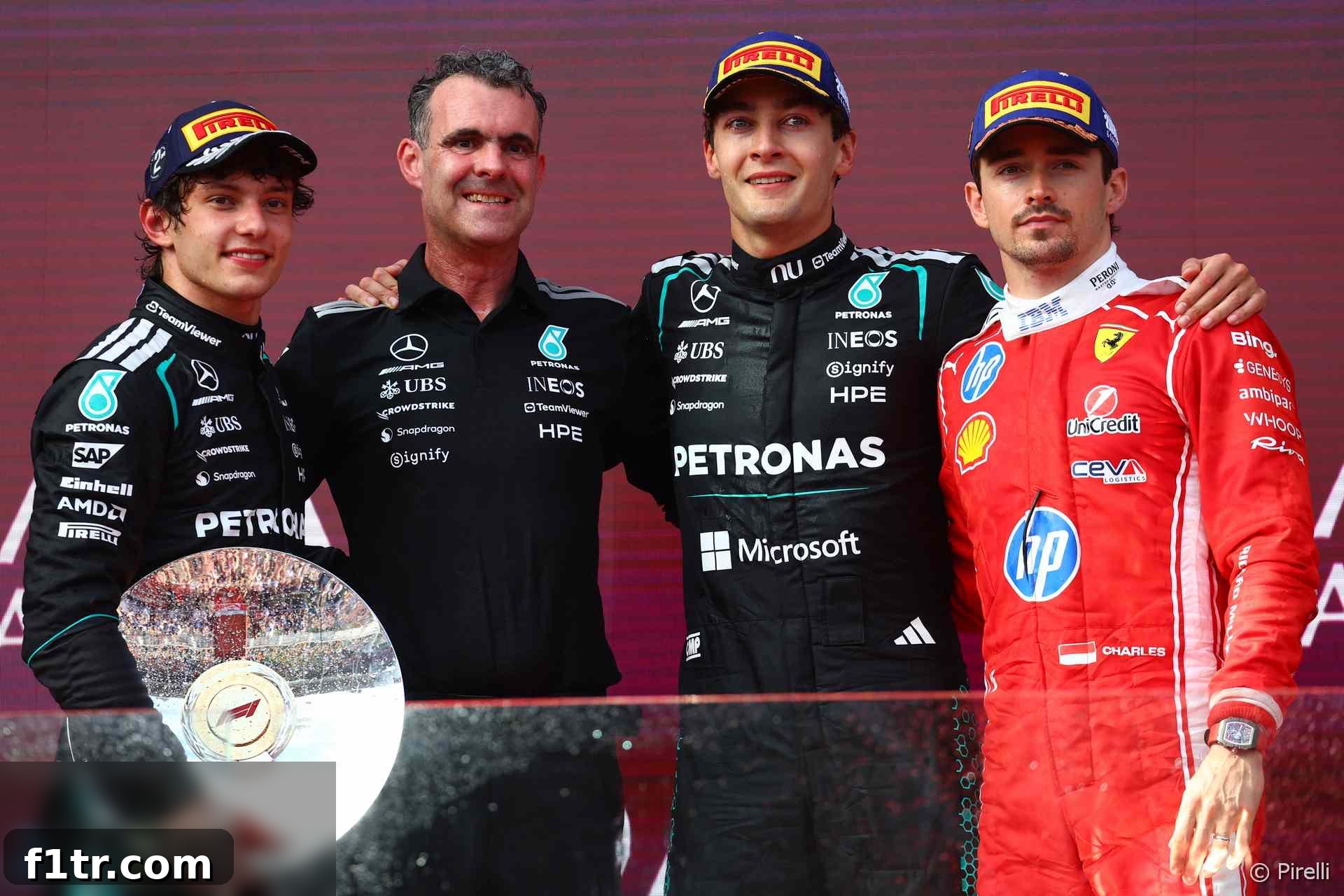
The 2026 Formula 1 season kicked off with a bang at the Australian Grand Prix, where George Russell delivered a stunning performance, securing a dominant one-two finish for Mercedes. This emphatic victory served as the best possible start to Formula 1’s much-anticipated new era, immediately establishing Mercedes as the team to beat and injecting immense confidence into their championship campaign.
However, the path to victory was far from straightforward for the pre-season favorites. Ferrari, eager to make a statement, mounted a fierce challenge from the opening lap. Charles Leclerc, starting from fourth on the grid, showcased an explosive start, rocketing past his rivals to snatch the lead early on, immediately putting Mercedes under intense pressure.
The initial phase of the race was a thrilling spectacle, with Leclerc and Russell engaging in a captivating wheel-to-wheel battle. The lead swapped hands repeatedly over the first eight laps, demonstrating the competitive edge between the two constructors and the drivers’ sheer determination. This exhilarating display kept fans on the edge of their seats, hinting at an unpredictable season ahead.
The dynamic of the race dramatically shifted on lap 11 with the deployment of the Virtual Safety Car (VSC). The incident was triggered by Isack Hadjar, whose Red Bull began smoking ominously on the approach to Turn 9, forcing him to bring his car to a halt. This VSC period presented a critical strategic juncture, and the teams’ decisions here would ultimately dictate the outcome of the Grand Prix.
Crucially, all the leading cars had just passed the pit lane entrance when the VSC was called. Mercedes seized this golden opportunity with remarkable speed and precision. As the field circulated under VSC conditions, Russell, with quick thinking from his pit wall, dived into the pits for a fresh set of tyres. This move, often referred to as a ‘free stop,’ allows drivers to pit without losing significant track position, as the rest of the field is also operating at a reduced speed. In stark contrast, Ferrari commanded both its drivers, Leclerc and his teammate, to stay out on track, a decision that would later prove costly.
The strategic divergence immediately sparked frustration within the Ferrari camp, particularly from Lewis Hamilton, who, after lining up in the seventh grid slot, was now running second behind Russell. On team radio, a visibly annoyed Hamilton questioned the decision, stating, “At least one of us should have come in.” This comment highlighted an early crack in communication and strategic alignment for Ferrari, especially poignant given Hamilton’s high-profile move to the Italian squad at the start of the year and his ongoing quest for a first podium with his new team.
Ferrari’s strategic woes were compounded by a second VSC period on lap 18, caused by Valtteri Bottas. The Cadillac driver’s car came to a stop on the approach to the final corner. However, this time, race control determined that Bottas’s car needed to be pushed into the pit lane for safety, leading to the unfortunate decision to close the pit lane entrance. This meant Ferrari, still running on older tyres and desperate for a pit stop, was unable to take advantage of this second opportunity, effectively sealing their strategic fate and handing Mercedes an even greater advantage.
Following the restart on lap 26, Ferrari finally brought Leclerc in from the lead for his mandatory pit stop. This allowed Hamilton to briefly inherit the lead, showcasing the raw pace of the Ferrari when its strategy was momentarily aligned. However, his tenure at the front was short-lived as the recovering Russell, now on fresher tyres and with clear track ahead, swiftly passed him. Hamilton subsequently pitted on lap 29, confirming Mercedes’ strategic masterclass. Ferrari’s hopes that Mercedes would struggle to make their tyres last on a bold one-stop strategy were well and truly dashed, as Russell demonstrated exceptional tyre management throughout the remainder of the race.
Exceptional Performances Across the Grid
Beyond the leading contenders, the Australian Grand Prix delivered a host of memorable performances, particularly from a new crop of talented drivers. Andrea Kimi Antonelli, making his highly anticipated debut, experienced a challenging start, spinning his wheels off the line and losing several positions. Yet, with incredible composure and raw speed, he began to claw his way back through the field, closing in on the leading trio just as the first VSC period was triggered. His decisive pit stop under the VSC proved to be a stroke of genius, leapfrogging him past both Ferraris into an astounding second place. This incredible recovery showcased not only Antonelli’s natural talent but also his ability to capitalise on strategic opportunities, marking him as a future star.
Lando Norris delivered a solid performance for McLaren, securing a commendable fifth place. He expertly resisted relentless pressure from Max Verstappen, who produced one of the drives of the day. Verstappen, starting from a lowly 20th position on the grid after a challenging qualifying session, demonstrated his unparalleled overtaking prowess and determination, climbing through the field with remarkable ease and speed to finish right on Norris’s tail. This incredible comeback drive highlighted the sheer talent of the reigning champion, proving that even from the back, he remains a formidable force. Unfortunately for both Norris and Verstappen, their respective teammates faced a less fortunate outcome. Oscar Piastri, McLaren’s local hero, suffered immense disappointment after crashing on a reconnaissance lap over half an hour before the start, rendering him unable to take his place on the grid and denying his many home fans the chance to cheer him on.
Another debutant, Arvid Lindblad, made an exceptional first impression, running at the sharp end of the midfield throughout the race. He demonstrated maturity and race craft beyond his years, showcasing strong pace and defensive skills. While he eventually had to relinquish seventh place to the experienced Oliver Bearman, Lindblad bravely withstood a late and aggressive attack from Gabriel Bortoleto to claim valuable points for eighth place on his debut. This impressive showing immediately positioned him as one to watch for the future.
Bortoleto’s ninth-place finish was significant, marking Audi’s first points in their debut Formula 1 race. This achievement provided a much-needed boost for the new manufacturer, signaling their competitive intent. However, the joy was tempered on the other side of the former Sauber garage, as Nico Hulkenberg failed to start the race due to an unforeseen technical problem, highlighting the challenges new teams often face in Formula 1.
Pierre Gasly brought a glimmer of cheer to the Alpine team, salvaging a single point for tenth place after what has been an underwhelming start to their season. He led home teammate Esteban Ocon, though the pair had drawn the attention of the stewards earlier in the race for an incident. Ocon remains under investigation for potentially driving unnecessarily slowly, adding to Alpine’s early-season woes.
Cadillac, another new entrant to the sport, managed to get one of their cars to the finish in their inaugural race. Despite the retirement of Valtteri Bottas, Sergio Perez successfully took the chequered flag in 16th position on his return to F1, a valuable learning experience for the fledgling team.
Aston Martin endured a particularly difficult first race, as had been widely anticipated. Fernando Alonso, a two-time world champion, pulled into the pits seemingly to retire on lap 14, only to mystifyingly rejoin the track a quarter of an hour later. Aston Martin later issued a statement explaining, “The team decided to bring Fernando back into the garage to make some adjustments to his AMR26.” He subsequently retired for good later in the race, underscoring the technical issues plaguing their weekend. His teammate, Lance Stroll, while eventually reaching the end of the race, did so after a lengthy stoppage, completing a challenging and frustrating weekend for the British outfit.
The 2026 Australian Grand Prix delivered an electrifying start to the season, setting the stage for what promises to be an epic championship battle. Mercedes’ dominant one-two finish, spearheaded by George Russell, sends a clear message to their rivals, while Ferrari’s strategic missteps highlight the fine margins at the pinnacle of motorsport. The impressive debuts of several young talents, alongside compelling comeback drives and the mixed fortunes of new teams, ensure that the season ahead is brimming with anticipation and excitement for fans worldwide.
2026 Australian Grand Prix
- Briatore “not happy at all” with Alpine’s “very weak” performance
- Drivers want rules changes to cut “dangerous” risk of crash at start
- Russell becomes the 68th different Formula 1 driver to lead the world championship
- Hadjar told Red Bull his car’s performance was “embarrassing” and “just c***”
- “How did you not call the pit?” Ups and downs in Hamilton’s first race with new engineer
Browse all 2026 Australian Grand Prix articles