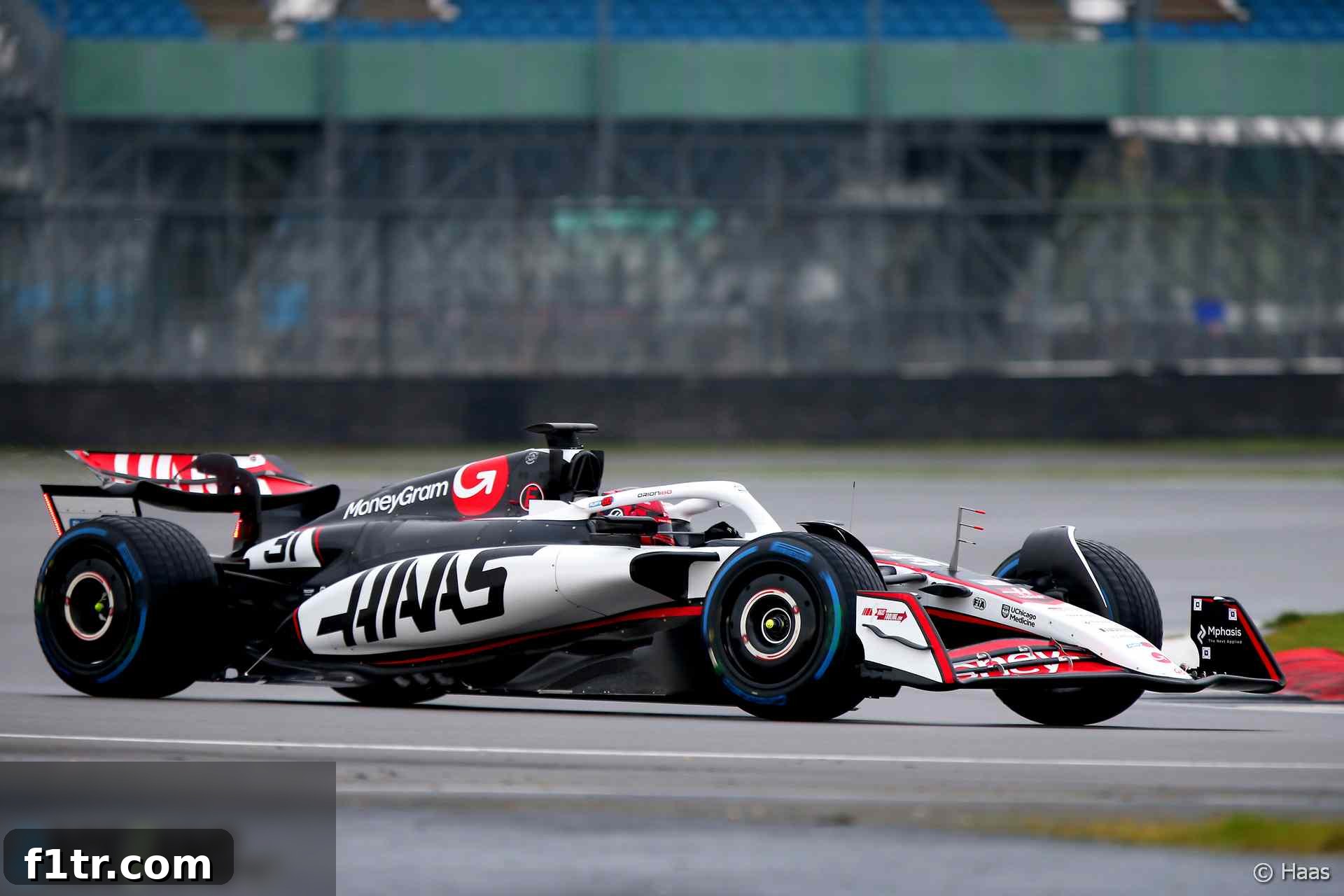
The Haas Formula 1 team is brimming with optimism, holding high expectations for the significant performance enhancements integrated into their new challenger for the 2025 Formula 1 season. Simulations suggest that the VF-25, as the new car is designated, represents a substantial leap forward in design and capability, fueling hopes for a more competitive and consistent season for the American outfit.
Davide Paganelli, Haas’s head of aerodynamics, has articulated the team’s belief in the potential of their latest creation. According to Paganelli, the detailed data gleaned from extensive simulations indicates that the VF-25 has made major strides, specifically addressing the areas of concern that plagued its predecessor, the VF-24.
Engineering a Stronger Foundation: The VF-25’s Design Philosophy
“Our focus was unequivocally on the points of weakness identified in the VF-24,” Paganelli explained. This targeted approach was a fundamental pillar of the VF-25’s development. The team didn’t merely seek incremental improvements; instead, they embarked on a mission to systematically dismantle and reconstruct critical aspects of the car’s performance profile.
Working in close collaboration with the performance team, a holistic strategy was adopted to overhaul the car as a complete package. This comprehensive approach aimed to resolve inherent issues rather than merely masking symptoms. Paganelli emphasized the intensive work undertaken on the rear of the car, highlighting the rear wing as a particular area of meticulous development.
Aerodynamic Breakthroughs: The Rear Wing Revolution
The rear wing in Formula 1 is a cornerstone of aerodynamic performance, responsible for generating crucial downforce that pushes the car into the track, enhancing grip and stability, particularly in high-speed corners. Any gains in this area can translate directly into faster lap times and improved handling characteristics. “I think that we’ve done a really good job on this for 2025,” Paganelli affirmed, underscoring the team’s confidence in their refined rear wing design.
The belief within the Haas camp is that the entire aerodynamic package designed for the VF-25 is a robust one, poised for significant development potential throughout the season. However, Paganelli wisely tempered this enthusiasm with a note of caution: the ultimate validation lies in on-track performance. “Obviously, we must check if the delivery is what we expect. If we’re able to see on track what we think we’re discovering in the wind tunnel, I think that we can have a massive boost from the very first race.” This correlation between simulation data, wind tunnel results, and real-world track performance is often the make-or-break factor for any new F1 car.
Achieving Consistency: A Car for Every Circuit
The 2024 season saw Haas climb three positions to seventh in the Constructors’ Championship, a commendable achievement. Yet, their form exhibited a noticeable fluctuation from one track to another, often struggling to adapt to diverse circuit characteristics. This inconsistency was a critical area targeted for improvement in the VF-25.
“We’ve tried to design a car that can adapt to different races,” Paganelli stated, addressing one of the VF-24’s most prominent weaknesses. The challenge in Formula 1 is creating a car that performs optimally not just on specific layouts – like high-speed power tracks or technical street circuits – but across the entire spectrum of the F1 calendar. This adaptability is crucial for gathering consistent points and maintaining a strong championship position.
Beyond varying track types, environmental factors such as temperature play a significant role. “I think that we did a good job in trying to close this kind of gap as well as providing a configuration that is better in hotter races,” Paganelli added. The early part of the Formula 1 season typically features races in high-temperature environments, such as Bahrain and Saudi Arabia. Engineering a car that can perform effectively in these demanding conditions is paramount for a strong start to the campaign. The ability to manage tyre degradation and engine cooling in extreme heat can be a decisive competitive advantage, and Haas aims to be well-prepared.
A Transformed Team: The Ayao Komatsu Era
The mood within the Haas team is undeniably upbeat, a sentiment largely attributed to the significant progress made over the last 12 months, particularly since Ayao Komatsu took the helm as team principal. Komatsu’s arrival heralded a new chapter for the team, fostering an environment of growth and renewed confidence.
“Last year we grew a lot in terms of design resource and we also gained a lot of confidence that we can definitely do better,” Paganelli reflected, emphasizing the tangible and intangible gains. This increase in resources, coupled with a belief in their own capabilities, has created a palpable positive energy within the design office. “The mood in the design office today is absolutely positive, we can feel the energy here. Last season we were able to demonstrate to ourselves and the rest of the grid that we can do a very good job.”
Unlocking Potential: Organizational Restructuring and 2024’s Success
The 2024 season, despite its challenges, is viewed internally as a success, particularly given the team’s starting position at the very bottom of the championship standings. To deliver positive results with existing resources was a difficult task, but it was achieved through strategic organizational restructuring. This restructuring, spearheaded by Komatsu, allowed the team to unlock the previously untapped potential of its members.
“It was really difficult to be able to deliver something positive with the same resource, but by changing the organisational structure we unlocked the potential of team members, and that was really satisfying,” Paganelli elaborated. This strategic realignment focused on optimizing workflows, improving communication, and empowering engineers and designers, ultimately leading to a more efficient and motivated workforce. The satisfaction derived from this internal transformation is a powerful driver for future success.
New Faces, New Ambitions: The VF-25 Hits the Track
The VF-25 recently made its on-track debut last weekend at Silverstone, with new Haas driver Esteban Ocon behind the wheel. Ocon, bringing a wealth of experience and a reputation for consistent performance, will be pivotal in providing valuable feedback for the car’s development. His initial impressions and data gathered from the shakedown run will be crucial for fine-tuning the VF-25 ahead of pre-season testing.
The team’s other driver, rookie Oliver Bearman, is slated to experience the new car for the first time on Monday at the Bahrain International Circuit. This critical outing precedes next week’s official pre-season test, giving Bearman an early opportunity to familiarize himself with the VF-25 and contribute to its setup. Bearman, an exciting young talent, represents the future for Haas, and his ability to quickly adapt to the car will be a key storyline for the team.
Looking Ahead: Haas’s Aspirations for the 2025 Formula 1 Season
With a renewed sense of purpose, significant aerodynamic enhancements, and a more consistent car design, Haas F1 is poised to make a stronger statement in the 2025 Formula 1 season. The collaborative efforts between the performance and aerodynamic teams, coupled with the organizational changes implemented under Ayao Komatsu, have instilled a profound belief that the VF-25 can deliver on its promise.
The target for Haas will undoubtedly be to build on their 2024 performance, translate their simulation gains into tangible on-track results, and consistently challenge for points throughout the championship. The early races in hotter climates will be a critical test of their adaptability, while the overall consistency of the VF-25 across diverse circuits will determine their standing in the fiercely competitive midfield battle. The journey towards a more prominent role in Formula 1 continues, and with the VF-25, Haas believes they have engineered the right tools for the task.
Related Formula 1 Insights
- Controversies, Norris, Newey and more: Five new motorsport books reviewed
- One of F1’s greatest races happened 15 years ago today. Or did it?
- “Overtaking is overtaking”: Domenicali denies F1’s yo-yo racing is “artificial”
- The crashes F1 is trying to prevent may be rare – but the danger is obvious
- F1 returning to India soon after 2027 sounds like wishful thinking
Browse all Formula 1 articles