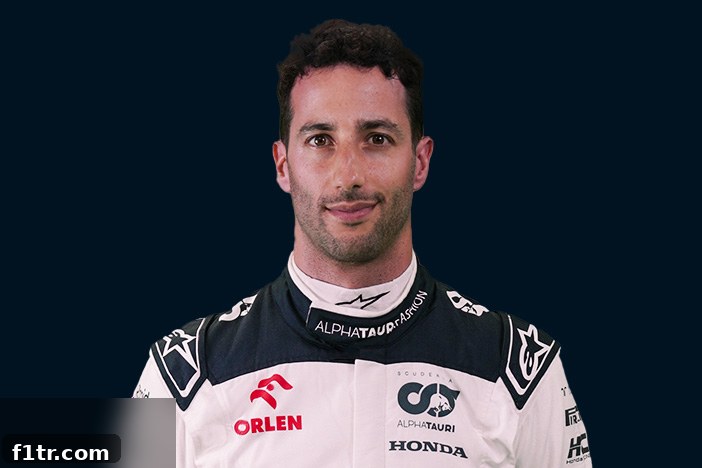
After a period away from the competitive fray, Daniel Ricciardo has made a triumphant return to the Formula 1 grid, securing a seat with Red Bull’s junior squad, AlphaTauri. However, as confirmed by team principal Christian Horner, this immediate comeback is merely the prelude to a grander ambition: a full-circle return to the senior Red Bull Racing team at the earliest opportunity. Ricciardo’s “golden objective” is clear – to replace Sergio Perez and reclaim a coveted spot alongside Max Verstappen for the 2025 F1 season, reaffirming his status at the pinnacle of the sport.
The Australian’s unexpected return saw him replace Nyck de Vries, whose tenure at AlphaTauri was cut short just ten races into his debut season. This swift change underscores the ruthless, performance-driven nature of Formula 1, particularly within the Red Bull ecosystem, where opportunities are precious and expectations are sky-high.
The Genesis of a Comeback: Silverstone’s Pivotal Test
The groundwork for Ricciardo’s dramatic return was laid in the days leading up to last week’s Pirelli tyre test at Silverstone. This wasn’t just another routine test; it was a crucial audition, a moment for Ricciardo to prove he still possessed the raw speed and racecraft that once made him a Grand Prix winner. Christian Horner recounted the pivotal moments, stating that the team was convinced almost immediately. After merely seven laps in the formidable Red Bull RB19, a car widely considered the benchmark of the current F1 era, Ricciardo had already demonstrated enough to sway opinion. By his eleventh lap, the decision was effectively made, leading to motorsport consultant Helmut Marko’s call to de Vries, informing him that his services were no longer required.
This rapid assessment and definitive action highlight Red Bull’s decisive philosophy when it comes to driver performance. The team’s conviction in Ricciardo, based on such a short stint in the car, speaks volumes about the impression he made and the latent talent they believe he still possesses. It wasn’t just about pace; it was about confidence, feedback, and the sheer joy of driving that Ricciardo exuded, which had seemingly been absent during his challenging spell away from the Red Bull family.
A Journey Back: From McLaren’s Exit to Red Bull’s Embrace
Ricciardo’s path back to the Red Bull fold, where he previously drove for Toro Rosso (now AlphaTauri) in 2012 and 2013 before graduating to the senior team, has been a winding one. His contract with McLaren was prematurely terminated last season, a decision that left him without a full-time F1 seat for 2023. This unexpected break, however, opened the door for a potential reunion with Red Bull. Discussions between Ricciardo and Christian Horner began as early as the Mexican Grand Prix, hinting at the possibility of bringing the popular Australian back into the family.
Following the 2022 season finale in Abu Dhabi, Ricciardo took a significant step by driving the Red Bull simulator for the first time since his departure from the team in 2018. This initial simulator session, however, wasn’t without its challenges. Horner openly shared his observations with the official F1 website, noting a significant change in Ricciardo’s driving style since his earlier days with the team. “I didn’t really recognise the Daniel, over the last couple of years, that we’d sort of grown so used to, that had grown up with us,” Horner admitted, detailing the complexities of his initial virtual runs.
Horner described the first simulator outing as “a complete disaster,” indicating that Ricciardo had picked up “every bad habit imaginable” from his previous engineering collaborations. This candid assessment reveals the deep dive Red Bull undertook to re-evaluate Ricciardo. It wasn’t just about giving him a chance; it was about meticulously analyzing and rectifying issues that had potentially hampered his performance elsewhere. “Gradually we unpicked it,” Horner explained, highlighting a structured and patient approach. “With each session he just got better and better. You could see his confidence growing to the point that he was absolutely on the pace with the race drivers.” This process of re-calibration in the simulator was crucial, not just for Ricciardo to regain his speed, but also to rebuild the trust and understanding with the Red Bull engineering philosophy.
The Silverstone Revelation: Echoes of the Past
The simulator progress culminated in the much-anticipated Silverstone test. Horner reiterated that “the plan was always to put him in for that Silverstone test,” emphasizing its strategic importance. The test itself proved to be “extremely impressive,” exceeding even the team’s high expectations. Ricciardo’s performance was so striking that it drew parallels to his test a decade prior, which ultimately convinced Red Bull to promote him to the senior team alongside Sebastian Vettel for the 2014 season. That earlier test was a turning point in his career, and the Silverstone outing in 2023 carried a similar weight.
Horner recounted his observations from the test, expressing his astonishment at Ricciardo’s immediate pace. “What impressed me the most when I went up to have a look at the test was, bearing in mind he hasn’t driven this car, hadn’t been in a car for seven months, within his third or fourth lap he was down to a time that was within a second of what our drivers were achieving.” This instant adaptation is a hallmark of truly elite drivers, showcasing an innate feel for the car and track. Even more remarkably, during his first proper run on comparable tyres, “that first lap on probably what was his seventh lap of the day would have put him on the front row of the grid. So it was hugely impressive.”
The emotional impact on Ricciardo was also palpable. Horner recalled telling him, “‘that would have put you on the front row of the grid,’ and you could see almost the relief in his eyes and almost like the pressure release off his shoulders that he could still do it, that he wasn’t going mad and the old Daniel was still there.” This moment of validation was critical for Ricciardo, confirming to himself and the world that his talent had not diminished, only perhaps been misdirected. His subsequent long runs during the test were equally impressive, proving his consistency and value for Pirelli’s data collection, which was “absolutely on the money.” This robust performance across various test conditions solidified Red Bull’s conviction in his abilities.
De Vries’ Departure: A “Stopgap” Role Concludes
The decision to bring Ricciardo back naturally necessitated the departure of Nyck de Vries. While the timing of the announcement seemed sudden, discussions with Ricciardo about the AlphaTauri seat had taken place even before the Silverstone test. Horner revealed that they had sounded out Daniel, asking if he would be “up for driving an AlphaTauri because things aren’t quite going as we’d hoped with Nyck. Would you be up for that challenge?” Ricciardo’s enthusiastic “yeah, absolutely” demonstrated his readiness to “take a step backwards to try and take two steps forward,” a clear indication of his unwavering focus on returning to the top tier.
Helmut Marko had previously hinted at Horner’s initial reservations about de Vries, a sentiment the Red Bull team principal confirmed. While acknowledging de Vries’ credentials as “a very capable driver and a Formula E champion and Formula 2 champion,” Horner highlighted a critical mismatch with Red Bull’s long-term philosophy. “He’s not a young driver as such, from an age perspective. And I just didn’t see how it fitted within the junior program. It was always a stopgap.” This statement provides crucial insight into Red Bull’s talent pipeline, which prioritizes nurturing young talent through AlphaTauri for future Red Bull Racing seats. De Vries, despite his impressive resume, didn’t fit this specific mould, making his position inherently precarious.
Performance on track further complicated de Vries’ situation. He failed to score any points in his first ten races at AlphaTauri, while his teammate Yuki Tsunoda managed to secure two. “It was becoming obviously a difficult situation for Nyck de Vries,” Horner reflected, acknowledging the mounting pressure. “There was a high expectation on him because whilst inexperienced in Formula 1, he’s obviously a very experienced driver.” The gap in performance and the lack of progress led to a “general feeling that Nyck wasn’t quite hitting the mark.” With Ricciardo presenting a compelling alternative, the choice became clear. “From a Red Bull Racing perspective, the most interesting option for me was to see how Daniel performed. So that was the decision that was made. It all happened pretty quick. And here he is for the Hungarian Grand Prix,” concluded Horner, encapsulating the swift and decisive nature of the change.
The Golden Objective: Targeting the 2025 Red Bull Seat
Despite the shared ownership, Red Bull and AlphaTauri operate as distinct entities, and Ricciardo’s current stint with the junior squad is explicitly described as a “loan.” With Sergio Perez contracted to Red Bull Racing until the end of the next season, Ricciardo’s sights are firmly set on the 2025 campaign. Horner articulated this ambition clearly: “At the moment there’s only something in place until the end of the season. So there’s no thoughts or expectations beyond that.” While acknowledging that Max Verstappen and Checo Perez will remain the Red Bull drivers for 2024, Horner emphasized the value of having “talent in reserve.”
“I think Daniel is viewing AlphaTauri, he firmly wants to be pitching for that 2025 Red Bull seat. That’s his golden objective,” Horner stated, leaving no room for doubt regarding Ricciardo’s ultimate aim. This strategic move to AlphaTauri is not an end in itself but a means to an end. It provides Ricciardo with a platform to demonstrate his revitalized form, consistency, and ability to contribute valuable feedback to a team within the Red Bull family. “By going to AlphaTauri, I think he sees that as his best route of stating his case for 2025,” Horner added. The path is clear: impress at AlphaTauri, prove his worth, and lay an undeniable claim to one of the most coveted seats in Formula 1, alongside the reigning world champion, Max Verstappen.
This journey back to the grid is more than just a comeback; it’s a meticulously planned strategic manoeuvre by Ricciardo, backed by Red Bull, to potentially reshape the future of the sport’s most dominant team. The next chapters of this story, unfolding on track with AlphaTauri, will be critical in determining whether Ricciardo can indeed achieve his golden objective and complete a truly remarkable return to the forefront of Formula 1.
2023 Hungarian Grand Prix
- Was F1’s Alternative Tyre Allocation test successful? Drivers and teams have their say
- How far can McLaren climb with car rivals now say is the second-fastest in F1?
- Why Ricciardo says McLaren’s car “speaks Lando’s language” – but Norris disagrees
- Mercedes reveal cooling error behind loss of pace in Hungarian GP
- Perez answered critics in Hungary but needs to qualify better – Horner
Browse all 2023 Hungarian Grand Prix articles