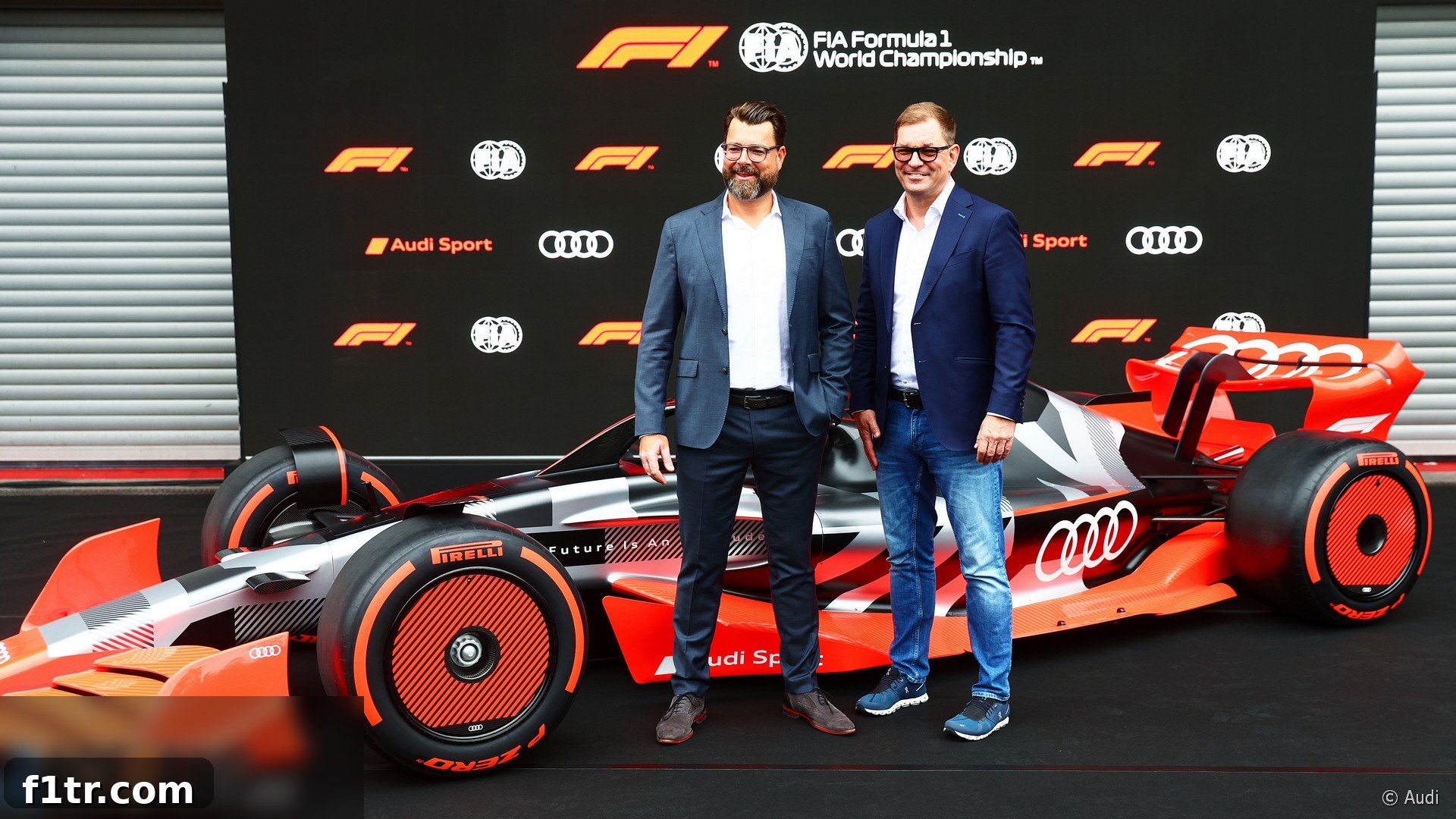
The exhilarating world of Formula 1 is poised for a seismic shift in 2026, with the highly anticipated arrival of Audi as a new engine supplier. Situated just a short drive from its headquarters in Bavaria, south-east Germany, Audi’s ambitious Formula 1 project is already in full swing. This momentous undertaking will see the iconic German manufacturer challenge the established titans of the sport, such as Mercedes and Ferrari, who boast decades of unparalleled experience and countless championship trophies. Audi’s entry isn’t just a bold move; it’s a testament to the evolving landscape of motorsport and the marque’s commitment to cutting-edge technology and sustainable innovation.
Audi’s preparations are extensive, with the company targeting full operational readiness for its Formula 1 program by the close of 2022. The motorsport facility in Neuburg an der Donau is undergoing significant expansion, specifically designed to accommodate the rigorous demands of F1 engine development. State-of-the-art test benches for power unit testing are already installed, forming the backbone of their research and development efforts. Furthermore, key personnel have been strategically reallocated from Audi’s recently concluded Formula E project, bringing invaluable expertise in electric propulsion and energy management to the F1 initiative. Despite these considerable investments and meticulous planning, the sheer scale of the challenge facing Audi remains immense.
History, regrettably, offers a cautionary tale for new entrants. The last major manufacturer to join the Formula 1 grid provides a stark reminder of the difficulties involved. Honda’s much-heralded return to Formula 1 in 2015, marking their fourth spell in the sport following an announcement in 2013, was met with considerable struggles. The McLaren cars, powered by the new Honda units, languished at ninth place out of ten teams, with frequent retirements plaguing their season. Performance was so abysmal that two-time world champion Fernando Alonso famously humiliated Honda management during their home race, publicly deriding their power unit as a “GP2 engine” over team radio. This incident underscored the profound gap between the Japanese manufacturer’s ambitions and their initial on-track reality.
Honda’s timing was a significant factor in their initial woes. They entered in the second year after the introduction of profoundly complex hybrid power unit regulations, which saw Formula 1 cars adopt sophisticated energy recovery systems. The existing manufacturers – Mercedes, Ferrari, and Renault – had already spent a full season refining their power units and had enjoyed a crucial head start. While Honda began developing their unit in 2013, they were playing catch-up against rivals who had a year of real-world data and competitive refinement under their belts. This crucial temporal disadvantage highlighted the importance of lead time in such a technologically intensive sport, where every fraction of a second in development can translate into significant performance disparities on track.
In contrast to Honda’s challenging entry, Audi will benefit from a more equitable starting point for the 2026 season. The new Formula 1 engine regulations aim to reset the playing field, theoretically allowing all teams and engine manufacturers to begin development from a similar baseline. However, even with this “clean slate,” existing manufacturers will retain a distinct advantage: a deep, practical understanding of how the current V6 turbo-hybrid iterations function. This invaluable experience, accumulated over years of competitive racing and continuous development, could prove absolutely crucial for the interpretation and innovative development of the new power units, which, while radically altered, will still be based on the same fundamental V6 turbo block architecture. The nuances of hybrid integration, thermal management, and energy recovery are lessons hard-earned and not easily replicated.
The 2026 power unit regulations present an even greater array of challenges beyond simply starting from scratch. These new rules are meticulously crafted to push the boundaries of sustainability and technological efficiency. Key changes include a significantly redesigned battery, which must utilize entirely recycled materials in its production and be fully recyclable itself. The fuel composition will undergo a radical transformation, moving towards 100% sustainable sources. This necessitates a substantial amount of research and development for both the V6 internal combustion engine and the turbocharger, as they will need to be optimized for these novel fuels. A higher proportion of electrical energy will be mandated for propulsion, demanding a much denser, higher-capacity energy store. The design of this energy store is explicitly stipulated to incorporate recycled and recyclable elements, aligning with F1’s broader environmental goals. The MGU-K (Motor Generator Unit – Kinetic), while likely sharing design principles with its predecessors, will require substantial reinforcement to handle the increased voltages and energy demands, pushing material science and electrical engineering to their limits. These interconnected changes mean that developing a compliant and competitive F1 power unit for 2026 is an unprecedented engineering feat.
Audi, however, is not the sole new contender starting from the ground up. Red Bull Racing made a pivotal decision last season to take control of its own power unit supply, establishing Red Bull Powertrains (RBPT) to supply engines to its team from 2022 onwards. Their long-term vision extends to developing their very own 2026 Formula 1 power unit. While Red Bull Powertrains initially received significant technical support from Honda during the transition period – a legacy of their successful championship-winning partnership – the team has meticulously built its own state-of-the-art production facility at their Milton Keynes base. This strategic move was made in anticipation of the current V6 hybrid turbo power unit regulations changing dramatically in 2026, allowing Red Bull to fly solo in the engine development game. Despite earlier speculation about a potential collaboration with Porsche, Red Bull appears firmly committed to its independent engine program. There is also persistent speculation that Honda themselves might consider a fifth return to F1, following their impressive seven-year stint. Honda’s motorsport boss, Masashi Yamamoto, openly admitted last year his hope that “history repeats” if they could successfully “convince senior management” of another comeback, signaling a potentially even more crowded engine supplier landscape.
Christian Horner, the revered Team Principal of Red Bull, offers a sobering perspective on the monumental task ahead. He emphatically states that one “absolutely shouldn’t underestimate the scale of the challenge” when attempting to compete against the sport’s deeply entrenched manufacturers under the radical 2026 engine regulations. Horner elaborates on this difficulty, highlighting the “massive” advantage held by the current incumbents due to their extensive “longevity” and “continuity” in Formula 1 engine development. “Of course, a company like Audi’s reputation talks for itself,” Horner acknowledges, recognizing the German marque’s engineering prowess. However, he quickly pivots back to the core issue: “But the scale and the size of the challenge, as we’ve seen ourselves at Red Bull, is enormous, especially when you’re starting from scratch.” Despite the daunting nature of the task, Horner concludes with a characteristic note of optimism and ambition, stating, “[But] it’s exciting, because it is a challenge and you have to believe anything is possible.”
The journey to the 2026 regulations has also seen its own twists and turns. Originally slated for implementation in 2025, the new engine regulations were judiciously delayed by 12 months, shifting their introduction to 2026. This crucial delay provided a much-needed lifeline and additional preparation time for both new entrants like Audi and Red Bull Powertrains. Furthermore, teams unanimously voted for an engine freeze to commence at the beginning of 2022. This freeze means that existing manufacturers are spared the colossal financial burden and engineering complexity of simultaneously developing both the current power units and the entirely new 2026 power units. This regulatory foresight aimed to create a more stable financial environment and to encourage new entries into the sport by mitigating the competitive advantage of established players. Horner himself reinforced the critical nature of this delay, stating, “Thankfully the regulations were delayed 12 months to 2026; otherwise, I don’t think you would have seen either potentially Red Bull or Audi participating in the sport.”
Nonetheless, even with the added year, Christian Horner remains unequivocal that three-and-a-half years represents an incredibly tight timeframe to design, develop, and produce competitive engines for the new formula. His candid assessment underscores the relentless pressure facing all manufacturers, particularly those starting anew. “Even 2026… You know, it’s 10 past midnight and Cinderella’s already buggered off,” Horner quips, using a vivid analogy to convey the urgency and compressed schedule. He emphasizes that despite the difficulty, this intense pressure is inherent to Formula 1, fostering the “creativeness and drive that happens within the teams.” Looking to the future, Horner expresses genuine excitement about the prospect of “more power unit manufacturers on the grid for 2026,” believing it will enhance competition and spectacle for fans worldwide. This influx of manufacturers promises a new era of technological rivalry, pushing the boundaries of what is possible in motorsport.
From the perspective of an incumbent and highly successful power unit manufacturer, Mercedes High Performance Powertrains managing director Hywel Thomas offers a balanced view. Drawing from Mercedes’ deep-rooted heritage in traditional automotive manufacturing, Thomas firmly believes that Audi’s extensive motorsport and automotive background will be a significant asset in confronting the formidable challenges that all power unit manufacturers must overcome. “Someone like Audi is not new to making combustion engines, they’re not new to making racing engines, and they’re not new to electrical racing,” Thomas observes. He acknowledges Audi’s vast experience, especially from their successful tenure in endurance racing and Formula E. “So whilst I’m sure there will be a lot of new technology, a lot of differences they’ll have, I’m sure, a very capable engineering team and a very capable operations team to back that up,” he continues, expressing confidence in Audi’s formidable resources and talent pool. While acknowledging the difficulty, Thomas concludes with a unifying thought: “It’s going to be tough, but then it’ll be tough for all of us. We’ve all got the same constraints in terms of the cost cap. We’ve all got the same constraints for physics.” This sentiment underscores that even for the most experienced teams, the 2026 regulations represent a significant step into the unknown, leveling the playing field in terms of fundamental engineering limitations and financial oversight.
Ultimately, all manufacturers, both established and new, will navigate a similar labyrinth of technical and logistical challenges over the coming years. Despite Audi having provided the FIA with their intention to enter at the end of last year, granting them an effective four-year runway to get up to speed before their 2026 debut, the sheer magnitude of the obstacles ahead cannot be overstated. As highlighted by seasoned figures like Christian Horner, the hurdles facing Audi’s personnel – from engineering and design to logistics and strategy – are substantial. Attracting a prestigious global automotive brand like Audi into Formula 1 is, without a doubt, a monumental coup for the sport, signaling its enduring appeal and future direction. Compared to Honda’s challenging return in 2015, Audi enjoys the advantage of more lead time and a truly fresh regulatory start. However, the true hard work is only just beginning for the four rings of Ingolstadt. The world of motorsport eagerly awaits to see if Audi’s immense investment, engineering prowess, and strategic foresight will translate into championship-winning results in just a few years’ time.
News Focus
- No happy ending for Ricciardo’s made-for-Netflix redemption arc
- No ‘two alphas’ for Red Bull as team forms its longest-running driver line-up
- Will Mercedes come to the rescue of Ocon’s career a third time?
- How the midfield’s hottest team mate rivalry boiled over
- Petty officialdom or deserved decisions? Five drivers stripped of wins in 2024
Browse all News Focus articles