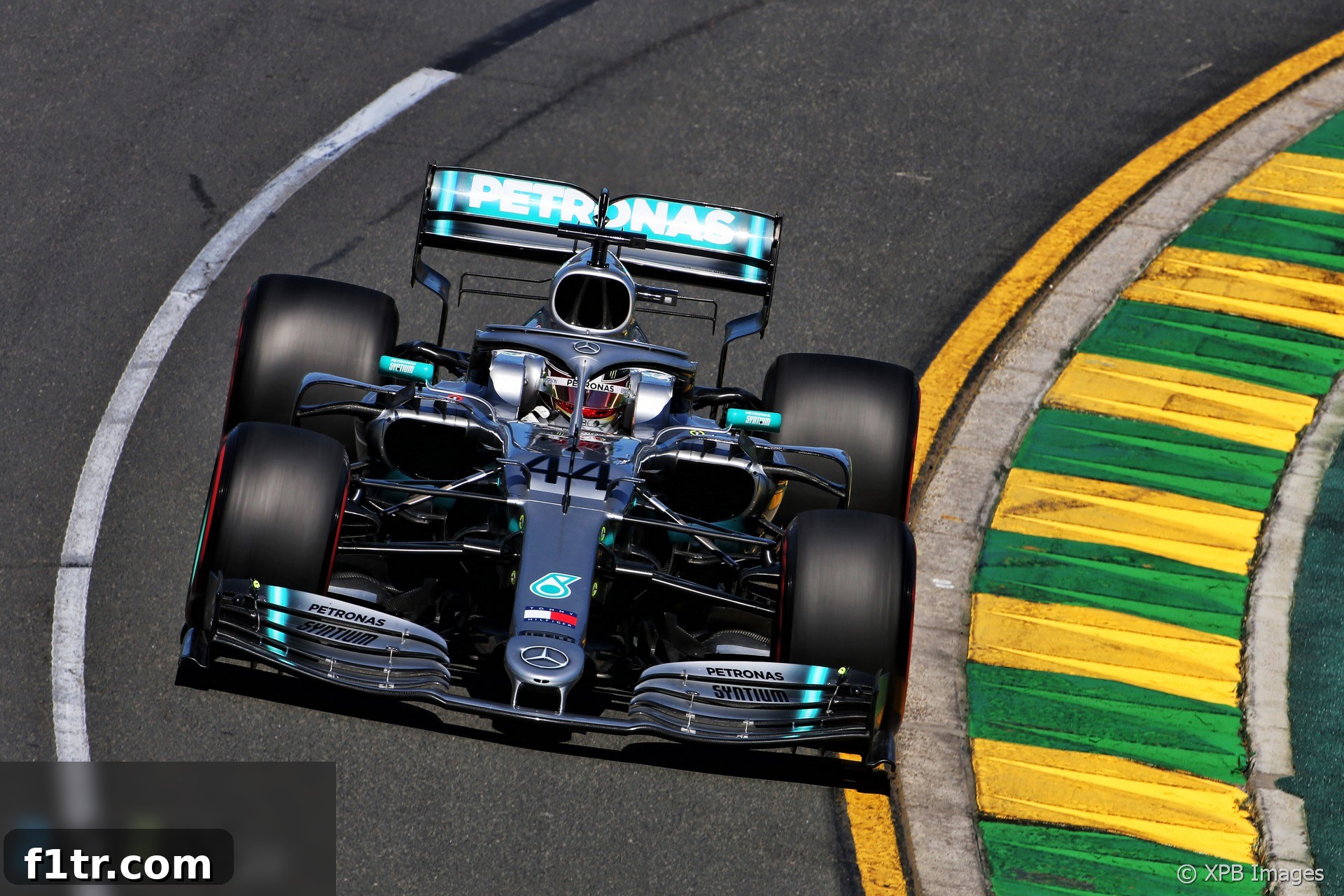
Lewis Hamilton continued to assert his early dominance in the second practice session for the 2019 Australian Grand Prix, as the Mercedes-AMG Petronas Formula One Team extended its formidable margin over the competition. The reigning world champion’s performance at Albert Park delivered a clear statement of intent for the season opener, leaving rivals with significant ground to make up on the Silver Arrows.
The highly anticipated Free Practice 2, often considered the most representative session for qualifying and race pace due to similar track conditions, saw Hamilton not only outpace his teammate but also establish a commanding lead over the rest of the field. His blistering lap around the iconic Albert Park circuit placed him narrowly ahead of his teammate, Valtteri Bottas, underscoring the team’s potent one-two punch. Hamilton’s fastest time was a significant eight-tenths of a second quicker than the closest challenger from a rival team, Max Verstappen of Red Bull Racing. Verstappen, showcasing the potential of the new Red Bull-Honda package, was himself closely followed by his teammate, Pierre Gasly, suggesting a formidable challenge from the Milton Keynes outfit at the top of the midfield pack.
Mercedes-AMG Petronas: Setting the Benchmark for the 2019 F1 Season
Mercedes’ performance in FP2 was nothing short of a masterclass in precision and speed. Lewis Hamilton’s ability to extract maximum performance from the W10 chassis was evident, with his lap time of 1’22.600 standing as the session’s benchmark. His teammate, Valtteri Bottas, was incredibly close, just 0.048 seconds behind, reinforcing the Silver Arrows’ strong package and deep understanding of the Albert Park circuit. This incredibly narrow gap between the two Mercedes drivers is a testament to the team’s meticulous preparation and the fundamental strength of their car, signalling that they are well-positioned for both qualifying on Saturday and the race on Sunday. Their consistent pace on both short, qualifying-style runs and longer, race-simulation runs during the session suggests that Mercedes has indeed started the 2019 campaign with a significant advantage, putting immediate pressure on their competitors to bridge the performance gap quickly if they hope to challenge for the championship.
Red Bull Racing: Honda Power Showing Promising Potential
Max Verstappen’s third-place finish, an encouraging 0.800 seconds off Hamilton’s pace, provided a strong indication of Red Bull-Honda’s potential. The team’s new engine supplier, Honda, appears to be delivering the goods, allowing Verstappen to consistently challenge at the sharp end of the grid. This performance marks a positive start to their much-anticipated partnership. Pierre Gasly, making his competitive debut with the senior Red Bull squad, secured an impressive fourth place, just 0.042 seconds behind his more experienced teammate. This tight margin between Verstappen and Gasly suggests that while the team still has some work to do to catch Mercedes, they have a solid baseline to build upon. Their competitive showing also hints at a potentially close fight with Ferrari, adding another layer of excitement and unpredictability to the battles at the front of the grid throughout the 2019 Formula 1 season. The reliability and power of the Honda engine will be key to their aspirations.
Ferrari’s Strategic Silence: Is There Pace in Reserve?
Ferrari’s performance in Free Practice 2 proved to be one of the most intriguing storylines of the day. Sebastian Vettel’s fifth-placed Ferrari was covered by less than a tenth of a second from the Red Bull pair, indicating a tight battle for third best on the day. However, given that the quickest midfield runners were only fractionally slower than Vettel, speculation mounted that Ferrari might be deliberately keeping some pace in reserve, avoiding showing their full hand too early. This strategic approach, often employed by top teams, keeps rivals guessing about their true potential and can be a psychological tactic. Their highly anticipated new recruit, Charles Leclerc, experienced a challenging session, including a spin at Turn 4 in the final minutes. He ended up ninth fastest, separated from his teammate by a significant gap and several midfield contenders. While Leclerc’s single-lap pace might not have been fully unleashed, his incident highlights the fine margins and demands of the Albert Park track, and the immense pressure on drivers to perform flawlessly in the season opener.
The Intense Midfield Scramble: Who Will Be ‘Best of the Rest’?
The midfield battle, as expected, was fiercely competitive and incredibly tight, promising an exhilarating qualifying session and a thrilling race. The top ten featured a fascinating mix of teams and drivers, with incredibly small margins separating them. Kimi Raikkonen, in his debut for Alfa Romeo Racing, impressed by securing sixth place, just under a tenth of a second ahead of Nico Hulkenberg’s Renault. This strong performance puts Alfa Romeo firmly in contention for points, demonstrating the potential of their Ferrari-powered challenger and Raikkonen’s enduring skill and experience, proving he’s still a force to be reckoned with.
Renault, with their highly anticipated driver lineup, saw Hulkenberg take seventh, while newcomer Daniel Ricciardo finished eighth in the other RS19. The two Renaults were closely matched, suggesting strong internal competition and a collective effort to establish themselves as the leading midfield team. Ricciardo, under immense pressure in his home race debut for Renault, showed flashes of speed, indicating he is beginning to adapt to his new machinery and team environment, a crucial step for the ambitious French outfit. Rounding out the top ten was Romain Grosjean for Haas, further underscoring the formidable challenge faced by any team aiming to consistently score points in 2019, as the margins are incredibly fine.
Toro Rosso’s Mixed Fortunes and Rookie Challenges at Albert Park
Daniil Kvyat, making his return to Formula 1 with Toro Rosso, narrowly missed a place in the top ten by just a tenth of a second, demonstrating his ability to quickly get back up to speed and proving he still has what it takes. His performance suggests Toro Rosso has a competitive package for the midfield fight, a positive sign for the junior Red Bull team. However, his teammate, rookie Alexander Albon’s travails continued through the session. Albon experienced a series of off-track moments, including a spin at Turn 14, indicating the steep learning curve for a new driver in Formula 1. He finished seven-tenths off Kvyat’s pace, underscoring the challenges of adapting to F1 machinery and the demands of a complex circuit like Albert Park. His experiences are typical for a debutant, and the team will be looking for him to gain confidence and consistency as the weekend progresses, learning from every lap.
Racing Point and McLaren Show Glimmers of Promise
Further down the order, the updated Racing Point RP19 secured 13th place in the hands of Lance Stroll. This position, while not stellar, indicates a decent starting point for the newly rebranded team, with potential for development throughout the season under their new ownership. Stroll’s effort was closely followed by Carlos Sainz Jnr, who led the charge for McLaren. Sainz was just a tenth of a second slower than Stroll, placing McLaren firmly in the thick of the midfield battle. The Woking-based squad, also undergoing a rebuilding phase, will be eager to demonstrate consistent improvement and challenge for points on a regular basis. Meanwhile, his rookie teammate, Lando Norris, found himself further down the order in 18th place. The commentary noted that Norris did not appear to have a clean flying lap, suggesting his true pace might be higher than his practice results indicated. This leaves McLaren with a mixed but potentially promising outlook as they look to fine-tune their cars for qualifying and capitalize on any opportunities during the race.
Williams’ Difficult Start to the 2019 F1 Season Continues
The difficulties for Williams Racing continued in earnest at the 2019 Australian Grand Prix, painting a bleak picture for the iconic British team. George Russell, one of the highly touted rookies, concluded second practice a substantial 1.7 seconds slower than McLaren’s Lando Norris (who himself had an “unclean” lap), highlighting the significant performance deficit facing Williams. His teammate, Robert Kubica, on his emotional return to Formula 1 after a long absence, found himself at the very bottom of the time sheets, four seconds adrift of Lewis Hamilton’s leading time. The gap to the rest of the field, and particularly to their nearest competitors, underscores the immense challenge ahead for Williams. Their struggles during pre-season testing appear to have unfortunately carried over into the race weekend, suggesting a tough start to the season for both drivers and the team as they grapple with the fundamental issues of their FW42 challenger. The focus for Williams will undoubtedly be on closing this gap and finding any glimmer of performance as the season progresses, but the early signs from Albert Park are certainly concerning and point to a challenging year ahead.
Become a RaceFans supporter andgo ad-free
Detailed Free Practice 2 Results: 2019 Australian Grand Prix
The table below provides a comprehensive overview of the Free Practice 2 results, offering insights into each driver’s best lap time, their gap to the leader, and the number of laps completed. These statistics are crucial for understanding the pecking order and identifying potential dark horses for the weekend ahead, as teams finalize their setups for qualifying and the race.
| Pos. | No. | Driver | Car | Best lap | Gap | Laps |
|---|---|---|---|---|---|---|
| 1 | 44 | Lewis Hamilton | Mercedes | 1’22.600 | 33 | |
| 2 | 77 | Valtteri Bottas | Mercedes | 1’22.648 | 0.048 | 33 |
| 3 | 33 | Max Verstappen | Red Bull-Honda | 1’23.400 | 0.800 | 33 |
| 4 | 10 | Pierre Gasly | Red Bull-Honda | 1’23.442 | 0.842 | 31 |
| 5 | 5 | Sebastian Vettel | Ferrari | 1’23.473 | 0.873 | 35 |
| 6 | 7 | Kimi Raikkonen | Alfa Romeo-Ferrari | 1’23.572 | 0.972 | 40 |
| 7 | 27 | Nico Hulkenberg | Renault | 1’23.574 | 0.974 | 37 |
| 8 | 3 | Daniel Ricciardo | Renault | 1’23.644 | 1.044 | 31 |
| 9 | 16 | Charles Leclerc | Ferrari | 1’23.754 | 1.154 | 35 |
| 10 | 8 | Romain Grosjean | Haas-Ferrari | 1’23.814 | 1.214 | 37 |
| 11 | 26 | Daniil Kvyat | Toro Rosso-Honda | 1’23.933 | 1.333 | 36 |
| 12 | 20 | Kevin Magnussen | Haas-Ferrari | 1’23.988 | 1.388 | 27 |
| 13 | 18 | Lance Stroll | Racing Point-Mercedes | 1’24.011 | 1.411 | 38 |
| 14 | 55 | Carlos Sainz Jnr | McLaren-Renault | 1’24.133 | 1.533 | 26 |
| 15 | 99 | Antonio Giovinazzi | Alfa Romeo-Ferrari | 1’24.293 | 1.693 | 37 |
| 16 | 11 | Sergio Perez | Racing Point-Mercedes | 1’24.401 | 1.801 | 34 |
| 17 | 23 | Alexander Albon | Toro Rosso-Honda | 1’24.675 | 2.075 | 40 |
| 18 | 4 | Lando Norris | McLaren-Renault | 1’24.733 | 2.133 | 26 |
| 19 | 63 | George Russell | Williams-Mercedes | 1’26.453 | 3.853 | 32 |
| 20 | 88 | Robert Kubica | Williams-Mercedes | 1’26.655 | 4.055 | 33 |
Analyzing the Visual Gaps: A Deeper Dive into FP2 Times
Beyond the raw numbers, the ‘visual gaps’ between drivers provide a compelling narrative of the session’s performance hierarchy. Lewis Hamilton, with a baseline lap of 1’22.600, set the gold standard. His teammate, Valtteri Bottas, was incredibly close, merely 0.048 seconds behind, illustrating Mercedes’ dominant one-two formation. This minimal gap underscores the team’s strong command of the Albert Park circuit and their car’s formidable pace, indicating a direct battle for pole position within the team.
A significant jump occurred before Max Verstappen, who was 0.800 seconds adrift of Hamilton. This eight-tenth gap highlights the challenge faced by Red Bull, though it’s a promising start with their new Honda power unit. Pierre Gasly followed Verstappen by only 0.042 seconds, an impressive showing for the new Red Bull recruit and indicative of his potential to match his teammate’s pace early in the season. Sebastian Vettel, just 0.031 seconds behind Gasly, suggests Ferrari is very much in the hunt, despite suspicions of holding back. The top five, though separated by almost a second from the leader, were tightly packed amongst themselves, setting the stage for a thrilling qualifying session.
The midfield fight began in earnest with Kimi Raikkonen in sixth, less than a tenth off Vettel’s pace and just 0.972 seconds behind Hamilton. Nico Hulkenberg was an infinitesimal 0.002 seconds behind Raikkonen, showcasing the intense competition at the front of the midfield. Daniel Ricciardo, just 0.070 seconds further back, underscored Renault’s position as a strong midfield contender. Charles Leclerc, despite his spin, was only 0.110 seconds behind Ricciardo, suggesting that his true pace is closer to the front of the midfield and that Ferrari’s single-lap potential remains high. Romain Grosjean rounded out the top 10, indicating a highly competitive bracket where every millisecond counts, highlighting the critical importance of a clean lap.
Moving further down, Daniil Kvyat missed the top 10 by a mere 0.119 seconds, demonstrating the tight margins. Kevin Magnussen followed closely, just 0.055 seconds behind, demonstrating Haas’s consistent midfield presence. Lance Stroll in the Racing Point was just 0.023 seconds behind Magnussen, indicating the extreme competitiveness of the lower midfield. Carlos Sainz Jnr then followed Stroll by 0.122 seconds, putting McLaren firmly in the mix. Antonio Giovinazzi, Sergio Perez, and Alexander Albon were all within a few tenths of each other, emphasizing the razor-thin margins throughout this part of the grid. Lando Norris was just 0.058 seconds behind Albon, again suggesting that with a cleaner lap, his position could be significantly higher and McLaren’s overall package has more to offer.
The true chasm appeared with the Williams cars. George Russell was a substantial 1.720 seconds slower than Lando Norris, who was already more than two seconds off the leader. Robert Kubica, in turn, was another 0.202 seconds behind Russell. These vast gaps of 3.853 seconds and 4.055 seconds respectively from Hamilton illustrate the profound performance deficit faced by Williams, signalling a challenging season ahead as they strive to catch up to the rest of the grid and address the fundamental issues with their FW42 chassis.
Note: Drivers more than ten seconds off the pace are typically omitted from detailed graphical analyses, but all drivers are included in the official results table for completeness.
Go ad-free for just £1 per month>> Find out more and sign up
2019 Australian Grand Prix Coverage
For more in-depth coverage and analysis of all the action from the season-opening race, explore our dedicated articles and reports. Stay updated with the latest news, qualifying results, and race highlights from Melbourne.
- Practice 1 Report: Australian Grand Prix 2019
- Qualifying Preview: What to Expect at Albert Park
- Race Strategy Guide for the Australian Grand Prix
- Driver Interviews from Melbourne
- Team-by-Team Analysis: Australian Grand Prix
Browse all 2019 Australian Grand Prix articles