Accelerating Inclusivity: The Drive to Empower Women in Motorsport and Formula 1
Last summer witnessed a historic moment for women’s sports, as a remarkable 17.5 million fans across the UK tuned in to watch England’s women’s football team triumph in the European Championship. This monumental viewership served as a powerful testament to the surging interest in female athletics, signaling a significant shift in public perception and engagement. However, when juxtaposed with the staggering 30.95 million UK viewers who watched the men’s Euro 2020 final between Italy and France, it becomes clear that a considerable journey still lies ahead in achieving true parity in sports viewership and, more importantly, participation.
This discernible gap in engagement extends beyond team sports and resonates deeply within the challenging world of motorsport. While interest in women’s football soars, the question remains: what tangible actions is motorsport undertaking to end the prolonged 30-year wait for the next female competitor to grace the prestigious circuits of Formula 1?
Insights from the charity Women in Sport, an organization passionately dedicated to transforming the sporting landscape for every woman and girl in the UK, reveal a significant gender disparity in grassroots participation. Their recent survey highlighted that while 58% of boys engage in team sports at least once a week, the corresponding figure for girls languishes at a mere 40%. Furthermore, girls consistently exhibit lower motivation across all age groups, particularly in crucial areas such as enjoyment, self-confidence, and perceived competence in sports. These foundational issues often lay the groundwork for later challenges in pursuing athletic careers.
While motorsport prides itself on being open to all participants regardless of gender, it arguably presents an even steeper ascent for women compared to more conventional sports. Success in racing demands a complex confluence of factors: substantial financial backing from a very young age, unwavering support from teams and sponsors, and crucially, parents who are not only willing but also financially capable of investing in their child’s racing ambitions. The stark reality is that this essential ecosystem of support and opportunity is not materializing for female talent anywhere near the frequency required to foster a strong pipeline of future champions.
W Series: A Bold Initiative and Its Unforeseen Hurdles
The W Series was initially heralded as a potential game-changer, even the “saviour” for women in motorsport. Conceived as a free-to-enter championship exclusively for women, its core mission was ambitious: to dismantle the significant financial barriers that historically impeded female racers, elevate their profiles within the sport, and ultimately provide a clear pathway up the competitive ladder towards Formula 1. Its emergence sparked considerable optimism, promising to level the playing field and showcase undeniable female talent.
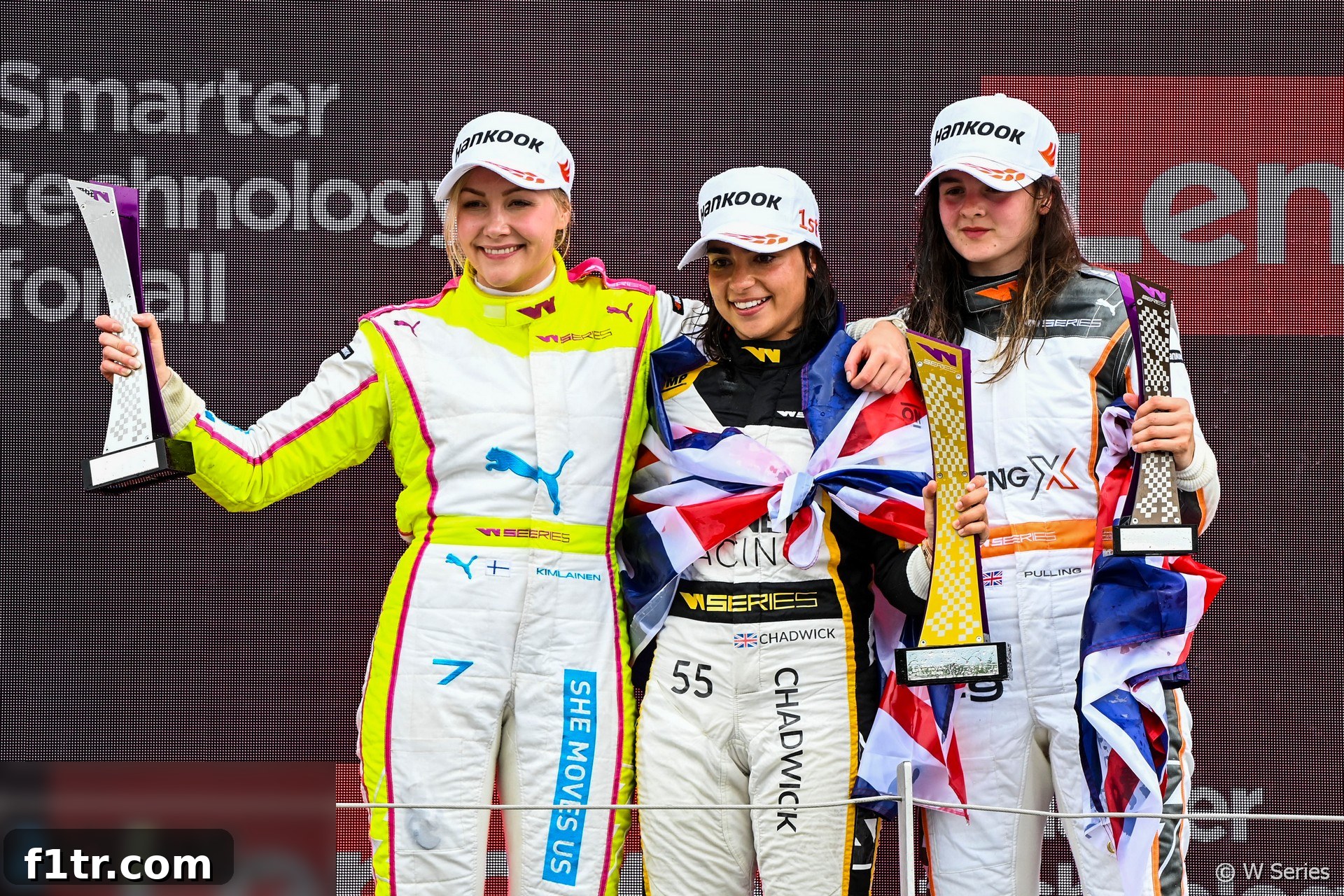
Launching in 2019 (with a temporary hiatus in 2020 due to the global pandemic), the series quickly proved successful in numerous aspects. It effectively created a dedicated platform where women could compete fiercely against each other, honing their skills and gaining invaluable race experience. Its profile received a significant boost through its integration into the prestigious Formula 1 support calendar, placing female racing talent directly in front of the sport’s global audience and key decision-makers. The series successfully raised the visibility of many of its competitors, including Naomi Schiff, who transitioned into a successful pundit for Sky Sports F1, and talented racers like Jamie Chadwick, Abbi Pulling, Emma Kimiläinen, and Jessica Hawkins, who joined Aston Martin’s F1 team in an ambassadorial role. These individuals became important role models, inspiring a new generation of aspiring female drivers.
However, despite these undeniable achievements, over its three seasons, the W Series struggled to fully realize its most ambitious stated goal: to consistently propel female racers into higher-tier single-seater championships. Jamie Chadwick, an exceptional talent who clinched all three W Series titles, found herself repeatedly returning to the championship. The unfortunate reality was that genuinely compelling opportunities in more senior series remained scarce. Even Bruno Michel, the CEO of Formula 2, expressed his perplexity regarding Chadwick’s struggles to advance, acknowledging reports of discussions with an F3 team that ultimately fell through. This underscored a systemic issue beyond the W Series’ control – the lack of a clear, fully funded progression route for its champions.
The W Series’ third season, unfortunately, came to an abrupt halt due to significant financial challenges, forcing the cancellation of its final three races. While hopes for its continuation in subsequent seasons persisted, the financial struggles highlighted the precarious nature of independent racing series, even those with significant positive intentions. Nevertheless, it would be inaccurate to label the W Series as a failure. Its legacy lies in successfully raising the profiles of many talented drivers and proving the market and appetite for female-only racing, paving the way for future initiatives.
F1 Academy: A New Chapter with Formula 1’s Backing
In the wake of the W Series’ difficulties, a new and highly anticipated category emerged: the F1 Academy. Unveiled at the Abu Dhabi Grand Prix, this all-female championship marks a significant shift, benefiting from the direct support and infrastructure of Formula 1 itself. Like the W Series, F1 Academy is strategically aimed at the junior end of single-seater racing, intending to nurture and develop young female talent from the ground up.
The F1 Academy is structured for robust competition and driver development. It will feature five established teams currently competing in F2 and F3, each fielding three cars to form a highly competitive 15-car grid. The inaugural season will comprise seven events, with each event hosting three races, ensuring ample track time for competition. Crucially, the calendar also allocates an impressive 15 days of official testing – a substantial amount, especially when considering that even seasoned Formula 1 grand prix drivers typically receive only three days of pre-season testing on the 2023 F1 calendar. This extensive testing program is designed to accelerate driver development and provide valuable experience.
Drivers in the F1 Academy will compete using the Tatuus T421 Formula 4 car, a proven platform for junior single-seater racing. The financial model for the F1 Academy also represents a significant departure. Formula 1 itself will contribute a substantial €150,000 for each entry, while drivers will be expected to contribute an equivalent amount. The remaining portion of the budget will be covered by the participating teams. This structured funding model, with direct involvement from F1, aims to provide greater financial stability and reduce the burden on individual drivers, addressing a key challenge faced by previous initiatives.
The creation of F1 Academy was widely welcomed, particularly by seven-time world champion Lewis Hamilton, one of the most vocal advocates for diversity and inclusion on the current F1 grid. While acknowledging the positive step, Hamilton emphasized that further investigation is still needed to understand the fundamental reasons why more women and girls are not engaging with motorsport at an earlier age. His insightful perspective highlights that top-down initiatives must be complemented by grassroots efforts.
Addressing the Root Cause: Grassroots and the Talent Pipeline
Lewis Hamilton’s personal reflections underscore the severity of the issue at the grassroots level. He recounted his own karting experience, spanning from ages eight to sixteen: “From my own experience, in the years I was racing there were maybe two or three girls, through my whole karting period of eight to 16, and there’ll be a class of 40 kids, 40 boys and one girl,” he observed. This glaring imbalance at the foundational stages of motorsport development means that by the time talent reaches junior single-seater categories, the pool of female drivers is already significantly diminished.
Hamilton passionately articulated the broader vision: “We’ve got to create a more inclusive environment because the inclusivity is an issue all the way down into karting, so we can have a bigger pipeline of young women trying to come through, and then that class will be good.” This highlights that creating opportunities at the elite level is only part of the solution; genuine change requires cultivating an environment where young girls feel encouraged, supported, and confident enough to pursue racing from their earliest years.
In recent history, the closest Formula 1 has come to having a female competitor is through Susie Wolff. A formidable talent, she proved her speed and capability in karting and the highly competitive DTM series, subsequently participating in four Formula 1 practice sessions for Williams in 2014 and 2015. Her husband, Mercedes team principal Toto Wolff, provided poignant insights into the immense difficulties she encountered during her career, and the crucial work she is now undertaking to reshape perceptions of women in motorsport.
“I was with Susie for the end of her career in DTM and in Formula 1 and I saw the stumbling blocks that were thrown in her way,” Toto Wolff recalled. He elaborated on her potential: “She was very competitive at Williams, she was being put into FP1 and was very close to the main driver. But still, even with a female team principal, she wasn’t given the opportunity, although it would have been great for the sport and probably great commercially also for the team.” This anecdote powerfully illustrates that talent alone is often insufficient; systemic barriers, unconscious biases, and a lack of belief in female potential can prevent deserving drivers from reaching the pinnacle.
Following her racing career, Susie Wolff channeled her experiences into advocacy. She founded Dare to Be Different, an impactful organization dedicated to increasing the participation of women across all forms of motor racing. This initiative later merged with the FIA’s Girls on Track scheme, amplifying its reach and impact in inspiring and supporting young female aspirants. Her continued dedication is evident, as Toto Wolff affirmed: “She is still very much involved in how can we get young girls into Formula 1. But it needs to start with grassroots. I think if you look at go-karting, there are 400 drivers and there are three girls and we’re talking about the 20 best drivers in the world. So clearly, this is where we need to start.” This re-emphasizes the critical need to address the problem at its origin point, fostering a robust and diverse talent pool from the very beginning.
Pioneering Spirits: Women in Junior Series and F1 Driver Academies
While the focus is often on Formula 1, the immediate feeder series, F2 and F3, are crucial proving grounds. In recent years, only a handful of women have appeared in these highly competitive junior categories, nowhere near the representation that is truly needed to challenge for an F1 seat. Tatiana Calderon, for instance, had opportunities in both F2 and F3, but like many before her, struggled to secure a sustained and successful campaign. Sophia Floersch spent a challenging season in F3, often racing at the back of the field, but has since found her niche and considerable success as an endurance racer. Jamie Chadwick, after her W Series dominance, is now seeking new challenges by moving her career to North America, competing in the IndyCar feeder series, Indy Nxt.
Despite these individual challenges, there are encouraging signs of future talent emerging within the structured environments of Formula 1 team academies. Young female racers like Aurelia Nobels, who recently joined the prestigious Ferrari Driver Academy and is set to compete in Formula 4, and Luna Fluxa, who is part of the Mercedes F1 Team’s junior programme, represent the next generation. Their inclusion in these elite academies provides them with unparalleled resources, training, and a structured pathway that has traditionally been unavailable to most female drivers.
The Path Forward: A Multi-faceted Approach to Inclusivity
Is the emergence of F1 Academy, coupled with the presence of young female talent in F1 driver academies, enough on its own to achieve the ultimate goal of seeing women regularly compete at the pinnacle of motorsport? Clearly not. However, as Lewis Hamilton thoughtfully points out, F1 Academy can serve as a vital and beneficial addition to the existing efforts. It significantly contributes to the overarching objective of cultivating a larger, more diverse pipeline of female talent. By providing structured development, increased track time, and a more stable financial footing, it can have a profoundly positive effect on the trajectories of aspiring female racers.
The journey towards full inclusivity in motorsport is complex and requires a multi-faceted approach. It demands continued efforts at the grassroots level to inspire and encourage young girls, robust development series like F1 Academy to nurture talent, unwavering support from Formula 1 teams and manufacturers, and a sustained cultural shift within the sport itself. While there has been significant progress and a renewed commitment to diversity, the ultimate goal of seeing women compete regularly and successfully in Formula 1 and other top-tier motorsport categories remains an ongoing endeavor, one that requires collaboration, persistence, and a steadfast belief in the talent and potential of every female racer.
News Focus
- No happy ending for Ricciardo’s made-for-Netflix redemption arc
- No ‘two alphas’ for Red Bull as team forms its longest-running driver line-up
- Will Mercedes come to the rescue of Ocon’s career a third time?
- How the midfield’s hottest team mate rivalry boiled over
- Petty officialdom or deserved decisions? Five drivers stripped of wins in 2024
Browse all News Focus articles