Red Bull’s Bold Aerodynamic Revamp for Monaco: Decoding RB15’s Nose and Floor Innovations
Red Bull Racing has long been celebrated for its distinctive and often unconventional approach to aerodynamic design in Formula 1. Renowned for pushing the boundaries and carving their own path, it came as a surprise when, for the Monaco Grand Prix, the team showcased a strategic shift. The RB15 arrived on the streets of Monte Carlo not only having discarded one of its signature aerodynamic solutions but also openly embracing an idea previously championed by a rival. This weekend marked the debut of a significantly revised nose tip and the addition of intricate fins along the floor’s edge, signaling a crucial development push.
Gain exclusive insights and enjoy an ad-free experience by becoming a supporter!
F1 Aerodynamics In-Depth
Unravel the complexities of Formula 1 car design and development. Every millimeter counts in the quest for speed.
Discover More >>
The Evolution of Red Bull’s Nose Design: A Decade of Innovation
The regulatory landscape surrounding Formula 1 nose tips has undergone several significant revisions since 2012, primarily driven by safety concerns following a series of high-profile incidents. Throughout these changes, Red Bull has consistently stood out for its ingenious interpretations of the rules. Their design philosophy often leans towards optimizing airflow in ways that others might overlook, or deem too complex. When the regulations were updated once more in 2017, the RB13 featured an innovative open nose tip design. This unique solution, which essentially created a channel through the tip of the nose, had remained a steadfast feature of Red Bull’s cars, undergoing only minor refinements, until now. For the prestigious Monaco event, the RB15’s nose tip appeared definitively blocked off for the very first time in its lineage.
Decoding the Closed Nose Tip: A Strategic Reversal?
The original “nose hole” concept was a clever workaround developed by Red Bull to navigate the stringent nose tip regulations. These rules were primarily implemented to enforce lower nose heights and specific minimum cross-sections. The aim was dual: to mitigate the risks associated with cars spearing each other in collisions and to reduce the likelihood of a car launching over another, thereby enhancing driver safety. However, a direct consequence of these safety-focused changes was the impediment to crucial airflow between the nose and the front wing. The solid, mandated nose tip inherently acts as a blockage, disrupting the smooth passage of air to vital aerodynamic components further downstream.
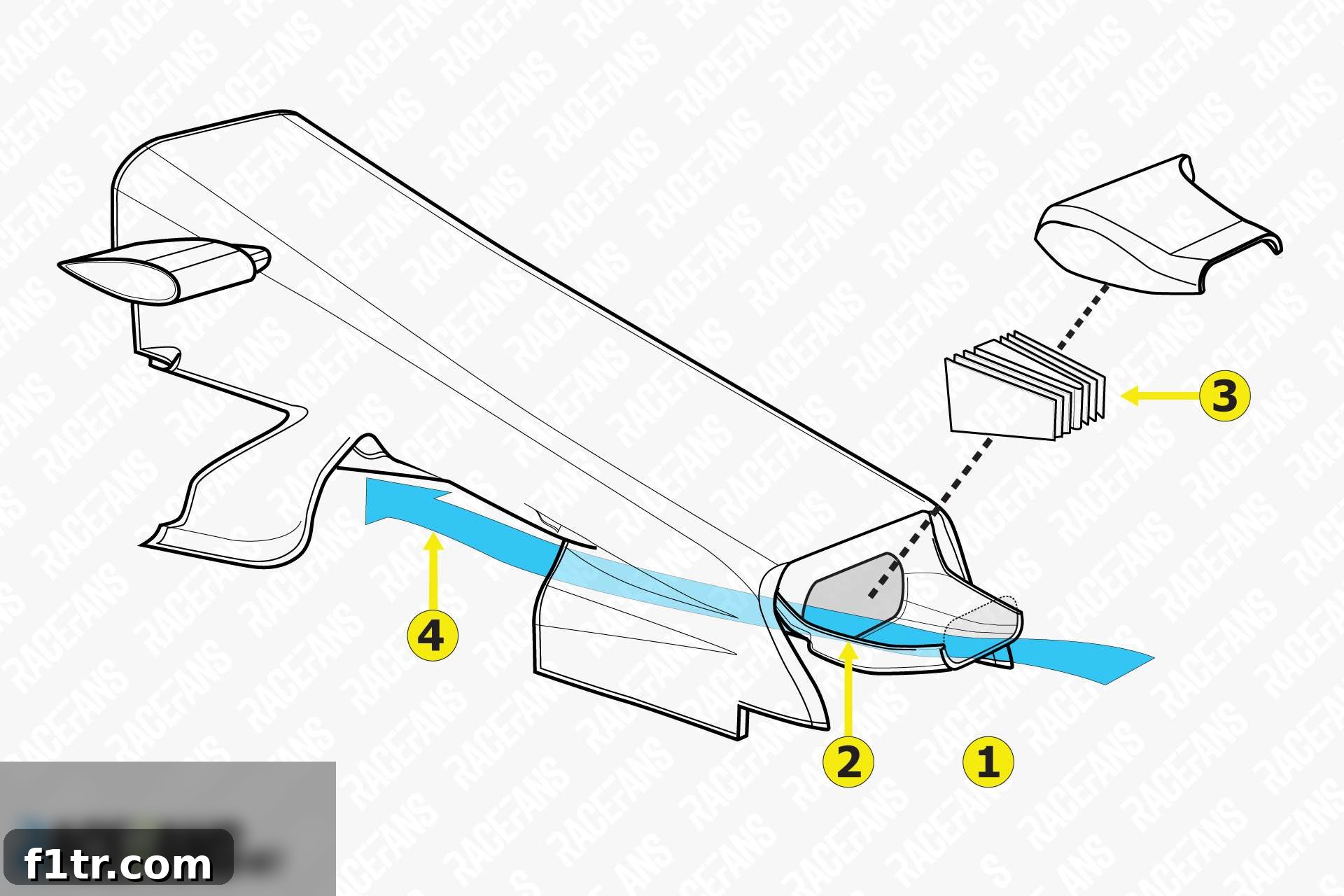
Red Bull’s innovative “nose hole” provided an elegant solution. By designing an open tip, they could still conform to the required height and minimum cross-section rules, while simultaneously allowing air to flow freely through the middle of this area. In technical diagrams, this open tip (often labeled ‘1’) demonstrated how air (typically depicted in blue) could pass through the internal channel and exit via a carefully positioned outlet (labeled ‘2’) located just beneath the nose structure. This ingenious internal ducting was crucial for the car’s overall aerodynamic performance.
The primary purpose of this ducted airflow was to effectively “clear” the aerodynamic blockage created by the nose tip, thereby ensuring a smoother and more consistent flow of air over the critical central section of the front wing. Furthermore, this improved airflow had cascading benefits. It led to cleaner, less turbulent air passing up and under the nose’s surface. This, in turn, prevented the build-up of stagnant airflow and the formation of a detrimental boundary layer on the underside of the nose. A clean boundary layer is paramount, as it allows subsequent aerodynamic elements like the turning vanes and bargeboards to operate with maximum effectiveness. Ultimately, this intricate interplay significantly enhanced the car’s overall aerodynamic efficiency and downforce generation.
Deep dive into F1 technology and support independent journalism.
Unlock More F1 Insights
Your support helps us deliver in-depth analysis and exclusive content.
Become a RaceFans Supporter Today!
Navigating the Regulatory Maze: The Single-Open-Section Rule
The design of the “nose hole” presented a significant challenge due to the existence of the “single-open-section regulation.” This specific rule was introduced in 2009, largely as a direct response to Ferrari’s 2008 car, which had featured a duct passing up through the nose from below, providing an aerodynamic advantage. The regulation was intended to prevent any form of internal ducting that created a visible passage through the nose. However, like many complex rules in F1, a loophole was discovered and exploited by astute design teams.
The critical loophole to the single-section rule states that if a team can arrange internal bodywork within the hole in such a way that it prevents a clear, unobstructed view directly through the opening, then the design is deemed legal. This clever interpretation has been utilized by several teams in varying forms. Racing Point famously employed this with its ducted nose, and subsequently, Alfa Romeo and McLaren adopted similar concepts, each with their own unique interpretation of the internal vanes. Red Bull’s specific solution to satisfy this regulation involved a series of intricately designed vanes (labeled ‘3’ in internal diagrams) positioned inside the nose opening. Each vane was precisely angled and offset from the next, meticulously engineered to allow air to pass through unimpeded, yet crucially, no clear opening was visible when viewed head-on, thus complying with the letter of the law.
The decision to block off this long-standing, complex nose hole for Monaco raises pertinent questions about Red Bull’s aerodynamic strategy. Is this merely a “Monaco special” arrangement, specifically tailored to the unique demands of the street circuit? It’s plausible that a closed nose generates a distinct airflow profile for the front wing, potentially offering advantages in the low-speed, high-downforce environment of Monaco. Alternatively, if this closed nose configuration persists for upcoming races such as Canada and beyond, it could indicate a more fundamental shift in their design philosophy. It might suggest that Red Bull has discovered that a streamlined, albeit more obstructive, solid nose performs more effectively than the more intricate, inner-vaned open nose, potentially simplifying the airflow and reducing drag on faster circuits. This remains a key area of observation for F1 enthusiasts and analysts alike.
Support independent F1 analysis and go ad-free.
Exclusive F1 Content
Get in-depth articles, analysis, and an ad-free viewing experience.
Join Our Community >>
The Strategic Adoption of Floor Edge Fins: A Ferrari-Inspired Innovation
Beyond the intriguing changes to the nose, the RB15 in Monaco also sported significant new aerodynamic furniture along its floor’s edge. These distinctive fins represent a fascinating example of competitive iteration in Formula 1. Similar floor fins were initially a pioneering innovation by Ferrari. When the Scuderia introduced them in the previous season, they quickly demonstrated their aerodynamic potential, prompting rival teams, including Red Bull, to react swiftly. Red Bull, known for their rapid prototyping capabilities, were observed testing 3D-printed versions of similar parts at subsequent races, a clear indication of their recognition of Ferrari’s ingenuity and their commitment to exploring every performance avenue.
Throughout the current 2019 season, Ferrari had been incrementally multiplying the number and complexity of these fins along their floor edge, continually refining their effectiveness. Now, Red Bull has followed suit, introducing a prominent row of four fins (labeled ‘1’ in accompanying diagrams) specifically for the Monaco Grand Prix. These fins are not standalone elements; they are meticulously designed to work in concert with the floor edge itself, and particularly with the subtly rolled edge of the floor (labeled ‘2’). This entire area is hyper-critical for controlling the complex airflow beneath the car, a region where even minor disturbances can have significant performance implications.
The Science Behind Outwash: How Floor Fins Enhance Performance
The primary function of these floor edge fins is multifaceted. They are instrumental in controlling the airflow under the floor, which is vital for generating the maximum possible downforce from this often-unseen part of the car. Additionally, these fins play a crucial role in actively directing some of the airflow back out from the edge of the floor. This directed expulsion of air creates what is known as “outwash.” Outwash is a highly sought-after aerodynamic phenomenon; it refers to the strategic manipulation of airflow to push the turbulent wake generated by the spinning front tires away from the sensitive rear of the car. By doing so, outwash significantly improves the operational efficiency and overall performance of the diffuser and the rear wing – two of the most potent downforce-generating elements on a Formula 1 car.
The importance of developing this floor edge area has grown exponentially, especially in the wake of the 2019 regulatory restrictions imposed on front wing design. With less freedom to generate outwash directly from the front wing due to simplified designs, teams have shifted their focus to other areas of the car to achieve similar aerodynamic benefits. The floor edge has emerged as an increasingly fertile ground for intensive development. Crucially, the current aerodynamic regulations offer relatively liberal freedom for the use of these fins, stipulating only that they must not extend more than 5cm above the reference plane of the floor. This flexibility has allowed engineers to unleash their creativity in this area.
Red Bull’s newly adopted fins function primarily as sophisticated vortex generators. They are activated by the air parting around the car’s body and flowing over the lower leading edge of the floor. As this air interacts with the precisely shaped fins, it generates miniature, high-energy vortices. These vortices work synergistically with the scrolled floor edge, effectively sealing the underfloor area. This sealing action is critical as it enhances the Y250 airflow – the region of airflow under the car’s central tunnel – thereby creating a more powerful, low-pressure area that generates significant downforce. Furthermore, these vortices actively contribute to the outwash effect, powerfully pushing the “dirty” turbulent air, specifically the front tire wake, away from the car’s rear, optimizing the performance of the crucial diffuser and rear wing assembly.
Go ad-free for just £1 per month>> Find out more and sign up
More F1 Technology & Aerodynamics Insights
Stay ahead with the latest in Formula 1 innovation and design:
- McLaren, Red Bull and Ferrari bring rear corner updates to Imola
- Ferrari, McLaren and Red Bull bring upgrades again for Saudi Arabian Grand Prix
- McLaren introduce major floor upgrade for Norris’ car at Mexican Grand Prix
- McLaren, Mercedes and Red Bull detail upgrade packages for United States GP
- Red Bull remove engine cover ‘cannons’ in major RB20 update – but they may return
Browse all F1 technology articles