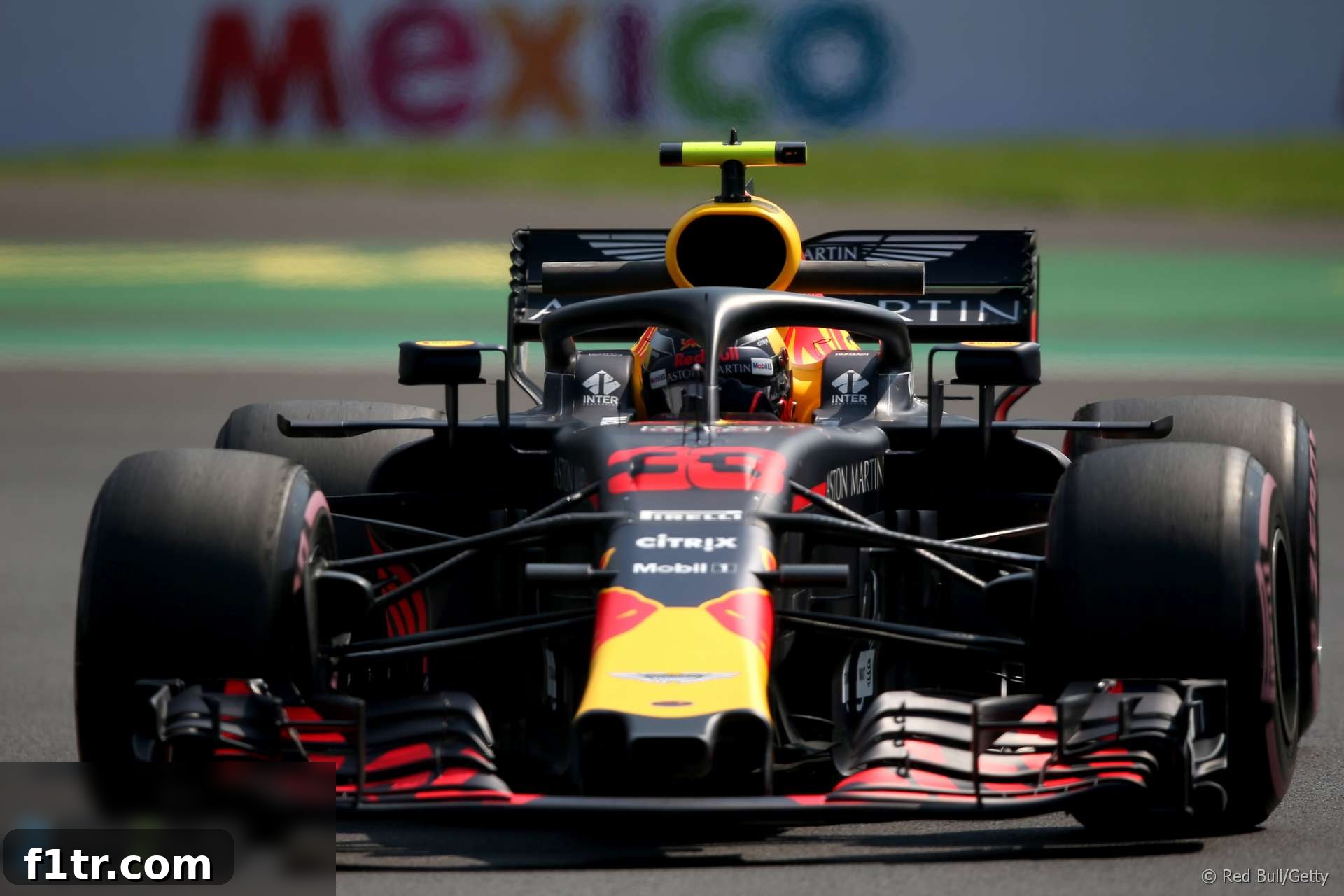
Max Verstappen continued his dominant form at the Autódromo Hermanos Rodríguez, topping the final practice session for the Mexico Grand Prix. This marked his third consecutive session at the pinnacle of the time sheets, underscoring Red Bull Racing’s formidable performance at the high-altitude circuit and setting a strong precedent for the upcoming qualifying session.
Advert | Become a Supporter & go ad-free
Verstappen’s blistering pace saw him set a best time of 1 minute 16.284 seconds, a remarkable lap that effectively shaved two-tenths of a second off the existing track record for the Autódromo Hermanos Rodríguez. His consistent speed throughout all three practice sessions firmly establishes him and Red Bull as strong contenders for pole position and, crucially, for the race victory. The unique characteristics of the Mexican track, with its high altitude reducing air density and impacting engine power and aerodynamic grip, seem to perfectly suit Red Bull’s chassis and aerodynamic package, allowing Verstappen to extract maximum performance.
Championship Battle Intensifies as Rivals Close In for Qualifying
For the first time this weekend, it wasn’t his Red Bull teammate Daniel Ricciardo who secured the second-fastest lap, but rather championship leader Lewis Hamilton. The Mercedes driver showcased significant improvement, demonstrating his relentless pursuit of performance and his desire to secure his fifth World Championship in style. Hamilton set his best time on his second flying effort using a set of hyper-soft tyres, indicating Mercedes’ diligent efforts to optimize their W09 in these challenging conditions and refine their strategy for Saturday’s crucial qualifying.
Just a mere two-hundredths of a second slower than his championship rival, Sebastian Vettel placed his Ferrari in a highly competitive third position. This tight grouping at the very front of the grid, featuring three different manufacturers, signals an enthralling qualifying session ahead. The minimal time differences suggest that pole position could be decided by the smallest of margins, with all three drivers pushing their machines to the absolute limit. Both Hamilton and Vettel are acutely aware that every fraction of a second will matter immensely as they vie for strategic grid positions, which could prove decisive in the race.
Mercedes Faces Setback with Valtteri Bottas’s Hydraulic Issue
However, the final practice session wasn’t without its significant concerns for the Mercedes camp. Valtteri Bottas was unfortunately forced to bring his car to a premature halt due to a hydraulic problem. This technical glitch occurred before he was able to set a truly representative lap time, curtailing valuable data collection and fine-tuning for his car. This incident is a considerable blow for Mercedes, especially given the high-stress environment of the Autódromo Hermanos Rodríguez, where car reliability and optimal setup are paramount. Such mechanical issues can have ripple effects, potentially impacting the team’s overall strategy and confidence heading into qualifying and the race. The team will undoubtedly be working tirelessly to diagnose and rectify the issue, hoping it doesn’t translate into penalties or compromise their Sunday performance. Bottas’s limited running also means fewer opportunities for long-run simulations for tyre degradation analysis, a critical aspect of race strategy in Mexico’s demanding conditions.
In Bottas’s absence from the top of the time sheets, Kimi Raikkonen secured fifth place, further demonstrating Ferrari’s consistent front-running pace and their ability to extract performance from the SF71H. The session also saw impressive performances from several midfield teams, with both Saubers and both Renaults managing to break into the top ten, showcasing the intense competitiveness beyond the top three teams. Charles Leclerc and Marcus Ericsson for Sauber, along with Carlos Sainz Jnr and Nico Hulkenberg for Renault, capitalized on the evolving track conditions to put in strong laps, fighting for the “best of the rest” title. Pierre Gasly also continued to showcase the potential of his Toro Rosso-Honda package, clinching eighth place in a highly competitive midfield, highlighting the progress made by the Honda power unit. These midfield battles are crucial for constructor points and often provide some of the most exciting on-track action.
Early Session Challenges: Damp Track and Technical Glitches Affect Preparations
The final practice session began under challenging conditions, with the track damp from earlier rain, making it treacherous for drivers. For the initial half-hour, most teams opted for single installation laps, cautiously waiting for the circuit to dry out and rubber in. This limited early running further compressed the already tight FP3 schedule, adding considerable pressure on teams to gather crucial setup data and complete tyre evaluations within a condensed timeframe. The dampness meant drivers had to manage grip levels meticulously, especially on the slick hyper-soft and ultra-soft compounds, which are sensitive to temperature and moisture.
Adding to the early session drama, Kevin Magnussen failed to set a time due to an unscheduled intercooler change, which sidelined his Haas for a significant portion of the session. Such technical interruptions during practice are always unwelcome, as they severely limit a driver’s preparation for qualifying and the race, impacting their ability to find a rhythm and achieve an optimal car balance. Haas will be working diligently to ensure Magnussen is ready for qualifying, where every millisecond counts, hoping this issue does not recur. This lost track time can be particularly detrimental on a circuit like Mexico, where unique altitude conditions demand extensive setup refinement.
Advert | Become a RaceFans supporter andgo ad-free
Mexico Grand Prix Free Practice 3 Results: A Detailed Look at the Timesheets
The final practice session offered a clear glimpse into the potential pecking order ahead of qualifying. Max Verstappen’s dominant performance was a strong statement, but the minimal gaps to Hamilton and Vettel suggest that Red Bull, Mercedes, and Ferrari are all within striking distance for pole position. The high altitude of Mexico City, sitting over 2,200 meters (7,300 feet) above sea level, significantly impacts engine performance, downforce generation, and aerodynamic efficiency. These unique conditions often level the playing field and can lead to unexpected results, where teams must strike a delicate balance between maximizing downforce and minimizing drag. Red Bull appears to have mastered this particular challenge this weekend, giving them a slight edge.
| Pos. | No. | Driver | Car | Best lap | Gap | Laps |
|---|---|---|---|---|---|---|
| 1 | 33 | Max Verstappen | Red Bull-TAG Heuer | 1’16.284 | 9 | |
| 2 | 44 | Lewis Hamilton | Mercedes | 1’16.538 | 0.254 | 9 |
| 3 | 5 | Sebastian Vettel | Ferrari | 1’16.566 | 0.282 | 11 |
| 4 | 3 | Daniel Ricciardo | Red Bull-TAG Heuer | 1’17.028 | 0.744 | 7 |
| 5 | 7 | Kimi Raikkonen | Ferrari | 1’17.045 | 0.761 | 16 |
| 6 | 16 | Charles Leclerc | Sauber-Ferrari | 1’17.059 | 0.775 | 13 |
| 7 | 55 | Carlos Sainz Jnr | Renault | 1’17.336 | 1.052 | 11 |
| 8 | 10 | Pierre Gasly | Toro Rosso-Honda | 1’17.525 | 1.241 | 16 |
| 9 | 9 | Marcus Ericsson | Sauber-Ferrari | 1’17.565 | 1.281 | 14 |
| 10 | 27 | Nico Hulkenberg | Renault | 1’17.623 | 1.339 | 10 |
| 11 | 31 | Esteban Ocon | Force India-Mercedes | 1’17.731 | 1.447 | 10 |
| 12 | 11 | Sergio Perez | Force India-Mercedes | 1’17.819 | 1.535 | 10 |
| 13 | 8 | Romain Grosjean | Haas-Ferrari | 1’18.145 | 1.861 | 10 |
| 14 | 2 | Stoffel Vandoorne | McLaren-Renault | 1’18.445 | 2.161 | 15 |
| 15 | 14 | Fernando Alonso | McLaren-Renault | 1’18.548 | 2.264 | 11 |
| 16 | 28 | Brendon Hartley | Toro Rosso-Honda | 1’18.637 | 2.353 | 10 |
| 17 | 35 | Sergey Sirotkin | Williams-Mercedes | 1’18.669 | 2.385 | 9 |
| 18 | 18 | Lance Stroll | Williams-Mercedes | 1’18.698 | 2.414 | 8 |
| 19 | 77 | Valtteri Bottas | Mercedes | 1’18.839 | 2.555 | 5 |
| 20 | 20 | Kevin Magnussen | Haas-Ferrari |
Advert | Become a RaceFans supporter andgo ad-free
Analyzing the Time Gaps in Third Practice: The Margins That Matter
The gaps between drivers in FP3 reveal a session that was closely contested, particularly at the very front. Max Verstappen’s impressive lead of 0.254 seconds over Lewis Hamilton, and 0.282 seconds over Sebastian Vettel, clearly highlights his individual advantage and Red Bull’s strong package. However, these margins are narrow enough to ensure that pole position remains very much an open contest. Daniel Ricciardo, despite slipping to fourth, was still within 0.744 seconds of his teammate, suggesting Red Bull’s overall strength with both cars.
Further down the order, the midfield remains incredibly tight, promising exciting qualifying battles. Kimi Raikkonen (0.761s gap) was narrowly ahead of Charles Leclerc (0.775s), showcasing the fierce competition for points and higher grid positions. Carlos Sainz Jnr (1.052s) and Pierre Gasly (1.241s) also demonstrated competitive pace within their respective teams, proving the gains made by Renault and Toro Rosso-Honda. The significant gap of 2.555 seconds for Valtteri Bottas, due to his technical issues, unfortunately places him at a considerable disadvantage heading into qualifying. These razor-thin margins emphasize the critical importance of every fraction of a second on this challenging and unforgiving circuit.
Combined Practice Times: A Comprehensive Weekend Overview
Reviewing the combined practice times from FP1, FP2, and FP3 offers a comprehensive overview of the teams’ progress and underlying pace throughout the Mexico Grand Prix weekend. Max Verstappen’s consistent improvement, culminating in his dominant FP3 time, clearly marks Red Bull as the team to beat heading into qualifying. His best time of 1’16.284, significantly faster than his previous two sessions, indicates successful setup optimization and a growing confidence with the track conditions.
| Pos | Driver | Car | FP1 | FP2 | FP3 | Fri/Sat diff | Total laps |
|---|---|---|---|---|---|---|---|
| 1 | Max Verstappen | Red Bull-TAG Heuer | 1’16.656 | 1’16.720 | 1’16.284 | -0.372 | 49 |
| 2 | Lewis Hamilton | Mercedes | 1’18.075 | 1’18.100 | 1’16.538 | -1.537 | 72 |
| 3 | Sebastian Vettel | Ferrari | 1’18.746 | 1’17.954 | 1’16.566 | -1.388 | 70 |
| 4 | Daniel Ricciardo | Red Bull-TAG Heuer | 1’17.139 | 1’16.873 | 1’17.028 | +0.155 | 58 |
| 5 | Kimi Raikkonen | Ferrari | 1’18.936 | 1’18.133 | 1’17.045 | -1.088 | 80 |
| 6 | Charles Leclerc | Sauber-Ferrari | 1’19.024 | 1’17.059 | -1.965 | 52 | |
| 7 | Carlos Sainz Jnr | Renault | 1’17.926 | 1’17.953 | 1’17.336 | -0.59 | 66 |
| 8 | Pierre Gasly | Toro Rosso-Honda | 1’19.047 | 1’17.525 | -1.522 | 54 | |
| 9 | Marcus Ericsson | Sauber-Ferrari | 1’19.312 | 1’19.322 | 1’17.565 | -1.747 | 83 |
| 10 | Nico Hulkenberg | Renault | 1’18.028 | 1’18.046 | 1’17.623 | -0.405 | 67 |
| 11 | Esteban Ocon | Force India-Mercedes | 1’18.485 | 1’17.731 | -0.754 | 34 | |
| 12 | Sergio Perez | Force India-Mercedes | 1’19.124 | 1’18.167 | 1’17.819 | -0.348 | 63 |
| 13 | Brendon Hartley | Toro Rosso-Honda | 1’19.024 | 1’18.061 | 1’18.637 | +0.576 | 74 |
| 14 | Valtteri Bottas | Mercedes | 1’18.322 | 1’18.140 | 1’18.839 | +0.699 | 72 |
| 15 | Romain Grosjean | Haas-Ferrari | 1’19.276 | 1’18.733 | 1’18.145 | -0.588 | 75 |
| 16 | Stoffel Vandoorne | McLaren-Renault | 1’19.716 | 1’19.096 | 1’18.445 | -0.651 | 74 |
| 17 | Fernando Alonso | McLaren-Renault | 1’19.543 | 1’18.548 | -0.995 | 42 | |
| 18 | Sergey Sirotkin | Williams-Mercedes | 1’19.899 | 1’19.335 | 1’18.669 | -0.666 | 76 |
| 19 | Lance Stroll | Williams-Mercedes | 1’20.142 | 1’19.219 | 1’18.698 | -0.521 | 59 |
| 20 | Nicholas Latifi | Force India-Mercedes | 1’19.078 | 23 | |||
| 21 | Antonio Giovinazzi | Sauber-Ferrari | 1’19.134 | 25 | |||
| 22 | Lando Norris | McLaren-Renault | 1’19.646 | 23 | |||
| 23 | Kevin Magnussen | Haas-Ferrari | 1’19.853 | 1’19.670 | 64 |
Hamilton and Vettel also showed significant gains in FP3 compared to their earlier runs, indicating that they found a better car balance and improved grip as the track evolved. The “Fri/Sat diff” column particularly highlights how much faster drivers were in FP3 compared to their best Friday time, with Hamilton and Leclerc showing some of the largest improvements. This suggests successful setup changes, increased track confidence, or simply the natural evolution of the track surface. The total laps completed also provides crucial insight into how much track time each driver managed, which is particularly relevant for those who faced issues, such as Bottas and Magnussen, as less running can significantly compromise their preparation.
What to Expect from Qualifying: A Battle for Pole Position
Given the highly competitive results of FP3, qualifying for the Mexico Grand Prix promises to be an enthralling session. Max Verstappen enters as the undeniable favorite, having dominated all practice sessions. However, the close margins to Hamilton and Vettel mean that pole position is far from a certainty, and any minor error could cost a driver dearly. Tyre strategy will be paramount, with teams needing to make critical decisions regarding whether to use the hyper-softs or ultra-softs for their Q2 runs to dictate their race start tyres. The high-altitude environment often leads to increased tyre degradation, making this strategic choice even more critical for Sunday’s Grand Prix.
The midfield fight for Q3 spots will also be incredibly intense. Drivers from Sauber, Renault, and Force India have all shown flashes of impressive pace, and with just a few tenths separating them, any small mistake or perfectly executed lap could make the difference between a top-ten start and being eliminated earlier. Home hero Sergio Perez will undoubtedly be pushing his Force India to the limit, hoping to secure a strong grid position for his enthusiastic local fans. The unpredictable nature of the Autódromo Hermanos Rodríguez, combined with the extreme grip from the hyper-soft tyres, sets the stage for a dramatic qualifying session where raw speed, precision, and strategic tyre management will be richly rewarded. The battle for pole position and the subsequent grid advantage will be one to watch closely.
Drivers more than ten seconds off the pace are omitted from the above detailed analysis, but are represented in the full results table where applicable.
Go ad-free for just £1 per month>> Find out more and sign up
2018 Mexican Grand Prix
- “These tyres are a disgrace for F1”: Over 300 Mexican GP team radio messages
- Verstappen breaks record for most wins without a pole
- 2018 Mexican Grand Prix Star Performers
- Top ten pictures from the 2018 Mexican Grand Prix
- Verstappen’s win, Hamilton’s title in tyre-dominated Mexican GP
Browse all 2018 Mexican Grand Prix articles