In the high-stakes world of Formula 1, converting pole position into victory is the ultimate testament to a driver’s raw speed and strategic prowess. For McLaren’s sensational talent, Lando Norris, however, the inability to maintain his lead from the front of the grid had, for much of the 2024 season, become a persistent and disheartening narrative. This recurring failure weighed heavily, a palpable statistical millstone around his neck, as the Formula 1 circus descended upon Singapore for the 18th round of a fiercely contested championship.
Singapore marked the sixth time this year Norris had secured the coveted pole position. The press conferences were predictably dominated by questions regarding his chances of finally translating his qualifying brilliance into a race lead beyond the first corner. The pressure was immense, not just from the media, but from within himself and his team, who knew the immense potential residing in their young star.
Then, in Singapore, he did it. The moment the red lights extinguished, Norris executed a near-perfect getaway, dropping the clutch with precision. He surged forward, keeping a crucial car’s length ahead of his closest and most formidable rival, Max Verstappen. Sweeping into Turn 1 with a decisive advantage, he maintained control throughout the race, ultimately claiming his third Grand Prix victory of the season. It was a victory that felt like a breakthrough, a significant psychological barrier overcome, sparking hopes that Norris had finally unlocked the secret to commanding the race from pole.
The euphoria, however, proved tragically short-lived. Just weeks later, in the vibrant motorsport hub of Austin, Texas, for the United States Grand Prix, those burgeoning hopes for McLaren and Norris were unceremoniously shattered. The promising trend established in Singapore failed to materialize, leaving fans and the team alike pondering what went wrong after another pole position was relinquished.
Throughout much of the 2024 Formula 1 season, Norris’s starts had been plagued by an inconsistent initial getaway. This recurring weakness often allowed rivals to draw alongside him from second on the grid, capitalizing on any momentary hesitation. Such instances were notably observed with Max Verstappen in the Spanish and Dutch Grands Prix, and with Lewis Hamilton during the Shanghai sprint race. These early concessions highlighted a crucial area for improvement, one that Norris and the McLaren team had been intensely focusing on in their quest for consistent performance.
Indeed, a noticeable and much-welcomed improvement in his initial getaway had been evident in his three most recent pole starts leading up to the Austin event. At Monza, he delivered a strong initial launch, only to be outmaneuvered by his resourceful teammate, Oscar Piastri, at the demanding second chicane. Then, in Singapore, he successfully held his advantage, securing that hard-fought victory and silencing his critics, albeit temporarily. This suggested a positive trajectory, a refinement in his starting procedure that many believed would now consistently yield results and bolster his championship challenge.
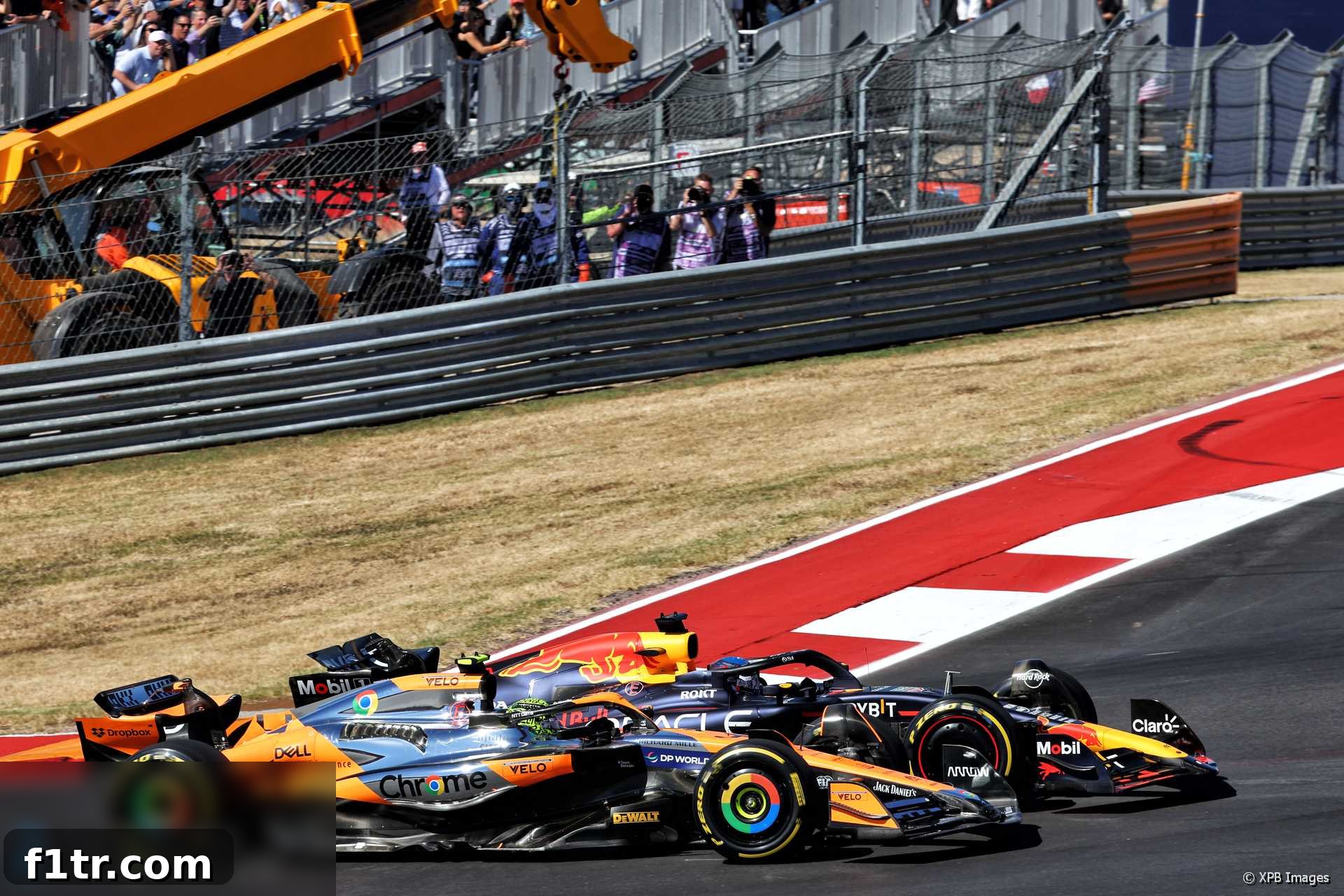
Yet, in Austin, Norris threw away arguably his most hard-won pole position of the season, despite having executed a perfectly respectable getaway off the line. This wasn’t a case of a sluggish launch, a common culprit in his past misfortunes, but rather a strategic misjudgment in the crucial opening metres of the race. What made this particular lapse even more painful was the fact that he surrendered a precious advantage directly to the championship leader, Max Verstappen, at a critical juncture in the season where every single point could prove decisive for his own title aspirations and McLaren’s constructors’ championship hopes.
The context of Norris’s Austin pole position makes his subsequent loss of the lead all the more perplexing and frustrating. Max Verstappen, renowned for his qualifying prowess and often the benchmark for speed, had been the overwhelming favourite for pole in Q3 the day prior. However, Norris delivered a masterful lap, a brilliant combination of exceptional driving skill and a touch of good fortune. His first run in Q3 was impeccably clean, extracting maximum performance from the McLaren MCL38, while Verstappen made a rare error, missing the apex at Turn 19. Subsequently, neither driver could improve on their second runs due to the yellow flags triggered by George Russell’s incident, effectively sealing Norris’s pole position. This hard-earned grid slot was a testament to his innate talent and the McLaren car’s impressive pace, amplifying the disappointment of the lost lead.
Starting from pole position in Formula 1 offers a myriad of strategic advantages, fundamentally influencing a driver’s race outcome. Foremost among these is the invaluable benefit of running in clear, undisturbed air. This is particularly vital given the sensitive nature of Pirelli’s Formula 1 tires, which perform optimally when not subjected to the turbulent, performance-degrading wake of a preceding car. Moreover, both front-row occupants, Norris and Verstappen, were acutely aware that the two potent Ferraris of Charles Leclerc and Carlos Sainz lurking directly behind them posed a serious and immediate threat to their track position, ready to pounce on any early mistakes. Given these considerable advantages and the known threats, Norris’s subsequent course of action after his clean getaway in Austin appears, in retrospect, all the more baffling and strategically unsound.
A stark and instructive lesson in how to effectively defend a pole position advantage had been offered just a year prior, during the sprint race at the very same Circuit of the Americas. In that instance, Max Verstappen, starting from pole, demonstrated precisely how to retain control from a decent initial start. He immediately moved across to the inside line, aggressively but fairly preventing Charles Leclerc from taking the optimal path into Turn 1. Crucially, Verstappen understood that sacrificing a fraction of his own corner speed by compromising his racing line was a small, acceptable price to pay for retaining the lead and dictating the race tempo and strategy from the front.
Norris, it would seem, had not taken sufficient note of this crucial defensive manoeuvre, or perhaps simply failed to execute it with the necessary conviction. After showing Verstappen a clean pair of heels off the line with his improved getaway, he began a gradual drift to the left, moving towards the inside line. However, this movement was executed far too slowly and without the decisive commitment required to effectively block Verstappen’s inexorable advance. The margin of error in F1 is minuscule, particularly in the opening corners, and such a tentative defence is an open invitation for a driver of Verstappen’s calibre and aggression.
Verstappen, ever the opportunist and a master of race craft, was always going to seize such an evident opportunity. He not only used Norris’s indecision and conservative line to surge past him for the lead but also deftly forced the McLaren wide, compromising Norris’s exit and leaving him dangerously vulnerable to the Ferraris charging hard from behind. This is precisely what unfolded, as both Leclerc and Sainz capitalized on Norris’s compromised position, relegating him further down the order from pole. The initial hopes of a Singapore repeat dissolved instantly, replaced by the familiar sting of lost track position.
An hour later, as Norris engaged in a relentless, lap-after-lap battle to try and wrest third place from Verstappen’s clutches – a battle ultimately complicated by a controversial penalty – he must have been consumed by regret at having surrendered the lead so cheaply at the very start. While McLaren later expressed fury at the stewards’ decision to penalize Norris, depriving him of a potential podium finish, it is arguable that the team should be equally unimpressed, if not more so, with the initial strategic miscalculation in driving that cost them the position in the first place. The penalty was a compounding factor, but the fundamental root cause of the lost opportunity lay squarely in the opening moments of the race, a lesson McLaren and Norris must absorb for future campaigns.
How Norris Lost the Lead from Pole Six Times This Year: A Detailed Look at Missed Opportunities
China Sprint Race: Shanghai Shocker
The Chinese Grand Prix sprint race saw Lewis Hamilton, starting from second, get a significantly better launch off the line than Norris. Norris attempted an ambitious manoeuvre around the outside of Turn 1, a high-risk strategy often difficult to execute from pole without adequate defence. This attempt backfired badly; instead of holding position, he lost multiple places, plummeting down to seventh. This early misjudgment effectively ended his hopes of a strong sprint race result, setting a worrying precedent for his pole position conversions and highlighting the need for a more conservative, defensive approach.
Spanish Grand Prix: Barcelona Bypass
At the Circuit de Barcelona-Catalunya, Norris again found himself unable to defend his hard-earned pole. Max Verstappen capitalized on a clear run down the inside, easily getting alongside Norris. However, the most impressive move of the opening lap came from George Russell in the Mercedes, who executed a spectacular sweep around the outside of both Norris and Verstappen. Russell’s audacious manoeuvre, perfectly judged and demonstrating exceptional car control, highlighted Norris’s failure to command the track in the critical first corner, allowing two rivals to pass him in one fell swoop, compounding the loss of the lead to Verstappen.
Hungarian Grand Prix: Hungaroring Hook
The Hungarian Grand Prix presented another frustrating scenario. Norris lost the initial lead not to a rival, but to his own teammate, Oscar Piastri, who made a more aggressive start. Adding insult to injury, Max Verstappen then tactically utilized the run-off area to get ahead of Norris, gaining a crucial advantage over his championship rival. While Red Bull later advised Verstappen to relinquish the place due to the clear breach of track limits, the incident underscored Norris’s consistent difficulty in consolidating his pole position advantage against aggressive competitors and even his own teammate, necessitating a stronger, clearer defensive strategy.
Dutch Grand Prix: Zandvoort Slip
The lights-out moment at Zandvoort left no room for doubt: Max Verstappen had made a superior start to Norris, demonstrating a better reaction time and traction. The reigning champion effortlessly surged into the lead, leaving the McLaren driver struggling to regain momentum. Despite this initial setback, Norris displayed impressive resilience later in the race, managing to re-pass Verstappen in a captivating battle, showcasing his race pace. However, the recurring issue of failing to defend pole position at the very beginning of the race remained a stark concern, forcing him to fight harder for positions that should have been his by right of qualifying and initial track position.
Italian Grand Prix: Monza Mayhem
Monza’s high-speed Temple of Speed witnessed another pole position escape from Norris. He seemed to have done the hard work, accelerating out of the Rettifilo chicane marginally ahead of his teammate, Oscar Piastri, having managed the initial getaway well. Yet, at the very next challenge, the Roggia chicane, Piastri launched a decisive and well-executed move, snatching the lead from Norris. To compound Norris’s woes, Charles Leclerc also capitalized on the situation, expertly nabbing second place off him for good measure, further emphasizing Norris’s defensive frailties in those critical opening corners. This was a particularly bitter pill, losing out to his own teammate for the lead at a crucial track.
United States Grand Prix: COTA Catastrophe
The most recent and perhaps most frustrating instance occurred at the Circuit of the Americas. Norris executed a perfectly decent initial getaway, avoiding the bog-down issues of previous races. However, what followed was a naive and costly failure to adequately cover the inside line into Turn 1. He left the door ajar for Max Verstappen, a driver who, with his unparalleled aggression and opportunism, was always going to exploit such an opening. This strategic misstep at the critical first corner allowed Verstappen to seize the lead effortlessly, initiating a cascade of events that ultimately cost Norris a potential podium finish, highlighting a persistent learning curve in race start strategy and execution despite improvements in his initial launch.
The consistent pattern of Lando Norris securing pole position only to lose the lead in the opening stages of the race has become a significant talking point in Formula 1 circles. While his raw speed and qualifying talent are undeniably world-class, his struggles to convert these prime starting positions into immediate race leadership highlight a crucial area for development. Each missed opportunity represents not just lost points in a fiercely competitive championship, but also a dent in psychological momentum and a greater challenge to secure the ultimate prize of a Grand Prix victory or even a championship title.
For McLaren, harnessing Norris’s exceptional qualifying pace with a robust and foolproof race start strategy is paramount. The difference between winning and fighting through the pack often hinges on those first few hundred metres, where track position can be won or lost in an instant. As Norris continues his journey towards becoming a consistent front-runner and potentially a Formula 1 world champion, mastering the art of defending pole position will be as critical as the speed that gets him there in the first place. The Singapore victory proved he has the capability and mental fortitude to succeed; the subsequent races, particularly Austin, underscore the inconsistency and the work still required to make it a regular occurrence. The fight for track position from the very first corner is a high-stakes chess match, and Norris must learn to play his opening move flawlessly, consistently sealing off the tactical avenues for his rivals, especially the likes of Max Verstappen, to truly maximize his potential.
2024 United States Grand Prix Articles: Further Reading and Analysis
- McLaren Insist Stewards Made ‘Provable Error’ After Losing Bid For Review Of Norris’ Penalty
- Why McLaren’s Focus On Verstappen’s Driving Failed To Overturn Norris’ Penalty
- Stewards Reject McLaren’s Request To Review Norris’ United States GP Penalty
- McLaren Know Norris’ Penalty Is Likely To Stand – So What Do They Hope To Gain?
- McLaren Request Review Of Norris’ Penalty For Off-Track Pass On Verstappen
Browse all 2024 United States Grand Prix articles