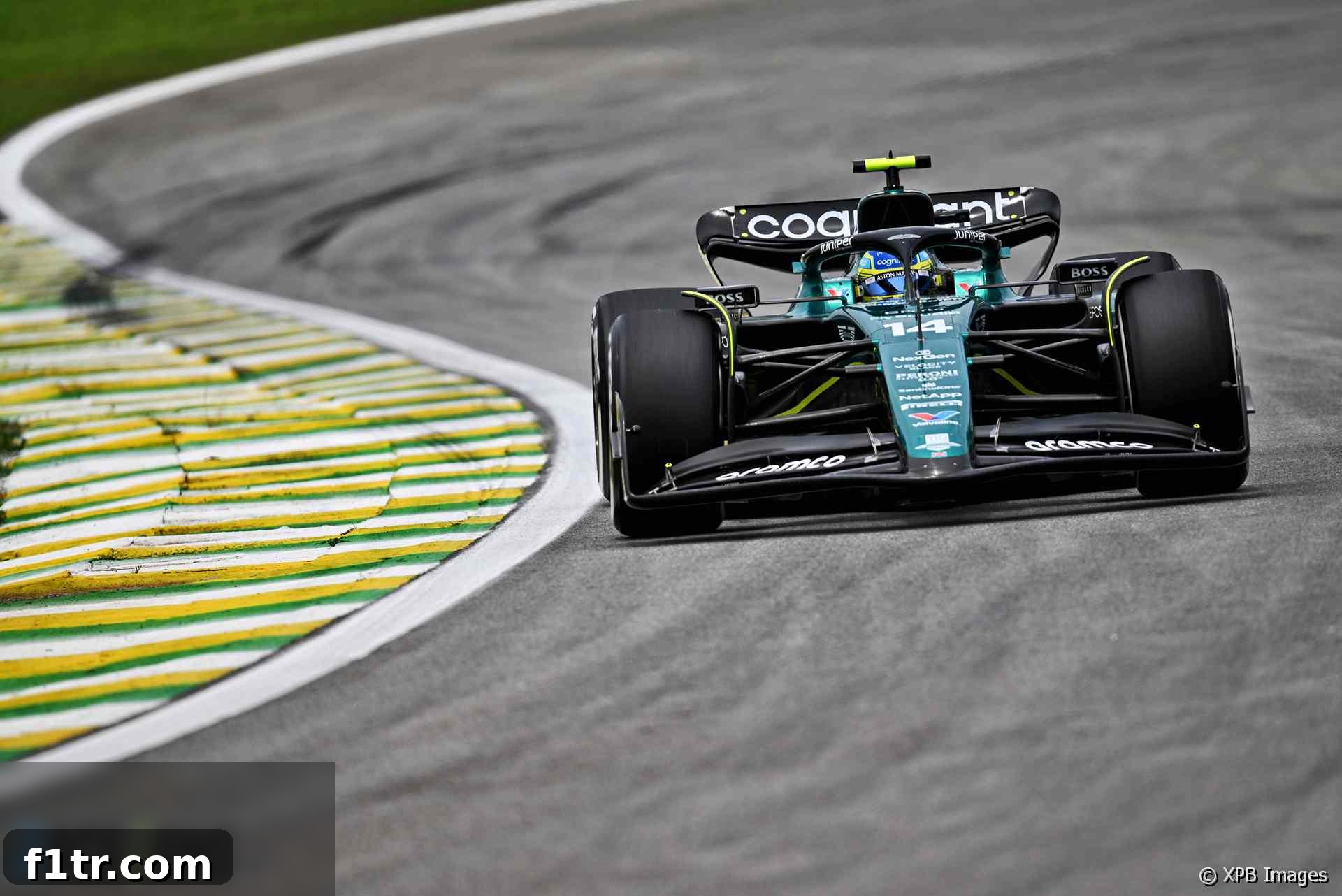
In a tense start to the Brazilian Grand Prix weekend, Formula 1 officials were compelled to delay today’s crucial qualifying session, a decision prompted by alarming reports of tyre punctures and significant track debris during the preceding free practice. This unexpected setback at the iconic Interlagos circuit underscores the ever-present safety challenges in motorsport and the meticulous preparations required for top-tier racing, highlighting the FIA’s unwavering commitment to driver well-being amidst competitive pressures.
The incident unfolded during the single hour of practice, a compressed schedule characteristic of an F1 sprint event weekend. Two of the sport’s most decorated drivers, Fernando Alonso of Aston Martin and Mercedes’ Lewis Hamilton, both experienced tyre deflations, sending ripples of concern through their respective garages and the wider paddock. These incidents quickly became the focal point of discussions, casting a shadow over the initial competitive running and raising immediate questions about the safety of the Interlagos track surface.
Advert | Become a Supporter & go ad-free
Confirming the severity of the situation, Mario Isola, Pirelli’s head of motorsport, officially requested that the FIA take immediate action to clean the track surface of the historic Autódromo José Carlos Pace. Pirelli, as the exclusive tyre supplier to Formula 1, carries the immense responsibility of ensuring tyre integrity and driver safety, making their assessment and subsequent recommendation critically important for the entire Grand Prix weekend.
Addressing the media, Isola elaborated on the findings and the underlying concerns: “We observed a couple of punctures stemming from debris, and additionally, we identified several distinct cuts on the tread of the affected tyres. This specific type of damage suggests sharp foreign objects on the surface. Consequently, we are informing the FIA to ensure the track undergoes a thorough cleaning operation before any further competitive sessions proceed.” He further nuanced his observations, suggesting a potential area of concern: “While we had a couple of genuine punctures on the main racing track, I lean towards believing the primary issue, or at least a significant contributing factor, might be more prevalent in the pit lane area rather than solely on the main racing line. Nevertheless, vigilance is paramount across the entire circuit perimeter to guarantee optimum safety for all participants.”
Aston Martin’s performance director, Tom McCullough, offered further insights from his team’s perspective, highlighting the contrast between the pristine track conditions expected and what was actually encountered. McCullough emphasized the comprehensive pre-event inspections: “When we assessed the track yesterday, the debris that caused these incidents was certainly not apparent. However, it was notably dirty, particularly where rainwater had evidently carried mud and other detritus across the surface, a common occurrence after rainfall in this region. This grimy residue was visible as the cars circulated during practice, indicating a general lack of cleanliness.” He added, explaining the team’s protocol, “We consistently relay our assessment of the track conditions to the race director after our initial reconnaissance laps. We had reported it as dirty, though at that stage, we hadn’t specifically noted any significant hard debris – perhaps, as Mario suggested, it was more concentrated in the pit lane entry or exit points, or areas less visible during initial walkabouts.”
Despite McCullough’s initial assessment regarding the general visibility of debris, Fernando Alonso’s immediate, in-car feedback painted a clearer, more concerning picture of localized hazards. Alonso, renowned for his acute sensory feedback, precise communication, and meticulous attention to detail, reported the presence of debris on track even before his left-rear tyre puncture occurred. McCullough recounted the veteran driver’s urgent message: “During Fernando’s very first run of the session, his immediate comments were ‘lots of stones, I feel like I’m being sandblasted as I’m driving’. This vivid description suggested a continuous bombardment of small, hard particles hitting the car’s underbelly and front aerodynamic elements.” He continued, describing the visible evidence: “We could visually observe the front wing and the front of the car taking significant impacts from these projectiles, indicating substantial kinetic energy transfer from the debris. Regrettably, this subsequently culminated in a critical left-rear tyre deflation, which severely curtailed his planned running and forced us to adapt our practice strategy considerably, losing invaluable setup time.”
The impact of such incidents extends far beyond mere inconvenience or a lost lap time. For Formula 1 teams operating on meticulously tight schedules, particularly in a sprint weekend format where practice time is severely limited to a single session, any disruption can have cascading effects on car setup validation, crucial data gathering, and driver confidence. A tyre puncture not only costs valuable track time and potentially forces teams to use up precious tyre allocations for the weekend, but it also raises serious questions about potential collateral damage to other sensitive car components from flying debris. This can lead to unforeseen repairs and compromise performance later in the weekend.
Adding to the evidence of a widespread issue, Peter Bonnington, Lewis Hamilton’s highly experienced race engineer at Mercedes, similarly confirmed that Hamilton also experienced a tyre deflation during the practice session. The fact that two prominent drivers from different top-tier teams encountered similar issues within the same practice session strongly indicated a systemic problem with the track surface rather than isolated incidents of driver error, mechanical failure, or a specific car’s susceptibility. This dual occurrence underscored the urgent need for intervention by the race organizers and the FIA.
The sequence of events leading up to the qualifying delay highlights the complex interplay of various factors at a Grand Prix venue. Following the Formula 1 practice session, two support races for a Porsche series took place on the very same track. The final Porsche practice concluded just an hour before the scheduled start of F1 qualifying. It is highly plausible that these support races, with their distinct car characteristics, chassis stiffness, and tyre compounds that might shed more rubber or kick up debris differently than F1 cars, could have exacerbated the track contamination. They may have dislodged existing debris, creating new fragments, or simply spread smaller particles more widely across the racing line, posing an increased and more acute threat to the more aerodynamically sensitive and lower-riding F1 machinery.
Responding decisively and prioritizing the paramount concern of driver safety, the start of qualifying was officially delayed by a quarter of an hour. The revised schedule now stipulated a start time of 3:15 PM local time. While a 15-minute delay might seem minor in the grand scheme of a multi-day Grand Prix event, it can significantly disrupt meticulously planned team schedules, media obligations, and global broadcast timings, affecting millions of viewers worldwide. This swift action, however, underscores the seriousness with which the FIA and circuit management treat driver safety, demonstrating that competitive urgency always takes a backseat to ensuring a safe racing environment.
The Interlagos circuit itself, nestled in São Paulo, Brazil, has a rich and often dramatic history in Formula 1. Its unique undulating layout, challenging corners like the iconic “Senna S,” and frequently unpredictable weather conditions make it a demanding and beloved venue for drivers and fans alike. While celebrated for its character and the incredible racing it often produces, these very attributes can also make it particularly susceptible to environmental factors, such as heavy rain washing debris onto the track from surrounding areas, as suggested by McCullough. The incident serves as a timely reminder that even the most iconic and frequently used circuits require constant vigilance, rigorous maintenance, and adaptable safety protocols to ensure the highest standards for the cutting-edge machinery and elite athletes of Formula 1.
For qualifying sessions, especially in a sprint weekend format where Friday qualifying sets the grid for both Saturday’s Sprint Race and Sunday’s main Grand Prix, optimal track conditions are paramount. Drivers push their cars to the absolute limit, seeking every fraction of a second, which demands maximum grip and consistent surfaces. The presence of even small debris not only risks catastrophic punctures at high speeds but can also lead to unpredictable handling, potentially causing accidents that could have far-reaching consequences for championship contenders, impacting points, grid positions, and even long-term team morale. The integrity of qualifying results is also dependent on a level playing field, free from such external hazards.
The FIA’s swift response, in close collaboration with Pirelli and circuit officials, demonstrates the rigorous safety protocols embedded within Formula 1’s operational framework. Prioritizing driver well-being over strict adherence to schedule is a fundamental and non-negotiable principle, ensuring that the spectacle of racing never compromises the safety of its participants. As the session finally gets underway, following comprehensive track cleaning, all eyes will be intently focused on the circuit to see if the extensive efforts have been successful, allowing drivers to push to the absolute limit without the underlying concern of unseen hazards impacting their pursuit of pole position.
Advert | Become a RaceFans supporter andgo ad-free
2023 Brazilian Grand Prix: Further Insights and Coverage
Delve deeper into the latest developments, analyses, and exclusive reports from the intense 2023 Brazilian Grand Prix weekend with these comprehensive articles, offering a complete picture of the action both on and off the track:
- Perez’s missed “open goal” in Miami was turning point in title fight – Horner
- F1 drivers insist new rules to prevent impeding in qualifying don’t work
- McLaren surprised by margin over rivals at track Norris thought would be “tough”
- “Follow Fernando’s line” – How Red Bull tried everything to get Perez past Alonso
- Mercedes’ Brazilian GP set-up was “conservative” after US GP disqualification
Browse all 2023 Brazilian Grand Prix articles