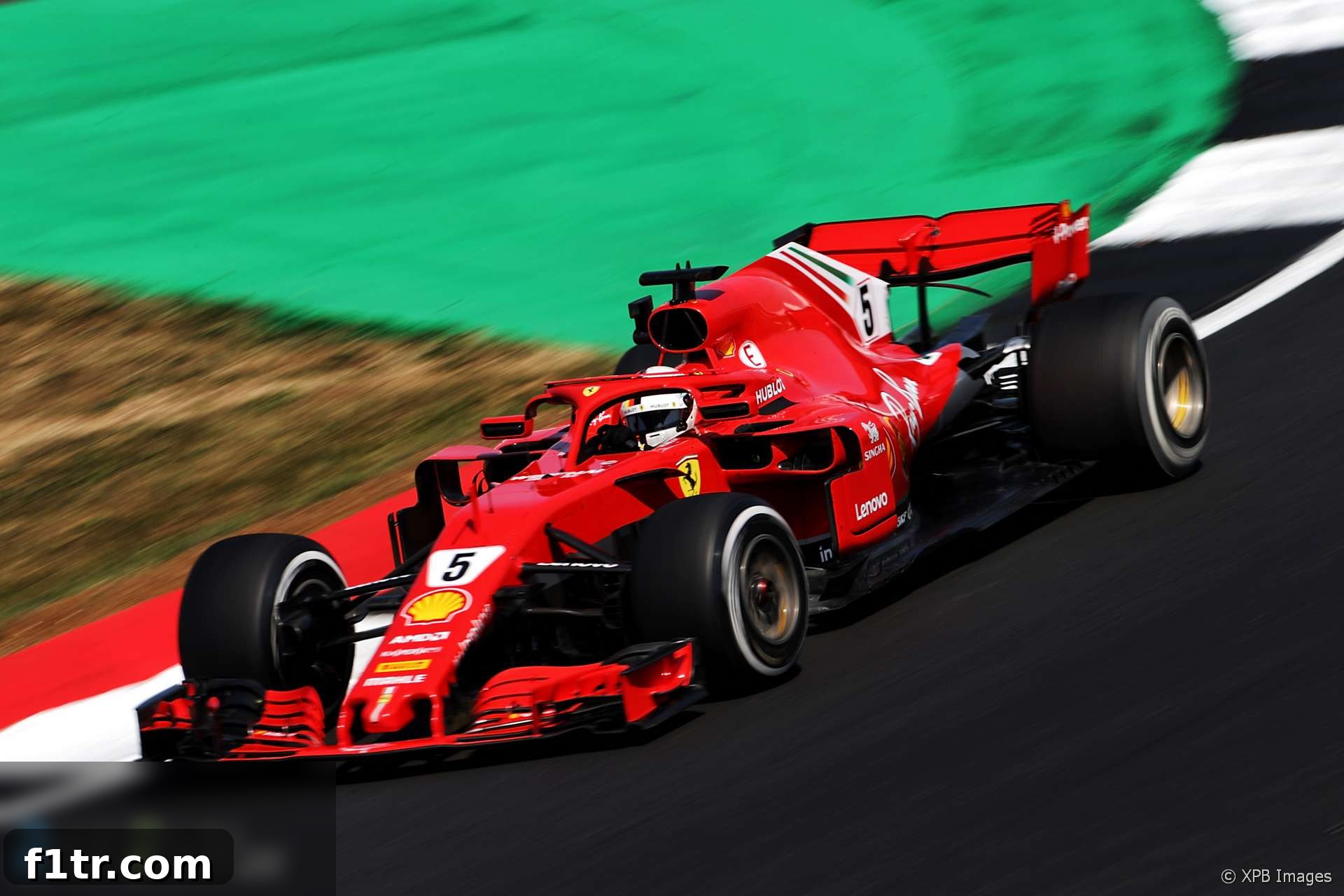
The iconic Silverstone Circuit, steeped in motorsport history, welcomed Formula 1 teams for the first day of practice under unusually scorching conditions. With track temperatures soaring well above seasonal averages, expectations are already building for a strategic British Grand Prix, likely to feature a nuanced one-stop approach that deviates from recent trends. This opening day provided crucial insights into tire performance, car behavior in extreme heat, and the potential for a dramatic reshuffling of the competitive order as teams grapple with the unique demands of this classic circuit.
Pirelli, the official tire supplier, has brought its hardest compound to Silverstone for the first time this season, a decision that has introduced an intriguing strategic variable. Despite its allocation, early indications suggest a reluctance among teams to heavily lean on the hard tire during the race. This hesitation stems from a lack of comprehensive data on its performance in these specific high-temperature conditions, coupled with concerns about its optimal operating window and overall lap time advantage. Teams have generally limited their running on this compound during practice, preferring to gather more data on the softer options.
Consequently, the race strategy is anticipated to heavily favor the soft and medium compounds. While the softer options typically offer superior grip and pace, they also come with higher degradation rates, particularly in the current heatwave. Historically, quicker teams have strategically opted to avoid using the softest available tire in Q2 to allow them the flexibility of starting the race on a more durable, strategically advantageous compound. However, this weekend presents a new challenge: the medium tire is proving to be approximately one second slower than the soft, a larger performance gap than Pirelli had initially anticipated. This significant delta might compel even the front-running teams to consider a different approach for qualifying, potentially limiting their options for a conservative Q2 strategy.
Adding another layer of complexity to the strategic puzzle is the introduction of a new DRS (Drag Reduction System) zone. Positioned between Club and Village, extending through the high-speed Abbey and Farm corners, this zone has dramatically amplified the performance disparity between the top three teams – Mercedes, Ferrari, and Red Bull – and the rest of the midfield. While the likes of Mercedes and Red Bull can exploit this new zone by taking it flat-out, unleashing maximum top speed, midfield contenders such as Haas and Renault are unable to carry the same pace through these demanding sections. This technical advantage for the front-runners means they can achieve significantly faster lap times, creating a larger-than-usual gap to the midfield. For instance, Fernando Alonso’s McLaren, the quickest midfield car on Friday, found itself almost two seconds adrift of the day’s fastest time. This considerable performance delta for the leaders might provide them with enough of a buffer to safely consider starting the race on the more durable medium tire, even if it means sacrificing some initial qualifying pace.
Despite these strategic nuances, a shift from a one-stop to a two-stop race remains unlikely. Pirelli’s Sporting Director, Mario Isola, confirmed this assessment after practice, explaining to media including RaceFans: “There’s a bit of degradation, especially on the soft. But we know that during the race they manage the pace so I’m expecting the level of degradation will decrease during the race.” He further elaborated, “If they manage the degradation it should be a one-stop race. The one-stop strategy is the quickest with soft and medium.” This indicates that while managing tire wear will be critical, teams are expected to adapt their race pace to extend tire life, making a single pit stop the most efficient path to the checkered flag.
However, the hard tire still presents a significant unknown. Its true performance potential under race conditions, especially given the unprecedented heat, remains a question mark. Isola noted, “The high temperature is something that’s in favour of the hard compound. It is slower by roughly one second compared to the data but we don’t have a lot of comparison.” This lack of comparative data makes it a wildcard. Should a driver be involved in a first-lap incident and be forced into an early pit stop, opting for the hard compound could be a daring gamble. If its lap times prove surprisingly competitive in the sustained high temperatures, it could prompt front-runners to take notice and potentially consider an aggressively early switch to the hard tire, betting on its durability and consistent performance over a long stint. The astonishingly high track temperatures at Silverstone, peaking over 50 degrees Celsius on Friday, certainly bolster the case for the hard compound becoming a viable, albeit risky, option.
Beyond tire strategy, the intense heat is poised to be a dominant factor in shaping the competitive hierarchy throughout the weekend. We witnessed a similar scenario in Austria, where unexpectedly high race-day temperatures brought Red Bull into contention for victory. The pattern repeated itself during Friday’s practice sessions at Silverstone. As track temperatures soared by 20 degrees Celsius in the afternoon, Ferrari suddenly appeared to eclipse Mercedes, whose cars struggled to replicate their faster morning lap times. This suggests that certain car designs and setups are more adept at handling the extreme thermal stress, potentially giving an edge to teams that can better manage cooling and tire temperatures.
While Mercedes demonstrated incredible performance through Abbey, taking it flat-out with DRS open from the very outset, Red Bull appears to be facing an uphill battle, at least for qualifying. A significant part of their struggle stems from rising downforce levels which have rendered several corners effectively flat-out. This characteristic, unique to Silverstone’s high-speed layout and exacerbated by the new DRS zone, effectively extends the straights. Such conditions amplify Red Bull’s inherent top-speed disadvantage, making it harder for them to challenge the raw pace of Mercedes and Ferrari in a single-lap shootout. They will be hoping to find a solution for qualifying to ensure they are not too far off the pace of their rivals.
Conversely, McLaren delivered a surprisingly strong performance on Friday, despite their car remaining unchanged from the specification raced in France and Austria. The MCL33 seemed to thrive on Silverstone’s array of high-speed corners, finding an impressive rhythm and balance. This unexpected burst of pace offers a glimmer of hope for a robust home showing, especially welcome after another challenging week of off-track news and developments for the team. Their ability to extract performance from the high-speed sections suggests a fundamental suitability of their chassis to Silverstone’s demands, which could translate into valuable points on Sunday.
Longest Stint Comparison – Second Practice
The following data represents the lap times (in seconds) recorded by drivers during their longest unbroken stints in Second Practice. This provides crucial insight into tire degradation and consistent pace over race distances. While the interactive chart is not displayed here, it typically allows for detailed analysis of driver consistency and tire wear profiles. Very slow laps, likely indicative of pit entry/exit or significant traffic, have been omitted to provide a clearer picture of sustained performance. Such a chart would visually illustrate who managed their tires best and maintained a strong pace over multiple laps, offering clues for race strategy.
Complete Practice Times
The comprehensive results from both Free Practice 1 (FP1) and Free Practice 2 (FP2) sessions at the British Grand Prix are presented below. These times offer a snapshot of team performance and driver pace on Friday, though they do not always directly correlate to qualifying or race results. The fastest time for each driver in either session is highlighted in bold, alongside their total number of laps completed. These figures are instrumental for teams to analyze performance, identify areas for improvement, and fine-tune their setups for the decisive qualifying session and the main race event.
| Pos | Driver | Car | FP1 | FP2 | Total laps |
|---|---|---|---|---|---|
| 1 | Lewis Hamilton | Mercedes | 1’27.487 | 1’27.739 | 56 |
| 2 | Sebastian Vettel | Ferrari | 1’27.998 | 1’27.552 | 57 |
| 3 | Valtteri Bottas | Mercedes | 1’27.854 | 1’27.909 | 56 |
| 4 | Kimi Raikkonen | Ferrari | 1’28.218 | 1’28.045 | 58 |
| 5 | Daniel Ricciardo | Red Bull-TAG Heuer | 1’28.144 | 1’28.408 | 61 |
| 6 | Max Verstappen | Red Bull-TAG Heuer | 1’28.325 | 26 | |
| 7 | Fernando Alonso | McLaren-Renault | 1’30.322 | 1’29.306 | 50 |
| 8 | Romain Grosjean | Haas-Ferrari | 1’29.352 | 12 | |
| 9 | Nico Hulkenberg | Renault | 1’30.701 | 1’29.354 | 53 |
| 10 | Esteban Ocon | Force India-Mercedes | 1’29.815 | 1’29.467 | 57 |
| 11 | Sergio Perez | Force India-Mercedes | 1’29.812 | 1’29.522 | 55 |
| 12 | Charles Leclerc | Sauber-Ferrari | 1’30.027 | 1’29.557 | 57 |
| 13 | Carlos Sainz Jnr | Renault | 1’30.358 | 1’29.563 | 58 |
| 14 | Kevin Magnussen | Haas-Ferrari | 1’30.065 | 1’29.617 | 53 |
| 15 | Pierre Gasly | Toro Rosso-Honda | 1’30.004 | 1’29.831 | 47 |
| 16 | Lance Stroll | Williams-Mercedes | 1’29.878 | 1’30.069 | 59 |
| 17 | Marcus Ericsson | Sauber-Ferrari | 1’29.942 | 1’30.046 | 57 |
| 18 | Sergey Sirotkin | Williams-Mercedes | 1’31.017 | 1’30.103 | 58 |
| 19 | Stoffel Vandoorne | McLaren-Renault | 1’30.416 | 1’30.121 | 56 |
| 20 | Brendon Hartley | Toro Rosso-Honda | 1’30.749 | 1’30.404 | 66 |
Quotes: Dieter Rencken
2018 British Grand Prix
- Hamilton equalled another Senna record at Silverstone
- 2018 British Grand Prix Star Performers
- Top ten pictures from the 2018 British Grand Prix
- Vettel denies Hamilton at home as Ferrari and Mercedes clash again
- Paddock Diary: British Grand Prix day four
Browse all 2018 British Grand Prix articles