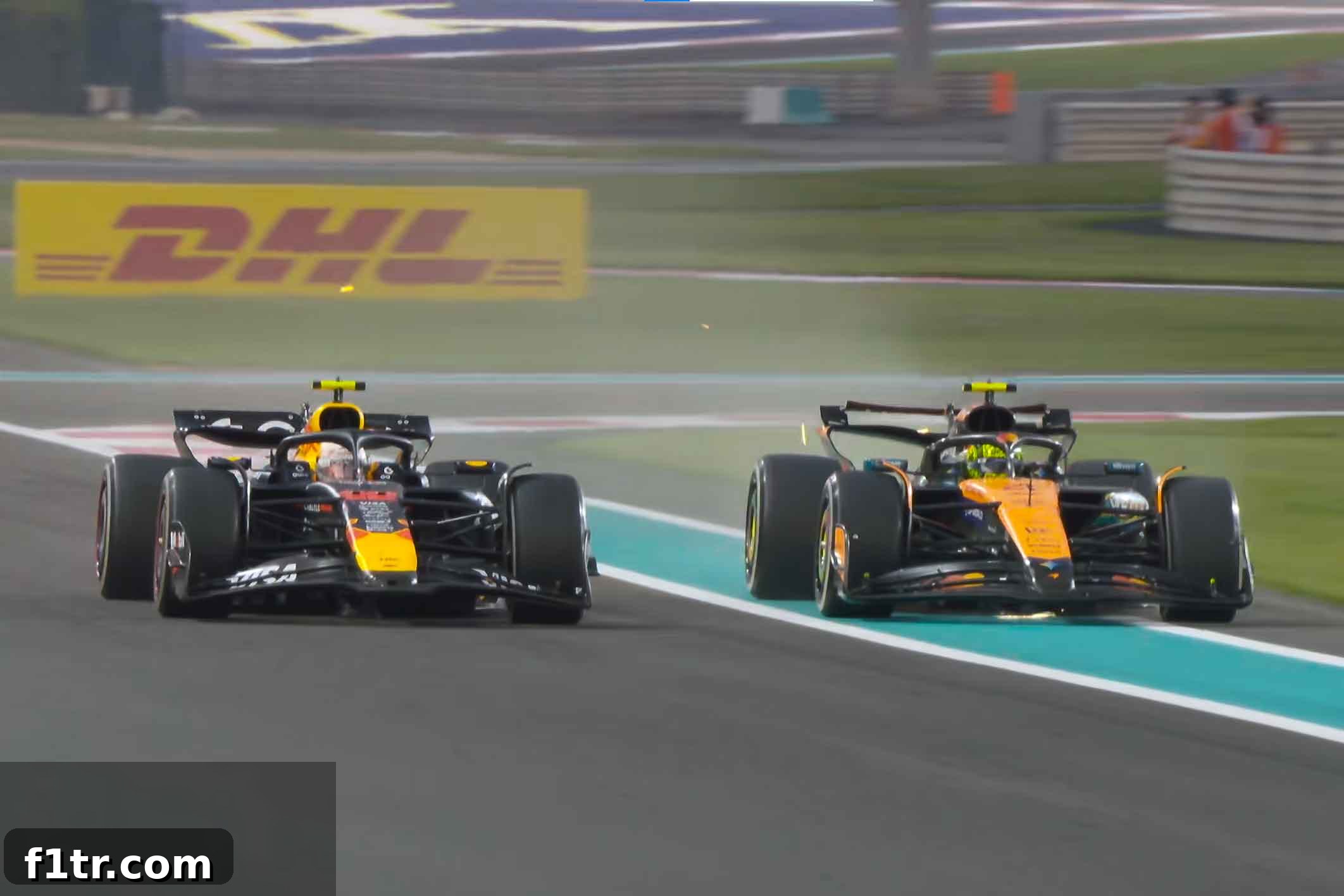
The final race of the championship season is invariably a pressure cooker, but the recent Abu Dhabi Grand Prix served up a particularly intense climax, with a moment of high drama that threatened to derail the outcome. Surprisingly, this most critical juncture, which had the potential to dramatically shift the championship balance, did not directly involve the two leading title contenders. Instead, it centered on a controversial on-track battle between Lando Norris and Yuki Tsunoda, the latter being a crucial teammate to Norris’s championship rival, Max Verstappen.
The Pivotal Lap 23 Incident: Norris vs. Tsunoda
The flashpoint occurred on lap 23, when Lando Norris executed an overtake on Yuki Tsunoda. What followed was arguably the most debated incident of the entire race. As Norris completed his pass, all four wheels of his car went beyond the white line on the straight connecting turns five and six. This immediately triggered two separate investigations by the race stewards, raising the stakes considerably for Norris, who was in a championship-winning position if he maintained his third-place finish.
The controversy surrounding the maneuver was immense. Observers and fans alike held their breath, understanding that a penalty for Norris could cost him the world championship. However, in a decision that sparked widespread discussion, Norris was ultimately cleared of any wrongdoing, while Tsunoda was handed a five-second time penalty. This ruling, which some found perplexing and others justified, became the focal point of post-race analysis.
Stewards’ Ruling: A Closer Look at the “Forced Off” Principle
The stewards’ justification for their decision hinged on a specific interpretation of racing guidelines. They concluded that Tsunoda had made too many changes of direction while attempting to defend his position against Norris. This “weaving” was deemed to have forced Norris off the track. Consequently, under the Driving Standards Guidelines, which state that drivers will not be penalized for exceeding track limits “if a driver has been considered to be ‘forced off’ by another car,” Norris was absolved. The stewards’ logic was clear: Tsunoda’s aggressive defending directly caused Norris to leave the track, thus mitigating any penalty for the McLaren driver, who ultimately secured the third place needed for his championship win.
While Tsunoda’s penalty for multiple changes of direction was not entirely unprecedented – three similar penalties were issued to other drivers during the same race – the decision to clear Norris was indeed unusual. This rarity stemmed from the unique confluence of events: Norris was overtaking a driver who was actively breaking rules by weaving, successfully completed the overtake, but concurrently left the track himself. This complex scenario forced the stewards to apply a nuanced interpretation of their regulations.
A significant factor enabling Norris to drive off-track while passing Tsunoda was the nature of the Yas Marina Circuit itself. Unlike many other Formula 1 tracks where such an excursion would likely lead to grass or gravel, this particular straight offered a generous asphalt run-off area beyond the white line. Had this incident occurred at a different circuit with less forgiving track limits, the outcome, and potentially the stewards’ ruling, might have been drastically different. The unique design of Yas Marina played an undeniable role in the feasibility and subsequent legality of Norris’s maneuver.
Tsunoda, however, was visibly displeased with the verdict, describing it as “crazy.” His reaction underscored the tension and differing perspectives on what constituted fair and legal racing in such high-pressure scenarios.
Consistency in Penalties: Other Incidents at Abu Dhabi
Tsunoda’s penalty was one of four instances of drivers being penalized for overly aggressive defensive moves during the Abu Dhabi race. Earlier, Liam Lawson received a penalty for crowding Oliver Bearman off the track on the approach to turn nine, though this was officially termed “erratic driving.” In Lawson’s case, the car positions and track barriers prevented Bearman from executing an off-track pass similar to Norris’s move on Tsunoda. Had Bearman been able to complete such a pass, the stewards would have faced a significant challenge in maintaining consistency with their Norris ruling.
Lawson, like Tsunoda, was given a five-second time penalty and a single penalty point on his Super Licence. Two other drivers later received identical penalties for making multiple defensive moves between turns eight and nine. Lance Stroll was penalized for his actions against Carlos Sainz Jnr, while Oliver Bearman was also penalized for his particularly “egregious” weaving when Stroll appeared in his mirrors. Stroll had weaved to prevent Sainz from re-passing him, and Bearman unsuccessfully attempted to prevent Stroll from passing him on the outside into turn nine.
The key distinction between these later incidents and Tsunoda’s encounter with Norris was the specific location on the track. Tsunoda made his controversial moves on the earlier straight approaching turn six, a different section with unique track characteristics that allowed Norris the run-off space he utilized.
Red Bull’s Strategic Role: Intentional or Incidental?
It is reasonable to assume Tsunoda’s initial change of direction was aimed at preventing Norris from gaining a slipstream, a defensive tactic that the Driving Standards Guidelines sometimes allow: “Moves intended to break the slipstream of a following car when the following car is a safe distance behind, considering relative speeds and position on the track, may be acceptable.” However, the stewards did not interpret Tsunoda’s move in this light, likely because Norris was already exceptionally close, well within DRS range, as they exited turn five.
Any comprehensive analysis of Tsunoda’s actions and subsequent penalty must acknowledge the broader championship context. While Tsunoda was fully entitled to defend his track position, the strategic implications for Red Bull and Max Verstappen’s championship aspirations amplified the importance of this battle. Red Bull needed to prevent Norris from finishing within the top three to secure the title for Verstappen, a situation reminiscent of four years prior at the same track when Sergio Perez famously delayed another of Verstappen’s rivals. Tsunoda had already played a similar team role earlier in the season and had publicly stated his readiness to assist Verstappen in the championship decider. “I’ll keep [trying to] help him as much as possible also [in the] next race,” he declared after qualifying. “With that, probably most likely [it] won’t be a straightforward strategy for me.”
During the race, Tsunoda’s engineer, Richard Wood, provided regular updates on Norris’s progress, prompting him with phrases like, “All you can when he catches.” Tsunoda’s confident reply, “I know what to do so leave it to me,” indicated his clear understanding of his assigned role.
As Norris closed in, Tsunoda conspicuously moved off the conventional racing line into the middle of the straight, then back onto the racing line, and then again into the middle. When Norris committed to overtaking on the left, Tsunoda shifted in that direction once more. This sequence of movements strongly suggested a deliberate attempt to force Norris off the track.
Had Norris chosen to back off to avoid contact with Tsunoda, the time loss would have been catastrophic for his championship bid. His only viable alternative was to risk a penalty by going off-track. This raises a compelling question: was this Red Bull’s premeditated strategy all along? Knowing that using Verstappen to delay Norris was deemed “risky and unlikely to work,” especially given McLaren’s anticipated strategy, did Red Bull deploy Tsunoda – in what was his final Grand Prix appearance, making him impervious to accumulating further penalty points – to provoke Norris into receiving a time penalty? Or was Tsunoda simply attempting a zealous “Perez-esque” defensive move that he pushed beyond acceptable limits? Only those directly involved can offer a definitive answer.
At best, Tsunoda’s actions amounted to an unsporting and crude attempt to force a significantly quicker car off the track. Had Norris lacked the run-off space available at that specific point of the circuit, this maneuver could have easily resulted in a severe crash. The confluence of the high-stakes championship battle and the peculiar characteristics of the Yas Marina circuit ensured that any stewards’ decision would be scrutinized and likely set a precedent.
Ultimately, regardless of Tsunoda’s true motives, the stewards were correct in their decision not to penalize Norris. Setting a precedent that allows teams to use championship contenders’ teammates to aggressively weave in front of rivals, forcing them off-track to trigger a penalty, would severely undermine the integrity of the sport. The ruling underscored the importance of fair play, even in the most intense championship scenarios.
Fan Perspective: Penalties and Sporting Integrity
Penalty Box: Community Verdicts
The controversial decisions surrounding the race ignited a fervent debate among fans, as reflected in various polls concerning the stewards’ actions. The community weighed in on whether the penalties issued were appropriate:
Tsunoda’s penalty for changing his line multiple times in front of Norris was:
- No opinion (0%)
- Far too lenient (9%)
- Slightly too lenient (11%)
- Correct (58%)
- Slightly too harsh (11%)
- Far too harsh (11%)
(Total Voters: 197)
A clear majority of fans (58%) believed Tsunoda’s penalty was “Correct,” indicating a general agreement with the stewards’ assessment of his weaving.
Do you agree with the stewards’ decision not to penalize Norris for his pass on Tsunoda?
- No opinion (1%)
- Strongly disagree (14%)
- Slightly disagree (6%)
- Neither agree nor disagree (2%)
- Slightly agree (11%)
- Strongly agree (67%)
(Total Voters: 192)
Overwhelmingly, 67% of voters “Strongly agree” with the decision to not penalize Norris, reinforcing the perception that he was indeed forced off track.
Lawson’s penalty for changing his line multiple times in front of Bearman was:
- No opinion (15%)
- Far too lenient (2%)
- Slightly too lenient (7%)
- Correct (68%)
- Slightly too harsh (5%)
- Far too harsh (2%)
(Total Voters: 41)
Liam Lawson’s penalty was also largely supported, with 68% deeming it “Correct,” suggesting a consensus on consistency for weaving maneuvers.
Bearman’s penalty for changing his line multiple times in front of Stroll was:
- No opinion (23%)
- Far too lenient (2%)
- Slightly too lenient (9%)
- Correct (50%)
- Slightly too harsh (11%)
- Far too harsh (5%)
(Total Voters: 44)
Bearman’s penalty received 50% approval as “Correct,” though with a higher percentage of “No opinion” votes, possibly due to it being a less high-profile incident.
Stroll’s penalty for changing his line multiple times in front of Sainz was:
- No opinion (28%)
- Far too lenient (2%)
- Slightly too lenient (12%)
- Correct (47%)
- Slightly too harsh (7%)
- Far too harsh (5%)
(Total Voters: 43)
Similarly, Stroll’s penalty was seen as “Correct” by 47% of voters, again with a notable portion having “No opinion.”
The poll results collectively indicate a strong public backing for the stewards’ application of rules regarding weaving and the “forced off” principle, particularly in the critical Norris-Tsunoda incident.
Conclusion: A Precedent Set for Sporting Integrity
The Abu Dhabi Grand Prix delivered an unforgettable championship conclusion, not least for the intense scrutiny placed on the stewards’ decisions. The encounter between Lando Norris and Yuki Tsunoda will undoubtedly be remembered as a defining moment, illustrating the fine line between aggressive defense and unsporting conduct. The unique blend of championship pressure and track characteristics made the stewards’ task exceptionally challenging, but their ultimate ruling upheld a vital principle: drivers must not be deliberately pushed off track to gain an unfair advantage or provoke a penalty. This decision sends a clear message that while racing in Formula 1 is fiercely competitive, it must always be conducted within the bounds of fair play and sporting integrity.
2025 Abu Dhabi Grand Prix Further Reading
The incident between Norris and Tsunoda was just one of many dramatic storylines from the 2025 Abu Dhabi Grand Prix. For more insights and analysis from the race weekend, explore the following articles:
- McLaren’s Las Vegas disqualifications cost them record points score in 2025
- 2025 Abu Dhabi Grand Prix weekend F1 driver ratings
- Antonelli asked team how many points Verstappen lost title by after online abuse
- Norris vs Verstappen vs Piastri: Full radio transcript from their championship showdown
- Norris’s engineer told him Tsunoda’s move was “classic Red Bull s***housing”
Browse all 2025 Abu Dhabi Grand Prix articles