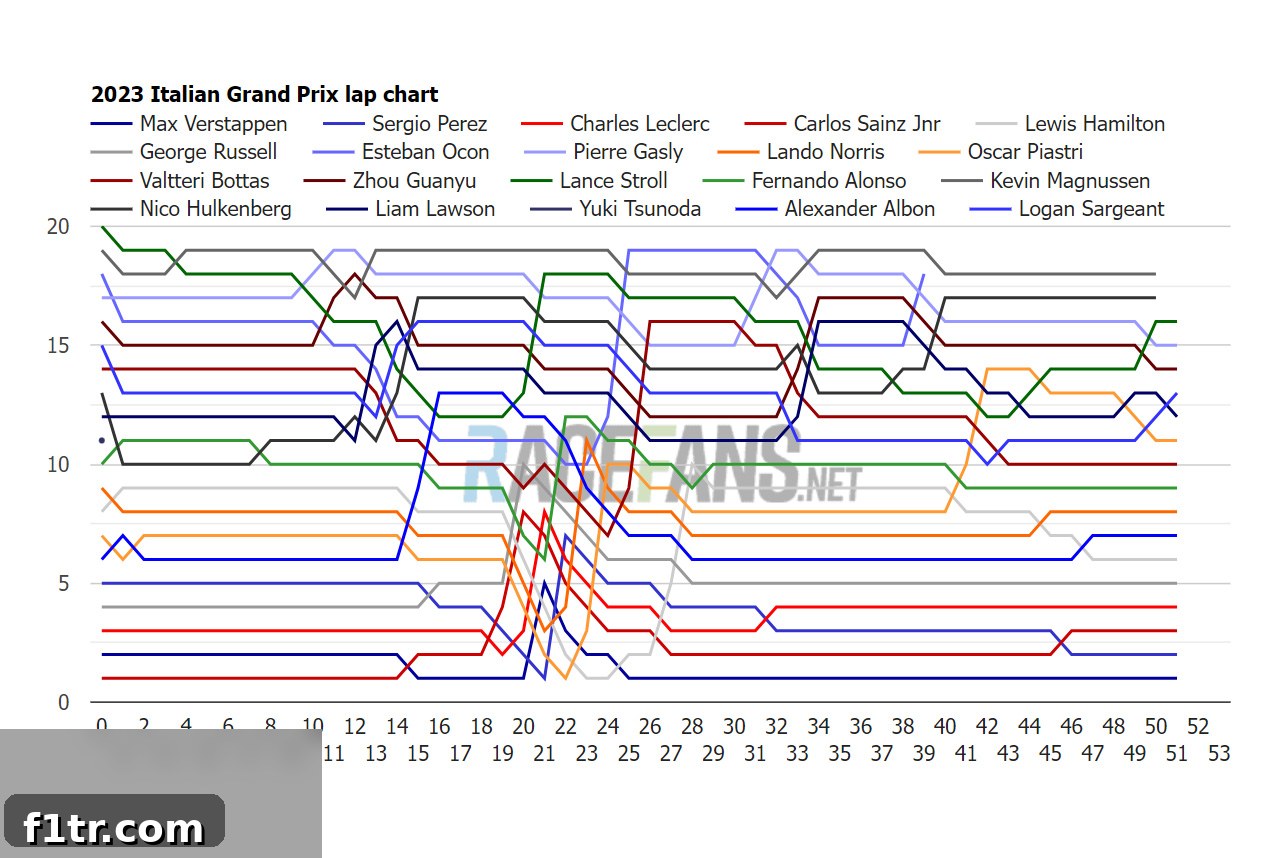
In the thrilling world of Formula 1, every strategic decision can mean the difference between victory and defeat. At the 2023 Italian Grand Prix, the home crowd at Monza watched with bated breath as Carlos Sainz Jnr led for Ferrari, only to lose the top spot to the relentless Max Verstappen on lap 15. This pivotal moment set off a strategic chess match, with Ferrari ultimately choosing a conservative approach that would prove decisive in the race outcome.
Advert | Become a Supporter & go ad-free
Once Verstappen seized the lead, a critical strategic window opened for Ferrari. They had the option to immediately pit Sainz, attempting an undercut to regain track position. This aggressive move would then allow them to cover Red Bull’s subsequent actions with either Sainz or his teammate, Charles Leclerc. However, Ferrari’s team principal, Frederic Vasseur, revealed the team’s apprehension regarding an early pit stop. Despite the race distance being shortened to 51 laps due to a delayed start, the uncertainty surrounding tyre life, especially on the harder compounds, was a significant deterrent.
The Pirelli Puzzle: Unforeseen Tyre Challenges at Monza
Vasseur elaborated on the team’s dilemma, stating, “We were all a bit worried with the life of the hard [tyre]. We were a bit blind because we didn’t do a long stint before [in practice].” This lack of crucial long-run data meant teams were operating with incomplete information, turning race day into a high-stakes experiment. The Italian Grand Prix weekend presented a unique confluence of factors that intensified these tyre management challenges.
For starters, the Alternative Tyre Allocation (ATA) format was in effect, meaning teams had fewer tyre sets available for practice sessions. This inherent limitation already reduced the data collection opportunities. Compounding this, Sergio Perez’s spin in the late stages of Second Practice disrupted long-run preparations for nearly all teams, robbing them of valuable insights into tyre degradation over extended stints. This incident inadvertently created a level playing field of uncertainty for everyone on the grid.
Adding another layer of complexity, Sunday was the warmest day of the weekend, leading many drivers to report unexpectedly high tyre degradation. Further, Pirelli, F1’s official tyre supplier, had brought softer compounds to Monza compared to the previous year, a decision also seen at the Hungarian Grand Prix where ATA was used. This combination of warmer conditions, softer rubber, and limited data created a perfect storm of unpredictability for tyre strategy. Vasseur summarized the situation: “It was also a risk to stop very early. We were all at the limit. I think Max the last couple of laps had some issue with the front-left also and we had not so much margin.” Even the race leader, Max Verstappen, felt the pinch of tyre wear, highlighting the universal nature of the challenge.
Sainz’s Struggle and the One-Stop Commitment
From the cockpit, Carlos Sainz described his one-stop strategy as “very tight and very on the limit.” He openly admitted that the degradation felt higher than anticipated, leaning more towards a two-stop race in his estimation. “It did feel high deg for me,” he commented. “It did feel more like a two-stop than a one-stop.” Despite his instincts, Ferrari’s pre-race calculations had pointed towards a single stop, a commitment they ultimately upheld.
Advert | Become a RaceFans supporter andgo ad-free
Sainz’s candid remarks painted a vivid picture of the tyre struggle: “In the end we committed to one stop because that’s what our numbers suggested before the race. But honestly, I was probably five laps short in each of these things. The last four laps I did on the medium I did it with zero rubber left. And the last five laps, ten laps I did with the hard I did them with zero rubber left, that’s why I was sliding around so much.” His experience underscored the fine margins teams were operating on and the immense pressure placed on drivers to manage severely worn tyres.
Two-Stop Strategies: A Risky Gamble for Mid-Pack Teams
While the front-runners wrestled with a challenging one-stop, several teams in the midfield attempted two-stop strategies, largely without success. Liam Lawson, making an impressive debut, was the highest-placed driver on a two-stop strategy, finishing 12th (later promoted to 11th after Oscar Piastri’s penalty). This result highlighted the difficulty in making an additional pit stop work at Monza, a track where track position is paramount and the time lost in the pits is significant.
Alpine, struggling for performance at the high-speed Monza circuit, chose to split strategies between their drivers. Esteban Ocon ran a single-stop race, while Pierre Gasly opted for two. Gasly explained the rationale behind this gamble: “We thought we’ll try something different on both cars and if a Safety Car comes in at any moment then either Esteban will benefit from it, or I will benefit from one at a later point. But, when you’re lacking so much performance like that you’ve just got to gamble, unfortunately there is no secret when you are competitive it always ends up pretty well, when you are not competitive it’s way harder.” Ultimately, the gamble did not pay off for Alpine, underscoring that even clever strategy can’t entirely compensate for a fundamental lack of pace.
Alfa Romeo faced similar challenges regarding pace and tyre uncertainty, also deciding to split their strategy. This move proved more fruitful for them, as the one-stopping Valtteri Bottas secured a valuable point, their first since the Canadian Grand Prix. Their experience demonstrated that while risky, a varied strategy could occasionally yield rewards, especially when circumstances are unclear.
Even Sergio Perez, reflecting on the weekend, admitted to the widespread uncertainty. He joked, “I don’t know who brought the red flag there in the end on Friday…” referring to the incident (his spin) that limited crucial long-run data. “So nobody really did more than four laps, five laps and you don’t get to see what the tyre is going to do and also it was hotter today so I think it was a bit of a combination in the regard that the degradation was a little bit higher.” His comments perfectly encapsulate the collective challenge faced by all teams in deciphering the optimal tyre approach under unusual conditions.
Advert | Become a RaceFans supporter andgo ad-free
Looking Ahead: The Future of F1’s Alternative Tyre Allocation
The 2023 Italian Grand Prix offered a compelling case study on the impact of various factors on race strategy and excitement. The combination of the Alternative Tyre Allocation format, the selection of softer Pirelli compounds, and the disrupted practice sessions undeniably contributed to a race filled with strategic intrigue and unexpected tyre management challenges. As Formula 1 evaluates whether to commit to the ATA format for more races in the 2024 season, the lessons learned from Monza will be rigorously scrutinized. The debate will center on whether these elements enhance the spectacle by creating uncertainty and diverse strategies, or if they merely add an unnecessary layer of risk and unpredictability for teams.
2023 Italian Grand Prix Lap Data Insights
For a deeper dive into the race’s dynamics, enthusiasts can review the detailed lap data:
The positions of each driver on every lap. Click name to highlight, right-click to reset. Toggle drivers using controls below:
The gaps between each driver on every lap compared to the leader’s average lap time. Very large gaps omitted. Scroll to zoom, drag to pan and right-click to reset. Toggle drivers using controls below:
All the lap times by the drivers (in seconds, very slow laps excluded). Scroll to zoom, drag to pan and toggle drivers using the control below:
Advert | Become a RaceFans supporter andgo ad-free
2023 Italian Grand Prix Fastest Laps
Each driver’s fastest lap times are crucial indicators of raw pace and potential. Here’s a breakdown of the quickest single laps recorded during the Grand Prix:
| Rank | No. | Driver | Car | Lap time | Gap | Average speed (kph) | Lap no. |
|---|---|---|---|---|---|---|---|
| 1 | 81 | Oscar Piastri | McLaren-Mercedes | 1’25.072 | 245.14 | 43 | |
| 2 | 1 | Max Verstappen | Red Bull-Honda RBPT | 1’25.240 | 0.168 | 244.66 | 33 |
| 3 | 55 | Carlos Sainz Jnr | Ferrari | 1’25.501 | 0.429 | 243.91 | 30 |
| 4 | 11 | Sergio Perez | Red Bull-Honda RBPT | 1’25.522 | 0.450 | 243.85 | 39 |
| 5 | 16 | Charles Leclerc | Ferrari | 1’25.580 | 0.508 | 243.69 | 38 |
| 6 | 44 | Lewis Hamilton | Mercedes | 1’25.582 | 0.510 | 243.68 | 29 |
| 7 | 10 | Pierre Gasly | Alpine-Renault | 1’25.758 | 0.686 | 243.18 | 44 |
| 8 | 40 | Liam Lawson | AlphaTauri-Honda RBPT | 1’25.842 | 0.770 | 242.94 | 44 |
| 9 | 63 | George Russell”>George Russell | Mercedes | 1’25.847 | 0.775 | 242.93 | 38 |
| 10 | 27 | Nico Hulkenberg | Haas-Ferrari | 1’25.894 | 0.822 | 242.8 | 50 |
| 11 | 24 | Zhou Guanyu | Alfa Romeo-Ferrari | 1’25.983 | 0.911 | 242.55 | 35 |
| 12 | 77 | Valtteri Bottas | Alfa Romeo-Ferrari | 1’25.988 | 0.916 | 242.53 | 27 |
| 13 | 14 | Fernando Alonso | Aston Martin-Mercedes | 1’26.105 | 1.033 | 242.2 | 43 |
| 14 | 4 | Lando Norris | McLaren-Mercedes | 1’26.144 | 1.072 | 242.09 | 24 |
| 15 | 20 | Kevin Magnussen | Haas-Ferrari | 1’26.278 | 1.206 | 241.72 | 42 |
| 16 | 23 | Alexander Albon | Williams-Mercedes | 1’26.389 | 1.317 | 241.41 | 33 |
| 17 | 18 | Lance Stroll | Aston Martin-Mercedes | 1’26.617 | 1.545 | 240.77 | 31 |
| 18 | 2 | Logan Sargeant | Williams-Mercedes | 1’26.840 | 1.768 | 240.15 | 16 |
| 19 | 31 | Esteban Ocon | Alpine-Renault | 1’26.963 | 1.891 | 239.81 | 33 |
Advert | Become a RaceFans supporter andgo ad-free
2023 Italian Grand Prix Tyre Strategies
Understanding the tyre choices and timings for each driver provides key insights into how different teams approached the race’s unique challenges:
Advert | Become a RaceFans supporter andgo ad-free
2023 Italian Grand Prix Pit Stop Times
Efficiency in the pit lane is paramount. These figures illustrate the speed and precision of each team’s pit crew during the Italian Grand Prix:
| Rank | No. | Driver | Team | Complete stop time (s) | Gap to best (s) | Stop no. | Lap no. |
|---|---|---|---|---|---|---|---|
| 1 | 4 | Lando Norris | McLaren | 23.727 | 1 | 22 | |
| 2 | 11 | Sergio Perez | Red Bull | 23.819 | 0.092 | 1 | 21 |
| 3 | 16 | Charles Leclerc | Ferrari | 23.931 | 0.204 | 1 | 20 |
| 4 | 81 | Oscar Piastri | McLaren | 24.133 | 0.406 | 1 | 23 |
| 5 | 40 | Liam Lawson | AlphaTauri | 24.212 | 0.485 | 1 | 13 |
| 6 | 63 | George Russell | Mercedes | 24.215 | 0.488 | 1 | 19 |
| 7 | 1 | Max Verstappen | Red Bull | 24.228 | 0.501 | 1 | 20 |
| 8 | 31 | Esteban Ocon | Alpine | 24.249 | 0.522 | 1 | 24 |
| 9 | 44 | Lewis Hamilton | Mercedes | 24.255 | 0.528 | 1 | 27 |
| 10 | 40 | Liam Lawson | AlphaTauri | 24.281 | 0.554 | 2 | 33 |
| 11 | 27 | Nico Hulkenberg | Haas | 24.328 | 0.601 | 2 | 39 |
| 12 | 24 | Zhou Guanyu | Alfa Romeo | 24.396 | 0.669 | 1 | 11 |
| 13 | 23 | Alexander Albon | Williams | 24.538 | 0.811 | 1 | 15 |
| 14 | 77 | Valtteri Bottas | Alfa Romeo | 24.658 | 0.931 | 1 | 25 |
| 15 | 20 | Kevin Magnussen | Haas | 24.66 | 0.933 | 1 | 12 |
| 16 | 10 | Pierre Gasly | Alpine | 24.686 | 0.959 | 2 | 31 |
| 17 | 20 | Kevin Magnussen | Haas | 24.765 | 1.038 | 2 | 33 |
| 18 | 2 | Logan Sargeant | Williams | 24.779 | 1.052 | 1 | 14 |
| 19 | 14 | Fernando Alonso | Aston Martin | 24.798 | 1.071 | 1 | 21 |
| 20 | 55 | Carlos Sainz Jnr | Ferrari | 25.183 | 1.456 | 1 | 19 |
| 21 | 18 | Lance Stroll | Aston Martin | 25.667 | 1.94 | 1 | 20 |
| 22 | 24 | Zhou Guanyu | Alfa Romeo | 25.959 | 2.232 | 2 | 33 |
| 23 | 27 | Nico Hulkenberg | Haas | 26.095 | 2.368 | 1 | 14 |
| 24 | 10 | Pierre Gasly | Alpine | 27.376 | 3.649 | 1 | 10 |
| 25 | 81 | Oscar Piastri | McLaren | 31.799 | 8.072 | 2 | 41 |
Become a RaceFans Supporter and Experience F1 Ad-Free
RaceFans thrives on the passionate support of its readers. By contributing just £1 per month or £12 per year (or your local currency equivalent), you can directly help us cover the operational costs of creating high-quality Formula 1 content, maintaining our platform, and developing new features for the future.
Join our community of RaceFans Supporters today and enjoy an uninterrupted, ad-free browsing experience on the site. Discover more about our supporter program and sign up via the links below:
- Become a RaceFans Supporter
- RaceFans Supporter FAQ
More from the 2023 Italian Grand Prix
- Despite close battles at Monza, F1 drivers want more powerful DRS
- Monza “frustrating” for Alonso but Aston Martin expect better form in coming races
- F1 changed rules to stop Mercedes in 2021 but we won’t ‘cry foul’ now – Wolff
- McLaren will bring ‘follow-up to Austria upgrade’ before focusing on 2024 car
- Magnussen explains why his driving style rarely works with the Haas VF-23
Browse all 2023 Italian Grand Prix articles