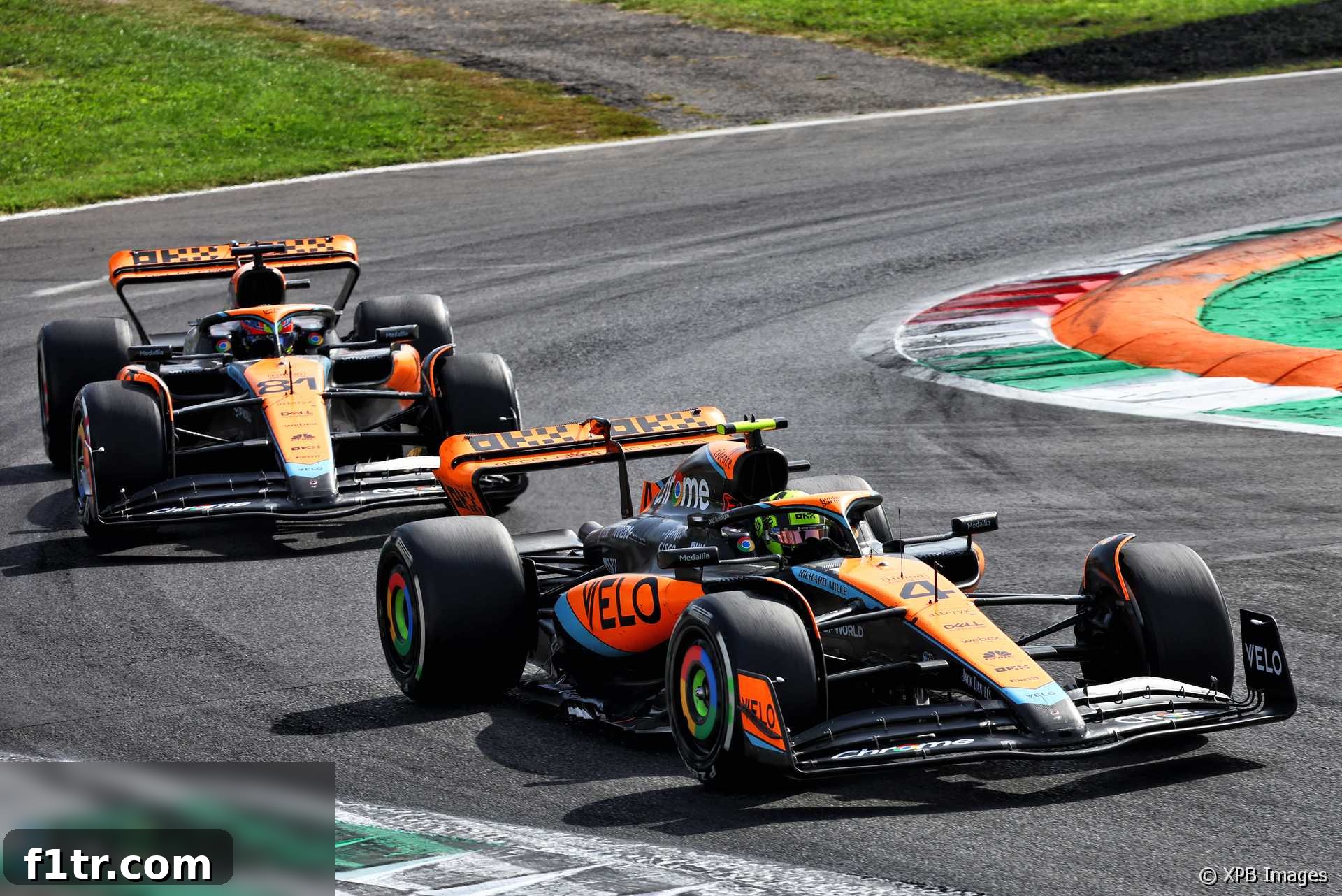
McLaren has demonstrated a remarkable mid-season turnaround in Formula 1, transforming their MCL60 from a midfield runner into a genuine contender for podium finishes. This resurgence is largely attributed to a meticulously planned series of upgrades, with more enhancements still in the pipeline for the remaining races of the season. Central to their strategy is a significant “follow-up” to the impactful Austrian Grand Prix upgrade, which initially laid the groundwork for their improved performance.
The journey, however, hasn’t been without its specific challenges. The Italian Grand Prix at Monza, renowned for its long straights and low-downforce requirements, presented a unique test. Despite introducing upgrades specifically tailored for the high-speed circuit, McLaren experienced their lowest-scoring weekend since the Austrian Grand Prix in July. This outcome highlights the intricate balancing act of Formula 1 car development, where optimizing for one track characteristic can sometimes compromise performance on another.
The Austrian Upgrade: A Game-Changer with a Trade-off
The upgrades unveiled at the Austrian Grand Prix proved to be a pivotal moment for McLaren’s 2023 campaign. These advancements significantly boosted the MCL60’s performance, particularly in the areas the team had targeted for improvement. Drivers Lando Norris and Oscar Piastri quickly found themselves in contention for top positions, a stark contrast to their earlier season struggles. However, as is often the case in the complex world of aerodynamic development, this leap forward came with an unintended consequence: increased aerodynamic drag. While beneficial on high-downforce tracks, this characteristic posed a considerable disadvantage for circuits like Monza, which demand minimal drag for straight-line speed.
McLaren Team Principal Andrea Stella elaborated on this challenge: “The Austria upgrades, while improving the MCL60’s performance in the areas McLaren was targeting, also made the car draggier. Therefore, new parts to address that unwanted characteristic were needed before tackling Monza’s long straights.” This candid admission underscores the continuous evolution required in Formula 1; every step forward often necessitates subsequent adjustments to maintain overall car balance and efficiency across diverse track layouts.
Monza’s Specific Demands: A Test of Aerodynamic Versatility
Monza’s unique layout compelled McLaren to develop a specific package of upgrades aimed at reducing drag. Stella explained, “The Monza-specific upgrades were centred around reducing the level of drag.” This focus was crucial for competing effectively on a circuit where straight-line speed is paramount. However, reducing drag, particularly by utilizing smaller rear wings, introduces a cascade of aerodynamic implications that can affect the entire car’s performance. “In addition to trying to reduce the level of drag, you also try to see what happens to the rest of the car and how can we now start mitigating the implication of putting small rear wings on,” Stella continued. He further detailed the aerodynamic chain reaction: “Because when you put small rear wings, then you reduce the suction at the back of the floor, the floor offloads, and then the whole car kind of tends to ‘switch off’.”
This phenomenon, where the car loses its overall aerodynamic efficiency and stability, is a critical concern for engineers. The team faced a strategic choice: invest significant time and resources in completely offsetting the effects of small wings, or accept a certain level of compromise given the tight development schedule. Stella indicated McLaren’s approach for Monza: “Therefore it depends on how long do you want to spend in compensating the impact of the small wings or how much you simply accept that’s what we have, we don’t have time to do much more. In our case, we have been able to produce the rear wings for very low downforce, but we haven’t put much emphasis into trying to fix the implications because we were focusing on the first group of upgrades, and then we were focusing on the follow-up to the Austria upgrade that we will see in the next couple of races.” This demonstrates a pragmatic decision-making process, prioritizing long-term development goals over a complete overhaul for a single, unique circuit.
Future Prospects: The “Follow-Up” Upgrade and Beyond
The immediate future for McLaren involves tracks demanding high levels of downforce, circuits where the MCL60 has historically performed at its strongest. This naturally raises hopes for further podium finishes, and potentially even challenging the dominant Red Bull. However, Andrea Stella tempered these expectations, emphasizing the magnitude of the performance gap that still needs to be bridged for outright victories. “When we see the gap that is still missing to be able to fight for victories, you would need at least another development as big as the one that we introduced in Austria,” Stella noted. He clarified that while further upgrades are coming, they won’t be on the same scale as the initial Austrian package. “This is at the moment not in the numbers of what we will be delivering trackside in the next couple of races. I would hope that we could add another like a few tenths, but this won’t be enough to challenge for victories. But hopefully it will allow us to lean on podiums a few times before the end of the season.”
This perspective underscores the relentless pace of Formula 1 development and the sheer challenge of catching up to a team like Red Bull, which possesses a significant performance advantage. While continuous improvement is McLaren’s mantra, the reality of F1’s competitive landscape dictates a phased approach to regaining top-tier contention. The “follow-up” upgrade is expected to further optimize the MCL60, building on the strengths of the Austrian package while addressing some of its inherent limitations, pushing McLaren closer to consistent podium finishes rather than immediate victories.
Development Strategy: Time vs. Budget Cap
A common misconception in Formula 1 is that budget cap restrictions are the sole determinant of development pace. However, Stella clarified that McLaren’s decision not to attempt another massive upgrade on the scale of the Austrian Grand Prix package was primarily a matter of time, not budget. “It’s more about time,” Stella explained. “At some stage you need to start working on next year’s car.” This highlights a crucial strategic pivot point for all F1 teams mid-season, where resources and focus must gradually shift from the current car to the next year’s challenger.
The iterative nature of F1 design means that lessons learned from the current car directly inform the development of its successor. Stella elaborated on this synergy: “Once we started to work on the upgrades, we realised that we do need to evolve the chassis and some other aspects of car layout in order to further exploit aerodynamics. So the more you know, the more you know what you can do further.” He reflected on the initial phase of the current regulations: “After year one [of the current rules] there were most of the elements of layout in continuity from year one to year two, potentially because we didn’t know enough as to what is possible. Now we are more knowledgeable and therefore actually we are adding work, because we know more to modify the layout of the car for next year and catching more aerodynamic benefit.” This commitment to understanding and adapting the core architecture of the car based on real-world data and wind tunnel findings is a testament to McLaren’s rigorous approach to long-term performance gains.
The Crucial Wind Tunnel Transition: A New Era in Woking
A pivotal factor in McLaren’s ongoing development work has been the recent transition from using Toyota’s wind tunnel in Germany to their own state-of-the-art facility at the McLaren Technology Centre (MTC) in Woking. This move, completed last month, represents a significant logistical and technological advantage for the team. Having an in-house wind tunnel allows for greater flexibility, quicker iteration cycles, and more seamless communication between aerodynamicists, designers, and engineers.
Stella confirmed the smooth integration of the new facility into their workflow: “We have started working and developing the 2024 car in the new wind tunnel. This process has been very smooth, to be honest. We were ready for having to face some anomalies and scratch our heads. In reality, there’s been really good continuity between the work we were doing at Toyota and the work we are doing at MTC wind tunnel, obviously with a massive advantage from a logistical point of view and from a financial saving point of view.” This seamless transition is critical for maintaining development momentum, especially when focusing on a completely new car for the upcoming season. The logistical ease and cost savings from not having to transport personnel and car models to a remote facility are tangible benefits that will undoubtedly accelerate their development cycles.
Bridging the Gap: 2024 Developments for the Current MCL60?
In a fascinating insight into Formula 1’s agile development processes, Stella revealed that some work being done on the MCL60’s successor, the 2024 car, could potentially be brought forward and adapted for this year’s car. This strategy, while ambitious, could provide an unexpected performance boost in the closing stages of the season.
“There’s a couple of areas that you can develop on next year’s car [in the wind tunnel], and think like if they are successful, should we release them for this year’s car?” he elaborated. This approach highlights the interconnectedness of F1 car development, where innovations often transcend specific model years. However, such decisions are not taken lightly, as they involve significant financial and logistical considerations. “I don’t want to say which areas, but definitely there’s a couple of areas in which we have this approach towards the development. In that case, we’ll have to look at can we afford that because it will go beyond what we had planned from a budget point of view. So it will depend on the cost, it will depend on the project being mature enough.” This careful evaluation process ensures that any mid-season injection of 2024 technology into the MCL60 is both feasible and genuinely beneficial, weighing the immediate performance gain against potential budget cap implications and the readiness of the new components.
Bringing the F1 news from the source
RaceFans strives to bring its readers news directly from the key players in Formula 1. We are able to do this thanks in part to the generous backing of our RaceFans Supporters.
By contributing 1 per month or 12 per year (or the equivalent in other currencies) you can help cover the costs involved in producing original journalism: Travelling, writing, creating, hosting, contacting and developing.
We have been proudly supported by our readers for over 10 years. If you enjoy our independent coverage, please consider becoming a RaceFans Supporter today. As a bonus, all our Supporters can also browse the site ad-free. Sign up or find out more via the links below:
- Become a RaceFans Supporter
- RaceFans Supporter FAQ
2023 Italian Grand Prix Articles
- Despite close battles at Monza, F1 drivers want more powerful DRS
- Monza “frustrating” for Alonso but Aston Martin expect better form in coming races
- F1 changed rules to stop Mercedes in 2021 but we won’t ‘cry foul’ now – Wolff
- McLaren will bring ‘follow-up to Austria upgrade’ before focusing on 2024 car
- Magnussen explains why his driving style rarely works with the Haas VF-23
Browse all 2023 Italian Grand Prix articles