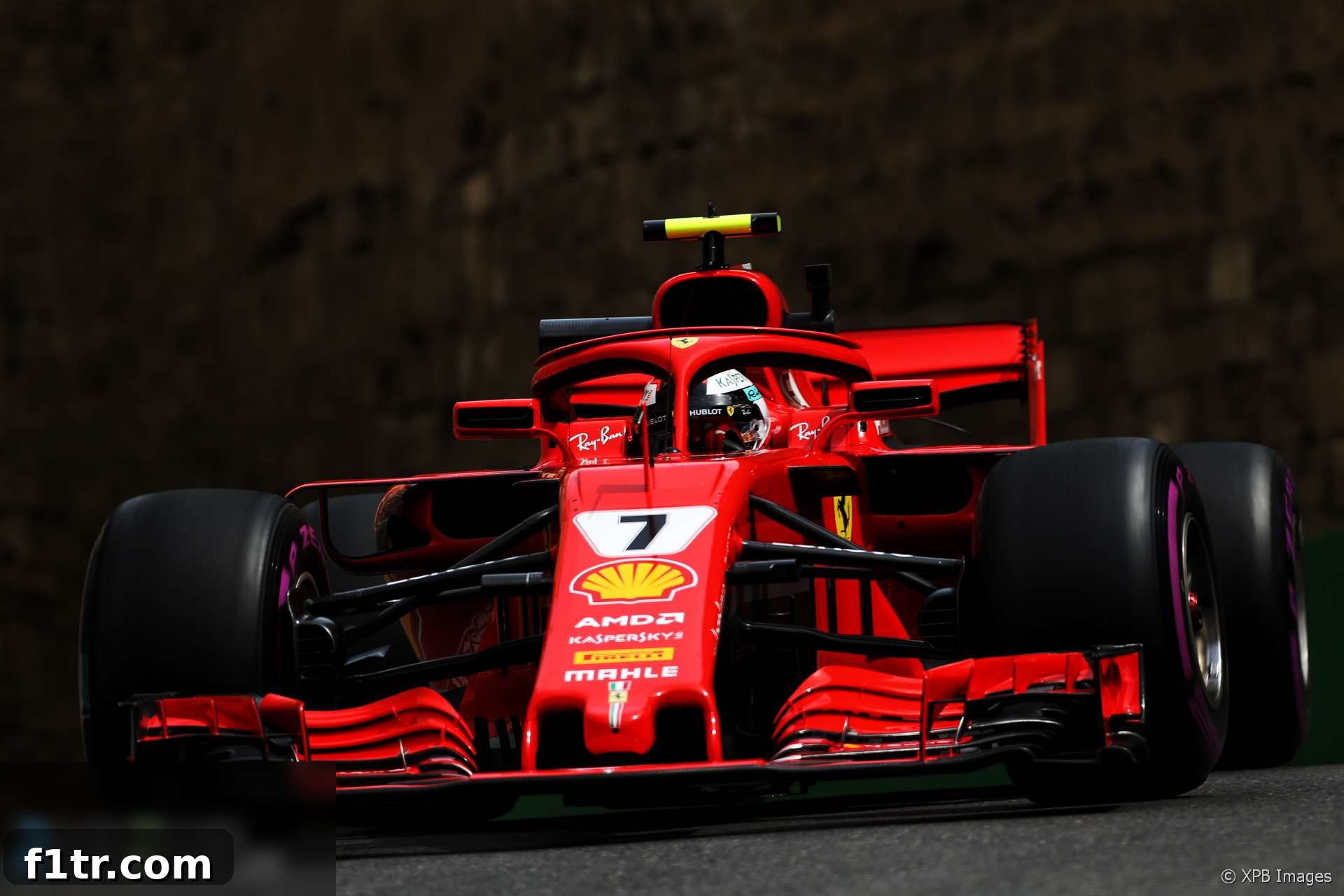
The exhilarating atmosphere of the Azerbaijan Grand Prix qualifying session for the 2018 Formula 1 season was thick with anticipation. Among the elite drivers pushing the limits on the challenging Baku City Circuit, Ferrari’s veteran star, Kimi Raikkonen, found himself in a familiar and profoundly frustrating predicament. A seemingly minor error, executed at the most inopportune moment, cost him what many believed was a certain pole position, leaving the usually stoic Finn to label it a “painful” mistake.
Raikkonen had demonstrated blistering pace throughout the session, culminating in a final qualifying run that showcased his exceptional talent. He had already set the two quickest final sector times of any driver, indicating a lap of immense potential. The SF71H, Ferrari’s formidable challenger that season, was responding beautifully to his inputs. However, as he navigated the critical exit of the final significant corner on the Baku track – a notoriously tricky sequence that demands pinpoint precision and unwavering commitment – a momentary lapse saw his car skid. This subtle loss of control, amplified by the high speeds and the proximity to the finish line, proved devastating, relegating him to a sixth-place grid start.
The Defining Error: A Close Look at Baku’s Crucial Corner
The Baku City Circuit is renowned for its unique blend of tight, technical sections winding through the historic old city and incredibly long, high-speed straights. The final sector, where Raikkonen’s error occurred, is particularly unforgiving. It’s a sequence that sets up the long run to the finish line, where any loss of momentum or control translates directly into lost lap time. Raikkonen’s car momentarily stepped out from under him, a fraction of a second that felt like an eternity for the driver and team alike. Despite his immediate and impressive recovery of the car, the damage was already done. In the unforgiving world of Formula 1 qualifying, where milliseconds dictate grid positions, even a brief sideways movement is enough to shatter a perfect lap.
Reflecting on the incident, Raikkonen offered a candid assessment. He stated he “took it a bit easier on the entry” to the corner, suggesting it wasn’t an over-ambitious attack but rather a subtle misjudgment. He was quick to dismiss rear tyre wear as a contributing factor, though he acknowledged the challenging conditions. “Obviously it’s been a bit tricky with the wind all day,” he noted, highlighting how external variables can subtly influence car behaviour and driver perception. His description of getting “sideways” and then recovering it, only to realise “at that point already I knew it was gone because it’s all flat out and long straights,” perfectly encapsulates the immediate understanding a top-tier driver has of their lost opportunity. The long straight following the corner meant there was no way to regain the time sacrificed by that brief slip.
“Sure Was Fast Enough”: The Frustration of Unfulfilled Potential
There was no doubt in Raikkonen’s mind, or indeed in the paddock, that the lap, had it been clean, would have been enough for pole position. “The lap was good, for sure was fast enough,” he asserted, a statement that underscores the profound disappointment of what might have been. His self-analysis was direct and without equivocation: “When you makes mistakes this is what happens. It came easily but the end result is definitely not what I wanted.” This raw honesty is characteristic of Raikkonen, often dubbed ‘The Iceman,’ who rarely sugarcoats his feelings or performance. The ease with which the mistake occurred made it all the more galling, demonstrating just how fine the margins are at the pinnacle of motorsport.
This incident in Baku wasn’t an isolated event; it was part of a discernible pattern of frustrations in qualifying for Raikkonen during the 2018 F1 season. Prior to Azerbaijan, he had come tantalizingly close to securing pole position at each of the preceding races, only for minor errors or circumstances beyond his control to deny him the top spot. This recurring theme amplified the pain of his Baku mistake, transforming a singular error into a symbol of unfulfilled potential throughout the early part of the season. For a driver of his caliber, with a World Championship title to his name, such repeated near-misses were undoubtedly taking their toll.
The Iceman’s Resolve: Looking in the Mirror
Despite the evident disappointment, Raikkonen’s resolve remained unwavering. “I can only look in the mirror and deal with it and go forward,” he stated, articulating the mindset essential for any top athlete. This stoic acceptance, combined with a determination to learn and improve, is a hallmark of his long and illustrious Formula 1 career. He was acutely aware of his inherent speed and the potential within himself and the Ferrari SF71H. “I know that the speed is there but obviously it’s frustrating when we are fast and you don’t get the result that you want,” he explained. This sentiment resonates deeply with any competitor who knows they possess the capability but falters at the crucial moment.
Raikkonen further elaborated on the unique pain of this particular mistake, distinguishing it from other challenges. “It’s much easier when you know that we have the speed and you know roughly where the speed takes you,” he observed. The frustration intensifies when the raw pace is undeniably present, and the ultimate outcome is thwarted by a self-inflicted wound. “Today I was pretty easily taking care of it in the last corners and then having that mistake is more painful,” he confessed. It was not a struggle for pace, but rather a momentary lapse in precision during what should have been a routine execution. His concluding remarks, “It’s not the first time unfortunately and I doubt it’s the last time. It’s just one of those days,” reflect a seasoned veteran’s philosophical acceptance of the unpredictable nature of top-tier motorsport, while simultaneously hinting at the internal battle against perfection that defines his craft.
Implications for the Race and Championship Hunt
Starting sixth on the grid, especially at a circuit like Baku where overtaking is possible but still challenging, significantly altered Raikkonen’s race strategy. Instead of controlling the pace from the front, he would be forced to battle through the field, contending with dirty air and the unpredictable nature of midfield skirmishes. For Ferrari, who were embroiled in a fierce championship battle with Mercedes in 2018, every point and every grid position mattered. A pole position for Raikkonen would have been a massive morale boost and a strategic advantage, putting two Ferrari cars (Sebastian Vettel had qualified fourth) closer to the front and increasing their tactical options against their rivals.
The Baku City Circuit is notorious for producing chaotic races, often featuring safety cars and dramatic incidents. While a lower starting position offers more opportunities to capitalize on such chaos, it also exposes a driver to a higher risk of being caught up in it. Raikkonen’s task for Sunday’s race became one of recovery and damage limitation rather than outright domination. The “painful” mistake in qualifying had effectively shifted the entire dynamic of his weekend, underscoring the relentless pressure and unforgiving nature of Formula 1, where the smallest error can have profound consequences on a team’s championship aspirations.
2018 F1 season
- F1 feared “death knell” for Drive to Survive after Ferrari and Mercedes snub
- McLaren staff told us we were “totally crazy” to take Honda engines in 2018 – Tost
- ‘It doesn’t matter if we start last’: How Red Bull’s junior team aided Honda’s leap forward
- Honda’s jet division helped F1 engineers solve power unit problem
- McLaren Racing losses rise after Honda split
Browse all 2018 F1 season articles