Aston Martin’s F1 Qualifying Appeal: Unraveling the Carlos Sainz Incident and F1’s Evolving Regulations
The qualifying session for the Shanghai International Circuit at the Chinese Grand Prix proved to be a weekend of strategic challenges and regulatory debates for the Aston Martin Formula 1 team. Their Saturday was marred by a series of events, starting with a penalty for Fernando Alonso, which significantly impacted their race prospects. However, it was their subsequent attempt to elevate Lance Stroll on the grid, following a contentious incident involving Carlos Sainz Jnr during Q2, that truly brought F1’s sporting regulations into sharp focus and ignited a significant discussion within the paddock.
A Dramatic Q2 Incident and Aston Martin’s Pursuit of Justice
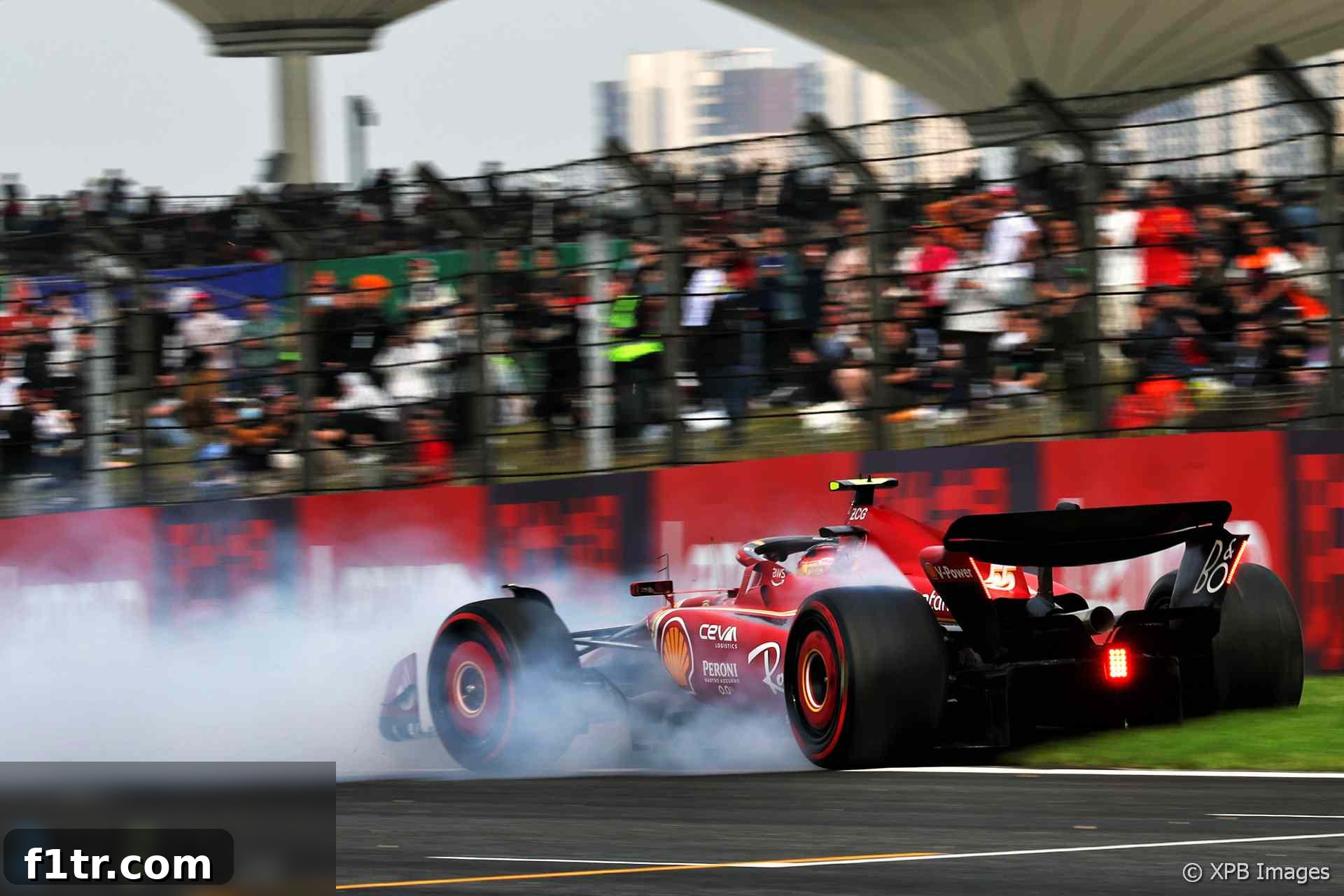
The qualifying session’s second segment, Q2, saw a momentary halt due to a significant incident involving Ferrari’s Carlos Sainz. The Spaniard lost control of his car, resulting in a spin and a collision with the barrier, bringing his SF-24 to a complete stop on the track. What followed was a period of over a minute where Sainz remained stationary, before remarkably managing to restart his car under his own power and rejoin the session. His ability to continue and ultimately progress to Q3 came at the direct expense of Lance Stroll, who was pushed out of the top ten, sparking Aston Martin’s immediate and determined appeal.
Aston Martin swiftly lodged a protest, wielding Article 39.6 of the Formula 1 Sporting Regulations. This particular article explicitly states that “a driver whose car stops on the track during the qualifying session… will not be permitted to take any further part.” For Aston Martin, the interpretation seemed unambiguous: Sainz’s car had stopped, and therefore, he should have been excluded from further participation, which would have promoted Stroll to 10th place on the grid. This wasn’t without precedent; in the 2022 Austrian Grand Prix, Sergio Perez famously lost all his Q3 lap times after stewards determined he should have had a Q2 lap deleted for a track limits infringement, effectively removing him from a later stage of qualifying retrospectively.
Aston Martin’s Dual Arguments Against Sainz’s Rejoining
Aston Martin’s case against Carlos Sainz’s continuation in qualifying was built upon two primary arguments, each aimed at proving a breach of Article 39.6. Their first point centered on the official race control messaging system. They highlighted that race control itself had noted Sainz’s car as “stopped” in an official message. This communication appeared 55 seconds after Sainz’s Ferrari initially came to a halt, while the car remained stationary by the barrier. Sainz then pulled away approximately 22 seconds later, completing a total stationary period of 1 minute and 17 seconds. For Aston Martin, the official designation of “stopped” by race control seemed to be unequivocal evidence of an infringement.
However, the stewards provided a crucial clarification on this point. They stated that race control explained the language used – “stopped” – was standard terminology within their internal timing system and did not necessarily convey the definitive meaning Aston Martin was attributing to it. Essentially, it was a descriptive status update rather than a definitive ruling on the legality of the car’s state under Article 39.6. This interpretation immediately diluted the strength of Aston Martin’s first argument, shifting the focus to the broader interpretation of the rule rather than a literal reading of a system message.
Aston Martin’s second argument revolved around the sheer duration of Sainz’s stoppage. The Ferrari remained by the barrier for a significant one minute and seventeen seconds. In their view, such a lengthy period of inactivity unequivocally constituted a “stop” on the track, making his subsequent resumption a clear violation of the regulations. This argument touched upon the practical implications of a driver stopping for an extended period and then rejoining a competitive session, raising questions about fairness and safety.
The Evolution of F1 Cars and the Ambiguity of “Stopped”
The rule forbidding drivers from rejoining qualifying sessions after a stop has been a part of Formula 1’s Sporting Regulations for many years, originally designed for an era when cars required external assistance to restart after coming to a halt. However, modern Formula 1 technology has introduced a new dynamic that challenges the traditional interpretation of this rule. Since the introduction of the current engine regulations in 2014, F1 power units have been equipped with self-starting capabilities. This technological advancement allows drivers to sit stationary for extended periods and then restart their cars without any outside intervention, a sight now common at the pit lane exit at the beginning of qualifying sessions.
This shift in car capability has inadvertently created a grey area within Article 39.6. What constitutes a “stop” under the current regulations, given that cars can now recover from significant pauses independently? The incident with Carlos Sainz highlighted this ambiguity perfectly. His ability to restart after a prolonged period on track sparked a renewed debate within the F1 community about whether Article 39.6 is still fit for purpose in its current form and if it needs to be revised to reflect modern F1 machinery.
The Stewards’ Deliberation: Intent and Precedent
The stewards’ hearing for Aston Martin’s protest was not limited to representatives from the protesting and defending teams. Crucially, other team managers were present, and their input proved beneficial to Ferrari’s cause. The stewards made it clear that “it was clear from the examples cited by a number of the team managers present” that Article 39.6 was never intended to be interpreted so strictly as to mean *any* driver who comes to a stop should be barred from further participation. This collective understanding from across the paddock suggested a prevailing practical interpretation rather than a purely literal one.
The FIA team further clarified their stance, explaining that as long as a car could restart and continue from a stopped position “within a reasonable time,” it would ordinarily be permitted. They suggested a typical timeframe of “around 30 seconds,” acknowledging that this could vary depending on specific circumstances. Interestingly, the teams themselves admitted to having previously attempted to agree on what they considered a “reasonable length of time” before a car would be deemed definitively “stopped” for the purposes of the rule. Unfortunately, these discussions had failed to yield a final agreement on a maximum allowable stationary time, leaving the rule open to interpretation.
Further bolstering their decision, the stewards cited several historical examples from races in Canada, Monaco, and Baku where cars had “stopped” on track – and thus, under a strict interpretation, would have breached Article 39.6 – but were nevertheless permitted to continue and take further part in their respective sessions without complaint from any teams. A notable example included Alexander Albon’s Williams, which was stationary for approximately 40 seconds at the 2022 Canadian Grand Prix. Albon restarted his car without external assistance, and the official messaging system similarly indicated his car had “stopped.” Crucially, no team lodged a protest then, establishing a precedent of allowing self-restarting cars to continue after a reasonable stoppage.
The Unimplemented Amendment and Future Clarity
Adding another layer to the complexity, the stewards’ verdict revealed that less than 12 months prior, a discussion had taken place within the Formula 1 Commission Meeting in Spa, Belgium, on July 28, 2023. Article 39.6 was specifically addressed, following an incident involving Zhou Guanyu during qualifying for the Canadian Grand Prix last year, where he received outside assistance. The conclusion reached at that meeting was an agreement “to add ‘outside assistance’ to Article 39.6,” intending to clarify that only stops requiring external help would lead to exclusion.
However, the stewards were informed that this crucial amendment to Article 39.6 was never formally implemented into the regulations. While they could not rely on these minutes as binding law, they noted that the documented agreement indicated a consensus among attendees consistent with the approach race control was already adopting – focusing on whether outside assistance was provided, rather than merely if a car came to a temporary stop. This lapse in regulatory update meant the stewards had to interpret the existing, arguably outdated, rule based on its perceived intent and established precedents, rather than a clearer, more modern definition.
Looking Ahead: The Urgent Need for Regulatory Reform
Carlos Sainz’s one minute and seventeen-second stoppage at the Shanghai International Circuit arguably represents a new high watermark for how long a Formula 1 car has been stationary on track and subsequently rejoined a session without penalty. This incident, and Aston Martin’s unsuccessful appeal, underscore a critical need for clearer, more definitive regulations regarding temporary stoppages in qualifying. The stewards’ expectation is that the race director will ultimately take the decision to set a precise upper limit for how long a car can be stationary and still be allowed to continue.
The debate surrounding Article 39.6 highlights the ongoing challenge for the FIA and Formula 1 to ensure that the sporting regulations keep pace with rapid technological advancements in the sport. The ambiguity surrounding what constitutes a “stop” and the lack of a defined “reasonable time” can lead to inconsistent application and potential disputes, impacting sporting fairness and competitive integrity. As F1 continues to evolve, regular reviews and proactive amendments to its rulebook will be essential to prevent similar controversies and ensure a clear, equitable playing field for all teams and drivers.
Related F1 Content from the Chinese Grand Prix
- Alonso and Sainz incidents prompt changes to Formula 1’s rules
- Aston Martin fail in bid to have Alonso’s Shanghai penalty reviewed
- Mercedes cleared over Hamilton pit stop infraction as ‘nearly all teams in breach’
- Aston Martin petitions FIA to review Alonso’s penalty for Sainz collision
- “You need to be more on it”: 12 unheard radio exchanges from the Chinese GP
Browse all 2024 Chinese Grand Prix articles