Pierre Gasly Relives History: Driving Ayrton Senna’s Iconic Toleman F1 Debut Car
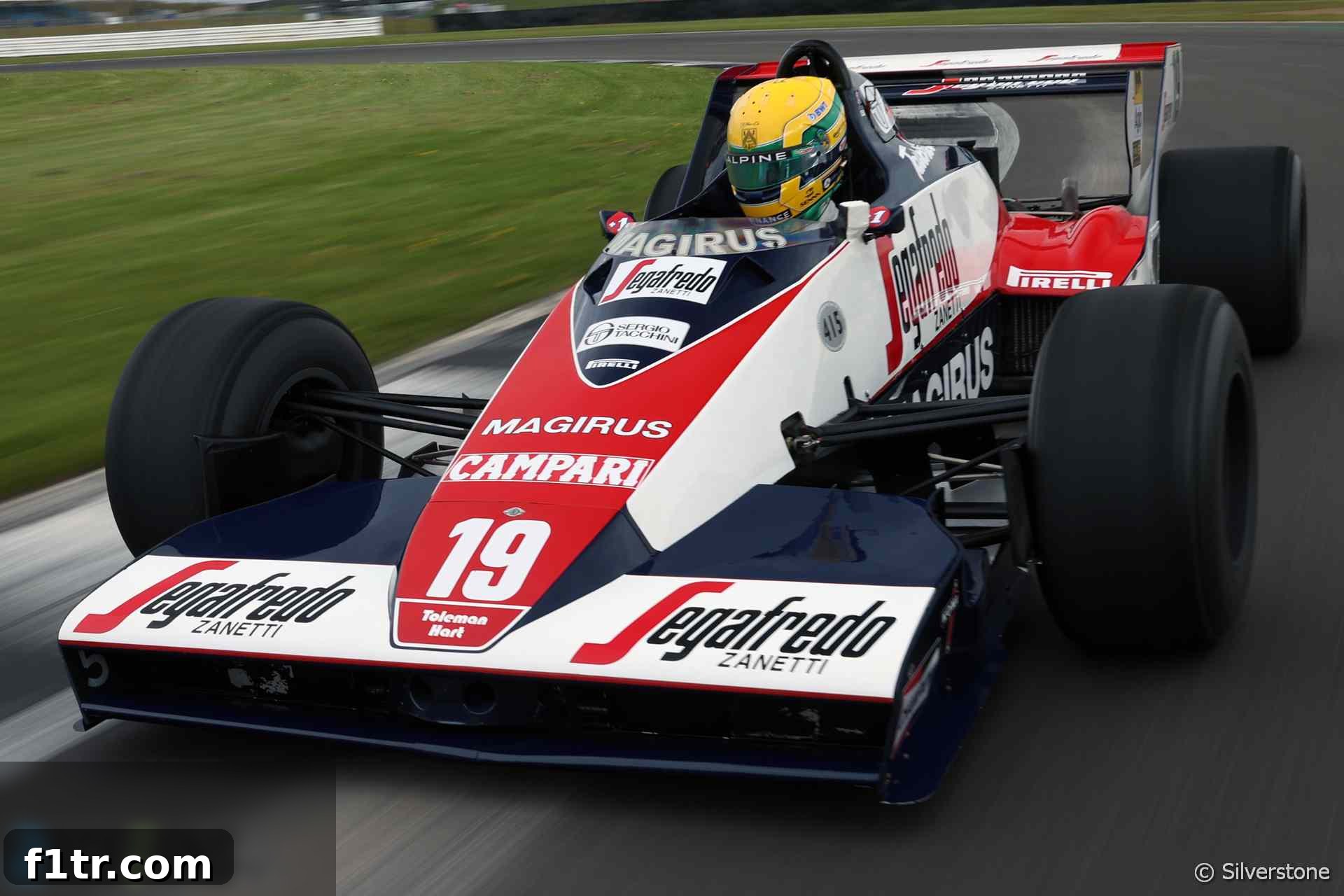
In a truly electrifying moment for Formula 1 enthusiasts and fans of motorsport history, Pierre Gasly recently reignited the engine of the very car Ayrton Senna drove for his Formula 1 debut 40 years ago. The Toleman-Hart TG183B, a significant piece of F1 heritage, roared back to life at Silverstone, with Gasly, a modern F1 star, taking the wheel. This extraordinary event served as a profound tribute to one of racing’s most revered figures, blending the past and present of Formula 1 in an unforgettable spectacle.
For Gasly, an ardent admirer of the legendary Brazilian three-time champion, this experience was more than just a drive; it was a deeply personal connection to his hero, who tragically passed away at Imola three decades ago. The 28-year-old Alpine racer has consistently paid homage to Senna, notably by adopting Senna’s distinctive helmet design during his first F1 race at Silverstone in 2020, a tradition he proudly continues this weekend, further solidifying his respect for the icon.
A Modern Star’s Tribute to a Legend: Pierre Gasly’s Deep Connection to Senna
Pierre Gasly’s reverence for Ayrton Senna is well-documented, extending beyond mere admiration to a profound appreciation for Senna’s unparalleled skill and pioneering spirit. This connection was palpably evident as Gasly settled into the cockpit of the Toleman-Hart TG183B. The opportunity to drive the car that launched Senna’s illustrious F1 career, a car that predates Gasly himself, was a dream realized for the Frenchman.
“I can’t remember such an incredible experience,” an emotional Gasly recounted. “Driving Senna’s first-ever F1 car exceeded all my expectations. It was so emotional. I had never before been in a racing car older than me, and the purity of the driving was incredible – just three pedals and a simple steering wheel, quite unlike what I’m used to in a modern F1 car. It was a once-in-a-lifetime episode that I will never forget. Very, very special.”
Gasly’s description perfectly encapsulates the stark contrast between the raw, mechanical nature of early 1980s Formula 1 cars and the sophisticated, electronically advanced machinery of today. The TG183B offers a visceral driving experience, demanding a different kind of finesse and courage from its pilot. For Gasly, this hands-on encounter provided invaluable insight into the challenges and triumphs faced by drivers of Senna’s era, deepening his understanding of the sport’s evolution and the sheer talent required to tame these powerful machines.
The Toleman TG183B: A Glimpse into F1’s Turbo Era
The Toleman-Hart TG183B is more than just a vintage race car; it’s a testament to the innovative, sometimes audacious, engineering of its time, and the foundation of a legendary career. Designed by the brilliant Rory Byrne, who would later achieve immense success with Benetton and Ferrari, the TG183B was a product of the highly competitive and technologically exciting turbo era of Formula 1. Its unique characteristics set it apart on the grid.
Weighing a mere 540 kilograms, the TG183B was almost one-third lighter than Gasly’s current Alpine A524, highlighting the significant weight evolution in F1 over the decades. This lightweight construction, combined with its compact size, made it an agile, albeit challenging, machine to master. Its aerodynamic features were particularly novel for the period, sporting an unusually tall front wing designed to house its oil and water radiators – an ingenious solution to manage cooling and optimize airflow. Furthermore, a distinctive double rear wing arrangement further pushed the boundaries of contemporary design.
Powering this engineering marvel was a 1.5-litre turbocharged engine, meticulously crafted by Brian Hart. This unit was capable of producing around 700bhp, a staggering figure for a car of its weight and size, demanding immense control and bravery from the drivers. The TG183B was an evolution of a car Toleman originally introduced for the final races of the 1982 season. Before Senna’s arrival, Derek Warwick had already demonstrated the car’s potential, securing the team’s first points finish with the TG183B late in 1983. Toleman continued to campaign this car for the initial four rounds of the 1984 season, setting the stage for Senna’s dramatic entry into the sport.
Ayrton Senna’s Formative Season: The 1984 Debut with Toleman
Ayrton Senna’s Formula 1 debut in 1984 with the Toleman team marked the genesis of a career that would redefine motorsport. His journey began at his home ground, Jacarepagua, where, despite a promising start, he retired eight laps into the race due to a loss of turbo boost. However, the raw speed and inherent talent of the young Brazilian were undeniable, as he had already signaled his potential by qualifying over 1.7 seconds quicker than his seasoned teammate, Johnny Cecotto, a gap that stunned the paddock and immediately stamped Senna as a prodigious talent to watch.
His next outing at Kyalami proved to be a milestone. Senna secured his first championship point with a commendable sixth-place finish, showcasing his tenacity even when faced with adversity. This achievement came despite damaging the TG183B’s nose after striking debris, a testament to his never-say-die attitude and ability to extract performance from challenging situations. The following race at Zolder saw him repeat this impressive result, though the point for sixth place was only officially awarded several weeks later. This was due to the eventual disqualification of the Tyrrell team from the championship, which saw Stefan Bellof lose his sixth-place finish, elevating Senna in the standings.
The final weekend for Senna in the TG183B presented a unique challenge and, surprisingly, the only ‘did not qualify’ of his illustrious career. A contentious dispute between Toleman and its tyre supplier Pirelli meant Senna was unable to run on Friday. Technical troubles then confined him to the garage on Saturday, preventing him from setting a qualifying time. He consequently missed the cut by over two seconds, a stark reminder of the unpredictable nature of early F1 and the critical role of team logistics and supplier relationships.
From TG183B to TG184: Senna’s Unmistakable Rise to Stardom
The turning point for both Ayrton Senna and the Toleman team arrived with the introduction of the new TG184 chassis and a crucial switch from Pirelli to Michelin tyres. This decision, though it would cause the team significant trouble 12 months later, proved instrumental in unlocking the team’s and Senna’s true potential in 1984. With the TG184, Toleman enjoyed its strongest ever season, and Senna truly began to demonstrate the raw talent that would later define his legendary status.
The Monaco Grand Prix, only the TG184’s second race, became the stage for one of F1’s most iconic drives and a pivotal moment in Senna’s burgeoning career. In treacherous, rain-soaked conditions, Senna delivered a masterclass in car control and audacious racing. Starting 13th, he scythed through the field with breathtaking precision, rapidly closing the gap on race leader Alain Prost. The speed at which he was gaining on Prost was astounding, taking seconds out of the Frenchman’s advantage each lap. The race was controversially abandoned due to safety concerns before Senna could challenge for the lead, leaving many to wonder what might have been. Nonetheless, his performance firmly cemented his status as a future star, establishing him as a rain master and a formidable force.
This sensational drive was not an isolated incident. Senna continued to impress throughout the season, adding two more podium finishes to his tally at Brands Hatch and Estoril. These consistent strong performances, achieved with a midfield team, underscored his extraordinary capabilities and hinted at the greatness that lay ahead. The 1984 season, despite its early challenges with the TG183B, became a foundational year, showcasing the nascent stages of a talent that would captivate the world and earn him a place among motorsport’s immortals.
Toleman’s Enduring Legacy: A Foundation for Future Greats
The 1984 season, powered by the TG184, truly marked the finest hour for the Toleman team. This remarkable outfit was founded by the visionary Ted Toleman, who sadly passed away earlier this year at the age of 86. Toleman’s initial venture into Formula 1, building on its success in junior categories, was driven by a passion for racing and a commitment to engineering excellence.
The team’s journey through Formula 1 reflects the sport’s dynamic nature. Toleman was eventually acquired by the Benetton clothing company, a move that ushered in a new era of vibrant liveries and further success, including multiple world championships. This evolution continued when the team was later taken over by Renault, a manufacturer with a deep and storied history in Formula 1. Today, the very same team operates under its Alpine sports car brand, forming the team Pierre Gasly currently drives for. This historical lineage creates a powerful connection: Gasly, driving for Alpine, is an indirect successor to the legacy forged by Senna in a Toleman, bringing the narrative full circle.
The Spirit of Senna Lives On
The recent event at Silverstone, with Pierre Gasly at the controls of the Toleman-Hart TG183B, was far more than a simple demonstration run. It was a vibrant homage to Ayrton Senna’s indelible legacy, a celebration of Formula 1 history, and a powerful reminder of the deep emotional connection between past and present generations of drivers and fans. Senna’s journey from a promising rookie in a Toleman to a three-time world champion captivated millions, and his spirit continues to inspire. Events like these ensure that the stories of heroes like Senna, and the iconic machines they drove, remain alive and continue to educate and thrill new generations of motorsport enthusiasts, further cementing his place as an eternal legend of Formula 1.
Formula 1 Insights
- Verstappen loathes F1’s new generation of cars – but what do his rivals reckon?
- The ‘throwback weekend’ is back in fashion. But it’s a flawed concept – especially for F1
- Is Formula 1’s double race cancellation a blessing in disguise?
- Todt admits Schumacher crashed on purpose – but did it really cost him two titles?
- 25 of the most memorable radio exchanges from the ‘Max and GP show’
Browse all Formula 1 articles