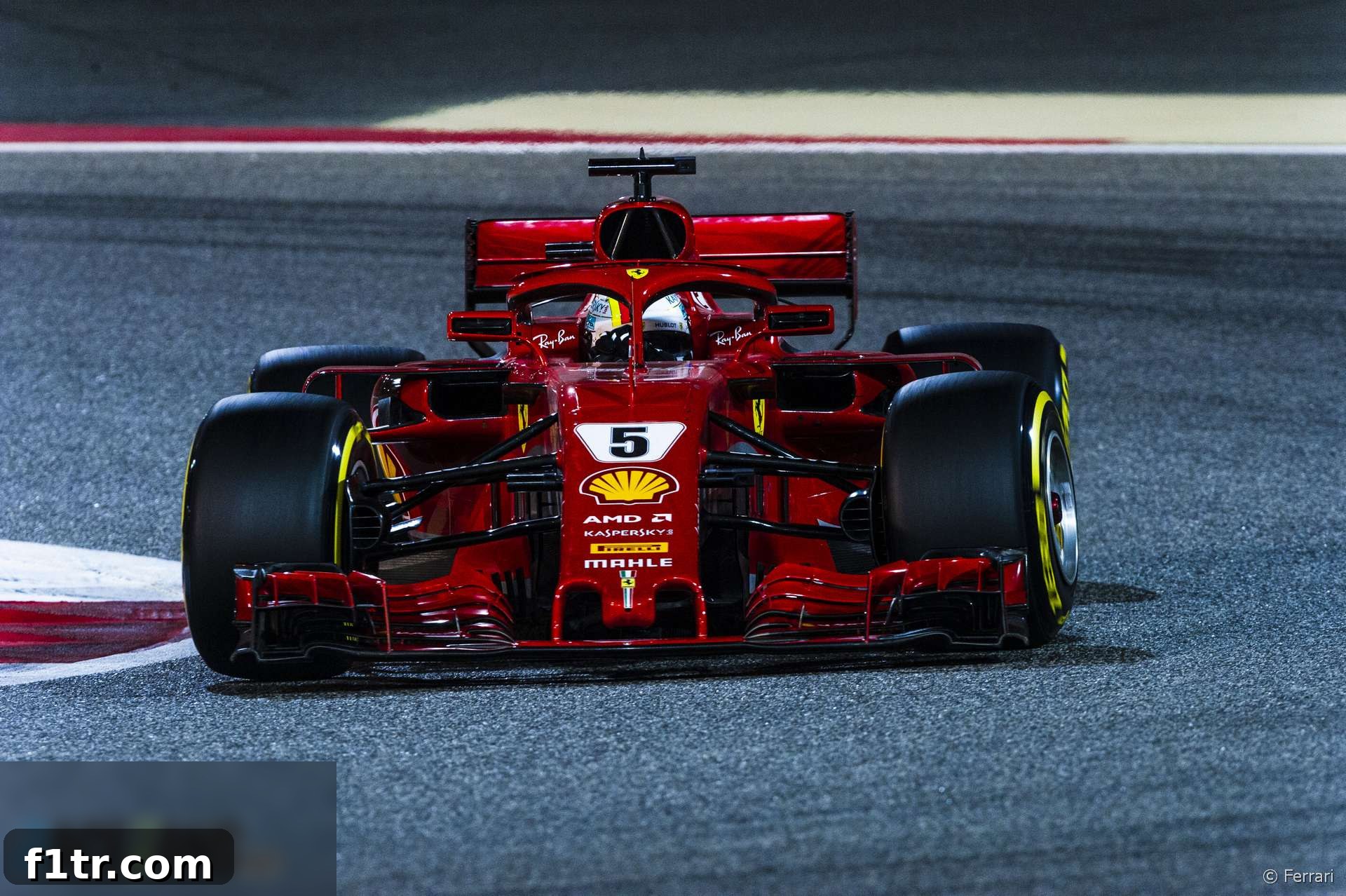
In the high-stakes world of Formula 1, where every decision, every word, and every millisecond counts, strategic deception can be as crucial as raw pace. This was vividly demonstrated during the thrilling 2018 Bahrain Grand Prix, where Sebastian Vettel, driving for Ferrari, successfully deployed a cunning tactic to clinch victory under immense pressure. Towards the nail-biting conclusion of the race, Vettel admitted to intentionally sending a misleading radio message to his Ferrari pit crew, a calculated move designed to throw his rivals at Mercedes-AMG Petronas Motorsport, particularly Valtteri Bottas and Lewis Hamilton, off their game.
The Ferrari team had made a bold strategic call earlier in the race: abandon plans for a second pit stop for Vettel. This meant the four-time world champion had to stretch a single set of soft compound Pirelli tyres to the very end of the grueling desert race, a monumental challenge given the high temperatures and abrasive track surface of the Sakhir circuit. As the laps dwindled, and the two formidable Mercedes drivers closed in, the pressure on Vettel mounted exponentially. It was in this crucible of intense competition that Vettel’s strategic brilliance shone through, employing a psychological tactic over the team radio.
With roughly ten laps remaining in the Grand Prix, Vettel transmitted a seemingly innocuous message: “Everything’s under control.” Speaking after his hard-fought victory, Vettel candidly admitted the true intent behind this communication. “That was a lie because I was hoping they’d tell Valtteri ‘Sebastian is taking it easy’, tell him to save the engine, turn it down and give up. But they didn’t do that,” he revealed, shedding light on the intricate mind games played at the pinnacle of motorsport. This demonstrates the constant chess match between teams and drivers, where not just speed, but also cunning and psychological warfare, dictate the outcome.
Vettel’s logic was sound: if he had communicated his actual struggles with rapidly degrading tyres, Mercedes would undoubtedly have relayed this information to Bottas, urging him to push harder with all available power until the chequered flag. Such transparency would have given Bottas a significant psychological edge and a clear target. Conversely, projecting an image of calm control, even if false, was intended to sow doubt and potentially encourage Mercedes to instruct Bottas to conserve his engine, believing Vettel was comfortably managing his lead. “Obviously my plan didn’t work but I tried,” Vettel reflected, acknowledging the calculated risk he took, even though Mercedes ultimately didn’t bite.
The reality for Vettel was far from “under control.” He detailed the dramatic performance drop-off of his soft tyres with about ten laps to go. “They weren’t getting any better. It was really difficult to keep the car on the line especially in turn eight, turn 10, just getting out of the low speed corners was really tricky,” he explained. These low-speed corners, requiring maximum traction and precise throttle control, become particularly treacherous with worn tyres, making the car prone to oversteer or understeer, costing precious tenths of a second and demanding exceptional car control from the driver. Navigating these sections lap after lap, knowing a charging Bottas was mere seconds behind, would have been an immense test of skill and nerve.
The climax of the race was a true spectacle of defensive driving versus relentless pursuit. Bottas, in the faster Mercedes, relentlessly chipped away at Vettel’s lead, but it took until the final lap for him to enter the critical DRS (Drag Reduction System) detection zone, putting him within a second of the Ferrari. This moment was pivotal. “When I saw him in DRS range, I was thinking it would be difficult to make it last,” Vettel admitted. His strategy then shifted from pure defence to intelligent energy management. He had to meticulously save and deploy his hybrid energy (ERS – Energy Recovery System) to ensure he had the maximum power boost available on the long straights, particularly the main straight where DRS would be most effective for Bottas. This sophisticated deployment strategy proved crucial in countering Bottas’s straight-line speed advantage, allowing Vettel to just hold on.
Ferrari’s decision to commit to a single-stop strategy was a reactive one, influenced by Mercedes’ initial approach. The Mercedes drivers had run longer first stints on their tyres and then switched to the medium compound, signalling their intention to likely complete the race without another stop. This forced Ferrari’s hand. Vettel explained that staying out on the softs was their “only chance to win the race.” A two-stop strategy for Vettel would have put him out of sync with Mercedes, forcing him to fight through traffic or concede track position, a disadvantage they couldn’t afford against the formidable Silver Arrows.
“With them on the medium tyre and having such strong pace for long we knew it would be difficult to come out with a fresh set,” Vettel stated, underscoring the strategic conundrum. Had Ferrari pitted Vettel for fresh tyres, he would have rejoined the track behind both Mercedes cars. “We’d probably chase them down but probably to pass is a different story. First we’d have to get past Lewis and then chase Valtteri and pass Valtteri. In the end we tried and it worked. It’s good when it works out like that,” he concluded, highlighting the massive risk and equally massive reward of their audacious strategy. This single-stop gamble was a testament to Ferrari’s belief in Vettel’s ability to manage his tyres and defend, even against the most relentless of pursuers.
The 2018 Bahrain Grand Prix stands as a classic example of how Formula 1 is not just about raw speed and engineering prowess, but also about the human element – the driver’s skill, the team’s strategic acumen, and the psychological battles fought on and off the track. Vettel’s radio bluff, while not directly deceiving Mercedes, showcased his quick thinking and willingness to push the boundaries of strategic engagement. It was a race that encapsulated the very essence of Grand Prix racing: high speed, high stakes, and high drama, concluding with a masterclass in defensive driving and strategic improvisation.
Such moments contribute significantly to the legend of Formula 1, keeping fans on the edge of their seats and reminding everyone that victory often hinges on fine margins and clever tactics. The memory of Vettel’s Ferrari sliding and gripping, lap after lap, under the floodlights of Bahrain, with the Mercedes cars looming large in his mirrors, remains one of the most iconic finishes of that season. It was a victory forged not just by speed, but by steel nerves and a subtle, yet significant, piece of psychological warfare that underscored Sebastian Vettel’s championship pedigree.
Go ad-free for just £1 per month>> Find out more and sign up
2018 F1 Season: Related Articles & Insights
Delve deeper into the memorable 2018 Formula 1 season with these insightful articles:
- F1 feared “death knell” for Drive to Survive after Ferrari and Mercedes snub
- McLaren staff told us we were “totally crazy” to take Honda engines in 2018 – Tost
- ‘It doesn’t matter if we start last’: How Red Bull’s junior team aided Honda’s leap forward
- Honda’s jet division helped F1 engineers solve power unit problem
- McLaren Racing losses rise after Honda split
Browse all 2018 F1 season articles