Daniil Kvyat’s Enduring F1 Journey: The Tale of a Resilient Racer’s Multiple Returns
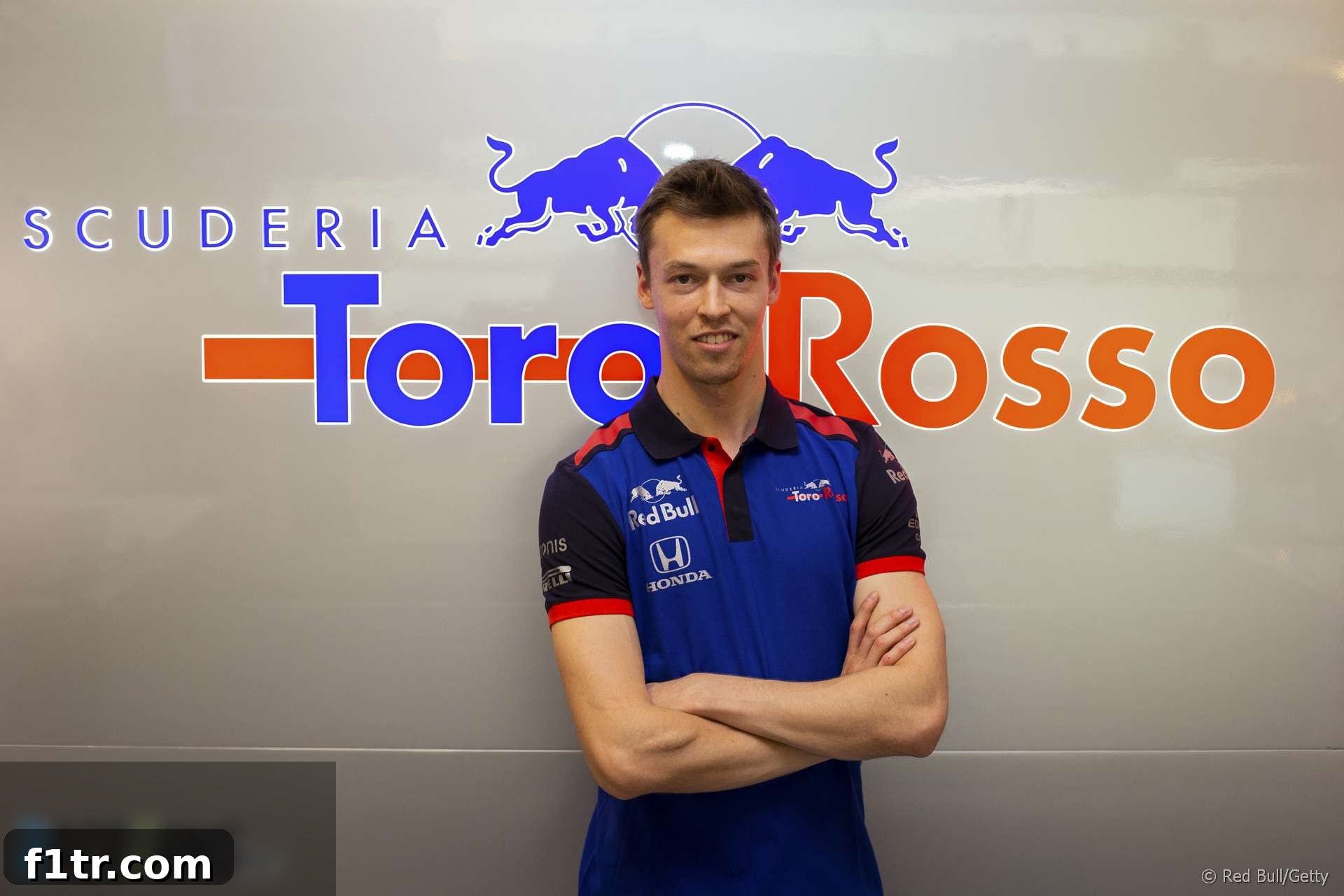
In the fiercely competitive world of Formula 1, opportunities are scarce and second chances are a rarity. Yet, the remarkable career of Daniil Kvyat stands as a testament to persistence, raw talent, and the intricate dynamics of motorsport. Kvyat, often dubbed the ‘Toro Rosso boomerang’, has carved a unique path, demonstrating an uncanny ability to return to the pinnacle of racing, arguably embarking on his fourth significant opportunity to solidify his place in the sport.
Kvyat’s F1 narrative is a rollercoaster of meteoric rises, sudden demotions, and improbable comebacks, painting a vivid picture of the relentless pressures and high stakes faced by young talents in the Red Bull driver programme. His journey from a promising junior to a Grand Prix podium finisher, only to face unexpected setbacks, has left an indelible mark on his career and captivated fans.
The Meteoric Rise and Abrupt Descent: Kvyat’s Early F1 Stint (2014-2016)
Daniil Kvyat’s Formula 1 odyssey began with great promise in 2014, making his debut with Scuderia Toro Rosso as the reigning GP3 Series champion. His swift progression through the junior categories showcased a prodigious talent, catching the eye of the formidable Red Bull Racing empire. After a solid rookie season, a surprising turn of events propelled him even further up the ranks. When four-time world champion Sebastian Vettel made the shock announcement of his departure from Red Bull to Ferrari, Kvyat found himself at the front of the queue for a coveted seat at the senior team for the 2015 season.
This promotion was a clear indication of Red Bull’s faith in his potential. In his debut season with Red Bull Racing, Kvyat seemed to justify their decision, notably out-scoring his highly-rated teammate Daniel Ricciardo. His performances included a memorable second-place finish at the Hungarian Grand Prix, signaling his arrival as a serious contender. The young Russian displayed flashes of exceptional speed and aggressive racing, suggesting a long and successful career lay ahead.
However, the rapid ascent of Max Verstappen, another prodigious talent within Red Bull’s junior stable, irrevocably altered Kvyat’s trajectory. Verstappen’s blistering debut with Toro Rosso in 2015, coupled with Kvyat’s increasingly erratic performances at the start of the 2016 season, led to a pivotal decision by Red Bull. A particularly disastrous home race in Russia in 2016, where Kvyat was involved in two separate incidents that compromised three of the four Red Bull and Toro Rosso cars, sealed his fate. Mid-season, he was demoted back to Toro Rosso, swapping seats with Verstappen, who then went on to win his very first race for Red Bull Racing at the Spanish Grand Prix.
This dramatic reversal of fortunes, from front-runner to demoted driver in such a short span, highlighted the brutal efficiency and unforgiving nature of the Red Bull driver development system. It also sparked considerable debate among fans and pundits about the fairness and timing of such a decision, particularly given Kvyat’s strong showing in 2015.
The Struggle and Apparent End: Kvyat’s Second Toro Rosso Stint (2016-2017)
Kvyat was granted a second chance to impress at Toro Rosso for the remainder of the 2016 season and into 2017. However, this period proved challenging. While he sought to rebuild his confidence and form, his performances often lacked the consistency and decisive edge required to stand out. Throughout this tenure, his teammate, Carlos Sainz Jnr, consistently out-scored him, showcasing greater reliability and speed. The pressure was further intensified by the emergence of another Red Bull junior talent, Pierre Gasly, who was fiercely competing for the GP2 (now F2) title and knocking on the F1 door.
Despite the accumulating evidence, Red Bull, somewhat surprisingly, showed less immediate enthusiasm for Gasly’s GP2 form than they had for Kvyat’s GP3 success three years prior. This led to Kvyat being handed a third opportunity at Toro Rosso for the 2017 season, a decision that underscored the complex and often unpredictable nature of driver management within the Red Bull program. However, 2017 proved to be a continuation of the same struggles. Sainz continued to be the more productive driver, while Kvyat accumulated more penalty points than championship points, signaling a deepening crisis of confidence and performance.
The nadir of this period was arguably the 2017 Singapore Grand Prix. While a jubilant Carlos Sainz claimed an impressive fourth place, Kvyat crashed his car in treacherous conditions just ten laps into the race. This incident seemed to be the final straw. It soon became clear that Kvyat’s time at Toro Rosso was drawing to a close, and he was ultimately shown the door a few races later, seemingly bringing his Formula 1 career to an abrupt end at the age of 23. This dismissal was widely perceived as the definitive conclusion to his F1 aspirations, a sad but perhaps inevitable outcome given his struggles and the intense competition for seats.
The Unforeseen Return: Why Red Bull Issued a Fourth Chance
The world of Formula 1 is, however, rarely predictable. Through another bizarre twist of fate, Carlos Sainz Jnr moved away from the Red Bull family, and astonishingly, Daniil Kvyat found himself on the precipice of another stint at Toro Rosso. This comeback, his fourth opportunity, begged the question: what compelled Red Bull to offer him yet another shot?
Undoubtedly, a degree of expediency played a significant role. The Red Bull-owned teams needed a replacement for Pierre Gasly, who, mirroring Kvyat’s earlier rapid ascent, had been promoted to Red Bull Racing. This created a vacant seat at Toro Rosso, and Kvyat, a known quantity with F1 experience, represented a pragmatic choice.
Beyond mere necessity, Kvyat had spent a year as a development driver for Ferrari, working extensively in their simulator. This experience would have provided him with invaluable insights into a competitor’s power unit and chassis development, making him an attractive asset for the Honda-powered Toro Rosso team. His technical feedback and understanding of modern F1 cars, honed during his time away, were undeniable benefits. Furthermore, Kvyat presented another kind of value: he was set to become the sport’s sole Russian driver following Sergey Sirotkin’s departure, a significant marketing advantage for teams seeking to expand their presence in the growing Russian market and attract new sponsorship opportunities.
However, what teams truly prize above all else is raw, unadulterated speed. And in the eyes of those best-placed to appreciate it – his former teammates and engineers – Kvyat undeniably possesses that inherent potential, even if he hadn’t always been able to consistently access or capitalize on it during his previous F1 outings. This belief in his underlying talent proved to be a critical factor in his improbable return.
Insights from Former Teammates: Acknowledging Talent and Maturity
Few drivers know Daniil Kvyat better than his former Formula 1 teammate from 2016-2017, Carlos Sainz Jnr. Their shared history extends even further back, having competed against each other and been part of the Red Bull Junior Team development program since their karting days. Sainz’s perspective offers unique insight into Kvyat’s capabilities.
“When he left Formula 1, I don’t know why, but I had the feeling he could make it back,” Sainz remarked last year. He elaborated, “I’ve known Dany for a while and I know how well he recovers from setbacks. And I’ve been together with him since we were both 13 years old so I had that feeling.” This long-standing relationship provides a deeper understanding of Kvyat’s character and resilience. Sainz openly expressed his pleasure at Kvyat getting another chance, stating, “I’ve seen how talented he is in all the categories that we’ve been together, before Formula 1, and I’ve seen how talented he is in a Formula 1 car when he gets things together and right. I think he deserves a Formula 1 seat.” This endorsement from a direct competitor, who had outperformed him in their previous F1 stint, speaks volumes about the respect Kvyat commands among his peers for his sheer natural speed.
Daniel Ricciardo, Kvyat’s teammate at Red Bull Racing in 2015 and early 2016, also shared his thoughts on the Russian driver’s return. Ricciardo was typically the quicker of the two during their only full season together in 2015, yet Kvyat managed to outscore him by three points, a statistic that underlines Kvyat’s potential on his best days. Ricciardo believes that Kvyat’s year away from the sport will ultimately serve him well.
“I think the year off will actually be quite good for him,” Ricciardo commented. “It’s probably made him realise a few things with himself and I think he’ll appreciate being back in the sport and I think he’ll be more mature. I’m not saying he was immature but I think these things will help him keep a cooler head so he’ll be able to fully reach his potential more consistently.”
Ricciardo further elaborated on Kvyat’s raw speed, albeit with an accompanying inconsistency. “On his day he was quick,” said Ricciardo. “Some days I was like ‘hey, he pulled that out’ but I was never sure if he really knew how he was doing it when the next day or maybe a week later he was eight tenths off.” This observation highlights the challenge Kvyat faced in harnessing his exceptional talent consistently. Ricciardo also pointed to Kvyat’s youth during his initial F1 foray. “He was very young as well. I think some young drivers are able to handle it but I think they’re exceptions. Normally, I don’t think a 20-year-old should handle F1 easily. Obviously Max and all that, there’s a few exceptions but to put everyone in that category, it’s too high an expectation.” This insight underscores the immense pressure placed on young drivers and the rarity of talents like Max Verstappen who can immediately thrive in such a demanding environment.
The “Boomerang” Effect: Learning from the Past, Looking to the Future
Daniil Kvyat’s often destructive, aggressive driving style during his first Formula 1 stint famously earned him the moniker ‘the torpedo’. However, as he embarks on what is arguably his fourth chance in the sport, a new, more fitting nickname might emerge: ‘the boomerang’. His repeated returns, each time with the hope of a more mature and consistent performance, speak to a career defined by resilience and second chances.
There are numerous examples in Formula 1 of drivers who arguably entered the premier category too soon and benefited immensely from a period away from the grid. Felipe Massa, for instance, took a sabbatical after his challenging debut season with Sauber in 2002. He returned to the team in 2004 as a much more complete and formidable driver, subsequently becoming a multiple Grand Prix winner and a championship runner-up with Ferrari. Kvyat’s time away from the intense scrutiny of active F1 competition, including his valuable year in the Ferrari simulator, could provide a similar growth period, allowing him to recalibrate and refine his approach.
This latest return represents a critical juncture for Kvyat. It’s an opportunity not just to prove his speed, but to demonstrate the maturity and consistency that Ricciardo alluded to. The stakes are incredibly high; failure to deliver could signal the definitive end of his F1 career. However, if 2019 becomes the first chapter in a long and stable career in the sport, it would not come as a surprise to some of his most respected peers on the grid.
Carlos Sainz Jnr’s final words on Kvyat encapsulate this sentiment of respect and belief: “Dany on his day is very difficult to beat. Extremely difficult to beat. Mostly [I’m] not here to speak well about my direct competitors but I just want to say I have a lot of respect for him. I keep to myself why and all that but he is definitely a guy who deserves to be in Formula 1.”
Kvyat’s journey is a compelling reminder that talent alone is not enough in Formula 1; consistency, mental fortitude, and the ability to learn from setbacks are equally vital. His fourth opportunity at Toro Rosso is more than just a second chance; it’s a profound test of his evolution as a driver and his enduring passion for the sport.
@HazelSouthwell contributed to this article.
2019 F1 season
- Crying in the Melbourne car park at 2019 grand prix was my career low – Ocon
- McLaren Racing reports reduced £71 million loss in 2019
- Kvyat: Hockenheim podium last year was “my biggest achievement” so far
- How the FIA’s new encrypted fuel flow meter targets Ferrari’s suspected ‘aliasing’ trick
- “He smashed my office door”: 23 must-see moments from ‘Drive to Survive’ season two
Browse all 2019 F1 season articles