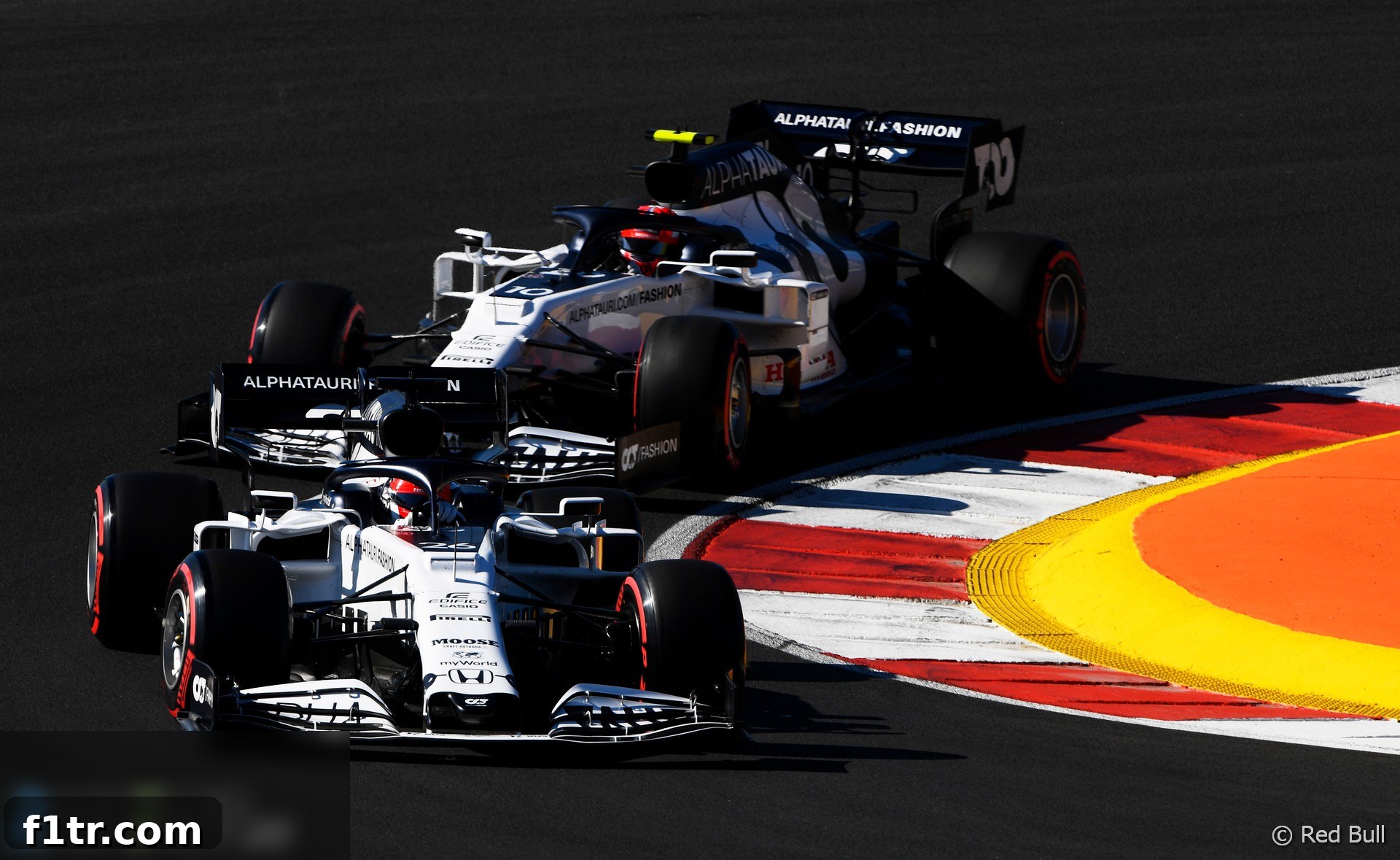
The 2020 Formula 1 season delivered an array of unforgettable moments, none more surprising and heartwarming than Pierre Gasly’s stunning victory at the Italian Grand Prix. This triumph wasn’t just a career highlight for Gasly; it stood out as by far AlphaTauri’s most significant achievement of the season, a fortuitous yet superbly executed win that resonated throughout the paddock. It underscored Gasly’s undeniable talent and cemented his status as the team’s leading driver, particularly after a tumultuous period in his Formula 1 career.
Advert | Become a Supporter & go ad-free
This remarkable victory served as a fitting reward for a driver who consistently demonstrated exceptional pace and determination, decisively outperforming his teammate, Daniil Kvyat, for much of the year. While Kvyat showed commendable progress throughout the 17-race calendar, growing increasingly comfortable with the AT01 chassis in the latter rounds, his improved form ultimately came too late to secure his position for the 2021 F1 season. The stark contrast in their early-season fortunes highlighted the challenge Kvyat faced in asserting his dominance within the team.
Pierre Gasly’s Redemptive Triumph at Monza
Gasly’s shock win at Monza, the eighth round and approximate halfway point of the season, propelled him to a substantial 43 points. At this juncture, Kvyat had managed to accumulate a mere four points, painting a picture reminiscent of the significant defeats he had previously endured against Carlos Sainz Jnr during his return to the team (then known as Toro Rosso) in 2016. The Italian Grand Prix itself was a chaotic affair, marked by a safety car, a pit lane entry closure violation by several drivers, and a subsequent red flag. Gasly, having started tenth, benefited from strategic decisions and impeccable timing, finding himself in the lead after the restart. He masterfully defended against the attacking Carlos Sainz Jnr in the McLaren, holding his nerve to cross the finish line as a Grand Prix winner. This victory marked AlphaTauri’s first win under its new name and the Faenza-based team’s first since Sebastian Vettel’s iconic triumph at the same circuit in 2008, a testament to Gasly’s skill and the team’s development.
Daniil Kvyat’s Late-Season Comeback and What-If Moments
To Kvyat’s credit, he persevered through his early struggles, refusing to be disheartened by Gasly’s dominant performances. His dedication began to yield results, and fortune eventually turned his way at the Emilia Romagna Grand Prix at Imola. On what was shaping up to be one of AlphaTauri’s most competitive weekends, a technical problem unfortunately cut short Gasly’s race. Kvyat, however, capitalized fully on the opportunity with a superb restart after a late safety car period. He demonstrated incredible racecraft, sweeping past formidable competitors like Charles Leclerc and relentlessly chasing Daniel Ricciardo for the final podium position, ultimately finishing fourth. This performance was a clear demonstration of Kvyat’s raw speed and ability to perform under pressure, showcasing the potential that had often been glimpsed but rarely sustained.
Throughout the 2020 season, Gasly consistently proved to be the quicker of the two AlphaTauri drivers in qualifying sessions. His ability to extract maximum performance from the AT01 on Saturdays was evident, as he managed an impressive 12 appearances in Q3, the final and most competitive segment of qualifying. In stark contrast, his teammate, Kvyat, only made it into Q3 on four occasions. This significant margin of superiority on Saturdays often translated directly into a substantial advantage of several grid positions over Kvyat, which was crucial in the intensely competitive Formula 1 midfield. However, as the season progressed, Kvyat steadily chipped away at this deficit, demonstrating his improved understanding of the car and adapting his driving style. This commitment saw him notably out-qualify Gasly in both of the final races of the season, illustrating a late surge in form that hinted at what could have been.
The consistent strength of Gasly’s qualifying performances had two primary consequences. Firstly, in a midfield where fractions of a second separated multiple cars, starting even a few places ahead could significantly alter race outcomes, offering cleaner air and a better chance to manage tyres. Secondly, Gasly’s frequent progression to Q3 often meant he had to start the race on used soft tyres, a disadvantage imposed by the regulations for drivers who make it into the top ten. Despite this, Gasly usually managed to overcome this particular hurdle, showcasing excellent race management and tyre conservation skills, which further underscored his maturity and comprehensive driving ability. His capacity to perform strongly regardless of the starting tyre compound highlighted his readiness to lead the team.
AlphaTauri’s Driver Dynamics and the Future
As the 2020 season drew to a close, AlphaTauri was actively assessing its driver lineup for the upcoming year, with an eye on promoting promising young talent Yuki Tsunoda into a Formula 1 seat. With Pierre Gasly already confirmed for 2021, the pressure was firmly on Daniil Kvyat to demonstrate compelling reasons why he should retain his seat. Despite his commendable late-season rally, which saw him improve significantly, Kvyat’s demeanor in the final races strongly suggested he had already come to terms with the reality that his improved performances were “too little, too late” to alter the team’s decision. The Red Bull junior programme, of which AlphaTauri is an integral part, is known for its uncompromising nature and its continuous search for the next generation of champions, making consistency and early-season performance paramount for drivers hoping to secure their futures.
Advert | Become a RaceFans supporter andgo ad-free
The table above, if populated with data, would vividly illustrate the points scored by both Pierre Gasly and Daniil Kvyat throughout the 2020 F1 season. It would show Gasly’s significant early lead, bolstered by his Monza victory, and Kvyat’s gradual accumulation of points, particularly in the latter half of the year. This graphical representation typically provides a clear visual comparison of their overall championship standings and the trajectory of their performances, underscoring Gasly’s consistent points-scoring capabilities versus Kvyat’s more sporadic but occasionally brilliant results. The numerical disparity at critical junctures of the season often highlights the decisive moments that shaped their respective campaigns and ultimately influenced AlphaTauri’s driver decisions for the following year.
Positive gap: Pierre Gasly was ahead; Negative gap: Daniil Kvyat was ahead
The chart above would typically display a detailed comparison of their qualifying performance gaps or average lap times over the season, providing deeper insights into their head-to-head speed. A positive gap would indicate Pierre Gasly’s advantage, while a negative gap would signify Daniil Kvyat being ahead. This data would visually support the narrative of Gasly’s consistent qualifying superiority for the majority of the season, particularly evident in his numerous Q3 appearances. It would also track Kvyat’s incremental improvements, demonstrating how he narrowed the performance gap, culminating in his stronger qualifying showings during the concluding races. Such analysis often reveals the nuances of driver adaptation to the car, track conditions, and evolving setup preferences, offering a comprehensive view beyond just raw results.
Advert | Become a RaceFans supporter andgo ad-free
Race-by-race results summary: Gasly and Kvyat
| AUS | STY | HUN | GRE | 70T | SPA | BEL | ITA | TUS | RUS | GER | POR | EMI | TUR | BAH | SAK | ABU | ||
| Daniil Kvyat | Q | |||||||||||||||||
| R | ||||||||||||||||||
| Pierre Gasly | Q | |||||||||||||||||
| R |
The race-by-race summary table, once populated with the qualifying and race results for both Pierre Gasly and Daniil Kvyat, would provide a detailed snapshot of their performance trajectory across the demanding 2020 Formula 1 season. It would allow for a quick comparison of their grid positions and finishing results for each Grand Prix, highlighting moments of brilliance, consistency, and any unfortunate DNFs (Did Not Finish). Such a granular view is essential for understanding the ebb and flow of their individual seasons and the direct impact of various race incidents, penalties, or mechanical failures on their overall standings. This data forms the backbone of any comprehensive driver comparison, revealing who maintained form, who struggled, and who ultimately delivered when it mattered most for the AlphaTauri team.
Join the RaceFans Supporters Drive!
If you’ve enjoyed RaceFans’ motor sport coverage during 2020, we invite you to take a moment to find out more about our Supporter Drive. Your support is invaluable in helping us continue our mission.
We’re actively aiming to welcome 3,000 new Supporters to help fund RaceFans, ensuring we can continue to produce high-quality, original, and independent motorsport coverage. Discover how you can contribute to our efforts and sign up:
- Join the RaceFans Supporters Drive!
2020 F1 season review
- 2020 F1 season driver rankings #1: Lewis Hamilton
- 2020 F1 driver rankings #2: Max Verstappen
- 2020 F1 driver rankings #3: Charles Leclerc
- 2020 F1 driver rankings #4: Carlos Sainz Jnr
- 2020 F1 driver rankings #5: Daniel Ricciardo
Browse all 2020 F1 season review articles