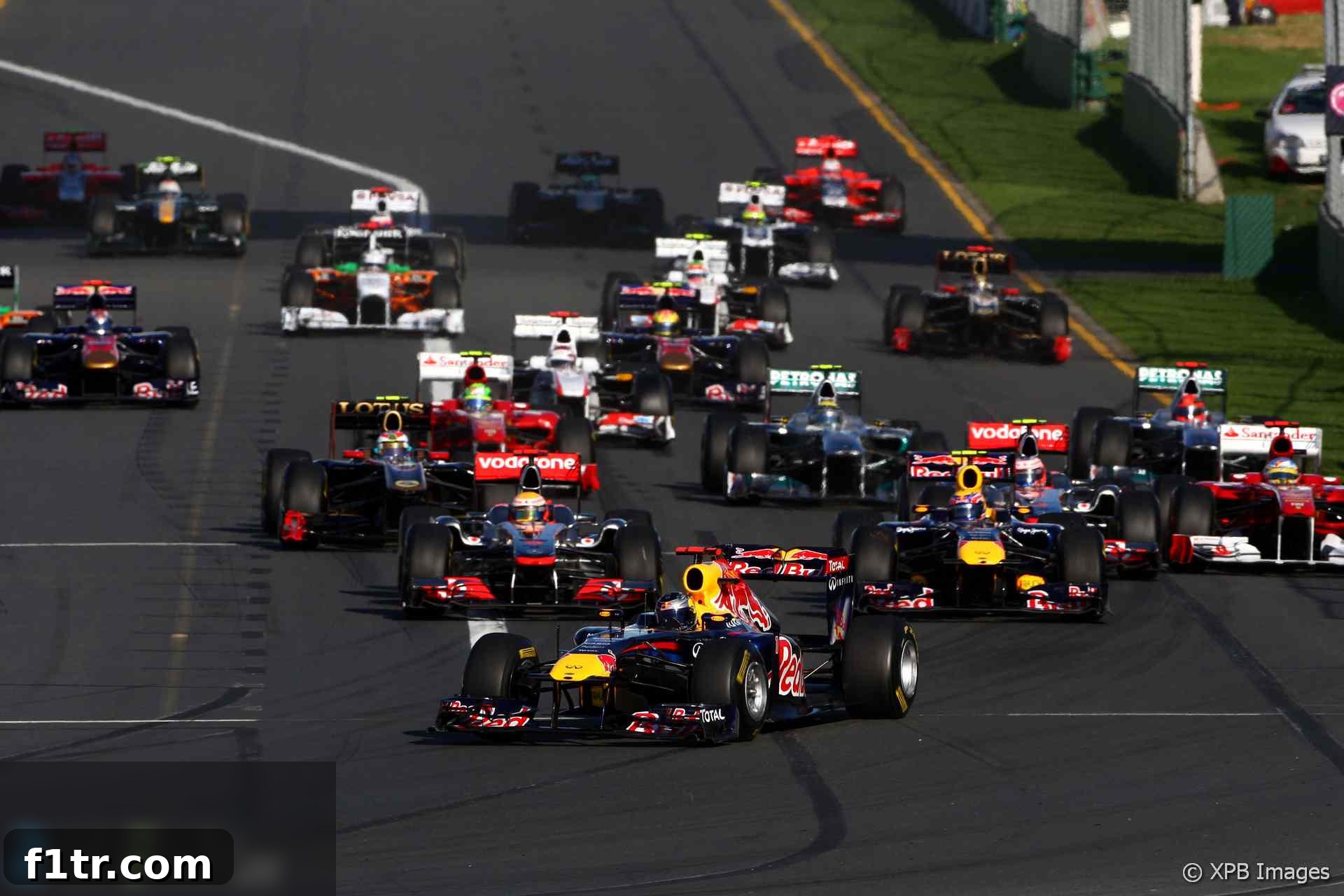
The 2011 Formula 1 season roared to life at the Australian Grand Prix, delivering a captivating spectacle of strategy, overtakes, and unexpected twists. Reigning champion Sebastian Vettel, driving for Red Bull, asserted his formidable dominance from the outset, clinching a commanding victory by over 20 seconds from McLaren’s Lewis Hamilton. This opening race at Albert Park set a compelling tone for the championship, showcasing the immense potential of the Red Bull-Renault package and signaling a fierce battle ahead for his rivals.
While Vettel’s performance was a masterclass in controlled aggression, the real surprise of the day belonged to Vitaly Petrov. The Russian driver, in his second season with Renault, delivered a career-best performance to secure his maiden Formula 1 podium finish. Petrov’s smooth and consistent drive saw him fend off the more experienced Fernando Alonso in the Ferrari, a result that significantly boosted his standing and offered a strong indication of Renault’s improved competitiveness. His achievement was a testament to both his growing confidence and the underlying pace of the Lotus Renault GP car, providing a thrilling narrative alongside the leading contenders.
One of the most talked-about aspects pre-race was Red Bull’s strategic decision to forgo the use of the Kinetic Energy Recovery System (KERS) on both of their cars. There were widespread concerns that this choice could leave them vulnerable, particularly during the crucial opening phase of the race. However, these fears proved unfounded as both Vettel and his teammate Mark Webber executed lightning-quick getaways from their respective grid slots on the left-hand side. Webber, starting third, even mounted an impressive challenge on Hamilton for second position into the first corner, showcasing the raw speed and traction of the Red Bull RB7 despite the absence of the KERS boost.
Behind the leading pack, the initial laps saw significant jockeying for position. Vitaly Petrov leveraged his strong start to jump up to fourth place, while Felipe Massa in the Ferrari also made an excellent start, climbing to fifth. This early reshuffle set the stage for several captivating mid-field battles that would define much of the race’s narrative. The new rules, including the Drag Reduction System (DRS) and Pirelli tyres, were already showing their potential to spice up the on-track action and strategic considerations.
One of the most intense duels of the race unfolded between Massa and McLaren’s Jenson Button. Button, known for his smooth driving style, found himself glued to Massa’s gearbox, applying relentless pressure. He launched multiple overtaking attempts, intensifying his efforts once the DRS zone was activated and he could deploy the adjustable rear wing. Despite his best endeavors and several strategic moves, Button struggled to find a definitive way past the tenacious Ferrari driver in the initial phase of their confrontation. The cat-and-mouse game showcased the difficulty of overtaking even with the aid of DRS when two drivers of such caliber were locked in battle.
The rivalry between Button and Massa reached its flashpoint on lap 13. Button bravely ventured to the outside of Turn 11, drawing alongside Massa in a daring maneuver. However, the Ferrari driver, perhaps not anticipating such a bold move, squeezed Button off the track, forcing the McLaren onto the grass. Button, naturally, felt he had earned the position and that Massa had left him insufficient racing room. The race stewards, however, viewed the incident differently. After reviewing the replays, they deemed Button to be at fault for attempting the overtake from an untenable position and subsequently handed him a drive-through penalty. This controversial decision sent Button plummeting down the order, severely compromising his race and leaving him with a mountain to climb.
Meanwhile, Fernando Alonso, who had a less-than-ideal start and initially dropped to tenth, was steadily making his way back through the field. Displaying his characteristic blend of aggression and precision, the two-time world champion picked off competitors such as Kamui Kobayashi and Nico Rosberg. He soon latched onto the enthralling Button-Massa battle, patiently waiting for his opportunity. Capitalizing on Button’s penalty and his own car’s pace, Alonso eventually moved ahead of his teammate Massa, demonstrating his superior pace and strategic awareness as the race progressed.
The new Pirelli tyres quickly became a dominant factor, exhibiting significant degradation and prompting drivers to make early and multiple pit stops. Mark Webber was among the first to dive into the pits on lap 12, swapping his soft compound tyres for the more durable hard rubber. This initial switch was just the beginning of a demanding three-stop strategy for Webber, who would require two more sets of soft tyres before the chequered flag. Alonso and Massa followed suit on the subsequent two laps, reacting to the rapidly deteriorating performance of their softs. Race leader Vettel pitted on lap 15, while Hamilton came in two laps later, showcasing slightly better tyre management.
Button’s unfortunate penalty forced him into the pits even before his scheduled tyre change, dropping him to a frustrating 12th position. Despite the setback, the former world champion refused to give up, showcasing remarkable resilience. He fought his way back up the order, executing a clean overtake on Kobayashi to regain seventh place. However, the time lost due to the penalty placed him firmly on the back foot, preventing him from challenging for a higher finish that his raw pace might have otherwise allowed.
As the race wore on, Sebastian Vettel continued to extend his lead over Lewis Hamilton during the second stint, his pace relentless and his tyre management impeccable. In stark contrast, Mark Webber struggled to maintain a consistent pace and conserve his tyres as effectively as his teammate. His additional pit stop further relegated him down the order, placing him behind both Petrov and Alonso. The absence of KERS was keenly felt in these mid-race battles, as Webber found himself powerless to make a decisive move on the Ferrari of Alonso, highlighting a crucial strategic disadvantage that Red Bull would need to address.
The intense battle for the final podium spot saw Alonso and Webber closing rapidly on Vitaly Petrov. The Australian’s pursuit of Alonso, and then their combined pressure on Petrov, was a gripping watch. However, despite their spirited efforts and closing speed, they ultimately ran out of laps to catch the Renault driver in time to challenge for third place. Petrov held his nerve, driving a flawless final stint to claim a richly deserved podium, solidifying his breakthrough performance at the season opener.
Further down the field, Jenson Button found himself once again in a direct confrontation with Felipe Massa. This time, however, the dynamic was different. Armed with the DRS, Button was able to make a clean and decisive overtake on the Ferrari driver at Turn One, effectively settling their prolonged rivalry. Massa’s race continued to unravel, as he opted for a third pit stop, which dropped him further back into tenth. In the closing stages, he managed to pick off Sebastien Buemi, who appeared to offer little resistance in defending his position, illustrating Massa’s ongoing challenges with tyre management and race pace.
The Sauber team delivered an exceptionally strong performance, securing a remarkable seventh and eighth place finish with Sergio Perez and Kamui Kobayashi, respectively. Perez, in particular, was the standout performer, achieving an impressive seventh place through an unconventional and highly effective one-stop strategy. Starting on the hard compound tyres, he managed to extend their life for an astonishing number of laps, proving the versatility of the Pirelli compounds and the brilliance of his team’s foresight. This result was a massive boost for Sauber and a clear signal of their potential in the new season.
Just outside the points, the Force Indias of Adrian Sutil and Paul di Resta finished in commendable positions, indicating their consistent mid-field pace. They were followed by Jaime Alguersuari, Nick Heidfeld, Jarno Trulli, and Jerome d’Ambrosio, who all completed the challenging race.
However, the season opener was not without its casualties. Both Williams cars and the Mercedes GP team failed to finish the race. Pastor Maldonado retired early in his debut race, while his veteran teammate Rubens Barrichello had a particularly eventful and ultimately disastrous Grand Prix. Barrichello demonstrated flashes of brilliance with an excellent overtake on Kamui Kobayashi early on, as the pair were in the process of lapping the seven-time world champion Michael Schumacher. However, his race took a turn for the worse when he made an overly ambitious lunge at Nico Rosberg, resulting in a collision that eliminated both the Williams and the Mercedes. Schumacher’s race also ended prematurely, adding to a disappointing start for several prominent teams.
Lewis Hamilton’s efforts to narrow the gap to the dominant Sebastian Vettel were further hampered by damage to his car’s undertray, which subtly affected its aerodynamic performance. Despite this, Hamilton managed to hold onto second place, a respectable start to his championship campaign. Yet, it was Vettel who stole the show, crossing the finish line with a comfortable 20-second advantage. This overwhelming victory at the Australian Grand Prix served as an ominous warning to Red Bull’s rivals, suggesting that the reigning champions had potentially found another gear and were prepared to mount another formidable challenge for the Formula 1 title throughout the rest of the season.
Formula 1 Insights & Updates
- Sprint races may delay fixes to 2026 F1 rules – Permane
- GT driver killed in multi-car crash at Nurburgring Qualifiers
- Should F1 change tracks or racing guidelines to tackle dangers in 2026 rules?
- Controversies, Norris, Newey and more: Five new motorsport books reviewed
- One of F1’s greatest races happened 15 years ago today. Or did it?
Browse all Formula 1 articles