Halo’s Unrivaled Protection: FIA Declares Alternatives 90% Less Effective
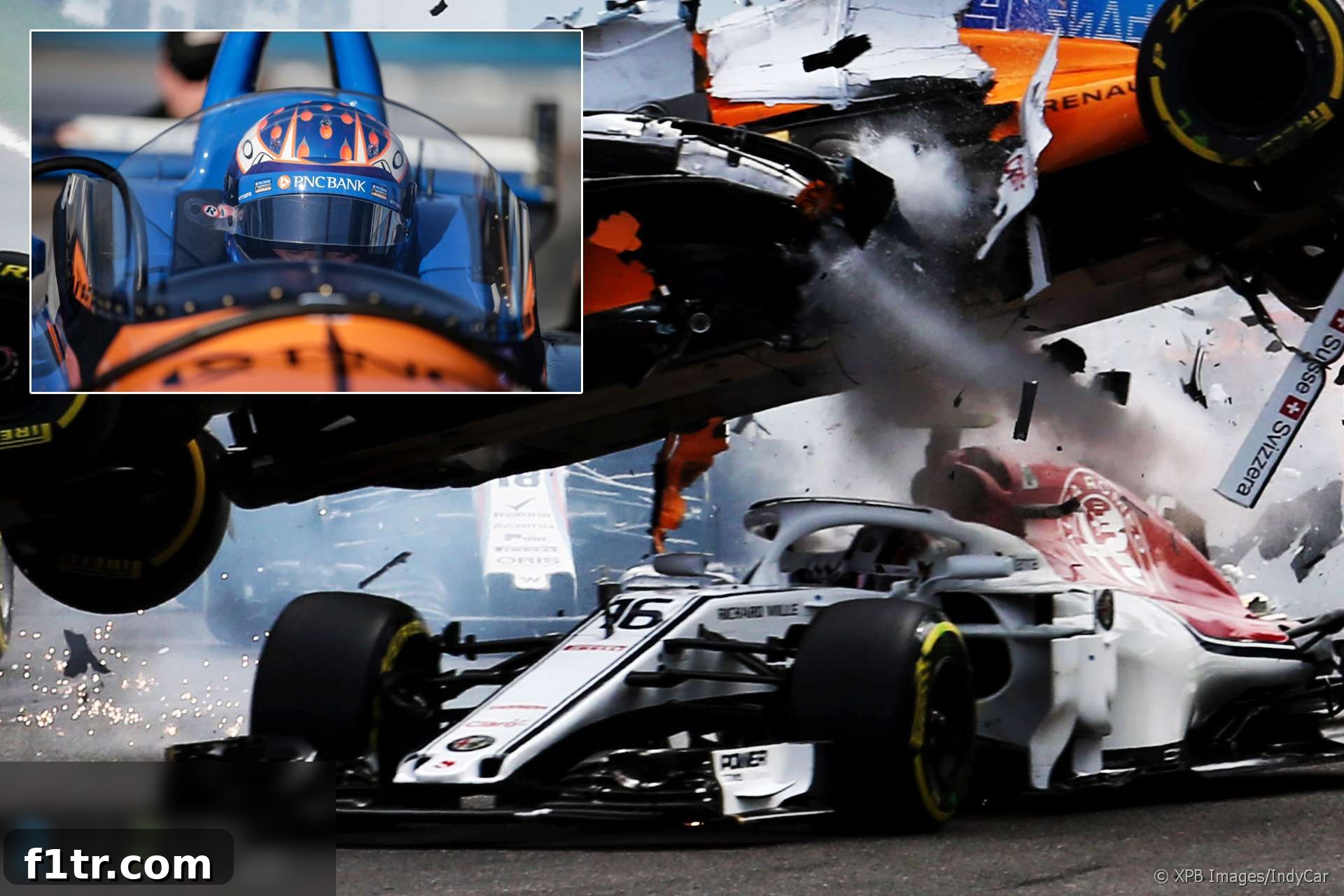
In the relentless pursuit of driver safety, Formula 1’s controversial yet undeniably effective Halo cockpit protection system stands as a benchmark. According to the sport’s governing body, the FIA, any alternative solution—such as the “Shield” or “windscreen” designs proposed and tested by various championships—would only offer a mere 10% of the protection provided by the Halo in critical incidents like Charles Leclerc’s terrifying crash at Spa-Francorchamps.
The Halo’s Indisputable Impact: A Game Changer for F1 Driver Safety
The adoption of the Halo for the 2018 Formula 1 season marked a pivotal moment in motorsport safety. This decision followed extensive research and testing of various cockpit protection structures, including the much-discussed Shield. Sebastian Vettel famously evaluated the Shield at Silverstone, but his test run with the windscreen-style device was cut short due to feelings of dizziness, highlighting one of its key ergonomic challenges.
The efficacy of the Halo was dramatically underscored during the 2018 Belgian Grand Prix when Charles Leclerc’s Sauber was involved in a chaotic first-corner collision. Fernando Alonso’s McLaren, launched airborne, made direct contact with Leclerc’s Halo with its front-right wheel. This impact generated a staggering 56 kilonewtons of force – equivalent to over five tonnes – shattering the suspension of Alonso’s car. Crucially, the Halo remained intact, deflecting the heavy wheel away from Leclerc’s head and preventing what could have been a catastrophic injury. This incident served as undeniable, real-world proof of the Halo’s life-saving capabilities, firmly silencing many of its initial critics.
Why Alternatives Fall Short: FIA’s Scrutiny of Shield and Windscreen Concepts
While IndyCar has also explored similar designs to the Shield, testing windscreen concepts on two separate occasions, the FIA’s safety delegate, Charlie Whiting, unequivocally stated that these alternative designs offer significantly inferior protection. “You’ve seen the sort of protection that they have been proposing and they’ve tested, similar to the Shield I think that Sebastian tried a couple of years ago in Silverstone,” Whiting remarked. “But I think what we’ve seen with Charles’ accident in Spa is that sort of thing wouldn’t have been nearly as effective. We’re looking at 10 percent of the protection that the Halo can offer, generally speaking.”
The fundamental difference lies in structural integrity and impact deflection. The Halo, a robust titanium structure, is designed to withstand massive forces and redirect heavy objects away from the driver’s head. Its open design allows for clear visibility while providing maximum protection. In contrast, windscreen or Shield concepts, while offering some protection against smaller debris, inherently lack the structural rigidity and energy absorption capabilities required to withstand the high-energy impacts seen in incidents like Leclerc’s crash. Their primary function often leans more towards debris management rather than the comprehensive head protection offered by the Halo, which proved crucial in a scenario involving a wheel-to-cockpit impact.
IndyCar Safety Under the Microscope: Lessons from Robert Wickens’ Devastating Crash
The debate surrounding open-wheel cockpit protection extended to IndyCar following Robert Wickens’ horrific crash at the Pocono 500. This violent incident, which left Wickens with life-altering injuries, reignited intense discussions over safety standards in the series. Prominent figures like FIA karting president Felipe Massa openly criticized IndyCar for its perceived slowness in adopting advanced safety improvements such as the Halo, emphasizing the urgent need for comprehensive head protection across all top-tier open-wheel categories.
Wickens’ crash, which saw his car make heavy contact with the debris fence, brought another critical aspect of track safety into focus: the performance of barrier systems at extremely high speeds. Charlie Whiting indicated that the FIA would engage in discussions with IndyCar regarding the specifics of the debris fence performance. “I think there are lessons that we can probably both learn from that because I think one of the things that was interesting about the accident was the way in which the car, after it hit the fences, what the fences can do at those speeds depending on the angle the car hits the fences,” Whiting explained.
He further elaborated on the complex interaction between a race car and high-speed barriers: “It’s supposed to deflect it but it gets hit on those very, very strong uprights which are necessary to stop it going into the crowd, but obviously it can also do things to the car and driver, as we saw with Dan Wheldon, for example.” This reference to the tragic death of Dan Wheldon in 2011 at Las Vegas serves as a somber reminder of the devastating consequences when car-to-barrier interactions do not perform as intended, particularly concerning the structural integrity of the car and the safety of the driver’s cockpit area.
FIA and IndyCar: A Collaborative Path Towards Enhanced Motorsport Safety
Although IndyCar is not an FIA-run championship, it maintains a crucial affiliation with the global governing body through the Automobile Competition Committee of the United States (ACCUS), which is an FIA member club. This connection fosters an important avenue for collaboration and knowledge sharing on critical safety matters. The FIA’s willingness to discuss fence performance with IndyCar highlights a universal commitment within motorsport to learn from every incident and continuously enhance safety standards across different series.
The overarching goal is to ensure that all measures, from cockpit protection to trackside barriers, work in concert to protect drivers. The detailed analysis of incidents like Wickens’ crash, focusing not just on driver protection but also on how cars interact with track infrastructure, is paramount for advancing safety protocols. While IndyCar had not issued a comment immediately following these discussions, the transparency and shared expertise between major motorsport bodies remain vital. Following his crash, Wickens’ team and family later issued further details of the extent of the injuries he suffered, underscoring the severity of the challenge and the necessity for ongoing safety innovations.
IndyCar’s Windscreen Tests: Visualizing the Alternatives
Further Reading: The 2018 F1 Season and Beyond
For more insights into the pivotal 2018 F1 season, the introduction of the Halo, and related safety discussions, explore these articles:
- F1 feared “death knell” for Drive to Survive after Ferrari and Mercedes snub
- McLaren staff told us we were “totally crazy” to take Honda engines in 2018 – Tost
- ‘It doesn’t matter if we start last’: How Red Bull’s junior team aided Honda’s leap forward
- Honda’s jet division helped F1 engineers solve power unit problem
- McLaren Racing losses rise after Honda split
Browse all 2018 F1 season articles